Authors: Shafik Kiraga, Givemore Munashe Makonya, Mohammed A. Youssef, Troy Peters, Lisa Wasko DeVetter
In Washington State and the Pacific Northwest, raspberry harvest typically falls within the hot summer months spanning from early June through early August. This is a period that increasingly overlaps with heatwaves that can damage the fruits. During these heatwaves, automated climate-responsive overhead cooling can play a critical role in protecting raspberries from heat stress and crop damage. Overhead cooling, also known as “evaporative cooling” or simply “cooling”, is the practice of applying overhead water on the plant canopy using microsprinklers at set temperature thresholds. As the water evaporates, the plant cools. Convection also contributes to cooling. The aim of this blog is to describe how Long-Range Wide Area Network (LoRaWAN) enabled sensor networks and remote-control can be utilized to automate cooling systems in real time and protect small fruit crops such as raspberries from heat damage. LoRaWAN is a low-power, wide-area networking protocol designed for connecting battery-powered devices to the internet over long distances. The benefits of using this technology for automated cooling of raspberries will be described in this blog.
Smarter Misting with Sensor-Based Control
Our team installed microsprinklers above raspberry canopies in a 3-year-old experimental field located in southeast Washington. Plots of various raspberry cultivars were arranged in the field and included industry standards ‘Meeker’ and ‘Wake™Field’, as well as the new cultivar, ‘Cascade Legacy’, and an advanced breeding line, ORUS 4715-2. ‘Meeker’ and ‘Cascade Legacy’ were developed by Washington State University and ORUS 4715-2 by USDA ARS. ‘Cascade Legacy’ and ORUS 4715-2 were selected for their resilience during the heat dome in 2021. In the same field, a weather sensor was installed to monitor air temperature, a critical parameter for understanding the microclimate around the raspberry canopy. At the main water supply line, a solenoid valve was installed to enable automated on/off control of the microsprinkler system. Approximately 1,000 feet away from the raspberry plot, a LoRaWAN gateway was installed to receive data from the weather sensor and control the solenoid valve remotely (Fig. 1). The weather sensor then transmits data every 15 minutes via a LoRaWAN-enabled sensing node to the gateway, which then forwards the data to the publicly accessible WSU AgWeatherNet (AWN) web platform.
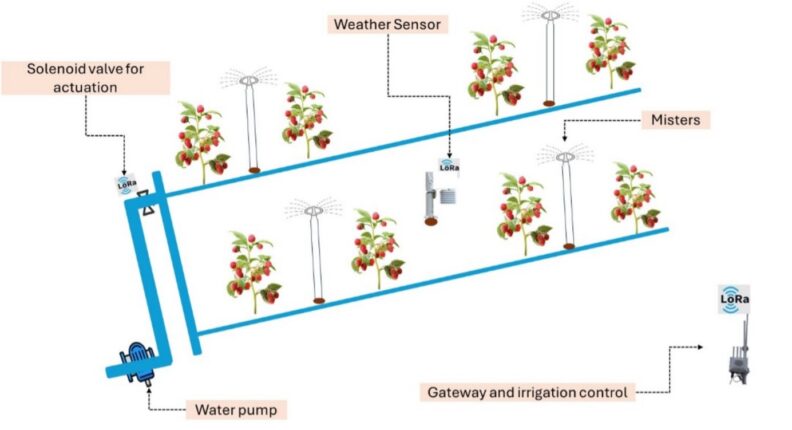
The installed overhead microsprinklers were triggered to cool the fruits when air temperatures, measured by the weather sensor, exceed a critical threshold of 90°F. When temperatures fell back below 84°F, the system shut off to conserve water and potentially protect the raspberries from molding due to excessive wetting of the canopies. All of this operates automatically, without the need for manual intervention, making it a powerful tool for growers managing large acreages or remote production fields.
Does automated microsprinkler use save water?
To first understand whether automated sprinklers conserve water, it is important to first define heat mitigation approaches using overhead cooling. There are three common approaches that can be used to mitigate heat stress via overhead cooling. They are:
a) Fixed misting cycles
With this method, microsprinklers are turned on and off at fixed intervals—for example, operating for 20 minutes, then off for 40 minutes—with the cycle repeating throughout the day or over a defined period. While simple to implement, this approach can result in significant water waste. In practice, growers often initiate the first 20-minute sprinkler cycle based on fruit surface temperature measurements; however, subsequent cycles proceed automatically at fixed intervals without periodic temperature monitoring to control the sprinklers. For raspberries, the effectiveness of this approach depends on whether the 40-minute off-period is sufficient to maintain fruit temperature within the optimum range. Additionally, if the actual temperature is significantly above the threshold, a fixed 20-minute cooling period may be too short to reduce the temperature effectively—or, conversely, too long if only a slight reduction is needed—leading to overcooling and water waste.
b) Continuous misting throughout the day
This approach entails running microsprinklers continuously from midday (12:00 PM) to evening (7:00 PM) when temperatures reached ≥86°F and was the approach we tested in 2024.
c) Temperature threshold-based automated cooling
This method uses real-time temperature data from weather sensors to trigger cooling only when air temperatures exceed a defined threshold (e.g., 90°F) and shuts off when temperatures fall below another defined threshold (e.g., 84°F). This system ensures only water is applied at times when cooling is needed.
Comparison between the continuous misting and temperature threshold-based automated cooling
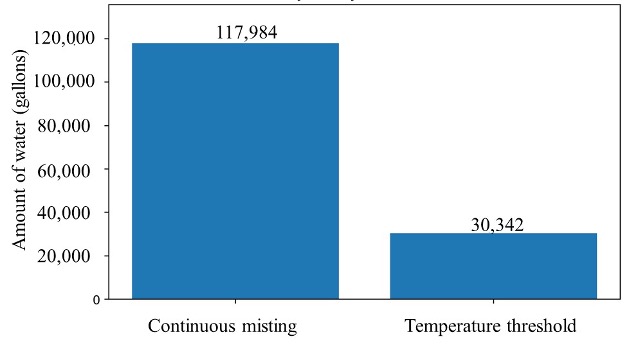
Applying the same continuous cooling approach during the 2025 season (between June 14 to July 8) would result in an estimated 117,984 gallons of water used (Fig. 2). However, by implementing the temperature threshold-based automated cooling approach during the same period, only about 30,342 gallons were applied. This is a 74% reduction in water use – a substantial water savings compared to the continuous method. These estimates are based on the application rate of our forty-four (44) overhead sprinklers, each delivering approximately 15.5 gallons per hour (GPH).
What’s next?
We are developing models to estimate raspberry fruit surface temperature (FST) based on real time field microclimate conditions. We hypothesize that controlling microsprinklers using FST-based models will outperform the temperature threshold-based cooling, which relies solely on ambient air temperatures.
Additionally, we are conducting experiments to determine the optimal FST thresholds for activating the cooling system. The air temperature thresholds used in our current system were initially estimated from observed relationships between measured air temperatures and FST (using thermocouples) during the 2024 growing season. On average, midday FST (recorded between 11:00 AM and 5:00 PM) was approximately 7°F higher than ambient air temperature. However, this difference varied over time and was not consistent throughout the measurement period. Therefore, by setting the air temperature activation threshold at 90°F, we aimed to keep berry surface temperatures below 104°F, a critical threshold temperature for preventing heat related fruit damage. Ongoing research is focused on identifying the optimal temperature thresholds to improve the precision and effectiveness of the overhead cooling system.
When and Where Can Growers Connect? Accessing the LoRaWAN System
AgWeatherNet, Washington State’s automated agricultural weather station network, collects and disseminates high-resolution meteorological data to support crop and resource management. In addition to its statewide network, AgWeatherNet is now encouraging growers to install private weather stations that can feed directly into the platform. With permitted access, any grower can view and use this site-specific weather information.
Looking ahead, once the raspberry FST models are developed, they will be deployed on the AgWeatherNet platform. This will allow registered growers not only to access model outputs but also to integrate them into automated irrigation management. To achieve full automated control, growers will need to install solenoid valves on their overhead sprinkler systems, enabling the platform to link forecasted FST conditions with real-time valve actuation for automation. This approach to data driven heat mitigation can also be employed in other crops such as blueberry.
This work is made possible through funding from the USDA Specialty Crop Multi-State and WSDA Specialty Crop Block Grant Program (Agreement Number: K3888), as well as through collaborative efforts of horticulturists, Extension specialists, engineers, and economists, bringing together diverse expertise to advance precision agriculture in the field.