Contributor: Katherine Anderson, WSU Undergraduate Intern
In 2021 extreme weather resulted in a Heat Dome event occurring over the Pacific Northwest, during which the Oregon blackberry industry lost over 57% of their crop due to consecutive days where temperatures reached over 115 degrees Fahrenheit. The Willamette Valley in Oregon was one of those areas hardest hit by the Heat Dome.
The Willamette Valley is one of the most important areas in the world for blackberry production and has been for over 100 years1. In the mid-1800s, settlers brought blackberry and other plants with them over the Oregon Trail1. The mild winters and warm dry summers in the Willamette Valley and elsewhere in the Pacific Northwest were favorable for blackberry production, but this is starting to shift due to climate change.
The Heat Dome of 2021 was a hallmark event that made researchers and industry alike realize the need to adapt to changing conditions where extreme heat is more common. The heat wave of 2024 further re-emphasized that the frequency and severity of extreme heat events is increasing and impacting the bottom line for this key area of blackberry production.
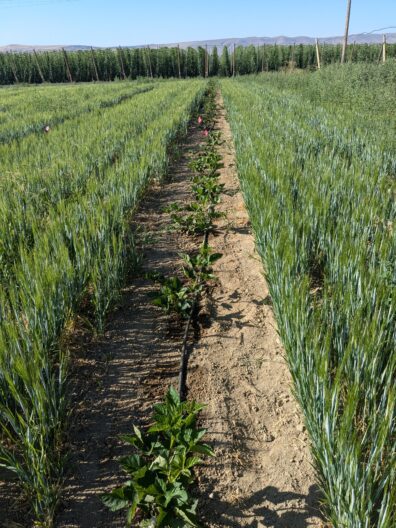
Adapting to extreme heat involves exploring possible short- and long-term solutions. The newly planted Blackberry Diversity Trial contributes to exploring long-term solutions with the project-specific goals being: 1) evaluate the response of existing blackberry cultivars to high temperatures, 2) develop tools for scouting and identifying heat stress in grower fields, and 3) support cultivar development by identifying superior genetic types with better plant health and fruit quality under heat stress.
This research funded by the Oregon Raspberry and Blackberry Commission is led by Dr. Michael Hardigan, USDA-ARS caneberry breeder. In this trial a genetically diverse panel of commercial blackberry cultivars and new experimental selections from the USDA-ARS blackberry breeding program are being examined for heat stress and heat tolerance in Prosser, WA. Why Prosser, which is not a historically significant region of caneberry production? Prosser has a semi-arid climate and with mid-summer air temperatures averaging nearly ten degrees Fahrenheit higher than the Willamette Valley where blackberry production is concentrated these high temperatures will ensure heat stress is experienced by the plants and observed.
Heat stress and damage will be examined via a diversity of methods including UAVs (unmanned aerial vehicles). The UAVs used in this project have multi-spectral and thermal imaging cameras which will estimate plant growth and canopy temperature respectively. Efficient ways to scout for and identify heat stress involving the use of UAVs should help researchers hone in on best methods to assess for heat and water stress but hinge upon them correlating with standard yet more time-intensive methods. Informed use of UAV and imaging approaches also may eventually help growers and consultant manage irrigation and heat protection strategies.
Heat damage will be evaluated based on plant physiological traits related to growth and water use as well as readily observable fruit traits such as firmness, sunburn, and color. Fruit samples from cultivars and selections that are replicated in Prosser, WA, and the Oregon State University North Willamette Research and Extension Center (OSU-NWREC; Aurora, OR) will be compared to assess quality differences between genotypes grown under normal and elevated stress conditions. It is important to know the range of phenotypic responses to heat stress as this will help establish measurable outcomes. Winter damage will also be assessed through subjective scoring of damage to canes in early spring as the long-term viability of cultivars and advanced selections to both weather extremes is important to crop productivity.
Breeding entails developing cultivars that meet the current and evolving needs of the industry. Developing cultivars that are high yielding with superior fruit quality and machine harvestable, thornless, and disease resistant is essential. The Blackberry Diversity Trial will be very impactful across Oregon and the Pacific Northwest as it will contribute new insights on heat tolerance which can lead to the identification of superior parental genotypes for developing breeding populations possessing greater heat tolerance in regard to both plant health and fruit quality.
References
1Blackberry production in the Pacific northwestern US: a long history and a bright future