Contributor: Katherine Anderson, WSU Undergraduate Intern
El Niño and La Niña are the warm and the cool phases of a natural climate pattern across the tropical Pacific known as the”El Niño-Southern Oscillation (ENSO). While we often hear about El Niño and La Niña, ENSO on its own is significant from a climate perspective given its impact on temperature and precipitation across the globe. The objective of this blog post is to describe El Niño and La Niña and the conditions in the Pacific Northwest under which these phases may increase the chances of heat injury in agricultural production.
To understand these phenomena, it is important to know how ocean surface temperatures are impacted by trade winds. Trade winds are the prevailing easterly winds that circle the equator and are named as such from early commerce to the Americas which depended on them for transport. Trade winds influence how surface ocean temperatures are cycled. Through a process called “upwelling”, trade winds blow west along the equator which spreads warm water towards Asia. Subsequently, this wind-driven motion causes cold water to rise to the ocean surface along the Atlantic coast of South America, resulting in a decrease of ocean surface temperatures.
An El Niño year occurs when trade winds weaken. This reduces upwelling of cold water and as a result, warm water is pushed towards the west coast of the United States. Jet streams, which are the fast air currents that encircle the globe, are impacted and react to these changes in warmer surface water temperatures. When the warm water is pushed to a different area, in this case to the west coast of the United States, the Pacific Jetstream moves south from its neutral position, resulting in warmer and drier conditions in the northern United States and Canada. Consequently, the risks of drought, water stress, wildfires, and heat injury increase, particularly in crops that are sensitive to heat. In contrast, while the northern United States experiences hotter and dryer conditions during an El Niño year, the Gulf Coast and southeastern United States becomes wetter and prone to flooding.
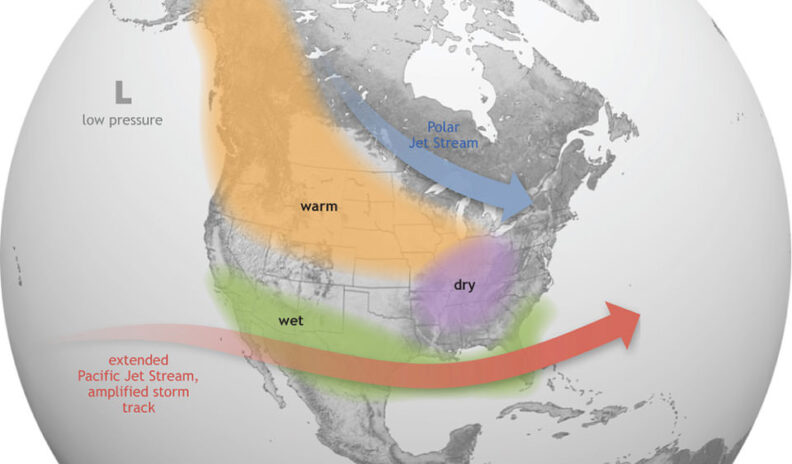
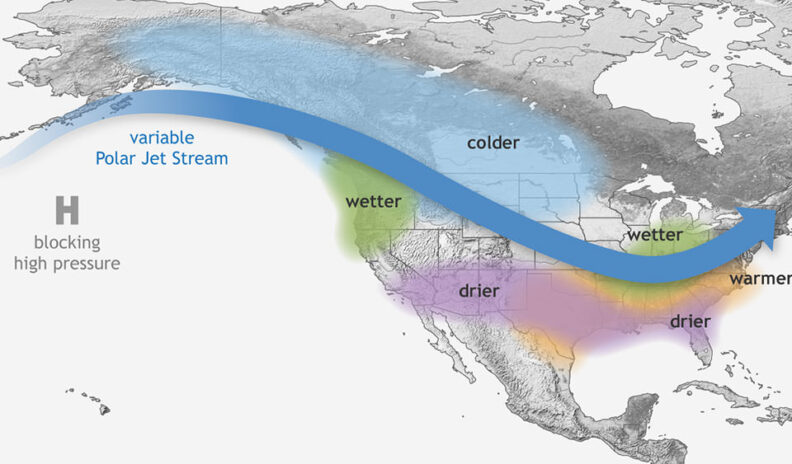
La Niña has the opposite effect of El Niño and is also known as a “cold event”. Strong trade winds push more warm water toward Asia, causing surface ocean temperatures near the west coast of the United States to be cooler. This shift pushes the Pacific Jetstream north of its neutral position, leading to a colder winter in the northern states and a warmer winter in the southern states. This often leads to droughts in the southern parts of the United States while the north will receive more rains and flooding during the summer months. Although the risk of heat injury is reduced during La Niña years, the potential of flooding and waterlogged soils that can also damage crops are likely increased.
We can also have neutral phases, which are distinct from El Niño and La Niña. This occurs when ocean surface temperatures are close to their average and weather is impacted by other climactic drivers.
Climate change is making El Niño and La Niña events more extreme, however, meaning the risk of heat injury during an El Niño year is increased in western parts of the United States, including the Pacific Northwest.
Overall Impacts Summary:
Crop Susceptibility: Different crops tolerate heat differently, and extreme temperature changes can lead to lower yields and quality.
Timing of Events: Heat events may align with critical growth stages, increasing the risk of heat injury.
In summary, ENSO affects agricultural heat injury by altering temperature and precipitation patterns, which can either raise or lower heat stress risks for crops. Understanding these changes helps farmers adapt their practices to minimize heat-related impacts.