Author: Micah Evalt, WSU Graduate Student in DeVetter’s Small Fruit Horticulture Program at WSU NWREC
Anyone living in the Pacific Northwest (PNW) will surely remember the “heat dome” experienced in late June of 2021, a weather event that lasted for a few days, breaking daily high temperature records in Washington, Oregon, northern California, and several Canadian provinces. For context, between 1894, when records begin, and June 2021, there were only three years with temperatures in Seattle over 100°F (1941, 1994, and 2009; Bush et al., 2021). During the heat dome, air temperatures reached over 100°F for three consecutive days, with the maximum temperature reaching 108°F (National Weather Service, 2021).
This unprecedented heat had all sorts of negative impacts on Washington agriculture. For blueberries, the results varied based on what heat mitigation factors growers implemented. Farms with no heat mitigation technology saw upwards of 100% crop loss, while farms that applied evaporative cooling to their fields experienced minimal damage. Other factors such as air temperature at a location and cultivar susceptibility to heat also affected the magnitude of damage and subsequent crop loss. For example, the cultivar Aurora was among the most heat sensitive cultivar impacted by the heat dome.
When high temperatures coincide with fruiting, water and carbohydrates are diverted from the fruit to supply leaves and other vegetative components of the plant to promote survival, resulting in a reduction in fruit quality and storability (Yang et al., 2019). Intense heat can also cause direct damage to the fruits such as poor coloration, shriveling, spotting, or even death of the tissue.
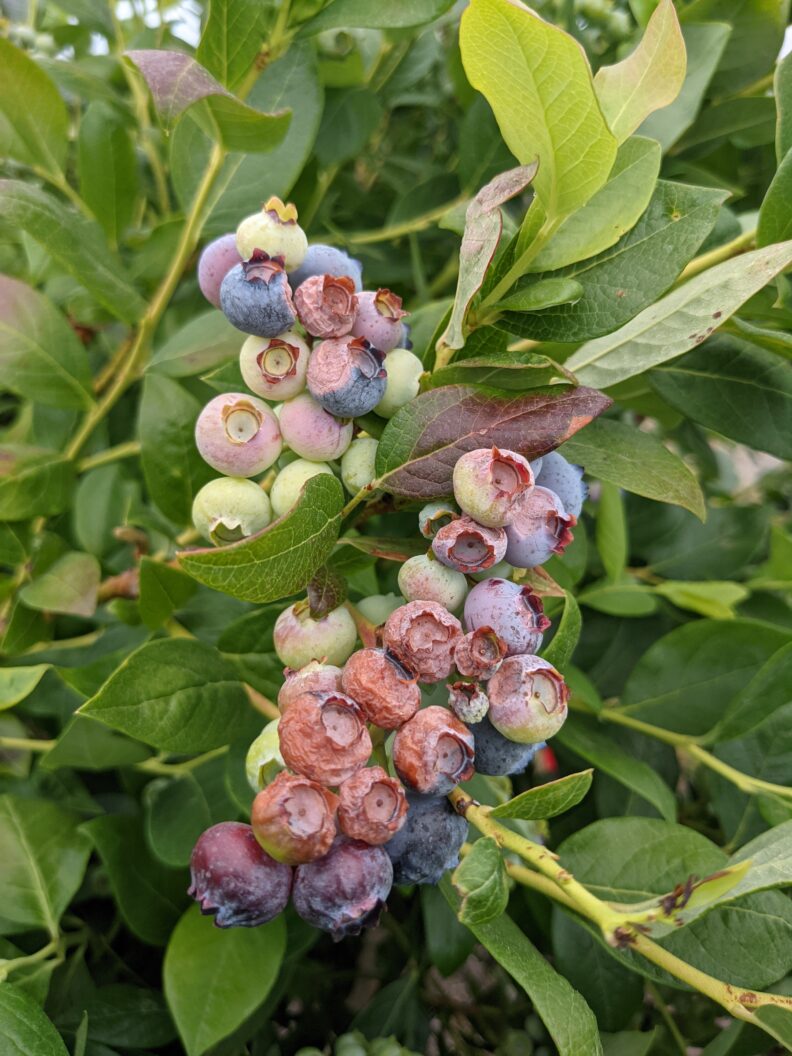
What happens when high temperatures coincide with flowering? We are starting to gain insights on how heat impacts flowering, a critical time for pollination which sets the stage for fruit development. For example, Michigan experienced an unusual heatwave in May 2018 that was followed by a 34% reduction in the state’s production compared to the year before. This also led to a decrease in revenue for farms, processors, and marketers.
This heat event sparked research at Michigan State University with the aim of understanding how extreme heat affects blueberry bloom. A little bit of “Biology 101” is required, however, to better understand how researchers are seeking ways to ensure continued fruit production in the face of increasing heat waves.
Blueberries, like 75% of the world’s flowering plants, depend on animals for pollination with bees being the most well-known and important pollinator in natural and farming systems. When a pollinator transfers pollen from one flower to another, some of the pollen gets stuck to the stigma, which is part of the female reproductive system. Under the right circumstances, the pollen germinates, growing a “pollen tube” along the style to the ovaries where fertilized seeds promote fruit development. Better pollination is associated with higher levels of fruit set and larger berries. This process is critical to achieve high yields of quality blueberries.
A recent study conducted at Michigan State University demonstrated that pollen exposed to air temperatures between 86 and 104 °F had reduced pollen germination rates, while tube growth was reduced above 95 °F (Walters and Isaacs, 2023). What does this mean? This suggests that even when a flower is pollinated, at high temperatures the pollen will be less likely to form its pollen tube and contribute to fertilization, leading to downstream effects on yield and fruit quality. Furthermore, their research demonstrated that exposure to 100 °F for only 4 hours resulted in substantial reductions in pollen tube emergence and pollen tube growth, even after pollen was moved back to optimal conditions of 77 °F. While this is an unusually high temperature, especially for late spring, it’s not unheard of and demonstrates how sensitive pollen is to extreme heat.
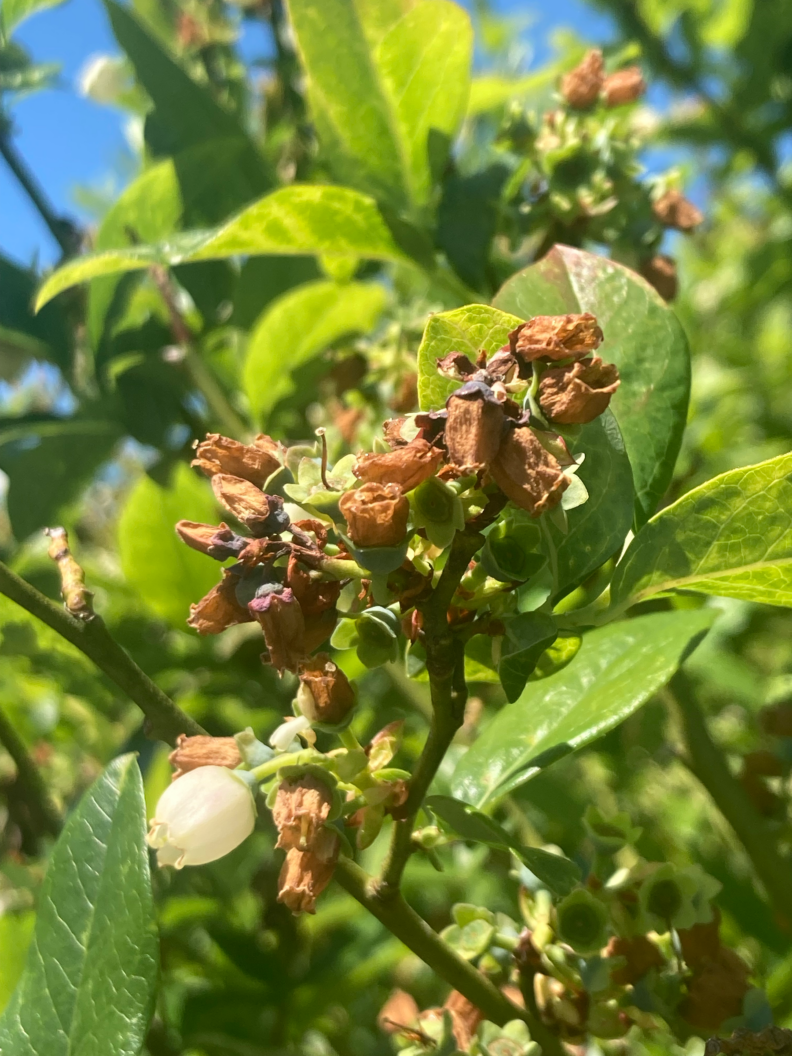
Heat events of this magnitude are rare, but they are expected to become more frequent and extreme under current global climate projections. According to the Intergovernmental Panel on Climate Change (IPCC), 10-year extreme heat events over land now occur at a 2.8x-higher rate than they would without human influence, i.e., they occur every 3.6 years (IPPC, 2023). This is considering that global average surface temperature has increased by roughly 2°F since the pre-industrial era (Lindsey and Dahlman, 2024). However, global average temperature is likely to increase by an additional 1°F between 2030-2052 if emissions continue to increase at their current rate. Under this scenario, what used to be a 10-year extreme heat event would occur every 2.4 years, with 50-year events occurring every 5.8 years. This demonstrates changes in global temperatures have occurred at a rapid rate and adaptation strategies will be needed to avoid negative consequences.
While there is uncertainty in future climate models, we can expect extreme heat events similar to the ones in Michigan in 2018 or the PNW in 2021 will become more frequent in the future. Considering blueberry production’s heavy reliance on pollination and pollen’s sensitivity to high heat, the predicted changes to our climate may result in serious challenges for the northern highbush blueberry industry as well as other pollination-dependent crops that will be exposed to high heat. Therefore, it is important that we are well-prepared. So, how are we addressing this issue in the scientific community?
Heat mitigation technologies can reduce the impact of extreme heat. Shade nets and evaporative cooling using micro-sprinklers during heat waves are common examples. Yet, there are costs and barriers to adopting these technologies that need to be understood. Water is not always available depending on farming location, and water conservation is a goal in many production regions. Heat protectants, including bio-stimulants, have shown potential to increase plants’ resilience to heat without incurring substantial infrastructure costs, but they are less well studied. Use of these heat mitigation technologies during flowering and pollination is less well understood and justifies continued research.
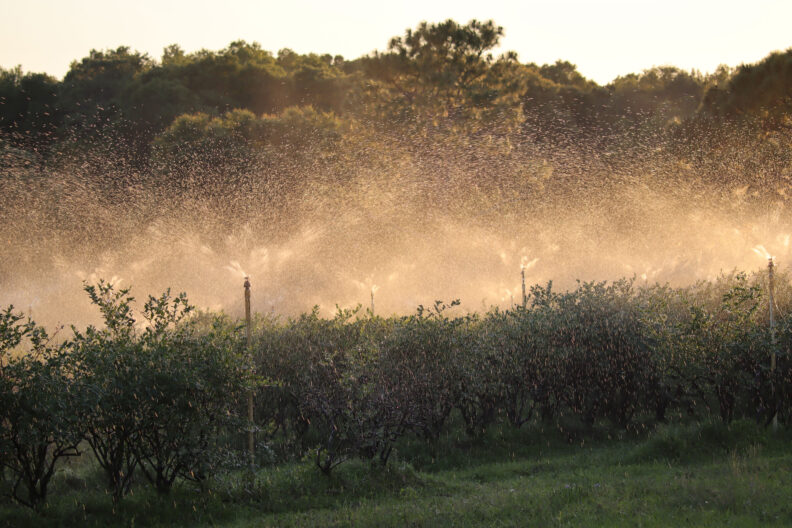
The costs of heat mitigation are a real-world challenge that needs to be considered. With the burgeoning threat of extreme heat, farmers have a decision to make: to invest in heat mitigation technology or not? If so, what type? We know technologies like shade netting and evaporative cooling work well for mitigating heat damage to fruits, but what about flowers that contain pollen and other parts necessary for pollination? How do these technologies affect bee activity, a requirement for successful pollination for most cultivars of blueberry and pollination-dependent crops? Do heat protectants present a more affordable, effective option? These questions are currently under investigation and are the main component of my research planned for the next few years in Washington and Oregon. Stay tuned to learn more about this exciting and important project where we learn how to “beat the heat”.
Special thanks to Dave Bryla, USDA-ARS scientist, and Rufus Isaacs, MSU Professor of Entomology, for their review.
References
Bush, E., K.A. Long, and J. Brunner. 2021. Seattle already set a record high temperature Sunday; Monday’s forecast is ‘unheard of’. Accessed 18 Oct. 2024.
IPPC. 2023. Summary for Policymakers. Accessed 18 Oct. 2024.
Lindsey, R., and L. Dahlman. 2024. NOAA: Climate Change: Global Temperature. Accessed 18 Oct. 2024.
National Weather Service. 2021. NOAA: NOWData. Accessed 18 Oct. 2024.
Walters, J. and I. Isaacs. 2023. Pollen germination and tube growth in northern highbush blueberry are inhibited by extreme heat. HortScience, 58(6):635-642.
Yang, F.H., D.R. Bryla, and B.C. Strik. 2019. Critical temperatures and heating times for fruit damage in northern highbush blueberry. HortScience, 54(12): 2231-2239.