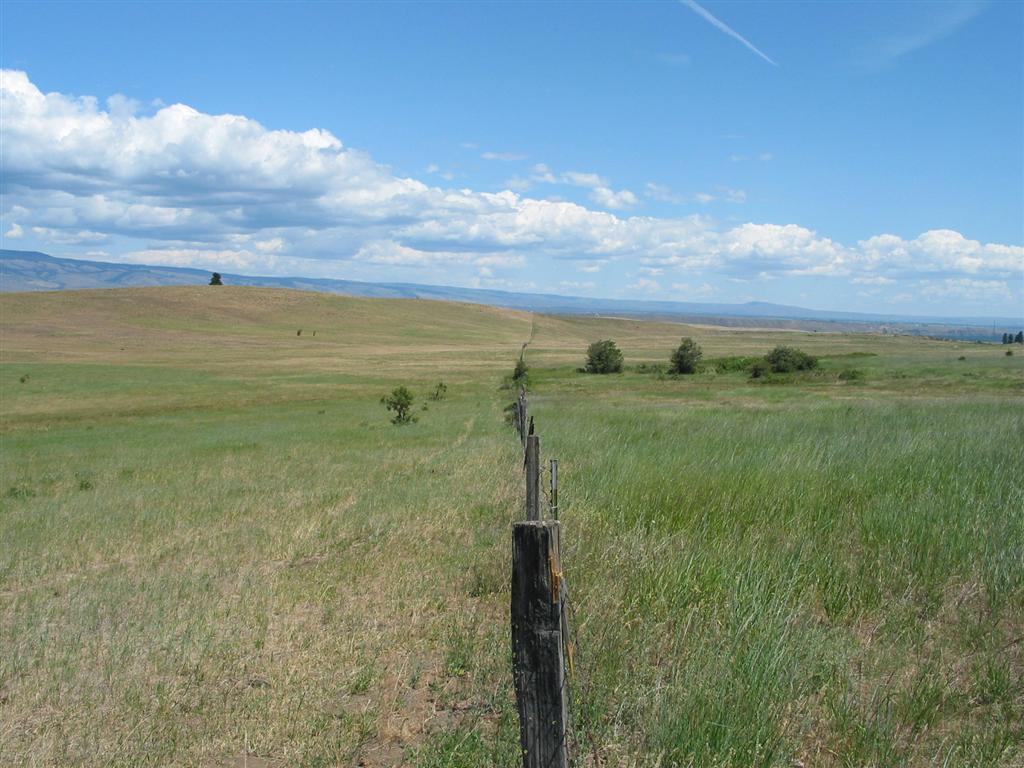

Grassy rangeland with a fence in the middle against a blue sky.

Forestry and Range

What is Rangeland?

Rangeland is defined by the Society for Range Management as “Land on which the native vegetation (climax or natural potential) is predominantly grasses, grass-like plants, forbs or shrubs suitable for grazing or browsing use.” While many areas fitting the definition of rangeland are not utilized by domestic grazing animals, nearly all are used by wild grazing animals of various kinds.

Extension Program Goals

The Extension program in Kittitas County focuses on sustainable use of rangelands by humans, including human management of livestock. Sustainability is a term perhaps overused; nevertheless, there is some agreement that our usage of rangelands should be environmentally, economically, and socially sustainable. Nathan Sayre has said that this is not a hopeless tautology. “Sustainability becomes meaningful when its referent is more carefully specified:  what exactly is being evaluated as to its sustainability (or lack thereof)? What are we  trying to sustain, over what time periods? What are the processes that sustain it, and how do those processes interact?”

To be profitable, a forage-based livestock operation must first be ecologically stable. As numerous authors have demonstrated, the components of profitability are linked to another such that a decline in ecological integrity, perhaps bunchgrass health, affects animal health, marketable output per unit area, production potential next year, and consequently profit by decreasing revenues and increasing costs. Even this apparently mercenary approach to rangeland health functions to protect ecosystem function such that we maintain ecological goods and services that are more difficult to quantify and value, such as open space, clean water, wildlife habitat, soil stability, carbon sequestration, etc.

Sustainable Range Grazing

The two primary components in how livestock grazing affects native rangelands are stocking rate and animal distribution. Prospective and current graziers of native rangeland must recognize that these ecosystems produce significantly less total forage per acre than irrigated pasture and even dryland pastures in more mesic regions like the Palouse or Western Washington. this is typically excellent quality forage, but an acre of shrub-steppe near Ellensburg may only yield 900 lbs of total biomass annually. Of this, some is new growth on shrubs and should be considered unavailable to domestic livestock, and well-established guidelines for grazing bunchgrasses recommends limiting livestock to 50% utilization of the current year’s forage production. Under this scenario, there may only be a few hundred pounds of dry matter forage per acre, which supports a cow for a week or two. Most damage to native rangeland results from poor distribution of grazing animals in either time or space. Overgrazing occurs when an individual plant is grazed before it has fully recovered from the previous grazing event. Managing the timing, frequency, and duration of livestock use is the key to maintaining healthy plants and healthy livestock.

Helpful Resources for Rangeland Management

Other Range Management Resources

Kitttas County Extension Research Briefs

  • Determining Forage Production and Stocking Rates By Tipton D. Hudson, originally published in 2014 (PDF). The first step to deciding how many cows (or sheep, horses, goats, etc.) are appropriate for a piece of ground is […]
  • Rangeland Seeding After Fire By Tipton D. Hudson, originally published in 2014 (PDF). Goals Goals for seeding rangeland are diverse. Increased plant diversity, improved forage quantity or quality for livestock, tall grass for structural […]
  • Riparian Grazing Strategies By Tipton D. Hudson, originally published in 2011 (PDF) in the Washington Animal Ag Team’s summer newsletter. Riparian areas are important because they provide a stable supply of clean water, […]
  • Rangeland Seeding in Lower Kittitas County By Tipton D. Hudson, originally published in 2012 (PDF). There are numerous reasons why a landowner considers seeding, but a primary consideration before spending any money should be whether conditions/practices […]
  • Dryland Seeding, Upper County By Tipton D. Hudson, originally published in 2009 (PDF). There are numerous reasons why a landowner considers seeding, but a primary consideration before spending any money should be whether conditions/practices […]
  • Post-Fire Grazing Considerations By Tipton D. Hudson, originally published in 2014 (PDF). There are a variety of objectives for prescribed fire in addition to preventing catastrophic fire, including improving forage quality and quantity; […]
  • Rangeland Health and Monitoring By Tipton D. Hudson, originally published in 2014 (PDF). Principles of Rangeland Health Intermountain West native bunchgrasses ranges are more susceptible to grazing damage than perhaps any other. In order […]
  • Grazing for Weed Control by Tipton D. Hudson, originally published in 2014 (PDF). It doesn’t take an agronomist to observe that rotationally-grazed pastures and well-kept lawns often have few weed problems. There are scientific […]

National Resource Conservation Service: Web Soil Survey

The NRCS has made soil survey data available on their website. A landowner can delineate their property on a map and extract a wealth of information about their soils. Of note for livestock producers is a rangeland productivity report, ecological site descriptions which provide expected plant species by functional group, a good starting point for rehabilitation efforts.

PLANTS National Database

Plant List of Attributes, Names, Taxonomy, and Symbols
The PLANTS Database provides standardized information about the vascular plants, mosses, liverworts, hornworts, and lichens of the U.S. and its territories.