
New Leaders:
Getting Started

Program Contact
Amy Alder, 4-H Program ManagerPhone Number509-962-7565 Email Address • amy.alder@wsu.edu
What is 4-H?
Welcome, New Leader!
Volunteers like you are key to making 4-H happen for the youth members and adult volunteers in our program. Throughout the program’s rich 100+ year history, 4-H staff members have learned a lot about how to create a successful experience based on positive youth development principles.
The information on this page was collected from six “Letters to Leaders” published by Missouri 4-H. They are intended to help new volunteer leaders find their feet. Together, along with the additional references contained on the page, they create a solid foundation on which leaders can build their skillset for a successful 4-H experience.
Organizational Structure
In the United States, 4-H is under the leadership of the federal Department of Agriculture. Policy and guidance, as well as national opportunities for youth and adults are organized by the National 4-H Council.
At the state level, 4-H is administered by a Land Grant University – in Washington, that is Washington State University. The University Extension office oversees the statewide 4-H program. The 4-H program is administered through county Extension offices, with county staff supporting a network of volunteers leading and supporting individual 4-H clubs.
The Importance of 4-H Projects
Because 4-H is a youth-led program, leaders help youth develop their curiosity through exploring new and challenging ideas and practicing their problem-solving skills. One way this is accomplished is through a 4-H project.
Projects consist of activities around a central specific subject or theme. These projects help youth learn by doing. They are directed by the members with the assistance of caring adults. Youth or entire clubs can choose one or more projects based on their interests, abilities, and any age-related restrictions. Projects require youth to establish goals, work toward these goals, and evaluate their progress.
Leaders assist with project-area learning in a number of ways, supporting their plans and helping them learn new skills. They help youth learn problem solving and creative thinking skills.
The Leader’s Role
4-H connects youth with caring adults through their clubs. Club leaders and other volunteers are thoroughly screened for youth safety. Washington law, WSU policy, and National guidelines govern the standards leaders and volunteers must meet in order to work directly with youth.
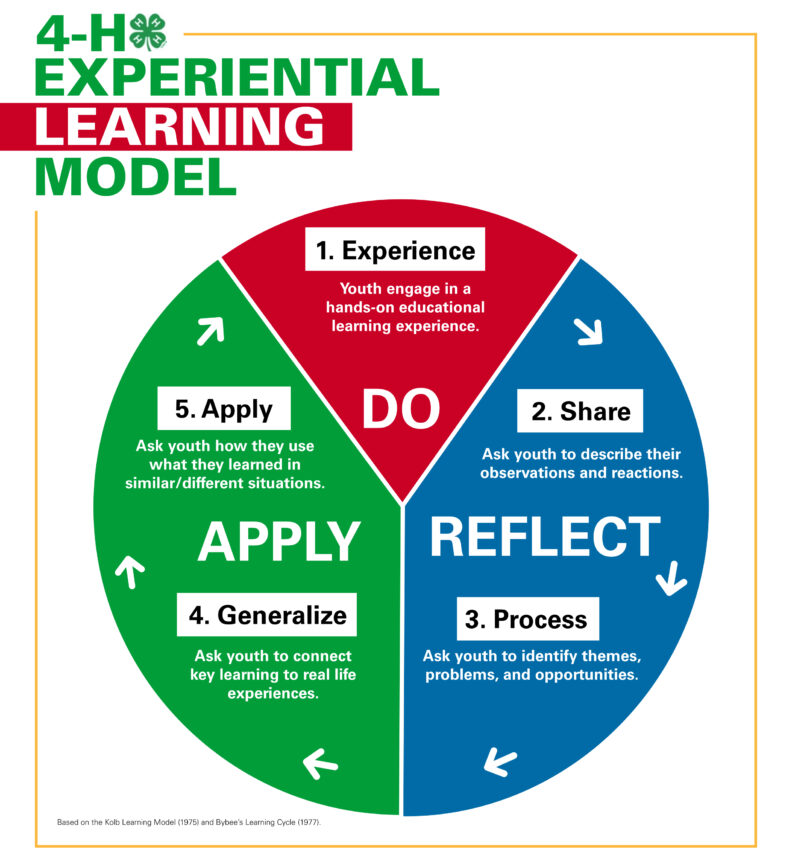
Leaders help youth develop life skills that are transferable beyond the club experience and outside of their chosen project areas. 4-H members learn through experiential learning, the process of “learning by doing” that the 4-H program considers central to the youth’s experience. Experiential learning consists of the following steps:
- Experience: Youth engage in a hands-on educational learning experience.
- Share: Youth describe their observations and reactions to the experience.
- Process: Youth identify themes, problems, and opportunities that arose from their experience.
- Generalize: Youth connect the things they learned through their experience to real-life applications.
- Apply: Youth determine how they can use the skills and what they learned beyond 4-H, generalizing the transferable skills to other situations.
Quality Matters in 4-H: A Checklist for Volunteers
- I know how to provide a safe physical and emotional youth program environment
- I know how to provide a warm welcome to all youth, free of bias or exclusionary behavior
- I know the physical safety safeguards I should put in place at all 4-H events
- I know best practice strategies for helping youth reframe conflict if needed
- I know how to support youth engagement with materials and abstract ideas
- I allow youth officers the opportunity to maintain control of at least 50 percent of club meetings
- I know how to support youth interaction through multiple planning techniques
- I know how to provide all youth with specific encouragement rather than blanket praise
- I know how to support youth decision-making in content and process choices
- I know how to create opportunities for all youth to serve in a leadership role in some capacity
- I know how to create opportunities for all youth to express ideas with others
- I know how to provide all youth with opportunities to reflect and evaluate activity and club experiences