The Washington Stormwater Center opened its doors in 2010 and a lot has changed since then. John Stark, Professor of Ecotoxicology and the Director of the Center, remembers how exciting it was to work with a great team of advisors to develop it.
The Center had its’ official start in 2009, when business interests, agencies, and environmental organizations urged the State legislature to find a way to provide independent, non-regulatory assistance to the hundreds of businesses and municipalities in Washington that were required to have stormwater permits. Legislation was passed, tasking the Department of Ecology to create a stormwater technical resource center. As a result, the Washington State University Puyallup Research and Extension Center and the University of Washington’s Tacoma Center for Urban Waters joined forces to create the Washington Stormwater Center. It opened in 2010 as a research and education center focused on improving stormwater management practices. The partnership has been a notable success, and continues to be funded by state and federal governments, as well as private foundations.
Today, the Center’s work includes:
- Researching innovative and cost-effective technical solutions for removing pollutants from runoff and reducing stormwater discharge.
- Assisting jurisdictions and businesses comply with their stormwater permits through technical support, education, and training.
- Evaluating emerging stormwater treatment technologies.
- Providing a clearinghouse for stormwater resources.
- Coordinating with agencies and private organizations in administering programs related to stormwater control measures.
- Collaborating with a wide range of business, non-profit, university and agency partners on research, outreach, best practices and approaches to stormwater management.
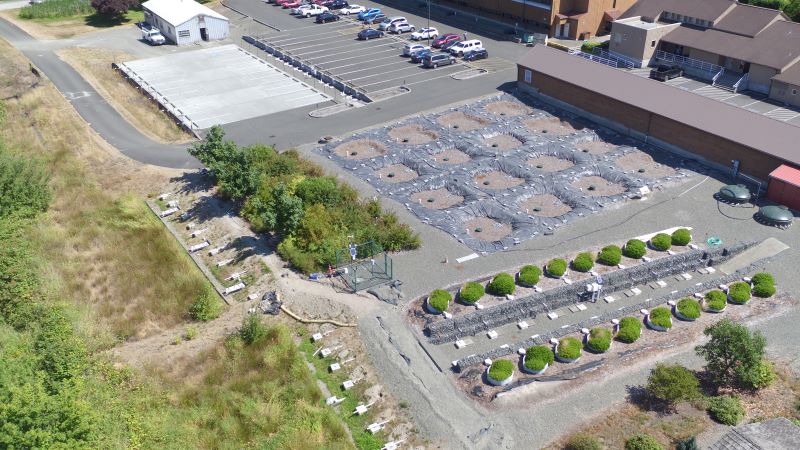
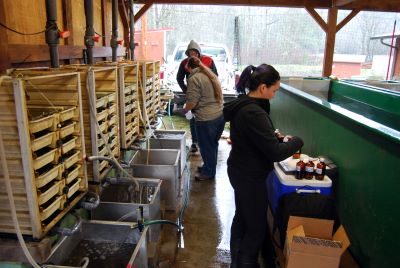
One of the Center’s primary research areas is the toxicity of stormwater pollutants to aquatic organisms and how to reduce or eliminate adverse effects. The facility’s research facility is a large Green Stormwater Infrastructure (GSI) complex that includes 16 rain gardens, 20 mesocosms (small, experimental areas that mimic an ecosystem), and a 100-space parking lot which showcases pervious pavements; all fully instrumented to determine how various treatments filter pollutants. The Center also houses the nationally recognized WSU Salmon Research Laboratory that investigates the effects of pesticides and other toxicants commonly found in surface waters on salmon and aquatic health.
From an education standpoint, the Center trains professionals on Low Impact Development (LID) through a certificate program. The online, self-paced curriculum provides fundamental, practical, and technical information on LID best practices. Some of the topics covered include: bioretention, permeable pavement, green roofs, rainwater harvesting, and site assessment, planning and layout.
The Center helps residential homeowners design, construct, plant, and maintain rain gardens with its Rain Garden Handbook for Western Washington. A series of companion online learning modules are planned. The Center also works closely with WSU Extension water programs and county offices to ensure that new information and resources are provided through their local outreach programs.
The Center provides technical assistance to municipalities and businesses for stormwater permit compliance. One of the Center’s biggest outreach successes is the Washington Stormwater Center Municipal Conference (MuniCon). Targeted toward professionals from across the state, the conference provides information on high-priority stormwater issues and challenges faced by permittees. MuniCon 2019 was sold-out with more than 450 attendees
The Center also provides additional assistance to municipalities with the Technology Assessment Protocols (TAPE) program, which evaluates and approves stormwater treatment best management practices.
The Center is actively involved in Puget Sound recovery through EPA’s National Estuary Program. It works with the Stormwater Strategic Initiative Lead (Ecology and Commerce) to develop strategic implementation plans to address stormwater, manages a standing advisory team and makes decisions about strategic financial investments in a wide range of research, capital, outreach and applied projects.
As the Center enters its next decade, one of the important research focuses will be understanding what contaminants are causing increased mortality of salmon, orca whales, seals, and other marine species.
In the Fall 2020 issue of Water Currents, we will bring you more information about stormwater and cutting-edge research findings from the Washington Stormwater Center. In the meantime, to learn more about the Center please visit the Washington Stormwater Center website.