
After nearly 20 years of searching for clues, researchers have made a stunning discovery. A previously unknown chemical created as tires age is linked to the death of Coho salmon. Studies have shown that more than half, and sometimes all, adult Coho salmon returning to many urban creeks in the Pacific Northwest, die before they can spawn. Now we know why.
Jen McIntyre, an assistant professor at WSU’s School of the Environment, based in Puyallup, called the discovery, “The end of a long road, and the beginning of another.”
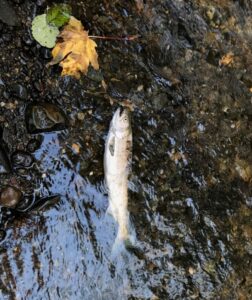
Salmon are born in freshwater creeks and migrate to the ocean after about one year to fatten up before returning to spawn. After a couple of years in the ocean, less than 0.1 percent return to freshwater to spawn. After spawning, Pacific salmon such as Coho die in the streams where they spawn, their nutrients help support future generations. As a result, in the Pacific Northwest, it is common to see dead salmon along riverbanks during spawning season. But in the 1990s, biologists determined that many Coho returning to urban areas had not spawned. They had died with their eggs intact. Scientists searched for the cause. They ruled out high water temperatures, low dissolved oxygen, pathogens, and known contaminants, such as zinc and pesticides. The one clue they had was that the fish died after it rained. Something in stormwater runoff was killing the Coho.
Scientists at NOAA and USFWS linked rates of mortality to traffic density in an area; the more busy roads in a drainage, the more of the Coho run was dying before spawning. There are thousands of different chemicals associated with urban roadways that end up in stormwater runoff. But which chemical was the problem? Was it a single substance or a toxic combination? McIntyre teamed up with Associate Professor of Civil & Environmental Engineering Edward Kolodziej’s team at the University of Washington to search for an answer. The effort ultimately involved more than 20 collaborators at six institutions, with funding from the National Science Foundation, the U.S. Environmental Protection Agency, Washington State Governor Funds, and the Regional Monitoring Program for Water Quality in San Francisco Bay.
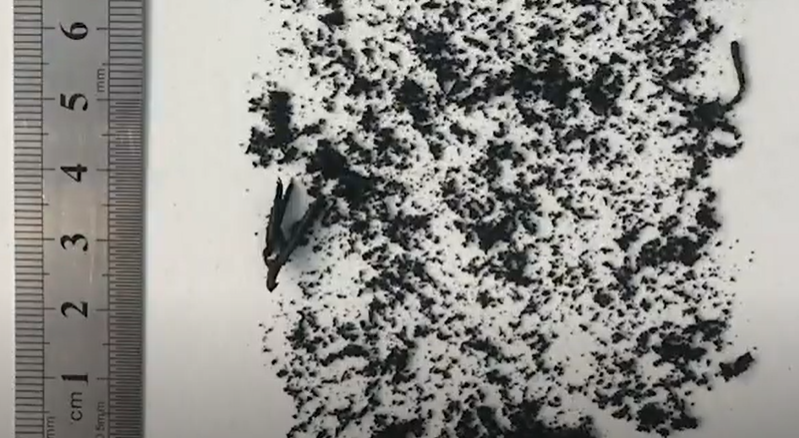
By comparing roadway runoff and water from different urban creeks McIntyre and her colleagues found that chemicals associated with particles from tire wear were ubiquitous. McIntyre discovered that water containing chemicals leached from tire wear particles was highly toxic to Coho salmon. The wear particles are composed of thousands of different chemicals. In an effort to narrow down the culprit, the team treated the water in different ways to reduce the number of chemicals in any one fraction, using toxicity testing to track the fraction containing the toxic chemical(s). But the surprise was when the toxic chemical turned out to be a completely unknown compound.
The suspect was similar to a chemical called 6PPD, which is used to keep tires from breaking down too quickly. 6PPD prevents ozone from degrading the chemical bonds that hold the tire together. Ozone is a gas created when pollutants emitted by cars and other chemical sources react in the sunlight. When 6PPD reacts with ozone, it is transformed into multiple chemicals. One of these is the previously unknown 6PPD-quinone (pronounced “kwih-known”), which was determined to be the toxic substance responsible for killing the salmon.
The tire industry’s response has been measured. According to the U.S. Tire Manufacturers Association, 6PPD is used because “it helps tires resist degradation and cracking, which is vital for passenger safety.” The Association issued a statement shortly after the research was published stating, “6PPD has been studied, but not enough is yet known about the newly discovered transformation product, 6PPD-quinone. We are committed to collaborating with researchers at the University of Washington and other scientists to better understand this product, fill knowledge gaps and determine next steps.”
This breakthrough research was published December 4, 2020 in the journal Science and leads to more questions. Researchers are now working to understand why this chemical is so toxic and why Coho are so sensitive to it compared to other salmon species. These next steps will hopefully lead to salmon-safe tires in the future.
References
Stokstad, Erik. Why were salmon dying? The answer washed off the road. December 4, 2020. Science. Vol. 370, Issue 6521, pp. 1145. https://science.sciencemag.org/content/370/6521/1145?intcmp=trendmd-sci
US Tire Manufacturer’s Association statement. December 4, 2020. https://www.ustires.org/ustma-statement-regarding-university-washington%E2%80%99s-research-6ppd-quinone-and-coho-salmon
Washington Stormwater Center website article and video: https://www.wastormwatercenter.org/tiresandsalmon/
WSU Insider. Tire-related chemical largely responsible for adult coho salmon deaths in urban streams. December 3, 2020. https://news.wsu.edu/2020/12/03/tire-related-chemical-largely-responsible-adult-coho-salmon-deaths-urban-streams/
Z Tian, H Zhao, KT Peter. A ubiquitous tire rubber–derived chemical induces acute mortality in coho salmon. Science 08 Jan 2021: Vol. 371, Issue 6525, pp. 185-189. https://science.sciencemag.org/content/371/6525/185
This article appeared in the Winter 2021 issue of Water Currents News. Subscribe today!