April 24th, 2025
Shepherds and herders are elusive individuals in Europe, not by design necessarily but incidental to their position in society. Oftentimes they are hired by farmers, conservation landowners (such as National Parks), or others. Other times they manage their own flocks and herds, but use land that marginal or remote: areas near highway entry and exit ramps, upland areas beyond reach of the plow, neglected communal lands, and the like.
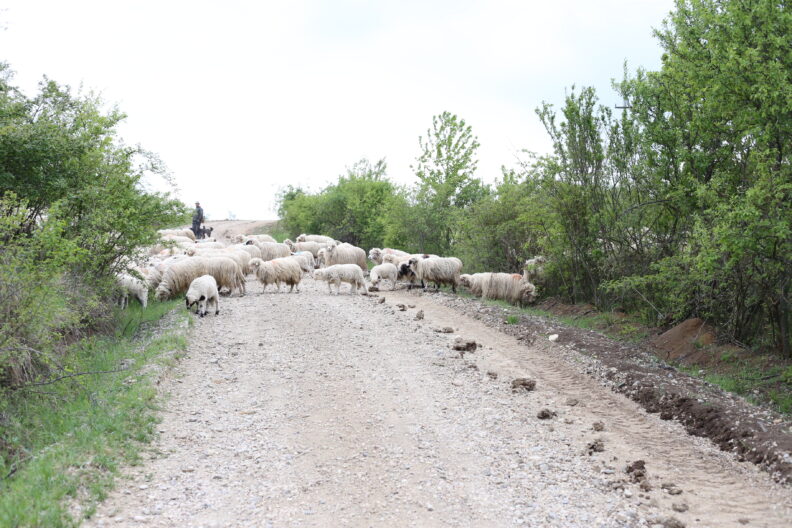
From travels in Romania and Hungary, shepherds and herders appeared to fall into one of three general archetypes: hired employee managing several farmers flocks, self-managed business operating on marginal land, or entrepreneurial operator managing a grazing business that hires multiple shepherds.
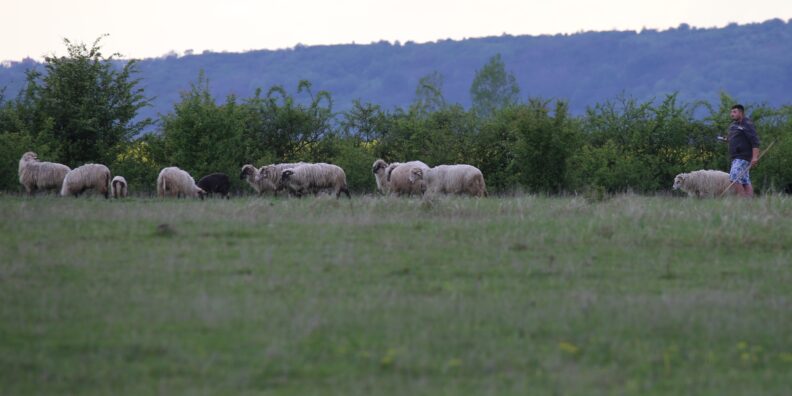
This is a young shepherd we stopped and talked to outside of Oradea, Romania. He runs his own flock. Contrary to popular opinion he does not shepherd because he is unskilled or incapable of other work. He consciously decided not to continue schooling in agricultural engineering. He had built a small flock during school, and decided to continue with a goal of increasing he breeding ewes to 300. In his mid-twenties, he notes he is the youngest shepherd in the area. He has taken up dog training, and proudly deployed his first trained dog to move sheep away from the far side of a fence several hundred yards off. He was mild-mannered, happy to talk, visibly enjoyed his work, and amicable. He lived in a caravan at the far end of the field. The land he grazed was apparently communal village land that he had requested to use after no other local shepherds were using it.
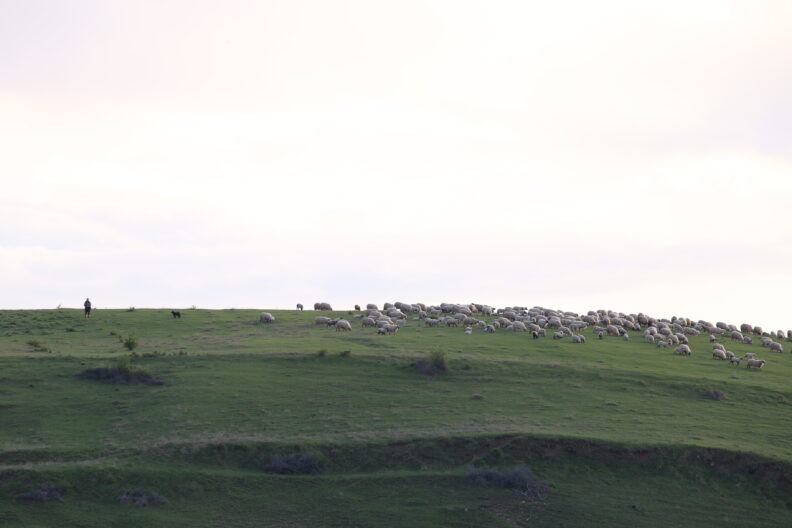
This flock we learned is likely managed by an employee of a business that runs several flocks in the area. This is outside of Jebecu, Romania. The business owner overseas approximately 4-5 shepherds, but we don’t know how many sheep. By the looks about 200+ per flock. This business takes advantage of the fact that there are fewer and fewer livestock producers in the area, and an excess of grazing lands. In Romania this is common as young people move to cities and fewer people farm. An opportunity arises for larger-scale operators to aggregate grazing lands formerly managed by many smaller operations, consolidating land and management. The implications can be overgrazing, and this was widely evident, as there are fewer people making decisions. Single large operators graze lands closer to villages more heavily, and communal lands receive less care. Even so, these consolidated businesses are what is left, and provide valuable grazing in the area that prevents afforestation and loss of the grassland habitat.
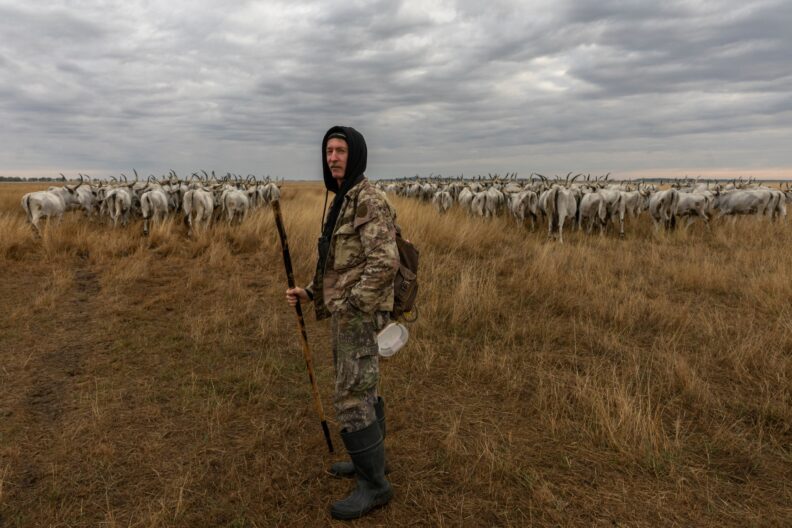
This is Tibor who manages livestock for the Koros Maros National Park in eastern Hungary. I interviewed him in early April, 2025. Tibor says the relationship with the national park is okay and challenging. As a herder raised in the trade, he is very familiar with the Hungarian grasslands, animal health, and forage ecology. Yet in many cases he feels his knowledge is not considered in decision-making. I found that National Park personnel seemed more likely to communicate well and develop collaborate management plans when they worked with herders or shepherds with their own flocks. In a sense the relationship was strong by necessity, and the outcome in terms of good communication and transparency was positive. When the park owned its own herds and hired herders, they seemed less likely to manage collaboratively; the relationship received less attention and the co-generation of knowledge and collaborative management was not as good. Tibor was distressed at how few herders there are less, and was not optimistic. He referred to it as a dying trade, and the grasslands themselves in a state of death due to climate change, declining water, and poor management. He would most like to have a young herder to train and work with in the field. He trains dogs for herding, is highly skilled at using the slingshot (can take a pheasant if he needs a meal), and carves grey cattle horns decoratively. If anyone wants to study with Tibor, we can put you in touch!