Volume 14 Issue 3
Lisa W. DeVetter (WSU NWREC) and David Bryla(USDA-ARS)
Calcium is an essential nutrient that provides many important functions in plants. Most notably, calcium is associated with fruit quality and firmness due to its influential role in maintaining cell wall strength and stabilizing the membranes of cells that make up the fruit. As a result, many growers attempt to improve fruit firmness by applying calcium as foliar and/or soil-applied fertilizers. However, scientifically sound information justifying this practice was lacking for red raspberry. Therefore, we conducted a two-year-long research project to address this knowledge gap.
Our overall goal was to evaluate methods to increase calcium concentrations in raspberry leaves and fruits and assess the impact of various calcium fertilizers on yield and fruit quality. Trials were executed on a commercial farm in Lynden, Washington, in fields of three different cultivars, including ‘WakeHaven’ in 2023, ‘Kulshan’ in 2024, and ‘Meeker’ in both 2023 and 2024. Soil pH in the fields ranged from 6.1 to 7.1, and soil organic matter ranged from 7.0% to 7.5%.
In each field, treatments were arranged in a randomized complete block design with four replicates and included foliar- and soil-applied calcium fertilizers, as well as an untreated control (Table 1). Each treatment plot was 56-ft long and spanned two post lengths (n=12 plots/cultivar). The fertilizers were selected based on pre-plant soil tests and consultation with local crop advisors. Foliar applications of calcium were targeted to overlap with the “half-developed” and “immature” stages of fruit development (S4-S6), which, as we determined previously, aligns with peak periods of calcium uptake in raspberry fruits (Dias Da Silva et al., 2023 and 2024).
| Treatments | Products | Application |
| Gypsum | Gypril (22% Ca) | 1 ton/acre (≈440 lbs/acre Ca) applied March 20231.5 ton/acre (≈660 lbs/acre Ca) applied March 2024 |
| Foliar calcium | NUE CAL-8 (8% Ca from calcium hydroxide) + SB-56 non-ionic surfactant | 8x (≈164 oz/acre Ca) applied weekly from June 13- Aug. 1, 20237x (≈144 oz/acre Ca) applied weekly from June 16-July 31, 2024 |
| Untreated control | N/A | N/A |
Data were collected from each treatment and included machine harvested yield, fruit quality (firmness, total soluble solids, pH, titratable acidity, and individual fruit weight), and tissue nutrient concentrations in ripe fruits, receptacles, and primocane leaves.
Like in many trials in other fruit crops, the calcium fertilizer treatments had no effect on most of the measured variables. In each cultivar, machine-harvested yield and fruit quality were no different between the untreated control and plots treated with foliar- or soil-applied calcium fertilizers (see Figure 1; fruit quality data not presented). Primocane leaf tissue nutrient concentrations sampled in early August were also similar among the treatments and, in each case, were within published leaf sufficiency ranges for raspberry (Davis et al., 2024), thus indicating there were no nutrient deficiencies in any of the treatments.
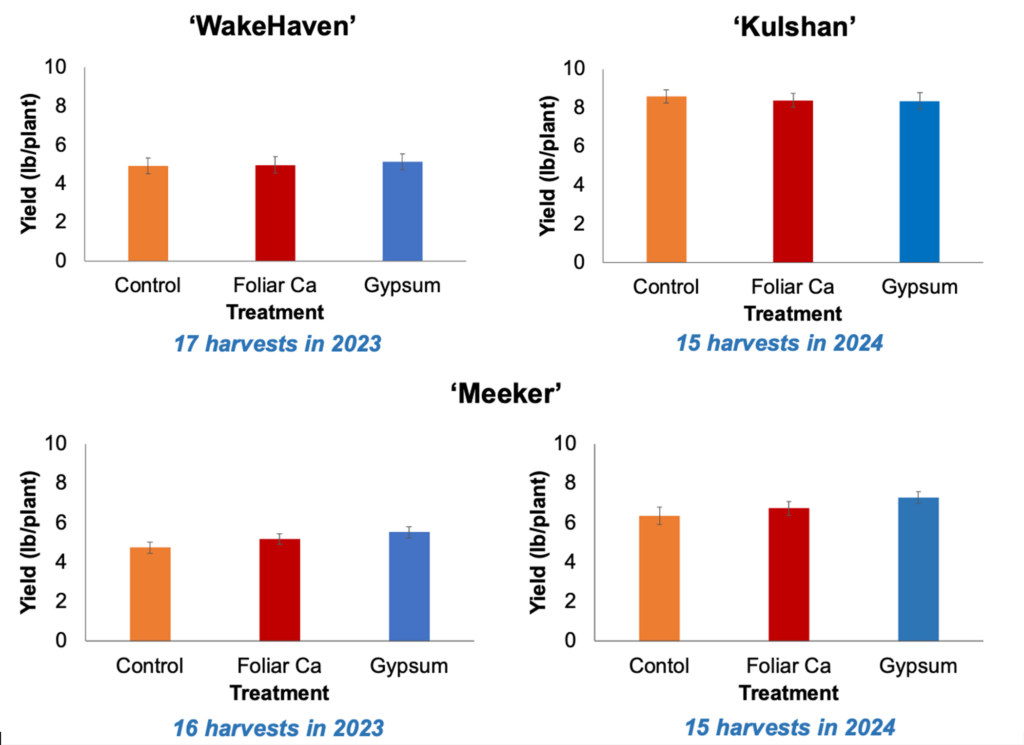
Important insights were gained, despite a lack of treatment effects. For example, we observed some interesting patterns regarding calcium concentrations in the receptacles and fruit. Firstly, calcium concentrations were at least 10x greater in the receptacle than in the ripe fruits (Figure 2). This suggests that vascular elements in the xylem are no longer functional during later stages of fruit development, limiting movement of calcium dissolved in plant sap into the fruits. Secondly, in ‘WakeHaven’, we found that calcium concentrations in the receptacle were significantly greater in plants treated with foliar calcium, followed by soil-applied calcium fertilizer, and was lowest in the untreated control (Table 2). Again, this indicates that moving calcium from the receptacle to fruits is a barrier, but gains with the fruit are possible given the differences in calcium concentrations of fertilizer-treated and untreated receptacles. Continued research should explore when isolation events occur developmentally in the fruit and whether vascular connections, and thus movement of calcium into the drupelets of the berries, can be extended through the application of plant growth regulators, such as abscisic acid (ABA).
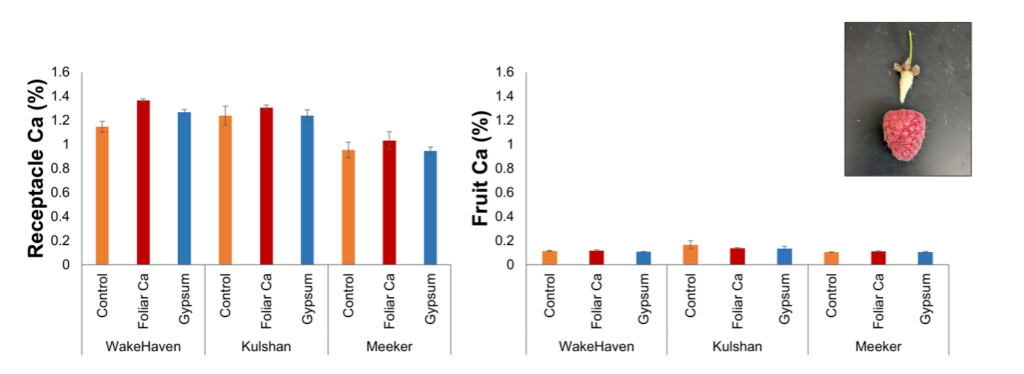
Table 2. Calcium concentration in the fruits and receptacles of ripe ‘WakeHaven’ raspberry fruits treated with no calcium fertilizer (“Control”), foliar calcium (“Foliar Ca”), and soil-applied calcium (“Gypsum”), 2023.
| Treatment | Calcium (%) | Calcium (%) |
| Fruit | Receptacle | |
| Foliar Ca | 0.12 | 1.37 az |
| Gypsum | 0.11 | 1.27 b |
| Control | 0.12 | 1.15 c |
| p-value | 0.408 | 0.001 |
To date, this research indicates that, as long as nutrients in the plants are within sufficiency standards, current calcium fertilizer programs are unlikely to have much impact on yield or fruit quality in red raspberries. This is not surprising given that other research frequently shows that calcium fertilizers have minimal-to-no impact on the fruit when the fertilizers are applied at recommended label rates. Moreover, foliar fertilizers tend to be more effective for applying micronutrients (e.g., zinc and copper) and less effective for applying macronutrients, like calcium, due to physical and physiological barriers in the leaf and fruit tissue. Continued research on the physiology of calcium uptake and transport to developing fruits, the role of plant growth regulators like ABA in augmenting uptake, and the effects on industry-relevant fruit quality traits should be explored to elucidate if calcium fertilizer programs can meaningfully and economically improve fruit quality for raspberry growers.
Questions or comments? Please reach out to Lisa W. DeVetter at lisa.devetter@wsu.edu
Acknowledgements: Funding for this project was provided by the Washington Red Raspberry Commission and Northwest Center for Small Fruits Research. We’d also like to acknowledge the excellent contributions of Riley Spears and his team at Rader Farms for assisting with the on-farm trial. Lastly, we’d like to acknowledge Brian Maupin and Scott Orr for project assistance.
References:
Davis, A., S. Lukas, B. Strik, A. Moore, L.W. DeVetter, D. Bryla, and E. Dixon. 2024. Nutrient management of raspberries and blackberries in Oregon and Washington. Pacific Northwest Extension Publication. Pp. 35. PNW 780
Dias Da Silva, A., S. Orr, M. Kraft, M. Hardigan, B. Maupin, R. Pio, D.R. Bryla, and L.W. DeVetter. 2024. Calcium accumulation in developing fruits of raspberry and blackberry. Acta Hortic. 1388, 339-346.
Dias Das Silva, A., D. Bryla, and L.W. DeVetter. 2023. Pump it up! Timing of calcium uptake in raspberry fruits. WSU Whatcom Ag. Monthly. 12(1).