Volume 14 Issue 9
Authors: Pedro Rojas-Barros, Ashley Fincham, Heather Pedroza, Clark Kogan, and Lisa Wasko DeVetter
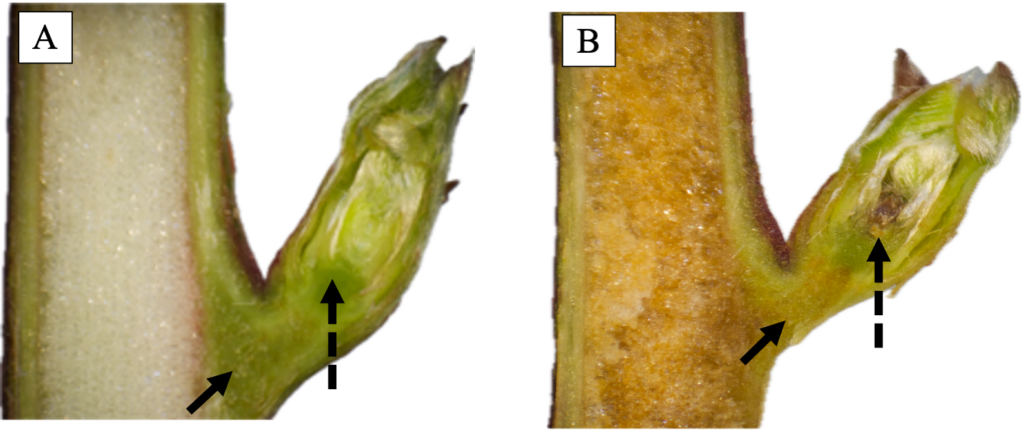
Blackberry is an increasingly important crop in the Pacific Northwest, including in Washington. However, production and expansion are challenged by freezing winter and early spring temperatures. Freezing temperatures can lead to freeze damage that results in partial to complete loss of the crop. Freeze-damaged or dead plant cells, which is characterized by distinct brown or black color (Fig. 1), is derived from ice formation inside plant tissues. Damaged or dead tissues are typically observed in fruiting buds but also the vascular tissue of the blackberry cane (Fig. 1). Tissue susceptibility to freeze damage depends on the degree of cold hardiness, which is influenced by day length and air temperature for most fruit crop species in temperate climates. Growers can minimize freeze damage in susceptible cultivars by deploying freeze mitigation technologies in combination with predictive cold hardiness models that estimate lethal temperatures (LT) based on air temperatures. These models help growers decide when to use costly mitigation technologies like heaters or wind machines. However, no such model exists for blackberry in the Pacific Northwest.
Predicting Cold Hardiness
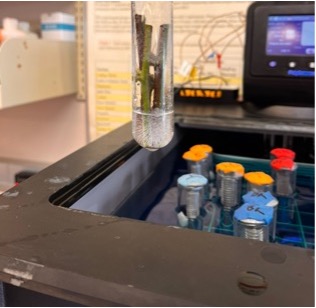
In our current cold hardiness model study initiated in 2024, we evaluated cold hardiness of ‘Victoria’ and ‘Celestial’ blackberry floral buds. Samples were collected weekly from Oct 15, 2024, to March 7, 2025. Plant material was collected from two commercial farms in Skagit County, WA. Samples were then placed into a glycol bath (Fig. 2) and exposed to 10 freezing temperatures ranging from 24.8 F to -7.6 F. Afterwards, bud damage was estimated and the LT in which 50% of the floral buds were damaged (LT50) was determined. In ‘Victoria,’ the LT50 was between 6.8 and 3.2 F through most of the winter season, while in ‘Celestial’, the LT50 ranged between -0.4 F and -4 F during the winter. The higher cold hardiness observed in ‘Celestial’ is attributed to its genetic traits as a semi-erect cultivar rather than environmental factors. An important future outcome of this work is an online decision-support tool that will help growers time mitigation strategies based on predicted hardiness and weather forecasts.
Biostimulants to Reduce Freeze Damage
Biostimulants are products made from substances like humic materials, algae, plant extracts, processed proteins and amino acids, elements, or microorganisms. They are designed to help improve plant functioning, even though they may not directly provide nutrients. Sprayable biostimulants are potentially more adoptable for growers, as they can be applied with existing farm equipment without added infrastructural costs. However, their efficacy against freeze damage is largely unknown. For this reason, we evaluated the effect of a glycine betaine-based biostimulant (FRUIT ARMORTM; 97% glycine betaine) at mitigating freeze damage in ‘Victoria’ floral buds. ‘Victoria’ was selected as the above study demonstrated it is more susceptible to freeze injury. The biostimulant was applied at its highest label rate (4 lbs/acre) on February 7, 2025, four days before a freeze of 10 F, within rows across different areas of a commercial farm in Skagit County, WA. Untreated controls were also included in the study for comparison purposes. Floricanes were collected four days after the freeze, and 720 treated and 720 untreated buds were scored for damage. Our statistical analysis showed that the single application of biostimulant increased freezing tolerance. This led to a reduction of 5.5% floral bud damage compared to untreated buds. We estimated that the damage reduction could be translated into approximately 0.5 lbs. more fruit per plant. Results suggest glycine betaine may be a cost-effective freeze protection strategy, but an additional season is necessary to confirm our findings. Our plan is to conduct additional experiments with biostimulants in blackberry and raspberry in the 2025/2026 winter.
Acknowledgements
This work is funded by the Washington State Department of Agriculture Specialty Crop Block Grant Program. Mention of product names is solely for the purpose of sharing information and does not represent endorsement. We also thank Driscoll’s and the grower cooperators that participated in this study.