This case study was developed by the USDA Forest Service, National Agroforestry Center and the USDA Northwest Climate Hub. Any errors or omissions are the responsibility of the authors and can be directed to the National Agroforestry Center. The lead author is Katherine Favor, ORISE Fellow with the National Agroforestry Center.
These and more case studies were developed for the Pacific Northwest Training Manual for Applied Agroforestry (to be released in 2026).
Introduction
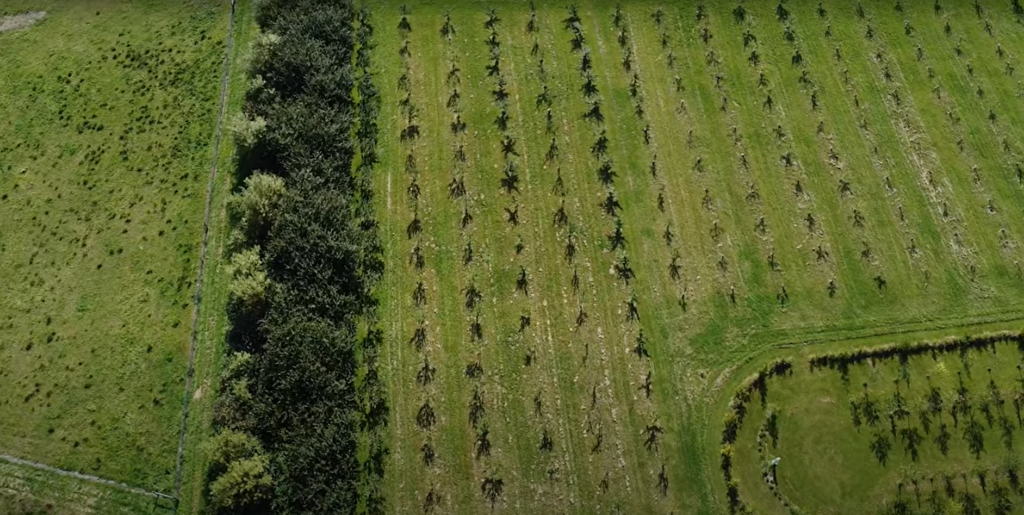
Nick Pate is the owner and operator of Raising Cane Ranch, a 38-acre organic farm and ranch in Snohomish, Washington. Much of the land is open pasture, including hay fields that are grazed by Highland cattle, which Nick raises and sells for beef. In 2010, Nick converted 3-acres of these hay fields into an alley cropping system by planting rows of cider apple trees into the hay fields in intercropped rows. Alley cropping is defined by the USDA Natural Resources Conservation Service as the practice of growing trees or shrubs in rows with other crops produced in the alleys between them (USDA NRCS 2017). Adding cider apple trees has helped Nick diversify his income and increase the overall productivity of his farm. Continuing to cultivate hay in between tree rows through the practice of alley cropping has allowed him to generate revenue from the land while the young apple trees are still maturing. Over time, the alley cropping system at Raising Cane Ranch has also provided other benefits to the surrounding Snohomish River Watershed ecosystem.
How it Started
Nick purchased Raising Cane Ranch in 2006. At the time, it was a struggling hay and beef cattle operation. “When we first bought the farm, it was all hay fields. There were only maybe a dozen trees on the whole 38-acre site,” says Nick. “But financially speaking, that model didn’t make sense. We needed a second source of income.”
Initially, Nick explored berry production, but the area’s high rainfall created significant fungal pressure, making berries a difficult crop to manage. Instead, he began researching more resilient fruit crops for the area and eventually landed on cider apples – a crop that often retains market value in Washington even with blemishes from pests and diseases.
Rather than establishing a traditional orchard, Nick chose to integrate cider apples with his existing hay production by designing an alley cropping system. In 2010, he planted cider apple trees in rows across a 3-acre parcel, with hay grown in the alleys between the rows. The apple trees are a mix of over a dozen varieties of sweet, bittersweet, sharp, and bitter-sharp apples so that Nick can make custom cider blends. The hay is harvested, bailed, and fed to his herd of Highland cattle, which he markets directly to consumers. Nick eventually plans on transitioning out of hay and cattle production entirely, but alley cropping allows him to maintain cash flow in the meantime. “Because it can take 5-10 years before cider apples generate a profit, it’s important to diversify in that initial period, so that income can be generated through other means,” he explains.
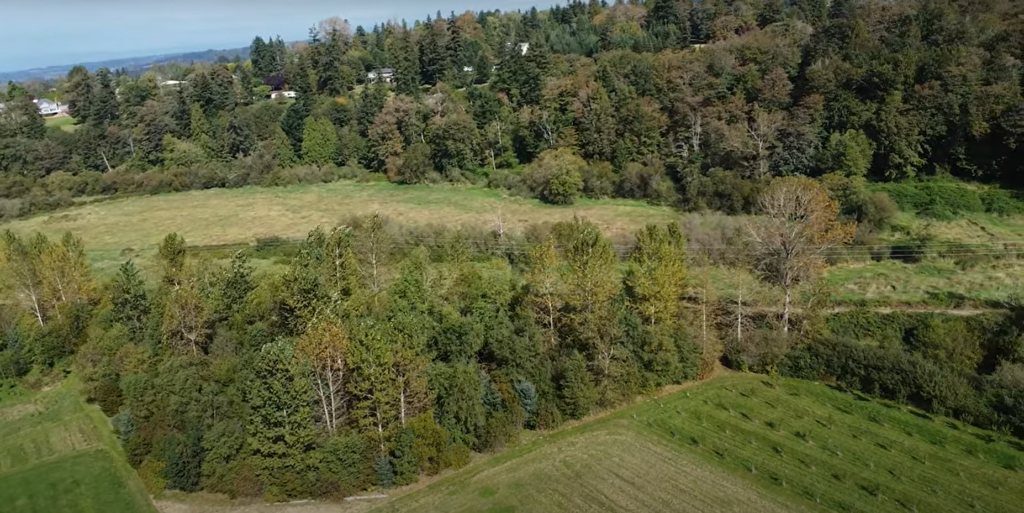
Nick’s decision to plant trees wasn’t only financially motivated; he also was interested in their ecological benefits. Raising Cane Ranch borders a riparian area that drains into the Snohomish River Watershed – the second largest watershed in the Puget Sound region. This watershed supplies clean drinking water to surrounding communities and also provides critical habitat to numerous plants and animals, including salmon – a keystone species in the region (Washington State Department of Natural Resources 2025). Before Nick bought the land, the farm experienced some erosion and leaching of agrochemicals during seasons of heavy rainfall. By incorporating trees into the landscape both through his alley cropping system and an adjacent riparian forest buffer, Nick aimed to stabilize the soil, reduce erosion, and minimize nutrient and chemical runoff, helping protect the health of the watershed downstream.
Design
The design of Nick’s alley cropping system was centered around the goal of streamlining farm management for greater efficiency. Apple trees were planted in straight lines across Nick’s existing hay fields to facilitate operations. “Straight lines, whether we like them or not, are very effective for mowing and maintaining and getting equipment in here,” Nick explains.
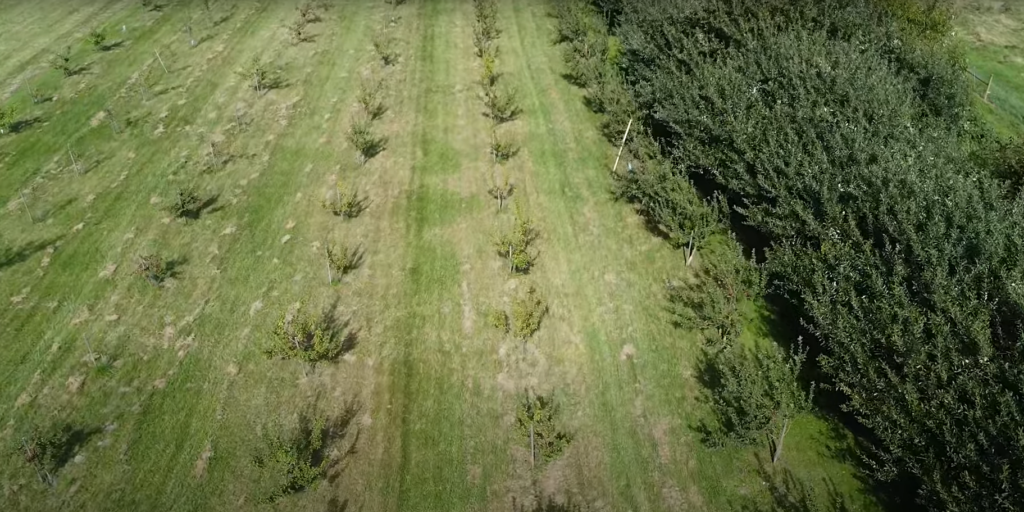
Spacing was also a key consideration in the design process. Nick spaced the tree rows at 20 feet apart – just wider than the width of the tractor and mower that he had already invested in to cultivate his hay. Within each tree row, apple trees were spaced 15 feet apart to maximize productivity while also minimizing competition between trees.
Planting density for cider apple orchards in Washington varies widely. Traditional low-density orchards may have around 300 trees per acre, while high-density systems can exceed 1,300 trees per acre (Bechtel et al. 1995). Nick opted for a very low planting density of just around 145 trees per acre. This spacing reduces competition between the apples and hay, but it also significantly lowers per acre apple yield. Likewise, Nick’s hay yield within the alley cropping system is also lower – just half of what an adjacent field yielded that was planted only to hay (SARE 2023). “It isn’t ideal for hay production, and it isn’t ideal for apple production either, but for our system, it makes sense,” Nick notes. This aligns with research indicating that while individual crop yields tend to decrease in alley cropping systems, the overall system productivity – or combined yield of both crops – is often higher (Dubey et al. 2016). For Nick, this tradeoff is worthwhile. The system allows him to produce more combined yield overall, and to continue producing hay for cattle feed and generating income during the early, low-yield years of the orchard’s establishment, when he would have otherwise generated very little income.
Alley cropping systems are dynamic and they evolve as the trees mature. As trees grow, they increasingly impact the understory crops by casting more shade and competing more for below-ground resources like water and nutrients. Because of this, the design and management of understory crops also often require modification. Nick is anticipating this shift. “In five years, I’d like to transition out of producing cattle and hay anyway, and that’ll be about the same time that these trees are producing a lot of fruit,” he says. When the apple trees are more productive and cast more shade, he plans to replace the hay with a more shade-tolerant crop, adapting the system as its conditions and productivity evolve. Some options for future understory crops that Nick has considered include cut flowers or lavender. Alternatively, he says he might decide to continue producing fodder for his cattle, but instead of growing hay, he might switch to a more shade-tolerant species, like cool-season grasses or legumes.
Establishment
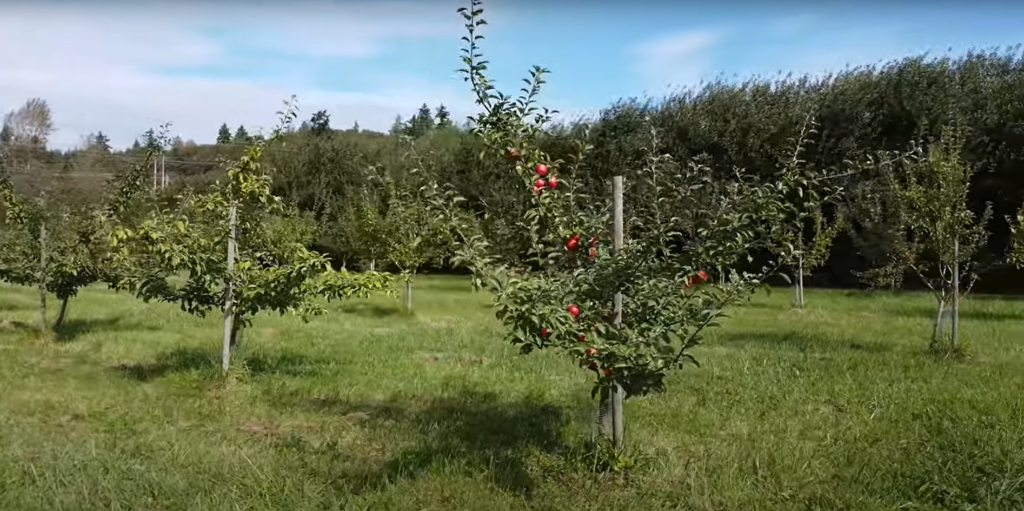
Planting trees involves a high upfront cost, and it can take years for trees to produce a harvestable crop and a return on investment. Harvesting hay during the trees’ initial growth period has helped Nick alleviate some of this cost. He also sought support from government programs and organizations, which made the transition to alley cropping far more feasible. “A lot of my costs were the initial investment – those plants, the hours, the compost,” says Nick. “To make that initial investment, with all the variables– it’s expensive and it’s risky,” To help with these costs, Nick received technical and financial assistance from several sources, including the USDA Natural Resources Conservation Service (NRCS) Environmental Quality Incentives Program, Western SARE’s Farmer and Rancher grant, the Snohomish Conservation District, the Washington Department of Ecology, the National Oceanic and Atmospheric Administration, and the USDA Farm Service Agency’s Conservation Reserve Program. “Getting help with the initial funding is a huge help for these pilot projects,” he says.
Management
Managing the hay component of the system is relatively straightforward. Nick harvests the hay three times a year – once in the spring and twice in the summer – by cutting it to a height of six inches using a 60-inch deck mower. After cutting, the hay is baled and stored for use as livestock feed in the winter.
As much as possible, Nick aims to reduce reliance on external inputs by creating synergies between different parts of the farm. For instance, he feeds his cattle rotten apples and leftover pressings from cider production rather than throwing them away. In turn, he uses cattle manure to fertilize the apple trees. “There is a bit of a full circle thing going on here, with livestock being a big, integral part of that,” says Nick.
Climate Risks and Adaptation Strategies
Hot and Dry Summers
Hot and dry summers are becoming increasingly common across Washington (Hegewisch and Abatzoglou 2025). Extended periods without precipitation can place stress on the hay at Raising Cane Ranch, which is unirrigated. However, alley cropping systems can alter the microclimate surrounding understory crops and reduce evapotranspiration. Nick has observed that the hay in his alley cropping system remains greener for longer during the summer compared to his other fields. The partial shade provided by the apple trees helps retain soil moisture and protect the hay from the full intensity of the summer heat.
High Winter Rainfall
Snohomish, Washington receives an average of 11.25 inches of precipitation during the winter months (National Centers for Environmental Information 2025), with some years bringing even more rainfall. Nick’s land is flat and sits just 10 feet above sea level, so in the winter pooling and ponding are common. To deal with this issue, Nick chose native crabapple rootstock to graft his apples onto, as crabapple rootstock is well-adapted to seasonal periodic flooding and saturated soils.
Extreme Weather
Periods of extreme rainfall are common in Washington, and this trend is expected to intensify in the coming years (Chang et al. 2023). Extreme rainfall can occasionally cause hay to rot before it can be harvested. However, because Nick is already generating income from the apples in his alley cropping system, the hay produced there serves more as a safety net than a primary crop. “This is sort of like my savings in the bank,” he explains. “Most of my other hay fields give me what I need through the winter for my livestock, but in some years, production is low, or sometimes the hay gets rained on and damaged.” Having an extra field of hay in his alley cropping system provides Nick with supplemental hay during these difficult years. “If the other hay fields aren’t sufficient for whatever reason, the hay in this alley cropping section at least give me a little bit of a bump.”
Conclusion
Nick Pate’s alley cropping system at Raising Cane Ranch is an example of how diversification can create resilient farming systems that are better-equipped to withstand the ups and downs of markets and the climate. By integrating cider apples with hay production, Nick has built a transitional system that supports his livestock and finances while his orchard matures. At the same time, integrating trees is helping to improve the long-term health of the surrounding watershed ecosystem. Although alley cropping requires tradeoffs, like lower individual crop yields and higher upfront costs, it can offer increased overall productivity, climate resilience, and many ecological benefits.
References
Bechtel L.; Barritt, B.H.; Dilley, M.A.; Hinman, H.R. 1995. Economic Analysis of Apple Orchard Management Systems with Three Varieties in Central Washington. College of Agriculture and Home Economics Research Center. [Date accessed: 18 April 2025].
Chang, M.; Erikson, L.; Araújo, K.; Asinas E.N.; Chisholm Hatfield, S.; Crozier, L.G.; Fleishman, E.; Greene, C.S.; Grossman, E.E.; Luce, C.; Paudel, J.; Rajagopalan, K.; Rasmussen, E.; Raymond, C.; Reyes, J.J; Shandas, V. 2023. Ch. 27. Northwest. In: Fifth National Climate Assessment. Crimmins, A.R., C.W. Avery, D.R. Easterling, K.E. Kunkel, B.C. Stewart, and T.K. Maycock, Eds. U.S. Global Change Research Program, Washington, DC, USA.
Dubey SK, Sharma N, Sharma JP, Sharma A, Kishore N. 2016. Assessing citrus (lemon) based intercropping in the irrigated areas of northern plains of Haryana. Indian Journal of Horticulture 73:441-444
Hegewisch, K.C.; Abatzoglou, J.T. 2025b. Future Climate Dashboard web tool. Climate Toolbox. [Date accessed: 26 March 2025].
National Centers for Environmental Information. 2025. U.S. Climate Normals Quick Access. [Date accessed: 18 April 2025].
SARE. 2023. Ecological and Economic Impacts of Transition to an Apple/Hay Agroforestry System. [Date accessed: 18 April 2025].
USDA NRCS. 2017. Alley Cropping (Ac.) (311) Conservation Practice Standard. [Date accessed: 5 April 2025].
Washington State Department of Natural Resources. 2025. Snohomish Watershed Resilience Action Plan. [Date accessed: 14 April 2025].
This resource was supported in part by the U. S. Department of Agriculture (USDA) Climate Hubs via an appointment to the USDA Forest Service Research Participation Program administered by the Oak Ridge Institute for Science and Education (ORISE) through an interagency agreement between the U.S. Department of Energy (DOE) and the USDA. ORISE is managed by ORAU under DOE contract number DE-SC0014664. All opinions expressed in this paper are the author’s and do not necessarily reflect the policies and views of USDA, DOE, or ORAU/ORISE.