TThis case study was developed by the USDA Forest Service, National Agroforestry Center and the USDA Northwest Climate Hub. Any errors or omissions are the responsibility of the authors and can be directed to the National Agroforestry Center. The lead author is Katherine Favor, ORISE Fellow with the National Agroforestry Center.
These and more case studies were developed for the Pacific Northwest Training Manual for Applied Agroforestry (to be released in 2026).
Introduction
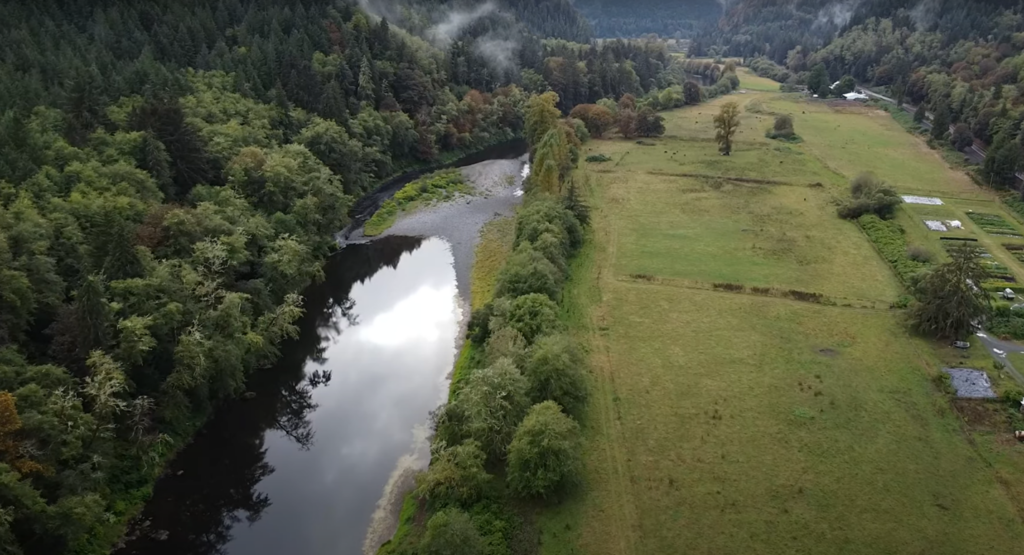
Nehalem River Ranch is a 100-acre diversified ranch along the Nehalem River in Northwest Oregon, owned and managed by Jared Gardner. Jared has implemented several agroforestry practices on his land, including silvopasture, windbreaks, and riparian forest buffers – managed areas of trees and shrubs that are located in between agricultural production and waterways for the purpose of water quality protection, streambank stabilization, wildlife habitat, and more (USDA National Agroforestry Center 2025). “Being stewards of 100 acres along a river is really magical, but it also comes with a responsibility,” says Jared. “We are excited to do our part to keep the river as clean as possible.”
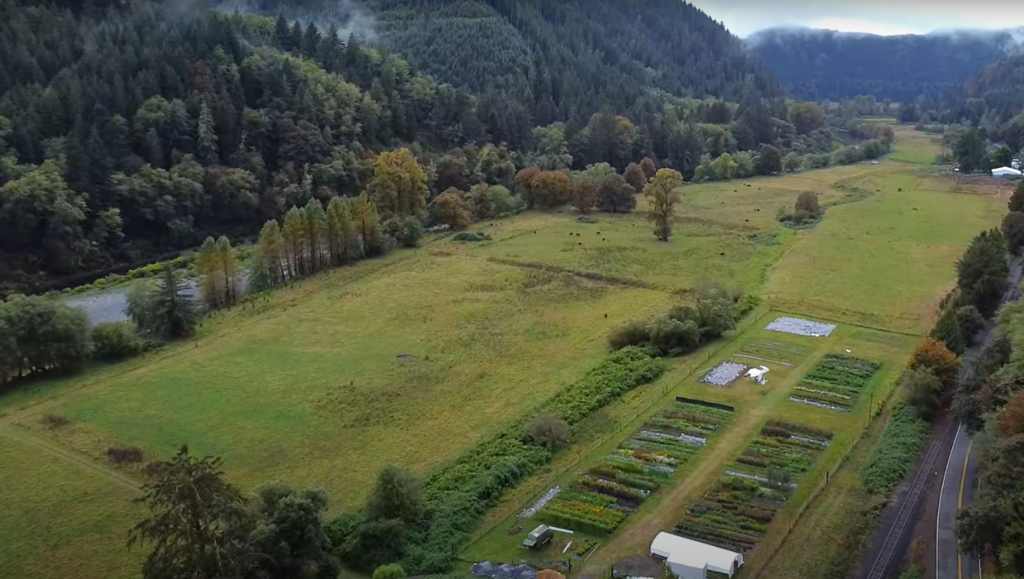
Focusing on diversity, Jared raises grass-fed and finished Angus-Hereford cross beef and Gloucestershire Old Spot cross pigs, and he also keeps bees for honey. Additionally, he partners with tenant farmers who lease shared pastureland and graze poultry in rotation behind his cattle and pigs. Along the river’s edge, the ranch’s riparian forest buffer serves as a barrier between the pastureland and the Nehalem River. The buffer filters runoff, reduces nutrient pollution, and stabilizes the riverbank to prevent erosion. It also supports Jared’s honey operation by providing a year-round supply of flowers for his honeybees.
Jared’s goals for his land are to produce healthy, local meat and honey, and to foster a biodiverse landscape that supports both his farm and the surrounding Nehalem River watershed. “This has been a really important ecological site, culturally and historically,” says Jared. “It’s our responsibility to think about the river, the riparian zone, and how we steward animals and plants in relation to the riparian ecosystem.”
How it Started
When Jared purchased Nehalem River Ranch in 2014, the riverbanks on his property had already experienced significant ecological degradation. Much of the land’s native woody perennial vegetation had been removed and converted into more pasture for cattle. Over time, much of the riverbank was overtaken by Japanese knotweed (Polygonum cuspidatum) – a bamboo-like invasive forb. The roots of Japanese knotweed are connected to weak rhizomes that easily break apart (Colleran et al. 2020). Without the stronger roots of woody perennials to help stabilize the soil and hold it in place, streambank erosion became a significant issue. Motivated to address the erosion and invasive species issues, Jared began a large-scale restoration effort. In partnership with several local organizations, he removed the knotweed through mowing and targeted, intensive grazing, and planted in its place over 5,000 native trees and shrubs to rebuild the river’s natural riparian buffer and stabilize the soil.
Jared’s restoration efforts were also aimed at improving habitat for terrestrial and aquatic wildlife. The woody perennials in the riparian forest buffer provide shelter and food to many terrestrial animals like elk, deer, and birds. The riparian forest buffer also filters runoff and reduces the amount of nutrients that end up in the river. This helps to prevent eutrophication – an accumulation of nutrients that leads to increased growth of algae, which can deplete oxygen levels and harm aquatic life. By reducing nutrient overload from livestock waste, the buffer protects aquatic organisms.
Jared was also interested in planting trees along the river to cast shade and lower water temperatures, further improving conditions for aquatic organisms. He recognizes that improving habitat for wildlife does more than just benefit the environment – it also benefits the ranch itself. “The more trees we plant, the more birds of prey we have. The more birds of prey we have, the less gopher holes and tripping hazards for our cows,” Jared explains. “So, it’s little, simple things like that that are a win-win for both the ecology and our production.”
Design
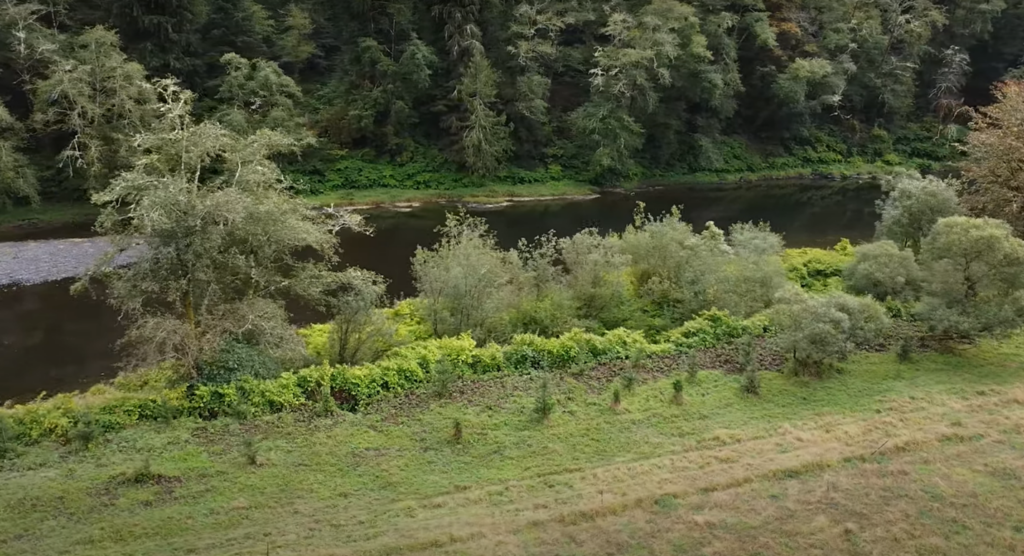
The riparian forest buffer at Nehalem River Ranch spans the entire length of the river border – over 7,000 linear feet in total. The trees and shrubs were planted in rows varying from two to six rows wide, depending on the topography of the land. Within rows, trees were planted close together – just six to 10 feet apart – to account for expected losses due to elk browsing and other pressures. “We over-planted instead of using protective cages,” says Jared. “We know that we will need to thin some trees down the line, but when we did the math, this method was more cost effective than having to pay for caging.” All in all, six of Nehalem River Ranch’s 100 acres are planted to riparian forest buffers.
Species selection was an important part of the design process. In the rows closest to the river, Jared chose native plants with deep roots that could tolerate seasonally saturated soils, like:
- western hemlock (Tsuga heterophylla)
- red currant (Ribes triste)
- willow (Salix spp.)
In the rows farther from the river, he chose taller species that not only help filter nutrient load and slow runoff, but that also act as windbreaks. These species include:
- Sitka spruce (Picea sitchensis)
- redosier dogwood (Cornus sericea L.)
- western redcedar (Thuja plicata)
- bigleaf maple (Acer macrophyllum)
As a beekeeper, Jared was intentional about selecting tree and shrub species to support his honeybees, along with other pollinators. To do so, he selected native species that flower at different times of the year, to ensure a continuous source of nectar and pollen. About 3,000 of the trees and shrubs planted were chosen specifically for their pollinator value, including species such as:
- oceanspray (Holodiscus discolor)
- twinberry (Lonicera involucrata)
- Pacific ninebark (Physocarpus capitatus)
- red-flowering currant (Ribes sanguineum)
- thimbleberry (Rubus parviflorus)
- western crabapple (Malus fusca)
- red elderberry (Sambucus racemosa)
“These trees are doing all sorts of things for the environment, but they also give us another product that we can sell – honey,” explains Jared.
Establishment
Nehalem River Ranch’s riparian forest buffer was established over the course of several years, through multi-agency partnerships, nonprofit collaborations, and community effort. The project was partially funded through a grant provided by the Oregon Watershed Enhancement Board by way of the Nehalem Bay Watershed Council. The Nehalem Bay Watershed Council, along with Resilience Permaculture, also provided technical assistance to help Jared develop a design and management plan. NRCS funded the purchase and establishment of the pollinator support species through the Environmental Quality Incentives Program (EQIP). The Tillamook Estuaries Partnership (TEP) provided many of the trees and much of the labor, contracting with a crew to plant and maintain the trees during the initial few years of establishment. In total, TEP provided and planted roughly two-thirds of the trees and shrubs. Jared, together with friends and volunteers from the local community, planted the remaining plants.
Prior to planting trees, the first step in the establishment process was to remove Japanese knotweed. Because the ranch uses organic practices, it was important to refrain from using herbicides during this process. “We don’t want any toxins to run off into the water, and we don’t want our cows to graze anything that has chemicals on it,” Jared explains. “It’s really important to us as a family, and also for our customers.” Instead, TEP provided contract labor to manually mow down knotweed in steeper areas of the riparian forest buffer, while Jared used high-intensity grazing with goats, chickens, and cattle in areas suitable for animal impacts.. The goats ate much of the Japanese knotweed, the cattle ate other weeds, and the chickens helped lightly till the soil, preparing it for planting.
Once invasive plants were under control, native tree and shrub saplings were planted. To protect newly planted trees, Jared installed fencing to exclude livestock. This also prevents cattle from entering the river and causing streambank erosion. After a few years, the woody perennials have grown tall enough that they are beginning to shade out the knotweed. Although this is an ongoing process that still requires intensive and regular weed management, Jared is hopeful that one day the area will be dominated by native perennials in the place of invasives.
Management
Nehalem River Ranch grazes multiple species of animals in successional rotation, one after another. While the cattle and hogs are managed by Jared, the poultry are managed by tenant farmers. “It’s a complementary system,” explains Jared. “Because there are multiple managers, no one person needs to learn all the skillsets needed to manage a diversified operation.” Because livestock management is shared, creating a shared grazing plan was important, to prevent overgrazing and to maximize the benefits of animal impacts on the land. This shared grazing plan is centered around rotational grazing principles, where animals are rotated into different paddocks every few days. 20% of the pasture is planted to silvopasture, with native trees interspersed across the grassland, providing shade and shelter for the animals as they graze.
In the riparian forest buffer, vegetation management is an ongoing task, particularly for Japanese knotweed. For the first few years, much of the weed whacking and mowing is being done by the Tillamook Estuaries Partnership, but Jared also uses animals to help with weed control. The 800 chickens that belong to the ranch’s tenant farmers have access to fenced off paddocks within the riparian forest buffer for two days at a time before being moved to the next grazing section. The chickens help clear surrounding weeds by scratching, while also fertilizing the trees. All in all, Jared estimates that the chickens supply the equivalent of $10,000 in fertilizer throughout the ranch, helping him save money on inputs.
Jared considers wildlife when making management decisions. While mowing and weed whacking are critical tasks to prevent competition, some birds and other wildlife species depend on grassland habitat. “So, we mow in cycles,” he explains. “We’ll mow this part of the land one month, and another part of the land another month, so that there’s always some grassland habitat available.” Replanting trees and shrubs is another major management task, but one that was expected. “We always knew we were going to lose some trees, so we overplanted, and planned and budgeted to replant,” says Jared.
Climate Risks and Adaptation Strategies
Despite the region’s high amounts of annual rainfall – an average of 121 inches per year – summers in Nehalem are typically a drier time of year, with an average of 6.5 inches of rain between June and August (National Centers for Environmental Information 2025). In the last 10 years, Jared notes that Nehalem River Ranch has experienced several summer seasons that have had periods of no rainfall lasting longer than 80 days. Oregon’s temperatures have also increased by 2.2°F per century since 1895 (Fleishman and Oregon Climate Change Research Institute 2025), and they are projected to increase by 4.7°F to 10.0°F by 2080 (Chang et al. 2023). High temperatures, combined with periods of little to no rainfall, can put stress on newly planted trees. To improve survival without installing irrigation, Jared applies woodchip mulch, which helps conserve moisture as well as prevent weeds.
Heavy rains in winter are another concern. From November through January, Nehalem receives an average of 57.5 inches of rain, which can lead to significant streambank erosion and flooding. Nehalem River Ranch’s riparian forest buffer has helped significantly reduce streambank erosion, helping to conserve soil and nutrients. Climate models project that both the frequency and intensity of extreme precipitation events are likely to increase in Oregon in the coming years (Chang et al. 2023). This concern has further incentivized Jared’s decision to plant a riparian forest buffer. “You can either lose your production land to planting a riparian forest buffer, or you can lose it to erosion from the river,” he explains. “I’d rather have a riparian forest buffer, because of all the additional benefits it provides to our ranch and the surrounding ecosystem.”
Conclusion
Nehalem River Ranch’s riparian forest buffer is multifunctional, preventing erosion, filtering runoff, preventing nutrient overload, providing shade to aquatic wildlife, and supporting terrestrial wildlife as well. At the same time, the buffer promotes income generation by preventing land loss, and by providing a source of food to Jared’s bees for his honey business.
To ensure long-term protection, Jared is working with the Oregon Agricultural Trust to establish a conservation easement on the property. “By having a conservation easement, we have a longer-term framework to ensure that these trees do live to 100 years and beyond,” says Jared. “There are trees on this property that I benefit from that were planted intentionally by someone a century ago. Now it’s my responsibility to pay it forward for the next 100 years.”
References
Chang, M.; Erikson, L.; Araújo, K.; Asinas, E.N.; Chisholm Hatfield, S.; Crozier, L.G.; Fleishman, E.; Greene, C.S.; Grossman, E.E.; Luce, C.; Paudel, J.; Rajagopalan, K.; Rasmussen, E.; Raymond, C.; Reyes, J.J.; Shandas, V. 2023. Ch. 27. Northwest. In: Fifth National Climate Assessment. Crimmins, A.R.; Avery, C.W.; Easterling, D.R.; Kunkel, K.E.; Stewart, B.C.; Maycock, T.K.; Eds. U.S. Global Change Research Program, Washington, DC, USA.
Colleran, B.; Lacy, S.N.; Retamal, M.R. 2020. Invasive Japanese knotweed (Reynoutria japonica Houtt.) and related knotweeds as catalysts for streambank erosion. River Research and Applications. 36: 1962-1969.
Fleishman, E; Oregon Climate Change Research Institute. 2025. Seventh Oregon Climate Assessment. Corvallis, Oregon. Oregon Climate Change Research Institute, Oregon State University.
National Centers for Environmental Information. 2025. U.S. Climate Normals Quick Access. [Date accessed: 18 April 2025].
USDA National Agroforestry Center. 2025. Riparian Forest Buffers. [Date accessed: 11 June 2025].
This resource was supported in part by the U. S. Department of Agriculture (USDA) Climate Hubs via an appointment to the USDA Forest Service Research Participation Program administered by the Oak Ridge Institute for Science and Education (ORISE) through an interagency agreement between the U.S. Department of Energy (DOE) and the USDA. ORISE is managed by ORAU under DOE contract number DE-SC0014664. All opinions expressed in this paper are the author’s and do not necessarily reflect the policies and views of USDA, DOE, or ORAU/ORISE.