This case study was developed by the USDA Forest Service, National Agroforestry Center and the USDA Northwest Climate Hub. Any errors or omissions are the responsibility of the authors and can be directed to the National Agroforestry Center. The lead author is Katherine Favor, ORISE Fellow with the National Agroforestry Center.
These and more case studies were developed for the Pacific Northwest Training Manual for Applied Agroforestry (to be released in 2026).
Introduction
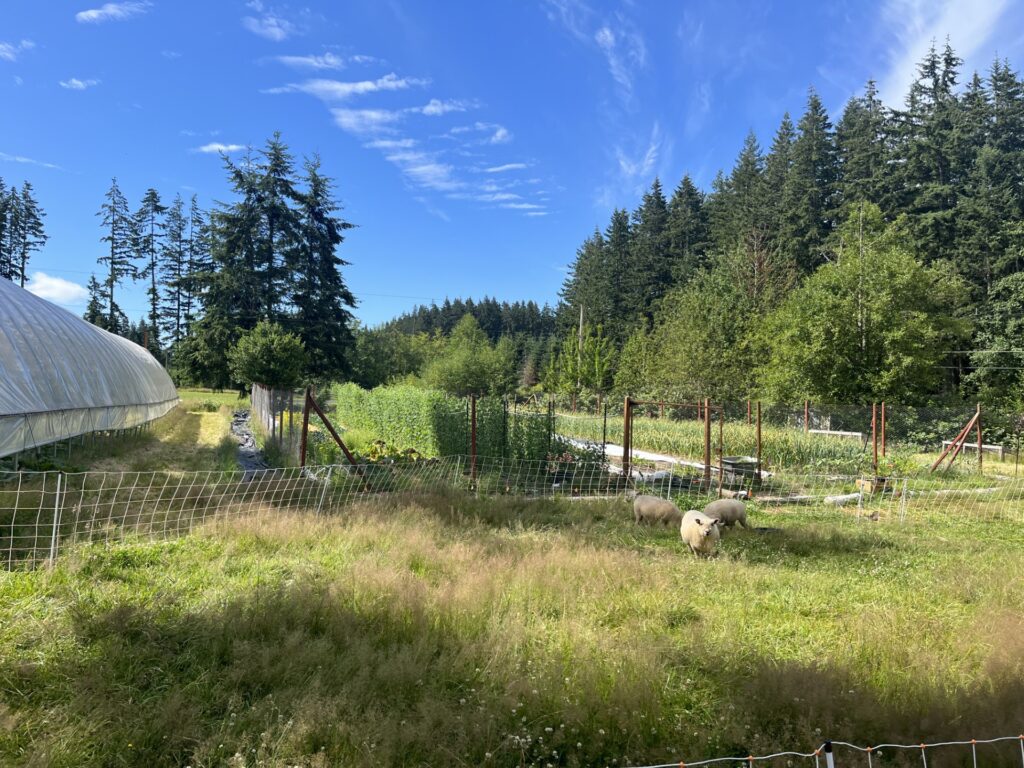
Jake and Aja Stewart are the owners and operators of Sweetwater Farm, a 24-acre farm on Whidbey Island, Washington. Sweetwater Farm is highly diversified, with orchards, vegetable gardens, livestock, and a food forest. Food forests (sometimes called forest gardens) are a type of forest farming system. Forest farming is defined by the USDA Natural Resources Conservation Service as the management of stands of trees or shrubs in coordination with understory plants or nontimber forest products (USDA NRCS 2022). While there are many ways to design forest farming systems, food forests in particular are characterized by their multiple layers of overstory and understory vegetation, managed together to create an integrated system that mirrors the structure of an early-succession forest while producing harvestable products.
At Sweetwater Farm, the Stewarts’ food forest consists of layers of food- and medicine-producing trees, shrubs, berries, forbs, herbs, mushrooms, and other crops, all planted beneath the canopy of a managed native forest. “We’re basically working with the existing forest to add food production capacity,” explains Jake. The various species in the food forest produce a diversity of harvestable crops for the Stewarts while also providing ecological functions that support the system as a whole.
How it Started
Jake and Aja began their farming journey 15 years ago in Austin, Texas. However, when their well went dry, their farm income dried up as well. Seeking a place with more abundant water, they eventually settled on Washington’s Whidbey Island, which receives an average of 31.6 inches of rain per year (Hegewisch and Abatzoglou 2025a). There they started Sweetwater Farm. “We named it after the sweet water that we were pursuing,” explains Jake. “We consider ourselves voluntary climate migrants in a way. We came here seeking water, and that’s what we found.”
Today, Sweetwater Farm’s food forest produces an abundance of food that is sold at their farm stand and through a local cooperative. The Stewarts designed their farm to rely on few external inputs, and to provide benefits to the ecosystem as a whole, including the wildlife that call Whidbey Island home.
Design and Establishment
Sweetwater Farm is primarily composed of forested land with native tree species such as Douglas fir (Pseudotsuga menziesii), western hemlock (Tsuga heterophylla), cedar (Cedrus spp.), bigleaf maple (Acer macrophyllum), and alder (Alnus spp.). “We have other areas of the farm where we cultivate rows of vegetables, but our main strategy for food production is incorporating harvestable crops into our forest,” says Jake. Working with nature is a central goal at Sweetwater Farm. “It looks wild and unruly, but that’s because our production systems are fitting into the natural landscape. We’re trying to tuck production into the existing ecosystem, not keep them separate.”
The first step in this process was identifying and creating open spaces in the forest where food-producing trees could be planted. Jake and Aja began by deciding which existing tree species to retain and which to remove. When they first bought their property, some pockets of the forest had already been cleared by the previous owner for timber harvesting. These openings were the first locations where they planted fruit and nut trees.
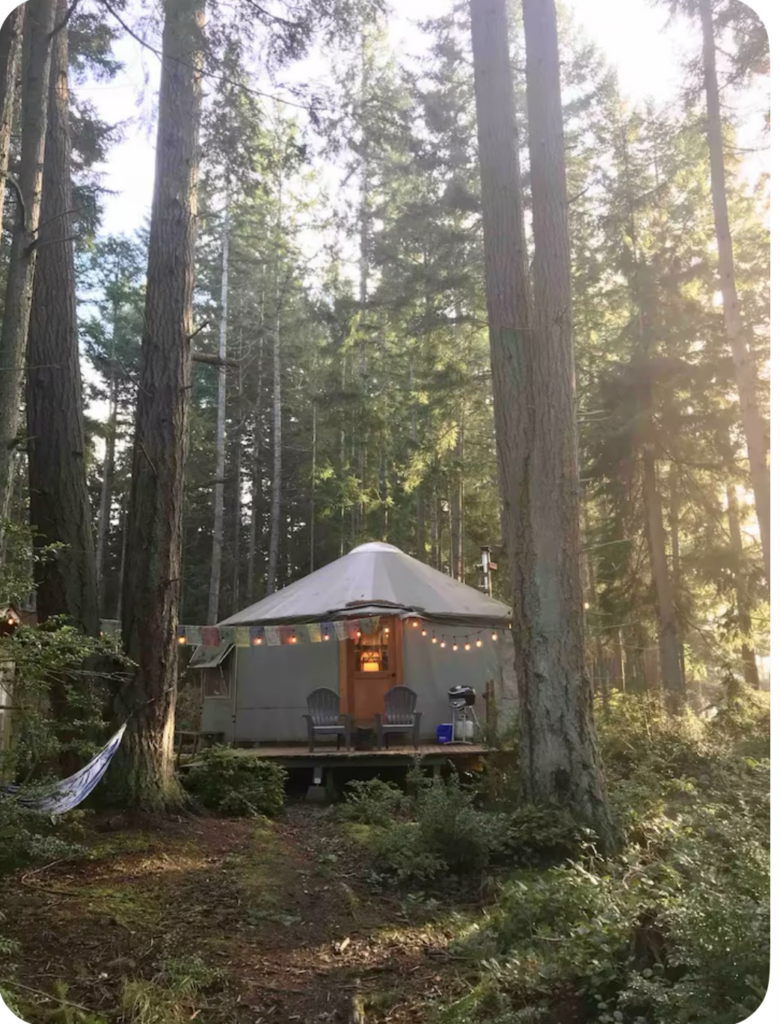
They conducted a detailed forest inventory and chose to leave some standing dead trees, or snags, as habitat for wildlife such as native bees and great-horned owls. They also felled several cedar trees, which they milled into lumber to build their home, fence, and other farm structures. Most of the remaining dead, diseased, and lower-quality trees were also removed, creating additional gaps of light in the forest canopy.
Rather than removing the felled biomass, the Stewarts chipped most of the small diameter logs and branches in place with a tractor-mounted wood chipper. The resulting mulch created a thick, moisture-retaining layer that fostered the growth of beneficial mycorrhizal fungi. They planted food-producing trees directly into these newly-opened, mulched areas. They also chose to leave some downed logs intact, which they then inoculated with oyster (Pleurotus ostreatus) and shiitake mushrooms (Lentinula edodes).
In the understory, Jake and Aja cultivate a diverse mix of crops. Small trees like Szechuan pepper (Zanthoxylum piperitum), and shrubs like goji berry (Lycium barbarum ), grow under the partial shade of taller fruit trees, while casting their own shade on other crops below. Blackberry brambles (Rubus spp.), salal (Gaultheria shallon), and native evergreen huckleberry shrubs (Vaccinium ovatum) fill the mid-story layer, helping maximize vertical growing space beneath the tree canopies. Nitrogen-fixing shrubs like sea buckthorn (Hippophae rhamnoides) are also planted in this layer. In addition to producing medicinal berries, sea buckthorn also enriches the soil by fixing nitrogen, reducing the need for external fertilizer inputs.
Vines such as grape (Vitis spp.) and hardy kiwi (Actinidia arguta) climb high into the canopy, using the trees and shrubs as natural trellises. In the lower layers of the food forest, the Stewarts grow oyster and shiitake mushrooms on downed logs, and they forage for naturally occurring chanterelles (Cantharellus cibarius) on the forest floor.
Climate Risks and Adaptation Strategies: Warmer Winters
Tree species selection was an important part of the Stewarts’ farm design process. To guide their decisions, they used the USDA Plant Hardiness Zone Map – a tool that maps the average annual extreme minimum winter temperature across different regions – to determine which perennial species would be suitable for their site. Currently, Whidbey Island is classified as Zone 8b, meaning average minimum winter temperatures range between 15 and 20°F (USDA Plant Hardiness Zone Map 2023). However, climate models project that by the end of the century, the region may shift to Zone 9a, with coldest average temperatures ranging from 20 to 25°F (Hegewisch and Abatzoglou 2025b).
Because trees can live for several decades or even centuries, Jake and Aja prioritized long-term climate adaptability in their planting choices. “We’re leaning into the next plant hardiness zone to prepare for what the conditions might be here in the future,” says Jake. The Stewarts selected tree species that are expected to thrive in both Zones 8b and 9a. On the sunnier edges of their forest, they planted sun-loving trees and shrubs suited for both of these zones. These include apple (Malus domestica), Washington hawthorn (Crataegus phaenopyrum), Italian plum (Prunus cocomilia), European chestnut (Castanea sativa), walnut (Juglans regia), American hazelnut (Corylus americana), pistachio (Pistacia vera), jujube (Ziziphus jujuba), and pineapple guava (Acca sellowiana). In more shaded interior areas of the forest, they chose tree species that can tolerate partial shade, such as honeyberry (Lonicera caerulea), pawpaw (Asimina triloba), mulberry (Morus spp.), and aronia (Aronia melanocarpa). Some of these species have not yet been widely cultivated in Washington, but Jake and Aja are excited to experiment and observe how they perform. “A lot of what we’re planting is a bit of a gamble,” says Jake. “We’re letting die what wants to die. And we’ll plant more of what does well.”
Management
One of the Stewarts’ primary goals is to promote healthy soil, with a particular focus on supporting the mycelial network that underpins the food forest’s ecosystem. “Focusing on the soil food web is a big part of our philosophy,” says Jake. “This means protecting the soil structure, reducing compaction, preserving the topsoil layer by preventing erosion, and keeping the topsoil covered.”
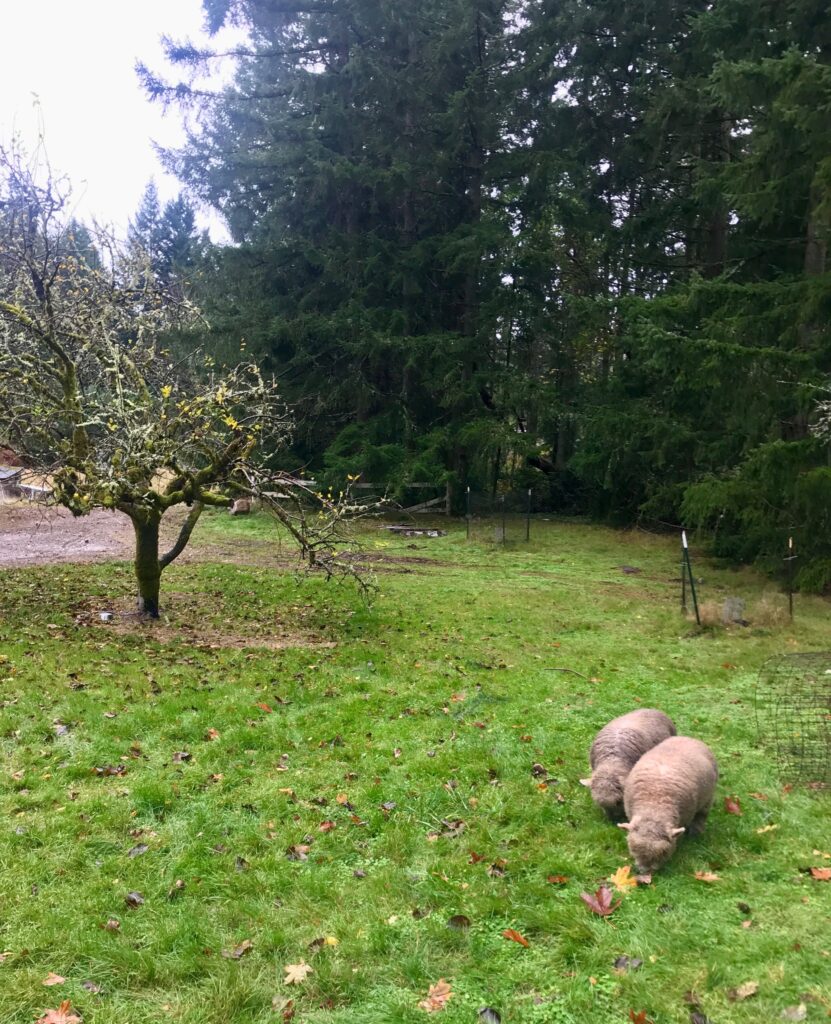
To support these goals, the Stewarts incorporate animals into their system at certain times of the year. Rotationally grazed sheep help manage weeds. Ducks, turkeys, and chickens lightly disturb the soil surface as they forage, without disturbing deeper mycelial networks. After livestock are rotated through, any remaining weeds are cut by hand or with a weed whacker, leaving root systems intact to maintain soil structure and microbial life. The livestock also contribute to soil fertility and help control pest populations – particularly snails and slugs – thereby reducing the need for nutrient inputs and pesticides.
“Our goal for our children one day is that the soil they inherit will be richer than what it started as, and that the farm’s input costs go down,” says Jake. “We’re trying to bank nutrients instead of spending them, while using as few external inputs as possible.”
Conclusion
At Sweetwater Farm, Jake and Aja Stewart are building a resilient, ecologically-grounded food system through thoughtful design, climate-adaptive species selection, and soil-focused management. By integrating multiple layers of tree crops, shrubs, vines, mushrooms, and other crops into their food forest, they can produce food while supporting the surrounding forest ecosystem.
References
Hegewisch, K.C. and Abatzoglou, J.T. 2025a. ‘ Historical Climograph’ web tool. Climate Toolbox. Accessed on [February 10, 2025].
Hegewisch, K.C.; Abatzoglou, J.T. 2025b. Future Climate Dashboard web tool. Climate Toolbox. [Date accessed: 26 March 2025].
USDA NRCS. 2022. Forest Farming (Ac.) (379) Conservation Practice Standard. [Date accessed: 5 April 2025].
USDA Plant Hardiness Zone Map. 2023. Agricultural Research Service, U.S. Department of Agriculture. [Date accessed: 17 April 2025].
This resource was supported in part by the U. S. Department of Agriculture (USDA) Climate Hubs via an appointment to the USDA Forest Service Research Participation Program administered by the Oak Ridge Institute for Science and Education (ORISE) through an interagency agreement between the U.S. Department of Energy (DOE) and the USDA. ORISE is managed by ORAU under DOE contract number DE-SC0014664. All opinions expressed in this paper are the author’s and do not necessarily reflect the policies and views of USDA, DOE, or ORAU/ORISE.