Background
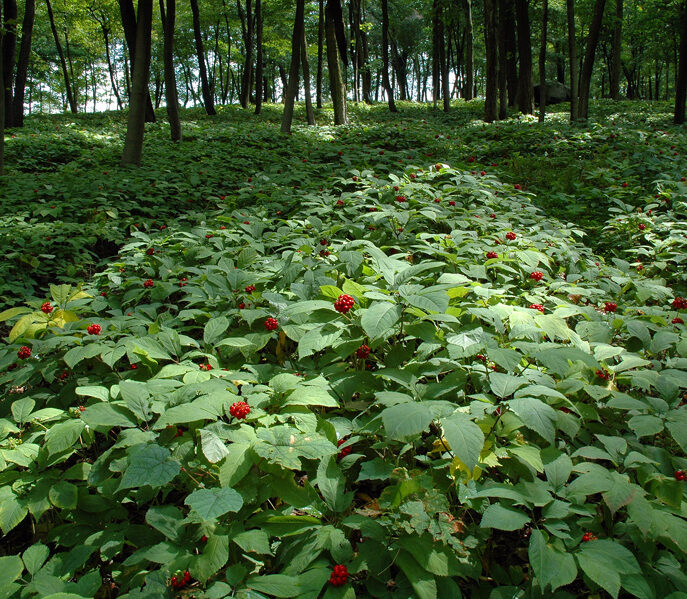
Ginseng (Panax spp.) is a perennial herb that grows in the understory of forests in North America and Asia. American ginseng (Panax quinquefolius) is the only native species in the United States and occurs west of the Rocky Mountains. It commonly grows in the Appalachian Mountains where it has a long history of being foraged by indigenous peoples, and later European settlers, for its medicinal benefits and use as a stimulant. Demand for American ginseng from Asian countries has grown significantly because of its similarities to Asian ginseng species, which have declined due to overharvest. This has also led to an overharvest of wild American ginseng. The practice of forest farming ginseng has grown in popularity over the last several decades because it provides a way to sustainably produce a crop that resembles wild ginseng while preserving natural populations.
There are no ginseng species native to Washington State, but it does have a history of being grown here. Starting in the 1990’s global demand for ginseng encouraged farmers to begin exploring growing it, primarily in Western Washington. However, these were not forest farming operations. Instead, it was cultivated under shade nets in agricultural fields, which provided uniform shade conditions and access for large equipment but also increased infrastructure costs. Although at one point there were over 100 growers in the state, production maxed out at 200 acres in total. In the last two decades, the small number of growers sharply declined, largely due to market fluctuations and an inability to compete with larger producers in Canada and the eastern U.S.
Currently there are no known ginseng growers in the state, but it remains an opportunity. The viability of forest farming ginseng has not been thoroughly explored in Washington and needs more research. The use of a forest canopy in place of shade nets would reduce infrastructure costs and may increase the viability of the practice. The potential to develop local demand for ginseng products may also help resolve issue with market fluctuations.
Overview and Inputs
Although the payoff can be high, American ginseng is a slow-growing species that requires specific site conditions and regular maintenance. Compared to shade net systems in agricultural fields, most of the work in a forest farming system will be done by hand or with small equipment. Since forest farming ginseng in Washington State has not been thoroughly explored and documented, starting with small plots is recommended to see how it grows and determine if you have suitable conditions. WSU Extension is currently hosting trials to explore ginseng cultivation in hardwood dominant forests in Western Washington, and this page will be updated with the results when they are available.
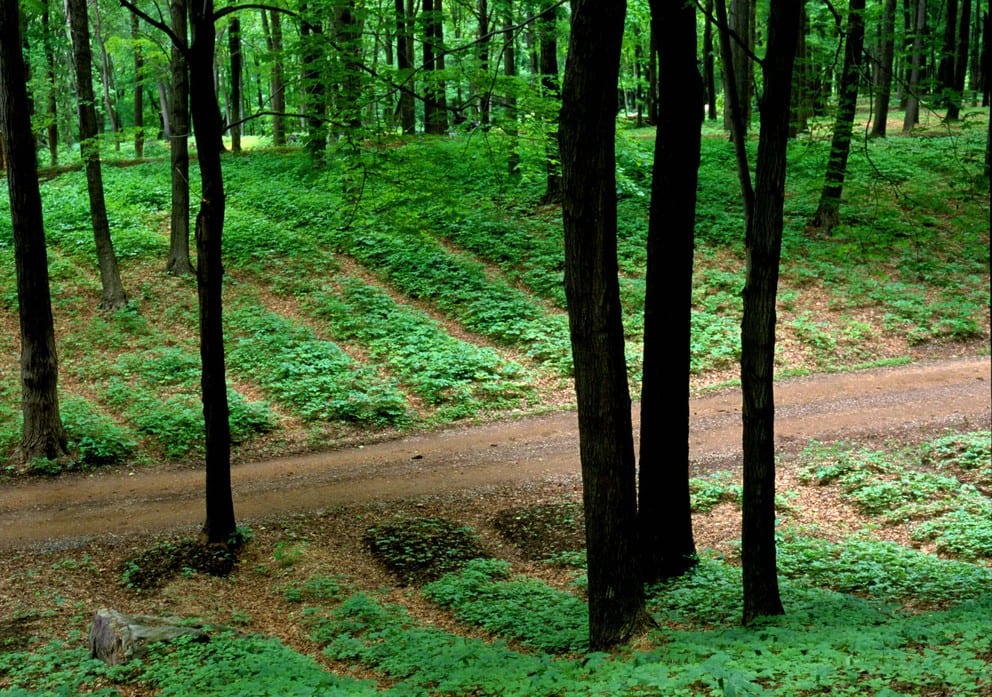
Since it is not native to Washington State, careful site selection is necessary to find growing conditions that are analogous to their ideal habitat in their native range. In the eastern U.S., ginseng is typically found on moist, rich soils with good drainage and an overstory of sugar maple, basswood, white ash, and other hardwoods. North, northeast, and east facing slopes tend to be best, as they stay cooler and retain more moisture. Research has shown that soils high in calcium support ginseng growth and disease resistance, and high phosphorous levels are necessary to facilitate calcium absorption. In Washington State, forests dominated by bigleaf maple and red alder are likely to provide the best analogue for ginseng habitat, as the are naturally higher in phosphorous and calcium and can more readily provide the ideal shade conditions (70-90%).
Where the right soil conditions exist, ginseng can be planted directly into the ground. On sites where soils are lacking the right characteristics, the soil can be amended with fertilizer and materials that manipulate drainage. Alternatively, ginseng can be grown in raised soil beds. Although this increases establishment costs, it provides an opportunity to create an ideal growing medium while avowing significant soil disturbance in riparian areas. Raised beds also make it easier to protect plants from pests and can be lined on the bottom with landscape fabric to reduce weed and pest pressure.
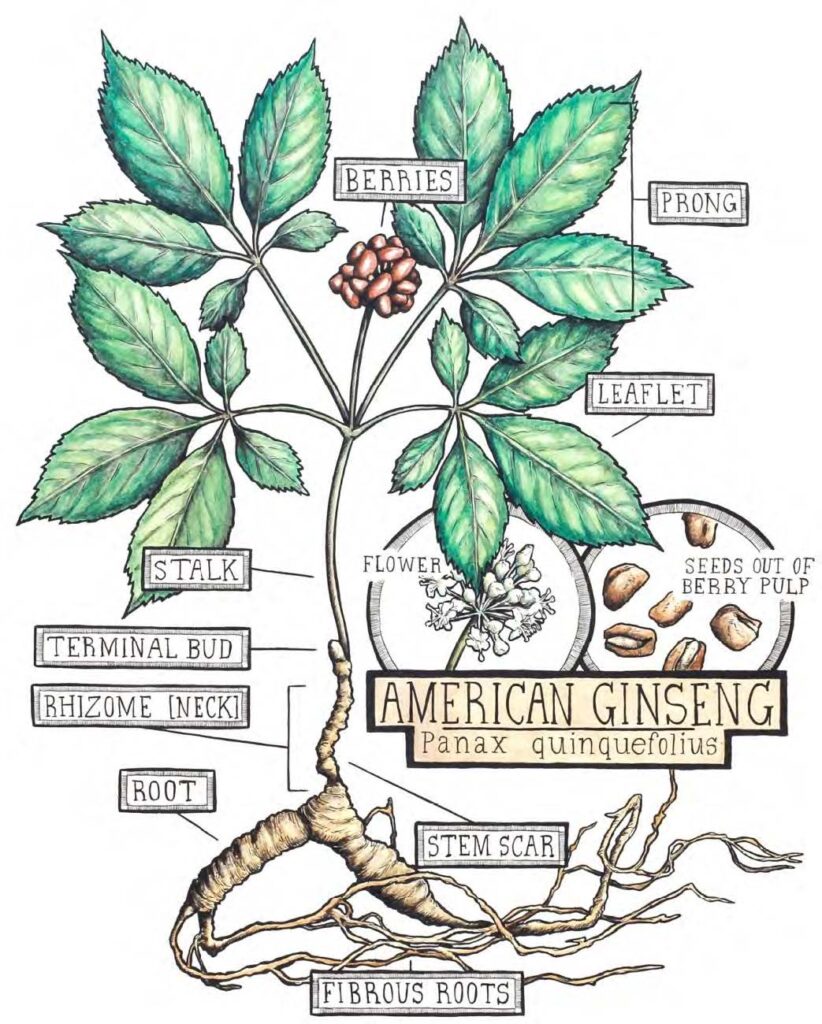
Ginseng can be established by seed or rootlets, both of which can be purchased from suppliers in eastern states. Seed should be scattered by hand on bare soil in the fall, then covered with leafy debris and left overwinter to stratify. Rootlets can be planted directly in the soil in the late winter or early spring. It’s common for forest farmers to use woody debris from the forest floor to demark the boundaries of their plots and cut down on material costs. Seed may take up to 18 months to germinate but rootlets should sprout in the first year. Plants spend 2-3 years as three-leaved seedlings before developing fully grown five-leaved “prongs”. Healthy plants will add a new prong each year, usually up to four, and roots are considered ready for harvest once it has at least three prongs. Leaves can also be harvested and eaten fresh in salads or soups, or dried for teas, but should only be done if two prongs can be retained on plants to maintain growth.
Routine maintenance is necessary to sustain the health and vigorous growth of ginseng. Plants should be monitored regularly for signs of foliar and root diseases, which can cause serious issues for ginseng growers. Chemical options are available, but cultural practices can help prevent disease and should be exercised to avoid use of pesticides in riparian buffers (discussed in the next section).
Pests may also prove to be an issue and inputs will likely be required to protect plants. Deer will browse on the foliage of ginseng, which can kill young plants and stunt growth in older plants. They can be excluded with fencing, netting, or other materials. Some forest farmers use six to eight foot “deer buster” fence and utilize trees as living posts to cut down on costs. Hunting can also be a strategy to help reduce deer pressure. Smaller animals, including mice, voles, moles, and slugs, may also cause damage to plants. Raised beds can be more easily protected by placing barriers below the growing medium and along the edges to deter small pests. Ground plots may be more difficult to protect. Live traps and baits can be effective and should be used utilized before poisons to reduce the chances of harming non-target wildlife in forests. Additionally, mesh barriers can help protect the seed as it matures, which should be harvested annually to reseed harvested areas and expand populations.
Harvesting ginseng is done in the fall when concentrations of ginsenoside are at their highest and the plants seeds have matured and been collected. Harvesting is done by hand and care should be taken to avoid damage to the roots which will reduce their value. Roots are washed and then preserved by drying at low temperatures (85-95 degrees Fahrenheit) or kept fresh in the fridge for several weeks. Since it is not native to Washington, ginseng grown here is unlikely to meet the standards of “wild” grown demanded by Asian markets but can be marketed as “forest grown” or “wild simulated” to local markets such as restaurants, farmers markets, and direct online sales.
Considerations for Riparian Buffers
Ginseng is highly conducive to riparian buffers where the right site conditions are available. It requires full shade and can be grown on the forest floor alongside native flora or in raised garden beds in any part of a buffers. There is limited soil disturbance necessary during establishment and harvesting, all of which is done by hand.
Ginseng can be prone to disease and more research is necessary to understand how common diseases behave in forest farming systems in Washington State. Most diseases can be prevented and/or treated with pesticides, but this should be limited where possible in riparian buffers. Cultural controls should be utilized to prevent disease over relying on pesticides. This can include thinning plots to ensure proper airflow, utilizing seed over rootlets during establishment, and ensuring there is sufficient calcium and phosphorous in the soil or raised beds support vigorous growth. If pesticides become necessary, use the WSU Extension guide “Crop Profile for Ginseng in Washington” to help identify the issue and determine the appropriate chemical option. When using pesticides, closely follow the instructions on the label and ensure that is allowable where you intend to apply it.
Although ginseng is more tolerant of conifer cover than spring ephemerals like ramps, hardwood dominant canopies are still preferrable for cultivation. This may make site selection difficult for those working in existing buffers, as many buffers are purposely planted exclusively with conifers because they are long-lived and can provide large, woody debris inputs for fish habitat. Removing conifers to increase hardwood cover in the inner buffer may be restricted or difficult due to regulatory barriers, depending on the type and size of the stream or wetland being buffered. However, in these cases ginseng habitat can be created by adding to a buffer or working in the outer zone where regulations are less restrictive. For those planting a buffer, determining the location and projected size of your ginseng operation ahead of time will help you plan the arrangement and composition of your buffer planting.
Guides and Resources
Currently, there are no guides available for forest farming ginseng in the Pacific Northwest, but there are a wide variety of resources on cultivation in eastern states. When using these, consider the unique traits of the Pacific Northwest climate and forests to translate them to our region. This page will be updated as more information is available on forest farming ginseng in Washington State.
- American Ginseng – Penn State Extension
- American Ginseng Cultivation and Growing Guide – United Plant Savers
- American Ginseng Cultivation Demonstration – United Plant Savers (YouTube)
- American Ginseng Production in Woodlots – National Agroforestry Center (PDF)
- Costs and Returns of Producing Wild-Simulated Ginseng in Established Tree Plantations – Purdue Extension (PDF)
- Crop Profile for Ginseng in Washington – WSU Extension
- Forest Farming: Ginseng – Pasa Sustainable Agriculture (YouTube)
- Forest Farming Ginseng – Appalachian Forest Farmers Coalition (YouTube Series)
- Ginseng, Fungicides, and Organic Alternatives – Appalachian Forest Farmers Coalition (YouTube)
- Growing American Ginseng in Forestlands – Virginia Cooperative Extension (PDF)
- Growing American Ginseng in Ohio: An Introduction – Ohio State University Extension
- Growing Ginseng in Your Woods – Cornell Extension (YouTube)
- Phytophthora Leaf Blight and Root Rot in Ginseng – PNW Pest Management Handbook
- Producing and Marketing Wild Simulated Ginseng in Forest and Agroforestry Systems – Virginia Cooperative Extension (PDF)
- Wild Simulated American Ginseng Field Workshop – Appalachian Forest Farmers Coalition (YouTube)