Background
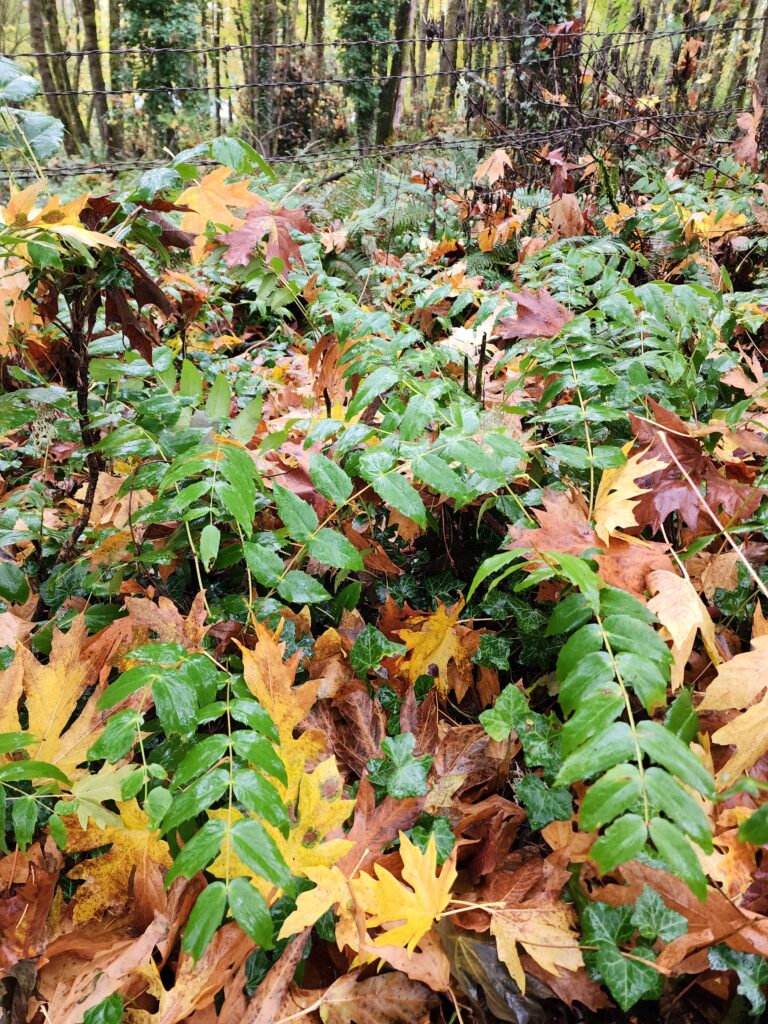
Oregon grape is a small shrub native to the Pacific Northwest and grows throughout Washington State. It has several utilities and potential markets as a forest farming crop. Its foliage can be collected and sold to florists or wholesalers for floral arrangements and leaves. It’s commonly used in landscape design, which means plants could be propagated in a forest and then sold as container plants. It also produces an edible berry which, although quite tart, can be processed into jams and jellies. The roots and stems can be used to create a yellow dye.
It’s most unique value, however, is as a medicinal product. The inner bark of the roots and stems of Oregon grape contain berberine, which is an alkaloid with anti-inflammatory and anti-bacterial properties (Buttolph & Jones, 2012). Goldenseal (Hydrastis canadensis), which also contains berberine, is a high-demand forest medicinal that is under significant pressure from overharvesting resulting in it being listed as threatened or endangered in several states in the eastern U.S. This scarcity can influence demand for Mahonia-derived berberine alternatives. The roots of Oregon grape can be collected and sold raw, or chipped and dried to be used in capsules, teas, powders, and tinctures.
Currently the market for Oregon grape root is quite small. The most recent examination of the total market was in 2010, which estimated the nationwide production at 20-30 tons per year (Buttolph et al., 2011). Minimum harvest to attract a wholesale dealer is estimated at 500lbs raw (Buttolph & Jones, 2012). This may be difficult to achieve through wild foraging on smaller private properties, but wild simulated and woods-cultivated forest farming practices would facilitate more intensive production and yield from smaller spaces. Direct to market sales though farmer markets or online stores can also provide an opportunity to sell at a higher price point, although efforts to develop the market will likely be required. Oregon grape may also provide benefits as a companion planting species. The anti-fungal effects of berberine exuded into the soil from the roots may help prevent disease in other forest farming crops when grown in mixed plots.
Overview and Inputs
As Oregon grape is native to Pacific Northwest and has a wide habitat range, it can often be found growing naturally in forests. It can be cultivated by tending and expanding naturally occurring populations or by planting it into sites with the appropriate conditions. There are two species, tall Oregon grape (Mahonia aquifolium) and dwarf Oregon grape (Mahonia nervosa). Tall Oregon grape is the more desirable species for most products, including medicinal products derived from the roots, but dwarf Oregon grape is often accepted (Buttolph & Jones, 2012). Tall Oregon grape can reach heights of six feet at maturity but it can require several years to get to this point, typically growing 3-6 inches per year. Waiting until maturity is not necessary for harvest but will increase yield of root derived crops. It is hardy to drought, pest, and disease, which means it typically requires few inputs to maintain.
Most shrubs will produce berries within 2-3 years and foliage may be partially harvested for decorative products within 3-5 years. There is little information available on best practices for cultivation and harvest of Oregon grape for root production, including ideal age for harvest. Harvest would be done by hand, whether that includes picking berries, collecting foliage, or uprooting the plant to harvest roots. Keep in mind that uprooting will destroy the plant, which means more work will be necessary to propagate and maintain populations. If growing to produce berries, inputs and materials (e.g. fencing, netting) will be required to protect plants from wildlife browse.
Considerations for Riparian Buffers
Oregon grape is a native species that can grow in full shade, making it ideal for forest farming and highly compatible with forested riparian buffers. It is considered a “generalist” in that it has a wide range of suitable habitats, but it grows best on sites below 4,000 feet and in dry to moist soils. This means it is not an ideal species for overly wet soils immediately adjacent to streams or wetlands, or areas that are subject to seasonal ponding. However, soils slightly upslope from areas like this could likely facilitate growth. Oregon grape’s growth and yields will benefit from greater light availability (especially berry production) along a forest edge, canopy gaps, or the dappled shade of hardwood canopy but it can maintain relatively high growth rates in conifer dominant stands provided shade does not exceed 90%. Thus, thinning may not be necessary and denser stands in the inner zone of a riparian buffer may still facilitate cultivation. As previously mentioned, Oregon grape does not usually require inputs like fertilizer, irrigation, or pesticides.
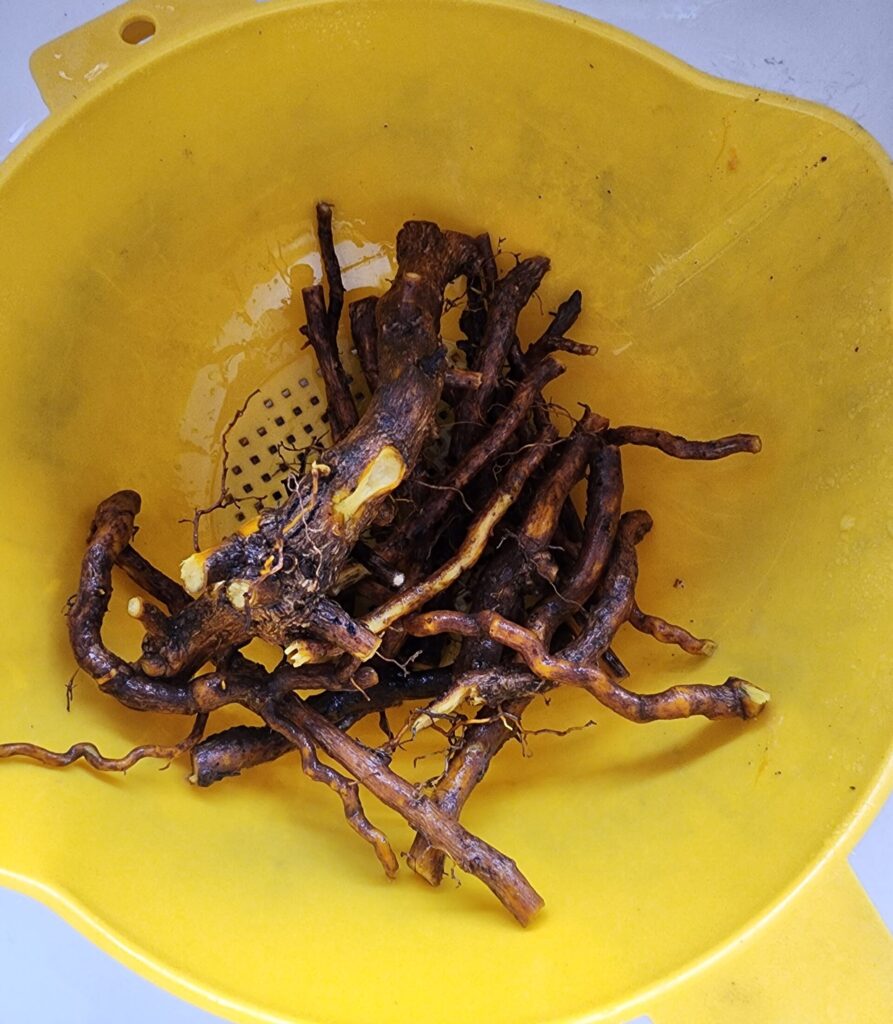
Harvesting berries and foliage does not incur any significant disturbance to riparian spaces but uprooting mature Oregon grape shrubs for roots can cause soil disturbance if done at scale. To avoid the negative effects of this on sensitive sites you can harvest individuals or small groups within the larger population you’re tending, rather than harvesting whole areas all at once. The harvested areas can then be backfilled with seedlings to maintain production. Alternatively, you can cultivate Oregon grape in rows that run parallel to a stream or other riparian feature and harvest select rows each year while leaving the others. This will reduce the risk of soil runoff to the waterway. Quickly replanting the harvested areas and/or covering them with mulch or leaf debris can also help reduce soil erosion as a result of harvesting.
Guides and Resources
- Oregon Grape Root: Introduction to Harvesting and Marketing Oregon Grape as a Medicinal Herb from Small Private Forestlands in the PNW
- Oregon Grape Market Analysis: A Business Planning Guide for Small Woodland Owners (PDF)
- Plant Profile: Mahonia Aquifolium – Oregon State University
- Plant Propagation Protocol for Mahonia Aquifolium (PDF)