Background
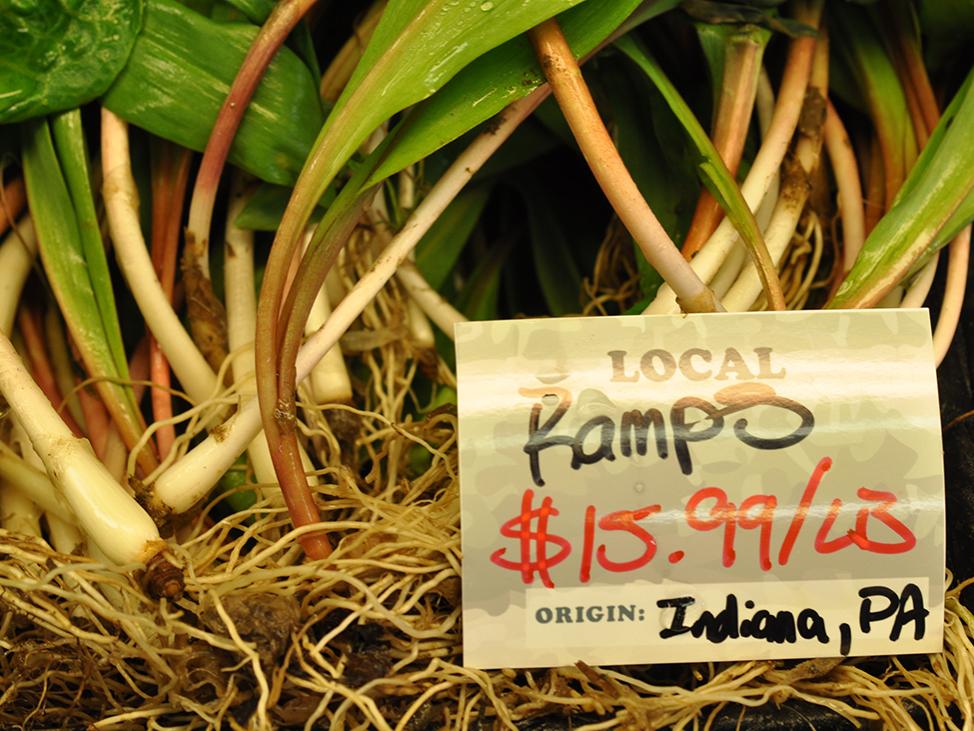
Ramps, also called “wild onion”, are members of the Allium genus and a common forest farming crop. There are several native species in North America that grow in a variety of habitats. In the eastern United States, ramps naturally occur in forests and are frequently harvested for personal use or sold commercially. Both the leaves and bulbs are harvested and are prized for their tender texture and delicate flavor, which is said to be a cross between scallions and garlic. The popularity of ramps has grown in recent decades. They can be seen featured in seasonal dishes at high end restaurants, grocery stores, farmer’s markets, and at the center of annual ramp festivals in parts of Appalachia. Demand for the two eastern species of ramps, Allium tricoccum and Allium burdickii, has led to declining natural populations in those forests due to overharvest. Fortunately, ramps can be cultivated in forest farming systems, which reduces pressure on native populations. There are significant efforts underway to encourage forest farming ramps for its conservation benefits.
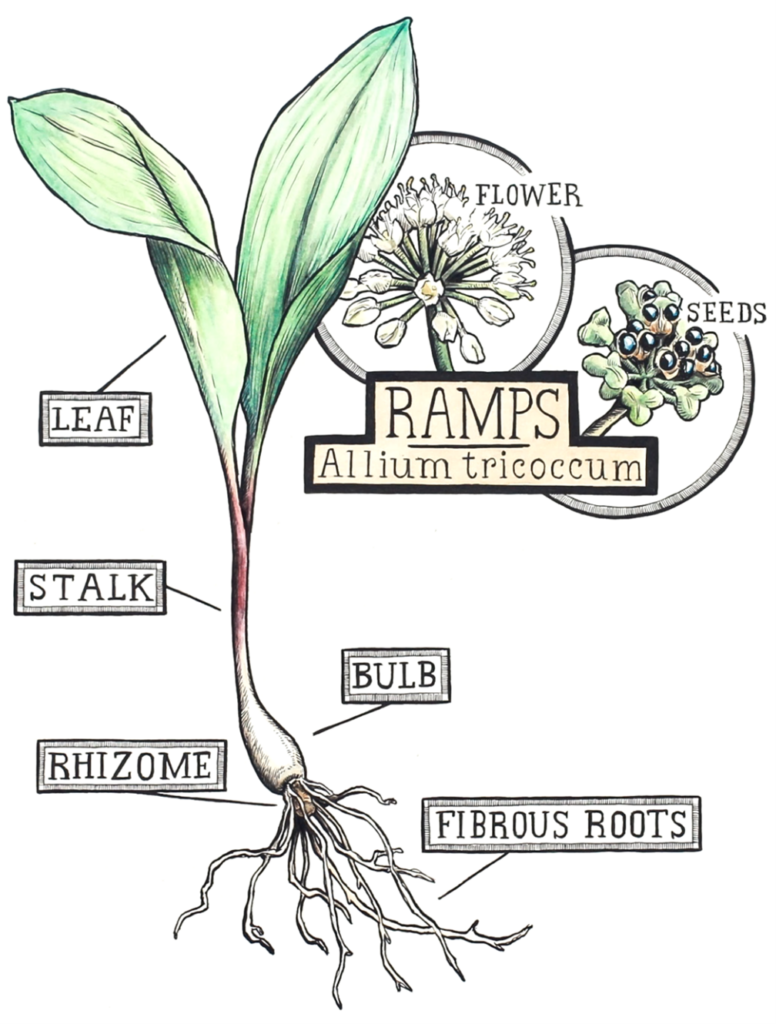
That Pacific Northwest has its own native Allium species, the most common of which is nodding onion (Allium cernum). Other species include Hooker’s onion (Allium acuminatum), Olympic onion (Allium crenulatum), and narrow leaved onion (Allium amplectens). Populations of these species are less abundant compared to eastern ramps and, unfortunately, all of these prefer open habitats in meadows, forest edges, or prairies, which means they are not great candidates for forest farming. However, there is significant potential for forest owners in Washington State to cultivate eastern varieties of ramps in forested settings that mimic their natural conditions. The information below, including the additional guides and resources, focuses on cultivating eastern ramp species.
Overview and Inputs
Proper site selection for ramps is essential and will reduce long-term inputs and maintenance. They are “spring ephemerals”, which means that they complete most of their growth in the early spring months before deciduous trees have leaved out while there is significant light available on the forest floor. Therefore, it is essential that ramps be grown in forests with deciduous dominant canopies. In eastern U.S. forests, they commonly grow in stands dominated be maple, basswood, beech, and birch. In Washington State, stands of red alder, bigleaf maple, and black cottonwood could mimic these conditions, but they are unlikely to grow well in stands where there is a significant conifer component. Ramps prefer moist, acidic soils high in organic matter and calcium. Avoid soils that are excessively dry or poorly drained. Sites dominated by bigleaf maple most closely mimic the natural conditions for eastern ramp varieties because soils in these stands are naturally high in organic matter due to large annual leaf inputs, which also increase calcium, and typically have good drainage.
Where the right soil conditions exist, ramps can be planted directly into the ground. On sites where soils lack organic matter or require other amendments, raised beds may be the best method for cultivation. Although this increases costs, it provides an opportunity to create an ideal growing medium while avowing significant soil disturbance. Raised beds also make it easier to protect ramps from pests, particularly slugs, and can be lined on the bottom with landscape fabric to reduce weed pressure.
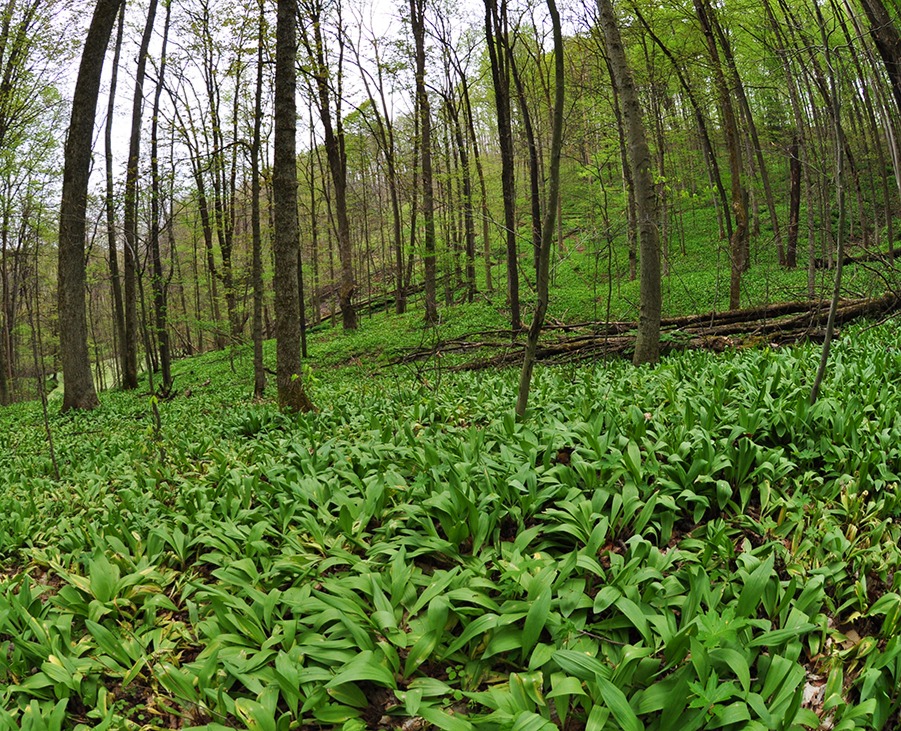
Ramps can be established by seed or by bulbs, both of which can be purchased from suppliers in the eastern states. Seed should be scattered in the early to mid-fall while bulbs are planted in the late winter. Bulbs may be preferrable to reach harvest earlier, but using seed reduces the risk of spreading any fungal disease, particularly Septoria leaf spot. Ramp bulbs typically take 5-7 years to be ready for harvest, but leaves can be collected annually at the end of the spring after they’ve conducted most of their growth and while they’re still tender. However, leaving some plants to produce flower stalks will allow you to collect seed and expand your population. This should be done every year, particularly once you begin destructive harvest (harvesting bulbs).
Whether using raised beds or cultivating directly in the soil, the area should be cleared of existing vegetation and routinely weeded to ensure that the ramps are not outcompeted. Annual leaf inputs from hardwoods can provide good mulch to keep weeds down in your plots and help insulate seeds and bulbs.
With proper site selection, fertilizers and pesticides shouldn’t be necessary. However, something that is uncertain about growing ramps in Washington State is whether they can tolerate our long dry period in the summer (July-Sept). Selecting sites with rich, moist soils high in organic matter or establishing raised beds may reduce the risk of drought damage, but periodic watering may still be necessary. WSU Extension is currently hosting trials to explore ramp cultivation in hardwood dominant forests in Western Washington, and this page will be updated with the results when they are available.
Considerations for Riparian Buffers
Eastern varieties of ramps are highly conducive to working riparian buffers because they require the full shade provided by a closed forest canopy and typically do not require chemical inputs. Where soil amendments are necessary, raised beds can be established to avoid significant disturbance. Understory vegetation may need to be removed but is quickly replaced. As a result, ramps can be cultivated anywhere in a forested buffer with minimal or no impact on its function.
Within an existing buffer, site selection for ramps may prove difficult for some. Many buffers are purposely planted exclusively with conifers because they are long-lived and can provide large, woody debris inputs for fish habitat. Removing conifers to increase hardwood cover in the inner buffer may be restricted or difficult due to regulatory barriers, depending on the feature being buffered. However, in these cases ramp habitat can be created by adding to a buffer or working in the outer zone where restrictions are reduced. For those planting a buffer, determining the location and projected size of your ramp operation ahead of time will help you plan the arrangement and composition of your buffer planting.
Guides and Resources
Currently, there are no known guides available for cultivating ramps in the Pacific Northwest but multiple resources are available on cultivation in eastern states. When using these, consider the unique traits of the Pacific Northwest climate and forests to translate them to our region. This page will be updated as more information is available on growing ramps in Washington State.
- Cultivation of Ramps – NC State Extension
- Farming the Woods (Book) – Steve Gabriel
- Forest Farming Ramps – Appalachian Forest Farmers Coalition (YouTube Series)
- Forest Farming Ramps – National Agroforestry Center (PDF)
- Forest Farming Quick Guide: Ramps (PDF)
- Non-Timber Forest Product Highlight: Ramps – Lincoln University (PDF)
- Ramp Cultivation Demonstration – United Plant Savers (YouTube)
- Ramps Cultivation and Growing Guide – United Plant Savers
- Sustainably Managing Ramp Lands – Delaware Valley Ramps (YouTube)