How to Read Pesticide Labels
by Julie Hunziker, Yakima Master Gardener
How to Read a Pesticide Label
At this time of year, many of us are whipping our yards into shape. We’re busy planting our annuals, prepping our vegetable gardens, and enjoying bushes and trees budding out everywhere.
But, alas, what is eating those new leaves? What is that sticky white or black stuff on the roses? Why is my plant looking so sickly? After doing some identification and research, you may choose to look to your arsenal of pesticides at home or at the store to see if there is a product to solve the problem.
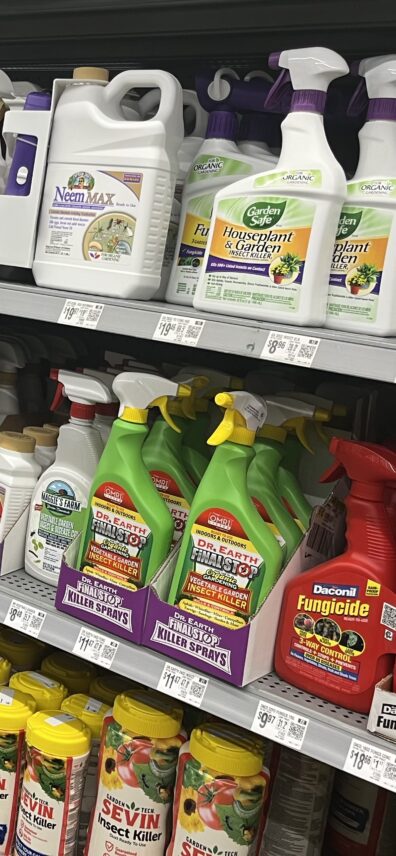
But there are so many choices! Where does someone even start?
First of all, just what is a “pesticide?” Anything that kills, repels, mitigates, or controls a pest is a pesticide. The pest may be as small as a bacterium, hence the term “bactericide.” Or it may it may be as large as a bear and an “ursuscide” is required.
In our gardening world, we consider three groups of pesticides: herbicides (weeds or unwanted vegetation), insecticides (insects, mites, bugs), and fungicides (causing plant disease).
The first step in using a pesticide is to READ THE LABEL. The label is a legal document with information controlled by the Environmental Protection Agency (EPA). The aim is to control the risks to both human health and the environment. While the EPA is a federal institution with its own restrictions, each state may have further restrictions, such as Washington restricting water or aquatic pesticides. In this case, a professional license may be necessary to purchase and use a product. When a product is not allowed by the EPA, it is also not allowed by any state. However, if a product is restricted by a state, it is not necessarily so with the EPA. It is important to read the label to know these restrictions.
Reading the pesticide label tells us how and when to use the product, how often, how much to use, where to apply, and when NOT to apply. There are several things to look for on the label:
- The plant or site: Are you treating your tomatoes? “Tomato” should be listed as a plant on which the pesticide works. Same goes for any plant, crop, or tree.
- Will the pesticide fit your issue? The first step in integrated pest management is the identification of the pest. Know what pest(s) you are dealing with. Is it aphids? Cutworms? Grubs? Since each pest has different feeding behaviors, each will require a different insecticide. The pest, weed, or disease should be listed on the label. There is further terminology that is pertinent. “Systemic” means it is taken up by the roots and affects the whole plant. “Contact” means the product affects what it touches, not the whole plant.
- EPA number: This number is unique to each product and relates to the active ingredient, such as glyphosate, malathion, or 2-4 D. This number is useful when looking up information about the product and is a key identifier for use in an emergency (such as a spill or exposure).
- How to apply: How much? When? How often? When to stop? Much research has been done to find the optimum strength for adequate treatment with the least amount of environmental impact. There may be an optimum temperature range for activation. Should it be applied before watering or after? What about windy conditions? A product may only need to be applied once per season, but maybe it needs to be applied at regular intervals. The label may also include when to stop using the product, such as during bloom time or a certain number of days before harvesting a crop.
- Precautionary Statements: This includes restrictions. The aim is to protect the environment, including pollinators and the people around you. It may be recommended to stay off the site for several hours or until the product has dried. Recommendations may also include use of protective equipment, such as a mask or gloves. Instructions are also given on how to dispose of the product and how to clean the environment after use.
- Lastly, the label must have signal words depicting the toxicity of the product, whether by ingestion, skin absorption, inhalation, or through the eyes. From least to most, the words include:
- “Caution:” slightly toxic
- “Warning:” moderately toxic
- “Danger:” highly toxic by at least one route of exposure.
- “Danger: Poison” indicates that it is highly toxic by all routes of exposure.
The information on pesticide labels can be several pages long, but read it. Remember, the label is a legal document and the user is legally obligated to follow the directions. The user is liable for its use, whether done so properly or improperly. By reading the label, you can maximize the effectiveness of the product as well as the safety of its use.
If you have questions about a product, reach out to your local extension office, which includes the Master Gardener Answer Clinic. They can be reached at askamastergardener@yakimamg.org or calling 509-574-1604.