A History of Seeds
By Master Gardener, Carol Barany
What came first, the chicken or the egg?
The answer is…… the egg came before the chicken. We know that because all the ancient relatives of chickens hatched out of eggs for hundreds of millions of years before the first chicken evolved. It follows that the chicken also hatched from an egg.
What came first, the plant or the seed? This time, the answer is “the plant.”
In the beginning…..
Life began in water 3 billion years ago. Primordial oceans or hydrothermal vents provided a nutrient-rich environment and protection from solar radiation where single-celled organisms could thrive. We think the earliest plants evolved from a single-celled green algae ancestor. Water was their means of transport, and reproduction was fairly simple.
500 million years ago, new means of reproduction were needed if plants were to transition from life in water to life on land.
Early land plants like liverworts and mosses produced male spores containing sperm and female spores containing eggs. When the spores were released in the air, the sperm and egg would hopefully find each other and form a new plant embryo. Growth of these early land plants was restricted to wet areas because water was needed for fertilization and development of the delicate embryo.
To expand their range on land, especially in places where moisture was not always available, plants would need new ways to reproduce. It took millions of years and countless adaptations before seeds finally evolved.
The first seed plants were gymnosperms. The seeds of gymnosperms are found on the surface of scales that are often held in cones. Male cones contain pollen, and female cones contain eggs. Pollination is typically by wind, and fertilization occurs without the need for water.
Early dinosaurs lived in a world dominated by gymnosperms. The conifers in your garden are modern gymnosperms.
Later, seed plants called angiosperms evolved. Angiosperms produce flowers which hold both male and female reproductive structures. Fertilization occurs in the ovary and the seed develops inside.
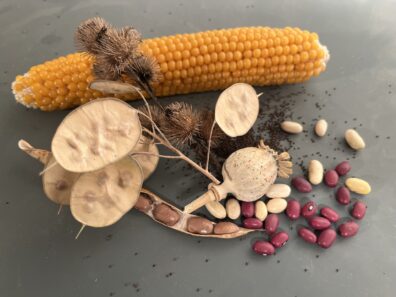
The evolution of seeds was a pivotal game-changer for plants. A seed contains an embryo and a food supply enclosed within a tough coating. These structures nourish and protect the embryo, increasing its chances of survival in diverse terrestrial environments.
Unique mechanisms also evolved that allowed the new and improved seeds to be even more widely dispersed.
Seed size is one of them. Coconuts are the largest seeds. Designed to float and carry with them enough water and nutrients to survive months at sea, they often germinate on isolated, nutrient-poor islands. Dandelions can produce much smaller seeds because they never have to go far to find a home. Orchids have the smallest seeds, and one million of them weigh a single gram. Orchids are epiphytes. Because the chance of finding a suitable growing site on a tree branch is very low, orchids need to produce millions of seeds at a time.
Some plants formed a fruiting body around the seed which would be a tasty food source for the animals and birds that were co-evolving at the same time. After being eaten, the seeds were pooped out in new locations where they could establish themselves without competing with their parent plant.
Other plants developed seeds with soft filaments, allowing them to be carried as far as 500 miles on the wind. Maple trees produce seeds with wings (samaras). We’ve all seen them detach and slowly spin to the ground, landing where they easily root in my yard by the bazillions.
Prickly structures on the seed coat evolved, giving one engineer the idea for Velcro. These prickles catch on animal fur until they eventually fell off to germinate in a new location.
If plants were to expand further geographically, species survival depended on the seeds getting through the winter months and waiting for warmer spring temperatures to sprout.
Seed dormancy is yet another relatively new evolutionary adaption that allows seeds to survive harsh conditions by suspending growth, development, and reproduction.
Plant hormones act on genes within the seed to increase the production of proteins that protect the walls of the seed or cell membranes from the pressures of freezing or stresses of drought. They also slow cell metabolism within the seed allowing the embryo to enter something like hibernation until favorable conditions for germination are present.
Some seeds are able to wait a long time for that to happen. Scientists successfully germinated a narrow-leafed campion seed that had been frozen for 32,000 years in Siberia.
Seeds are expected to continue to evolve even further and in less time, driven by environmental pressures and climate change. They will likely become even more resilient and able to adapt to extreme conditions for longer periods of time.
I’m counting on it.