by Carol Barany, Yakima Master Gardener
In a perfect world, we could recycle most of the organic waste our gardens generate by composting it ourselves on site.
When that’s not possible, the next best thing is using our city’s yard waste recycling program.
Signs of spring and a new growing season are everywhere. One of the most anticipated was the start of the City of Yakima Refuse Division’s weekly curbside pickup of yard waste bins earlier this month.
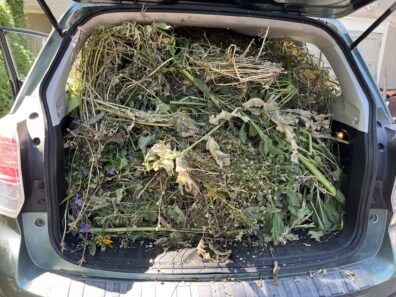
I felt like a child on Christmas morning when the city delivered my new yard waste bin in March. Up until then, I collected all the yard waste that was too big for me to run over with my mulching mower and loaded it in the back of my 1995 Suburban. With the back seats taken out, it held at least a pick-up truck load-and-a-half. I could cram less than half that amount into my Subaru SUV. I got a lot of funny looks on the drive out to Terrace Heights,
The system worked perfectly for years, but my Suburban finally ran out of steam. I was ready to give a yard waste bin a try.
I should have done it years ago.
Yard waste is grass clippings, leaves, and small branches cut into lengths of three feet or less and not larger than 3 inches in diameter. Everything must fit inside the cart with the lid closed. These bins are huge, and I have to work really hard to fill mine each week.
City refuse trucks can pick up yard waste carts weighing up to 150 pounds. Carts exceeding that weight limit will not be collected.
About 30% of the waste coming to the landfills in Yakima is yard and wood waste. Burying it in landfill turns a potential resource for compost into an environmental hazard and contributes to climate change.
What happens in a landfill doesn’t always stay in a landfill.
- Methane Production In landfills, organic waste decomposes anaerobically (without oxygen), releasing methane, a greenhouse gas 25-30 times more potent at trapping heat than carbon dioxide. Landfills are the third-largest source of human-related methane emissions in the United States. The landfills in
Terrace Heights and Cheyne in Zillah have active methane collection and control systems in place. - Wasted Space: Yard waste accounts for a significant portion of landfill volume, rapidly filling up space that should be reserved for non-biodegradable trash.
- Leachate Formation: The decomposition of organic material creates acidic liquid runoff called leachate that can seep through landfill liners and contaminate groundwater and soil.
- Slow Decomposition: The compacted, anaerobic conditions in landfills mean that even organic waste breaks down much slower than it would in a natural, aerobic composting process.
In 2025, the Terrace Heights Landfill received 15,189 tons of yard waste. This, along with the clean wood that comes to the landfill, gets chipped into nutrient-rich organic material.
Valley residents took 97 tons of wood chips and 350 tons of chipped yard waste for home use last year.
Chipped yard waste, or “green chip,” makes great feedstock for composting and is available free to the public. The Solid Waste Division recommends you compost the material prior to applying it to your garden. One way of doing this is by creating a windrow 3 feet wide and 3 feet high. Microorganisms feed on the organic matter, gradually breaking it down. Turning the rows moves material from the outside in, distributing heat, moisture, and increasing oxygen, which prevents anaerobic conditions.
Chipped wood is available for $10/ton.
Landfills use the remaining chipped waste to cover active waste and prevent windblown litter and odors. Chipped waste is also used to cover muddy areas to improve vehicle traction, and to prevent soil from tracking out of the landfill on truck tires. Some is used for erosion control for runoff collection ponds.
No bin? You can transport your yard waste to Terrace Heights for recycling in reusable containers like plastic garbage cans that can be dumped and used again. You can haul clippings and yard trimmings loose in the back of a truck, in a cardboard box, or in purchased paper yard waste bags. All loads must be tarped or tied down to prevent materials from falling or blowing out. If not, you will be charged an additional unsecured load fee.
Garbage, plastic bags, food scraps, animal waste, ashes, sod, building materials and tree trunks or large branches are considered contaminants and are not acceptable as yard waste. They belong in your garbage bin. County officials remind residents that just a little bit of contamination can turn a truckload of yard waste into a garbage load.
Loads that have both organic material and garbage will be charged the garbage rate of $46.00 ton, and a minimum fee of $12.00. Clean yard and wood waste is charged at a discounted rate of $23.00/ton, with a $7.00 minimum.