Meeting Day One
Contents
Select the link to jump to that section in the Meeting Day One Activity plan.
- Introductions, Branches of Government, Legislative Process
- Read the Curriculum
- Objectives of Meeting One
- Activity 1: Introductions and Teambuilding
- Activity 2: Overview of the KYG Program
- Activity 3: Create a Group Agreement
- Activity 4: TRAPPED Video (Three Branches, Legislative Process, and Roles)
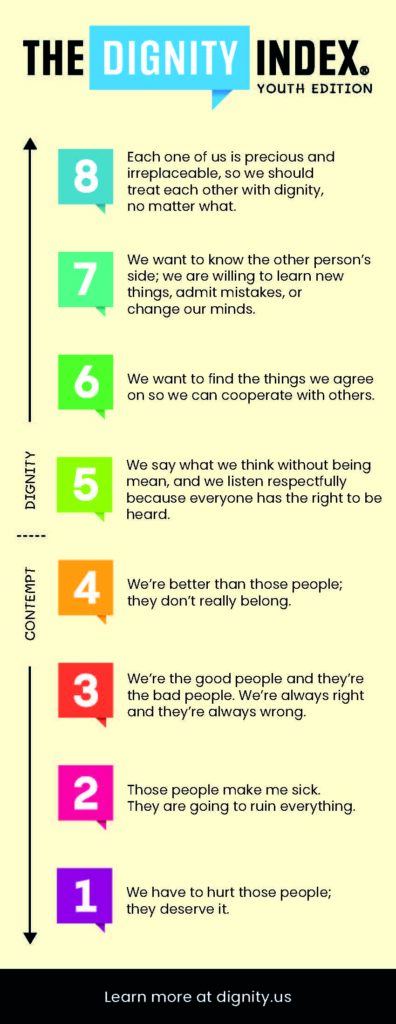
- Activity 5: Introduction to the Dignity Index
- Activity 6: Business
- Activity 7: Compliments and Closing
- Handouts

Introductions, Branches of Government, Legislative Process
Read the Curriculum
Being prepared means knowing what kinds of activities will take place and what resources you will need. A minimum is suggested in the Meeting Materials. Groups that spend more time preparing have a better experience at the conference. There will be three tracks to follow during the pre-conference meetings, identified by these notations:
- Meeting Essentials
- The Legislative System
- Dignity Index
Objectives of Meeting 1
Meeting one is estimated to take 3 hours and cover these objectives:
- Introductions and Community Building.
- Set Group Agreement.
- Overview of the Conference in February.
- Discuss registration and fundraising.
- Knowledge of the legislative branch and how it interacts with the other branches.
- Recognize and practice life skills of “accepting differences” and “decision making.”
Materials Needed
- Internet access
- Computer(s) for videos and research (encourage delegates to bring their own if they have them)
- Copies of handouts
- Flipchart, paper, and pens for group agreement creation
- Pipecleaners
Activity 1: Introductions and Teambuilding (20 minutes) – Meeting Essentials
Introduction: This activity is designed to build belonging. Use an icebreaker/teambuilding activity, either the Back to Back exercise or one of your own.
Exercise 1: Back to Back (10 minutes)
Purpose: To get delegates up, moving, and mixing with more than just their usual group of friends, and learn each other’s names
Materials Needed: None
Questions should start simple and progress to questions about the day and participant learning.
Exercise 2: Pipecleaner Legislation (10 minutes)
Purpose: To get delegates to be creative and share their interests.
Materials Needed: Pipe cleaners, an example pipecleaner car that you can share.
Activity 2: Overview of the KYG Program (25 minutes) – Meeting Essentials
Introduction: This conference focuses on the legislative system. Let’s explore what you already know and what you would like to learn.
Discussion 1: Brainstorm the Legislative System (5 mins)
Ask delegates to brainstorm what they currently know about the Legislative System. Use a flipchart or shared digital document to gather their responses. Save to add to in Meeting 4.
Discussion 2: KYG Mission, Program, Objectives, and Purpose of Pre-meetings (10 mins)
Introduce the mission and objectives of KYG and the purpose of the pre-meetings, then discuss the following questions:
- What part of the mission resonates most with you?
- How do you think this conference might strengthen your connection to your political and social networks?
Mission Statement of WSU 4-H Know Your Government
The 4-H Know Your Government (KYG) Conference serves to strengthen the connection between youth and our political and social networks through education, experience, application, and inspiration.
What is the 4-H Know Your Government Program?
Know Your Government (KYG) is a civic education program with a four-year rotation of topics: The Legislative System, The Judicial System, Elections, and Citizenship and Media. This year, we will explore the topic of the Legislative System. It is important to remember, though, that KYG is much more than learning about trials. In fact, one could argue that it is little about that. KYG and 4-H are about learning the life skills our delegates will need to be responsible citizens and productive adults. Delegation leaders facilitate this learning at the local level in pre-conference meetings, and Conference Facilitators (CFs), trained teen leaders, facilitate the application of the learned skills at the statewide conference in Olympia.
4-H KYG Values
- Inquiry – Fostered through critical thinking exercises, such as jury deliberation, where participants will analyze evidence and reason through case outcomes.
- Regard for Others – Practiced during mock trials and courtroom activities, where delegates will demonstrate respect for differing viewpoints, both in deliberations and interactions with peers.
- Respect/Cultural Competence – Developed as delegates engage in discussions on implicit bias and the diverse perspectives represented in judicial proceedings.
- Positive Communication – Strengthened through structured courtroom roles where participants must clearly communicate arguments, listen actively, and collaborate in a respectful manner.
- Strengthening Personal Values – Encouraged as delegates reflect on their role in the judicial system and how their decisions as jurors align with their personal values, contributing to a sense of civic responsibility.
The topics and activities experienced through the 4-H KYG conference, including the focus on the judicial system, provide opportunities and frameworks to develop these core values, ensuring participants grow in both their civic understanding and personal development.
Educational Objectives
This year, delegates will participate in the legislative process. Through pre-conference orientation, participants will learn about the Legislature and how it works with the other two branches of government: the executive and judicial branches. They will also learn how a bill becomes law in Washington State. At the conference in February, teens will take on the role of lobbyists. Delegates should learn that many bills are a product of compromise and negotiation. For example, in order for a bill to pass through both chambers, the supporters of the bill have to take in the concerns of many groups. A bill that may make perfect sense to a particular delegation may have very different implications for a family in another area of the state or the business owner right next door.
It is important that the delegates realize that they have a huge voice in this process, especially since any citizen of the state can testify for or against a bill during the hearing process or send an email to his/her senator or representative voicing their support or concerns about upcoming legislation. Any person of any age can voice his/her opinion about a bill.
From pre-conference county meetings and conference participation, the 4-H KYG committee believes delegates will have the opportunity to learn all or some of the following:
- Familiarity with the Legislative process;
- Realization that democracy requires responsible citizenship/participation and teamwork;
- Experience with parliamentary procedure
- Life Skill development with an intentional focus on:
- Accepting Differences: Treating people who are different from me with respect
- Decision Making: Choosing among several alternatives.
- Responsible Citizenship: Developing individual devotion in response to duties, rights and privileges as a member of a community or country
- Knowledge of his or her state legislative district, and an awareness of issues that affect his or her district, leading to responsible citizenship.
Pre-Conference Meetings
The purpose of pre-conference meetings is to:
- Teach the necessary skills.
- Provide the tools for success.
- Prepare for the project at the KYG Conference.
By the end of the pre-conference meetings, your delegates will have a similar experience that provides a common foundation for all delegates, regardless of geographic or other differences.
Learning something new and working with delegates from different perspectives can be uncomfortable. Pre-conference meetings are designed to help delegates feel comfortable with what will be happening at the conference, ensuring they feel safe and supported as they experience something new.
Discussion 3: Roles at the Conference (5 mins)
Discuss the roles delegates will play as advocates and legislators at the conference. Delegates will learn about the legislative system, gaining familiarity for when they want to advocate for a bill. During the sessions, delegates will work in groups to advocate for bills and then vote on them.
Question: Why do you think it is important to understand how the Legislature works?
Discussion 4: Experienced Delegate Insights (5 mins)
Have experienced delegates share about non-session agenda items, such as the Challenge, Delegation Afternoon Out, Delegation Meetings, Community and Youth Leadership Banquet, and Community Service.
Activity 2 Closing
Just like we are learning each other’s names and stories, at KYG, we’ll be learning about the different roles in government and how everyone plays a part
Activity 3: Create a Group Agreement (30 minutes) – Meeting Essentials
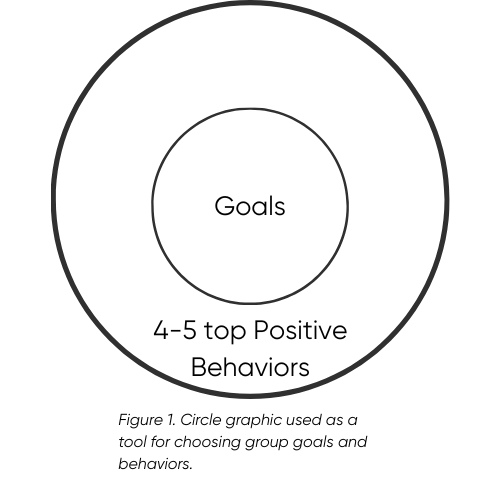
Exercise: Group Puzzle Assembly
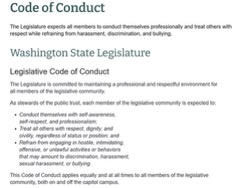
Purpose: Use the Legislative Code of Conduct as an introduction to Group Agreements
Materials Needed: Printed copy of the Legislative Code of Conduct torn into small pieces, flip chart paper, pens.
Activity 4: TRAPPED! Video (60 minutes)
TVW has produced a video about the animal trapping initiative and how other branches of government have been affected. You will use this video to introduce/review three main topics:
- Three branches of government,
- The legislative process,
- Roles in the legislative process.
Before watching the video, pass out the “TRAPPED!” video handout. Divide the questions among the delegates or groups of delegates so they can listen for the answers.
To play the video, go to Watch “Trapped” video
Watch the video and have the delegates listen for the issue and the two sides of the issue.
Watch the video again, but pause it at these intervals and point out the following things:
- 00:03:05-Signing up to speak at a committee hearing
- 00:03:27-Meeting with governor’s staff and legislators to discuss issue
- 00:04:00-Five citizens providing anecdotal evidence (these citizens could easily share this information during testimony at a committee hearing)
- 00:14:00-Description of the problem with I-713
- 00:15:09-Examples of senators making floor speeches
- 00:15:46-Examples of professional lobbyists testifying at a committee hearing (lobbyists and citizens routinely use written notes while testifying so they can be concise)
- 00:17:38-Examples of representatives making floor speeches
Have students answer these questions with a partner:
- Why is it important to know how the branches of government relate to each other?
- Why do we have this system of checks and balances?
- Do you think the process has worked in this situation? Why or why not?
- Report back to the whole group.
Activity 5: Introduction to the Dignity Index (15 minutes)
Introduction: The Dignity Index scores distinct phrases along an eight-point scale from contempt to dignity.
Lower scores (1-4) reflect divisive language while higher scores (5-8) reflect language grounded in dignity. A trained group of students supported by the University of Utah’s Kem C. Gardner Policy Institute and the Hinckley Institute of Politics scored selections from candidate speeches, debates, fundraising outreach, social media posts, and campaign ads in Utah’s federal congressional races.
By focusing on the speech and not the speaker, the Dignity Index is designed to draw our attention away from the biases of partisan politics and toward the power we each have to heal our country and each other. You can find out more at dignity.us.
This activity not only introduces students to the Dignity Index but also encourages them to think critically about how dignity can influence legislative processes and decision-making.
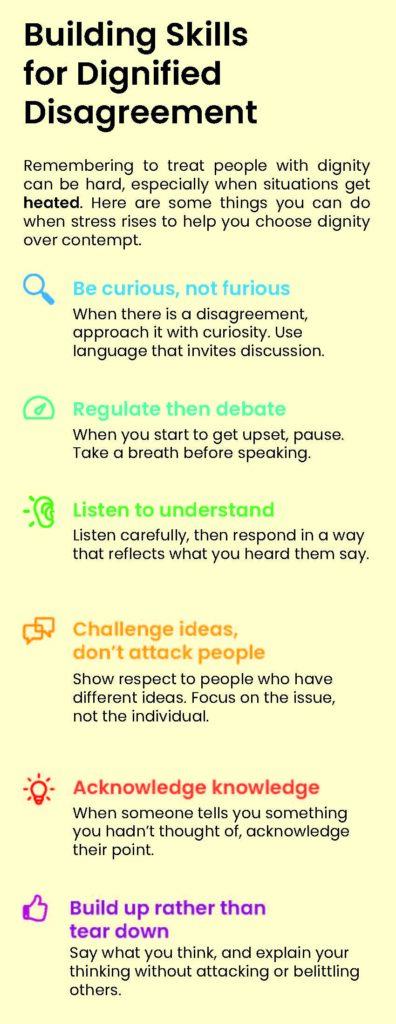
Materials: Dignity Index and Building Skills for Dignified Disagreement Handout
- Introduction (2 minutes): Start with a brief explanation of the concept of dignity and the Dignity Index. Emphasize its role in recognizing the inherent worth of every individual and promoting mutual respect.
- Overview of the Dignity Index (3 minutes): Provide a concise explanation of the Dignity Index Youth Edition, highlighting its key principles and how it can be applied in everyday interactions and decision-making processes.
- Scenario Presentation (2 minutes): Present a simple, relatable scenario to the group that involves a decision-making process. For example, deciding on a new 4-H policy that would require all 4-Hers to enroll in a cooking project or come up with a relevant scenario for your area.
- Group Activity (5 minutes): Divide students into small groups and ask them to discuss the scenario. Each group should identify how they would apply the principles of the Dignity Index to ensure all voices are heard and respected in the decision-making process.
- Reflect and Apply (3 minutes): Have each group share their scenario and how they applied the Dignity Index principles. Facilitate a discussion on how these principles can be integrated into legislative processes and why they are important for responsible citizenship.
Activity 6: Business (10 minutes)
Introduction: Today, we’ll quickly cover two important things for your participation in KYG: the registration process and some ideas for fundraising. First, we’ll go over what you need to do to make sure you’re fully registered and ready for the conference, and then we’ll brainstorm some fundraising ideas that can help cover any costs.
Step 1: Registration Process (5 minutes)
Begin by discussing the registration process for attending KYG using 4-H Online:
- Explain that all delegates must be enrolled and meet the minimum requirements set by the county or leader in order to attend the KYG conference.
- Remind delegates of important deadlines for completing their registration.
- Encourage any delegates who are unsure about the process to ask questions or reach out for help after the meeting.
Step 2: Fundraising Discussion (5 minutes)
Facilitate a quick brainstorming session on fundraising ideas:
- Encourage delegates to think about fundraising methods that are realistic given their timeframe, resources, and community. Suggest they consider fundraising activities that are simple to organize and well-suited to their local environment.
- Prompt them with questions like:
- “What are some quick, low-cost fundraisers we could run in the next few weeks?”
- “How can we engage our community to support us?”
- What resources do we have available that we can use for fundraising?
Closing: Make sure you’re clear on the registration steps and deadlines. Let’s also make sure we follow up on the fundraising ideas and get organized!
Activity 7: Compliments and Closing (20 minutes)
Introduction (5 min): Before we wrap up, let’s take a moment to talk about the difference between appreciation and compliments. Compliments go beyond a simple ‘thank you’ by recognizing the specific value someone brings. Let’s focus on giving meaningful compliments to acknowledge each other’s contributions today.
Exercise 1:
Explain the difference between appreciation and compliments:
- Appreciation: Saying things like “thank you,” “great job,” or “you’re the best” is valuable but often lacks specificity.
- Compliments: These go a step further by explaining the value a person provided that led to your appreciation. For example, instead of just “thank you,” say, “I really appreciate how you helped organize the activity today. Your attention to detail made the process smoother for everyone.”
Delegation Coordinator and Chaperones model giving compliments by sharing what they observed as the group’s strengths and achievements—both big and small. Take a minute to praise the group. Recognize their attentiveness, creative ideas, willingness to share, diligent work, or positive attitudes. This is an essential step toward valuing the group as a whole and as individuals.
Exercise 2 (15 mins):
Background information: Reflection is key to learning, especially for developing life skills. The “What, So What, Now What” framework helps participants think through their experiences, understand what they’ve learned, and plan how to apply it in the future. This process will be used in the curriculum and at the conference to connect activities with real-world skills.
Step 1: What?
This step helps participants reflect on what happened during the activity. It encourages them to think about the events, their role, and what life skill was being practiced. The goal is to help them organize their thoughts about the experience.
This helps participants recall both the facts and their own involvement in the experience.
Step 2: So What?
Once participants have recalled what happened, the next step is to explore the significance of the activity. The “So What” questions focus on what they learned, especially about the life skill that was the focus of the activity. This helps them connect the experience to meaningful outcomes.
This step encourages participants to reflect on the broader value of what they did and how it relates to their personal development.
Step 3: Now What?
The final step is to get participants thinking about how they will use what they’ve learned in the future. The “Now What” questions are about applying their learning in real-life situations to improve their own or the group’s future success.
This helps participants create a plan for how they’ll apply their new knowledge and skills, whether it’s at the next meeting, during the conference, or in their daily lives.
Life Skills and KYG
The “What, So What, Now What” reflection format is designed to focus on the core life skills that KYG emphasizes, such as:
- Accepting Differences: Treating people who are different from me with respect
- Decision Making: Choosing among several alternatives.
- Responsible Citizenship: Developing individual devotion in response to duties, rights and privileges as a member of a community or country
You can either let these life skills come up naturally during reflection or guide participants by asking direct questions. For example:
- “What happened with accepting differences today?”
- “So what did we learn about the acceptance of differences needed in KYG?”
- “Now when can we use this skill at the conference?”
By focusing the reflection on these life skills, participants can better understand how the skills apply to their activities and how they can use them in future KYG events, like the conference.
Introduction: We’re going to review our learning today using a 3-question format:
- What happened?
- So what did we learn?
- Now what will we do with that learning?
Let’s get into pairs! I’ll ask each question, and you’ll have about 30 seconds to discuss it with your partner. Ready? Let’s begin.
- What happened with the content we covered today? (Share your thoughts or feelings.)
- So what did you learn? (Think about the key lessons from today.)
- Now what will you do with that learning at the conference? (How will you apply it?)
Handouts
Washington State Legislature Code of Conduct
The Legislature expects all members to conduct themselves professionally and treat others with respect while refraining from harassment, discrimination, and bullying.
Legislative Code of Conduct
The Legislature is committed to maintaining a professional and respectful environment for all members of the legislative community.
As stewards of the public trust, each member of the legislative community is expected to:
- Conduct themselves with self-awareness, self-respect, and professionalism;
- Treat all others with respect, dignity, and civility, regardless of status or position; and
- Refrain from engaging in hostile, intimidating, offensive, or unlawful activities or behaviors that may amount to discrimination, harassment, sexual harassment, or bullying.
This Code of Conduct applies equally and at all times to all members of the legislative community, both on and off the capitol campus.
Code of Conduct on the Washington State Legislature Website
Word Version of Activity 3 Handout for Printing, JPG Version of Activity 3 Handout for Printing
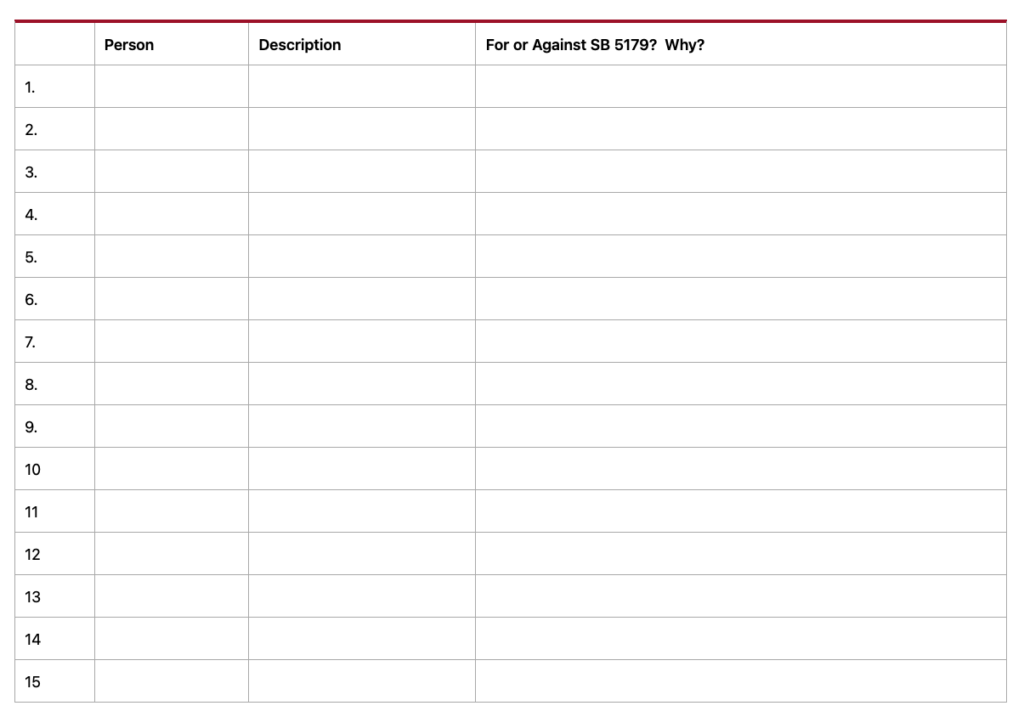
“TRAPPED!” Video Handout
What is the issue?
- Arguments For:
- Arguments Against:
What was the problem the initiative was trying to solve?
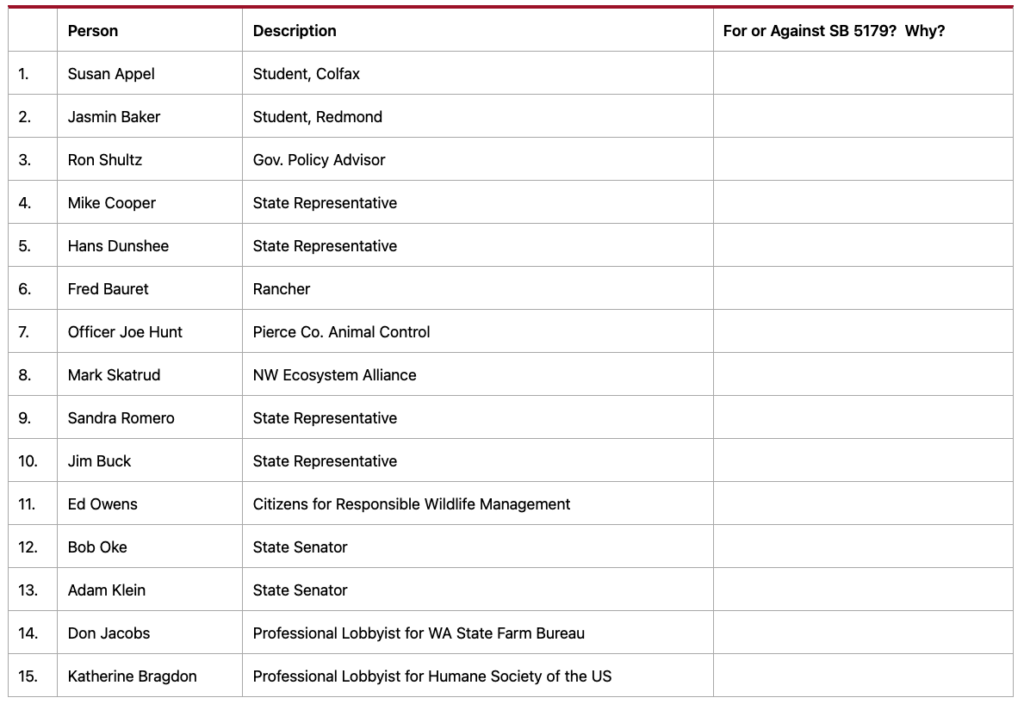
What was the problem the bill (Senate Bill 5179) was trying to solve?
What are the three branches of government and their duties as it pertains to the law?
How were each of the branches involved in this issue?
Word Version of Trapped Video Handout for Printing
What is the issue? Initiative 713 “banned the use of body-gripping traps to catch animals without a special permit and prohibited the sale of fur.”
- Arguments For: Prohibiting the sale of fur takes away the incentive to increase trapping, body-gripping traps may catch and kill more animals than they were intended to trap
- Arguments Against: Landowners no longer have the right to protect themselves or their animals from predators
What was the problem the initiative was trying to solve? Killing animals in order to sell their fur.
What was the problem the bill (Senate Bill 5179) in 2004 was trying to solve? Allowing landowners to use body-gripping traps to catch threats to their herds/flocks (coyotes, wolves, etc) or small animals (moles, mice, etc).
What are the three branches of government and their duties as it pertains to the law? Some possible answers:
- The Legislative branch makes the laws, sets the budgets and policies for new laws, appropriates money to pay for the implementation of the law.
- The Executive branch has veto power and carries out and enforces the laws.
- The Judicial branch interprets the laws if there is a challenge against them and enforces the laws through jail and fines.
Explain that the conference will be concentrating on the Legislative branch, but it is important to understand how the other branches are involved.
How were each of the branches involved in this issue?
Legislative: Wrote bills to change the law (the Revised Code of Washington-RCW) created by the initiative.
Executive:
- Attorney General wrote opinion that law pertained to mole and mice traps;
- Governor vetoed Senate Bill (SB) 5179 and instructed law enforcement to follow the intent of the law not necessarily the exact language (which meant enforcing the law
- When people illegally trapped animals to sell their furs and not enforcing the law when people illegally trapped moles and mice);
- State agency staff write rules (Washington Administrative Code-WAC) in order to implement the law, since RCWs are generally more broad. The law talked about body-gripping traps and the WAC likely refers to a specific definition of body-gripping traps. This was not referred to in the video but is an important part of new laws. State agency staff interpretation of laws is an important part of the implementation process.
Judicial: The Supreme Court ruled that the initiative did not violate the state constitution.
Printable version of “Trapped!” Video Handout Answers: Word
The Dignity Index Graphics
The following graphics can also be found on The Dignity Index’s website.