Meeting Day Three
Contents
Select the link to jump to that section in the Meeting Day Three Activity plan.
- Objectives of Meeting 3
- Activity 14: Differences and Commonalities (15 minutes)
- Activity 15: Dignity Index (80 minutes)
- Activity 16: Legislative Shark Tank Preparation (80 minutes)
- Activity 17: Compliments and Closing (20 minutes)
- Handouts

Objectives of Meeting 3
- Community Building
- Learn how to apply the Dignity Index
- Research issues for Legislative Shark Tank
- Develop persuasive communication skills
- Apply understanding of the legislative process
- Life Skill Objective: Responsible Citizenship
Estimated Time: 3.5 hours
Activity 14: Differences and Commonalities (15 minutes)
Differences and Commonalities (Journey Toward the Caring Classroom – Laurie Frank)
Purpose: To help participants learn about each other by finding similarities and differences, building trust, and understanding the importance of common ground—especially in teamwork and politics.
Materials: Deck of cards (enough for each participant to have one card)
Introduction: “We’re going to do an activity called Differences and Commonalities. Everyone stand in a circle. I’ll give each of you a card—don’t look at it yet. When I say ‘Go!’ look at your card and quickly find three other people with the same suit so you’re in a group of four. When your group is ready, put your finger on your nose.
Once you’re in your group, share your names and come up with four things you all have in common that you can’t see—like hobbies, favorite foods, or experiences. Each group will share one with everyone.
Then, we’ll mix it up! Trade cards with three people from other groups so you don’t know what card you have. When I say ‘Go!’ again, find your new group of four. This time, share names and find four differences that aren’t obvious. Again, each group will share one with the whole group.”
Large Group Reflection: “Finding similarities is important in groups, including ours. The more we find common ground, the better we work together. What are some places in politics where finding common ground is important? By the end of this lesson, we’ll have more ideas about why this matters.”
Group Agreement (Not needed as separate section, as it is in the dignity index activity. Cover there.)
Activity 15: Dignity Index (80 minutes)
Step 1: Reminder of the Dignity Index from the first meeting (15 minutes)
- Begin with a brief discussion about communication in politics:
- Ask: “How would you describe the typical tone of political debates you’ve seen?”
- Ask: “How does this tone affect our democracy and ability to solve problems?”
- Introduce the Dignity Index:
- Explain that the Dignity Index is a tool developed to measure the level of dignity in communication
- Present the 8-point scale:
- Lower scores (1-4): Characterized by contempt, dehumanization, dismissal
- Higher scores (5-8): Characterized by respect, recognition of complexity, willingness to listen
- Share examples of communication at different points on the scale:
- Level 2: “Those people are destroying our state with their radical agenda.”
- Level 5: “While I disagree with their approach, I understand they’re trying to address a real problem.”
- Level 8: “This is a complex issue with valid concerns on multiple sides. I’d like to understand your perspective better.”
Step 2: Analyzing Political Communication (20 minutes)
- Divide students into small groups of 3-4.
- Provide each group with samples of political communication to analyze:
- Excerpts from legislative debates
- Social media posts from political figures
- Op-eds on controversial issues
- Campaign advertisements
- Have groups:
- Rate each sample on the Dignity Index scale
- Identify specific language that influenced their rating
- Discuss how the communication could be revised to score higher
- Group sharing:
- Each group shares one example and their analysis
- Class discusses whether they agree with the rating and why
Step 3: The Impact of Dignity in Democracy (15 minutes)
- Facilitate a discussion on how dignity affects democratic processes:
- How does the level of dignity in communication affect:
- The ability to find common ground?
- Public trust in government?
- The willingness of citizens to participate?
- The quality of legislative outcomes?
- How does the level of dignity in communication affect:
- Connect to the Group Agreement:
- Revisit the Group Agreement created in Meeting 1
- Identify elements that align with high-dignity communication
- Discuss how the Group Agreement has supported productive discussion
- Relate to the “TRAPPED!” video activity:
- How might the Dignity Index have been applied to the debates around Initiative 655?
- Would higher-dignity communication have led to different outcomes?
Step 4: Applying the Dignity Index (20 minutes)
- Legislative Role Play:
- Divide the class into “committees” to discuss a controversial issue
- Assign some students to be “Dignity Observers” who will rate the discussion
- After 5-7 minutes of discussion, have observers provide feedback
- Revision Practice:
- Provide students with low-dignity statements related to legislative issues
- Have them rewrite these statements to achieve higher dignity scores
- Share and discuss the revisions
- Personal Application:
- Have students reflect on a time when they communicated with low dignity
- Ask them to rewrite what they could have said to maintain their position while scoring higher on the Dignity Index
Step 5: Integration into KYG Activities (10 minutes)
- Discuss how the Dignity Index will be applied at the KYG Conference:
- During committee hearings and floor sessions debates
- In discussions with peers from different backgrounds
- Establish group norms for applying the Dignity Index:
- Create a simple reminder card students can keep with them
- Agree on a respectful way to signal when communication is slipping into lower dignity levels
Homework
- Dignity Index Media Watch:
- Have students monitor political news for one week
- Record examples of high and low dignity communication and bring to Meeting 4
- Practice applying high-dignity communication in a family discussion.
Activity 16: Legislative Shark Tank: Pitching Bills for a Better Washington (80 minutes)
Introduction: You will pick an issue you want to pitch to the group to move forward to the KYG Conference. Today, you will work on the research, and in Meeting 4, you will pitch your bill ideas to a panel of ‘Sharks’ who have the power to support your legislation. Just like in the actual legislature at the conference, you will need to convince stakeholders that your bill deserves support.
Step 1: Distribute Bill Pitch Template handout (10 minutes)
- Problem statement (What issue does your bill address?)
- Solution overview (How does your bill solve the problem?)
- Implementation plan (How will it work in practice?)
- Cost and funding (How much will it cost and how will it be funded?)
- Benefits to constituents (Why should voters support this?)
- Anticipate questions from different perspectives
Step 2: Learn about Public Testimony (30 minutes)
- Watch Teach with TVW video: Public Testimony
- As a group, discuss the following questions:
- Why is public testimony important?
- Why is it important to “be on the record”?
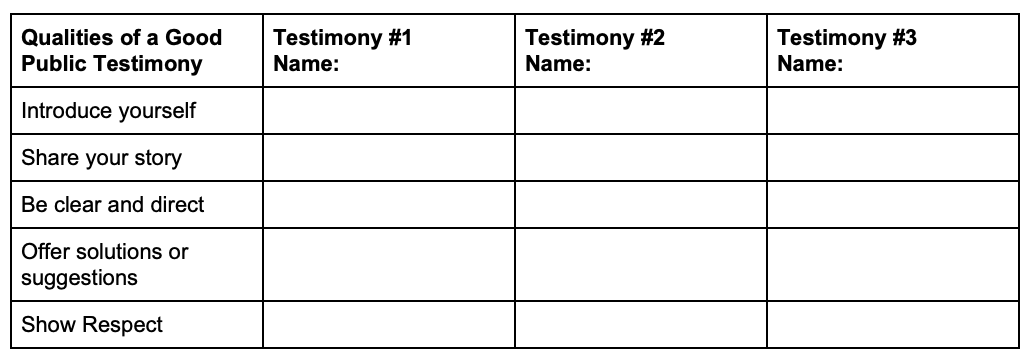
- Watch Public Hearing for HB1203: Prohibiting the sale of certain nicotine and tobacco products. Delegates should pick three public testimonies to watch from this public hearing, and assess on a scale of 1-5 (1=poor, 5=excellent). The YouTube link has chapters for each new testimony.
- Have students share the highlights and lowlights of the public testimony they heard.
- Have students think about what they would have done differently in the testimonies they watched.
- Where would each testimony fall on the Dignity Index and why?
Step 3: Brainstorm ideas (30 minutes)
- Return to Bill Pitch Template and have students begin brainstorming their policy change ideas
- Fill out the form by doing research
- Begin working on a 2-minute pitch, followed by 3 minutes of questions
- Consider following evaluation criteria:
- Clarity of problem/solution
- Feasibility of implementation
- Cost-effectiveness
- Potential impact
- Quality of presentation
- Dignity Level
Step 4: Share ideas (15 minutes)
- Have delegates pair up or get in small groups and share their bill ideas with each other informally
- Decide on the different perspectives that should be represented when the pitch is made at the next meeting
- Assign delegates or find adults to represent this perspective while they are listening to the pitch at the next meeting so questions can be asked or concerns can be raised.
- For example, if a bill idea is related to trapping, such as in the TRAPPED video from Meeting 1, have delegates choose to represent the different perspectives (ranchers, animal rights, wildlife management, etc)
Activity 17: Compliments and Closing (20 minutes)
Compliments and Appreciations
Purpose: To help participants recognize positive behaviors and reinforce the group agreement by sharing meaningful compliments and appreciations.
Materials:
Large sheet of paper with these sentence starters written for everyone to see:
- I appreciate that the group did…
- I appreciated that when… happened, the group…
- The group did … well.
Introduction: Part of our time together getting ready for the KYG Conference has been spent on team building. A big part of team building is noticing what we do that helps us get along and follow our group agreement. So today, we’re going to share compliments about things you appreciated the group doing well. I’ll start, and then we’ll go around the circle.
Reflections
Purpose: To help participants connect what they learned about decision-making and legislative processes to real-life situations. Reflection reinforces learning and prepares them to apply these skills at the KYG Conference.
Materials: Handouts with reflection questions (one per group of 3) OR post questions on a large poster for everyone to see. (Tip: If time is short, use pairs instead of groups of 3.)
Introduction: Today we focused on learning about responsible citizenship, especially as it relates to how we interact with each other and how our ideas can make our community better. Let’s take a few minutes to think about what we can learn from this and how we can use those skills moving forward.
- Form groups of three (or pairs if we’re short on time).
- You’ll get a handout with the questions (or look at the poster).
- Talk through each question together.
- Be ready to share one idea with the whole group when we come back together.
Closing: Have some share-outs. Thank the group and provide any needed information for the next meeting.
Handouts
Public Testimony Table
PNG Version of Public Testimony Table for Printing
Bill Pitch Template
Problem statement (What issue does your bill address?)
Solution overview (How does your bill solve the problem?)
Implementation plan (How will it work in practice?)
Cost and funding (How much will it cost and how will it be funded?)
Benefits to constituents (Why should voters support this?)
Anticipate questions from different perspectives
Word version of Bill Pitch Template for Printing
Reflection Questions
- What did we cover about what a responsible citizen is?
- So what did you learn about being a responsible citizen?
- Now, where can you use your responsible citizen skills in your school or community?
- What was a memorable part of Shark Tank?
- So what steps go into creating a strong bill pitch, and what qualities make public testimony effective?
- Now how will you use what you learned today to prepare a convincing pitch at the KYG Conference?