
Club Officers
Club Officer Roles
Club President
The president helps everyone in the club work together and does everything possible to make each member feel at home and take part in the club — discussions, activities, events, and business. You will work with the other club officers to plan and run meetings throughout the year.
Contact your local Extension office for more officer resources.
Club Vice President
The vice president will fill in whenever the club president is absent, fulfilling the duties as needed. The vice president also oversees the Program Committee and works with the other club officers to plan and run meetings.
Contact your local Extension office for more officer resources.
Club Treasurer
As treasurer, your responsibilities include managing the money, maintaining the bank account, and providing your club with regular reports regarding their funds. This officer position requires honesty, integrity, and cooperation with your club leader.
Contact your local Extension office for more officer resources.
Club Secretary
As secretary, your responsibilities include keeping accurate records such as roll call and minutes, assisting the club leadership with meeting preparation, and helping to facilitate the club meetings.
Contact your local Extension office for more officer resources.
Club Reporter
As a 4-H reporter, you are responsible for telling your community about your club and its activities, using a variety of media such as newspapers, social media, and the county 4-H newsletter.
Contact your local Extension office for more officer resources.
Club Meetings
Meetings should be used to carry out the purpose of the organization. You should understand this as well as the functions and policies of the organization and conduct meetings accordingly.
Preparation
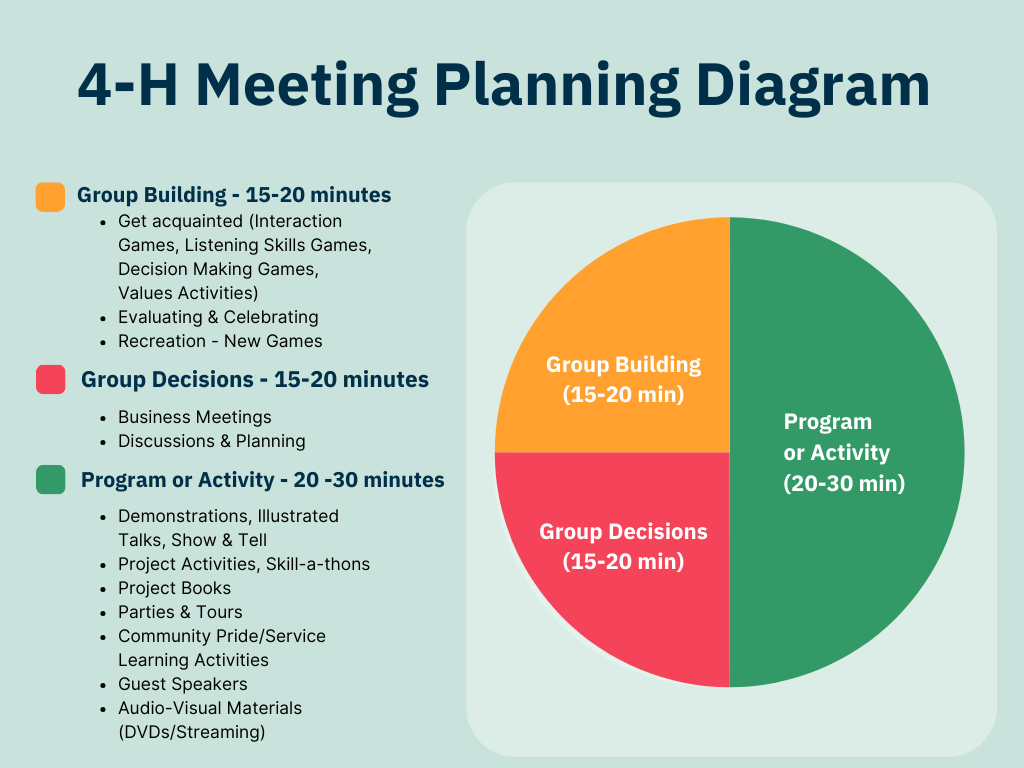
Meetings just don’t happen. It takes work and preparation before the meeting to ensure your meetings are effective. 4-H club officers and advisors should meet at the beginning of the year and before each club meeting to plan club activities and events and set the business agenda, the program, and the recreational activities.
As president, you should work with the club volunteer and officers to develop an agenda that lists parts of the program, time needed, and lists the person(s) responsible for each section.
Sample 4-H Club Meeting Agenda
- Call to Order
- U.S. Pledge of Allegiance
- 4-H Pledge
- Introductions & Roll Call
- Reading of the Minutes from the last meeting
- Treasurer Report
- Other officers’ reports (if needed)
- Committee reports (if needed)
- Old Business
- New Business and announcements
- Program
- Educational Component
- Oral Presentations by members
- Guest speaker
- Service learning
- Recreation
- Refreshments
- Reminders – next meeting, action items (if needed)
- Adjourn
The Order of Business for 4-H Meetings
Call to Order
- President: “Will the meeting please come to order.” (Raps gavel on desk.)
Pledge of Allegiance & 4-H Pledge
- President: “Will everyone please stand for the Pledge of Allegiance and the 4-H Pledge? Will Jane and John lead us in these pledges?” (Two different members each month, or can be appointed by the citizenship committee.)
Secretary Calls the Roll
- President: “Everyone, please be seated. Will the secretary call the roll?” (Only clubs with fewer than 25 members should call the roll. Larger clubs should pass a sign-in sheet around or have it at the door for people to sign as they come in.)
- Secretary: Calls the roll
Secretary Reads Minutes
- President: “Will the secretary read the minutes of the last meeting?”
- Secretary: Reads the minutes.
- President: “Are there any additions or corrections to the minutes? (short pause) If not, the minutes stand approved as read.”
Treasurer Gives Report
- President: “Will the treasurer please give a report?”
- Treasurer: Gives report
Reporter Reports
- President: “Is the reporter ready with a report?” (Must report on a 4-H activity and/or new article(s) since last meeting. This is not the same as the secretary’s minutes.)
- Reporter: reports club news.
- President: “Will the committee chairman give the report?” (Health Chairman Reports. Repeat for other committees if needed.)
- President: “Is there any old business?”
- President: “Is there any new business? Are there any announcements?”
Introduce Programs
President: “I will now turn the meeting over to the vice president for the program.” (Introduce Vice President and project talks, demonstrations, or special programs.)
Vice President: “Jane Doe will give a project talk.” Or “John Smith will present a demonstration today on making cookies .” Or “Jane Doe will present a special program titled ‘The Science of Cookie Baking’.”
Vice President: “This concludes our program. I will now turn the meeting back over to the president.”
President: “Welcome (Name of guest). I now turn the meeting over to the club leader, a resource volunteer, or our guest speaker to present additional programs or make announcements.”
Move to Adjourn Meeting
President: “Does our leader have any additional announcements? Do I hear a motion to adjourn the meeting? Is there a second to the motion? The meeting is now adjourned.”
4-H Emblem, Motto, Slogan, and Pledge
Emblem
The 4-H emblem is a green, four-leaf clover with a white “H” on each leaf, representing the 4-H’s: Head, Heart, Hands, and Health. The white stands for purity. Green, nature’s most common color, represents life, springtime, and youth.
Club Volunteers can download the 4-H Emblem at the 4-H.org Marketing Resources. A login is required.

4-H Motto
The 4-H Motto is “To Make the Best Better.”
4-H Slogan
The 4-H Slogan is “Learn by Doing.”
4-H Pledge
“I pledge my head to clearer thinking,
my heart to greater loyalty,
my hands to larger service,
and my health to better living,
for my club, my community, my country, and my world.”
Resources: Tips to Develop Effective Youth-Adult Partnerships in Your Club
- Actively seek youth input and be sure to listen to their ideas and ask questions.
- Ensure that each adult and young person enters a partnership with a clear understanding of everyone’s roles and responsibilities.
- Value youth participation and what they bring to the program (new ideas, enthusiasm, and a real connection to those youth that are being reached through the program.) Encourage youth to value the adults’ participation and what they bring – knowledge, experience,e and access to resources.
- Work with young people to find meaningful roles and responsibilities for all involved. This will result in youth becoming invested in the success of their 4-H programs.
- Prepare both youth and adults for involvement by sharing information before meetings/activities. Make sure that information on all programs is equally shared with both youth and adults.
- Set realistic expectations. Effective partnerships don’t set young people up for failure by throwing them into situations for which they are not prepared.
- Offer youth and adult training so they can work together and be accepting of one another.
- Develop an atmosphere of mutual trust and respect.
- Be a good role model. Set a good example through language and actions, and set the same standards for youth.
- Listen and validate the thinking of youth members and let them know their ideas are welcome.
- Be willing to try the youth members’ ideas even if those ideas did not work in your previous experience.
- Evaluate programs and be willing to change and adapt where necessary.
General Rules of Parliamentary Procedure
Parliamentary Procedure Made Easier (see references section) has detailed information regarding motions and the details of how parliamentary procedure works. Below is a very simplified guide to using parliamentary procedure.
- Always rise to make a motion or to address a group
- When making a motion, one should say, “I move that…” NOT “I make a motion.”
- A motion must be approved by a second person saying, “I second that motion.”
- The floor refers to the area in which business is being conducted (the meeting room). The president, presiding officer, always has control of the floor except when granted to another member.
- Use of the gavel:
- One tap: members are to be seated and signifies the pass/fail of a motion.
- Two taps: calls the meeting to order.
- Three taps: members are to rise.
- Voting methods include: voice, rising, show of hands, secret ballot, and roll call.
- The President only votes in the case of a tie.
- When used properly, parliamentary procedure will provide for a very orderly and efficiently run business meeting, which allows the right of everyone to be heard.
Types of Motions
- Main Motions: to present an opinion or propose an action for the group to consider.
- To Adjourn: to end a business meeting in an orderly fashion.
- To Call for Question or Privilege: provides for immediate action to be taken for the rights, privileges or comfort of the group.
- Table: to set aside a main motion until a given time for future consideration.
References
Bovitz, L., (n.d.). Creating Successful Youth-Adult Partnerships. New Jersey 4-H, Rutgers University.
Etling, Melang & Stanley, (n.d.). Piecing It All Together. University of Nebraska-Lincoln Extension.
National 4-H History Preservation Program, (n.d.). 4-H Motto, Creed, and Pledge.
Ohio State University Extension, (1999). Ohio 4-H Club Advisor’s Guide: Working with Officers and Committees.
Ohio State University, College of Food, Agricultural, and Environmental Sciences, (n.d.). Using Parliamentary Procedure Plain and Simple.
Oklahoma State University, (2008). Oklahoma 4-H: President’s Planning Guide for the Local Club.
Robert, H., (2000). Robert’s Rules of Order: Newly revised (Tenth Edition). Jackson, TN: Perseus Books Group.
Texas A&M System AgriLife Extension, (2014). The 4-H Club Officer Handbook.
University of Idaho Extension 4-H Youth Development, (n.d.). 4-H Club Annual Plan of Meetings and Activities.
Washington State University Extension, (2002). Officer’s Handbook.
Washington State University Extension, (2005). Parliamentary Procedure Made Easier.