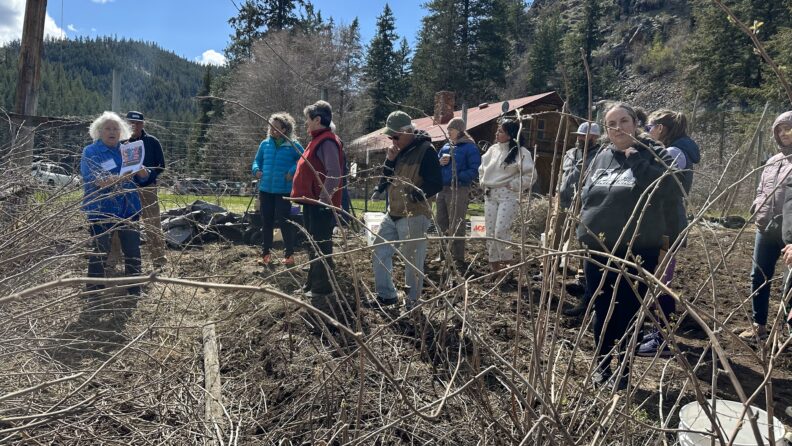
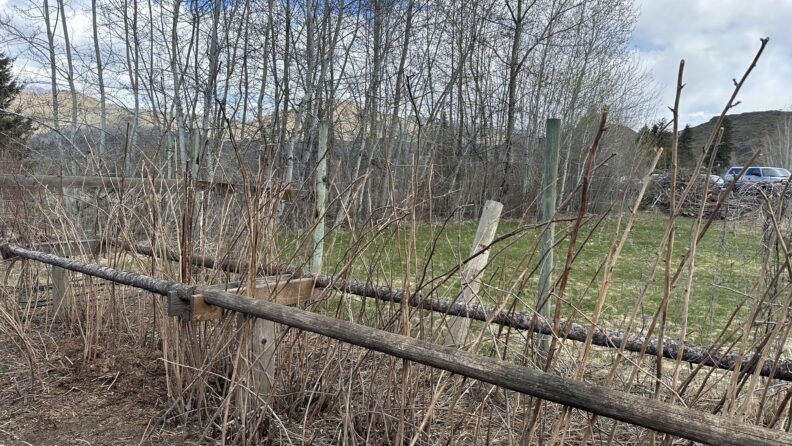
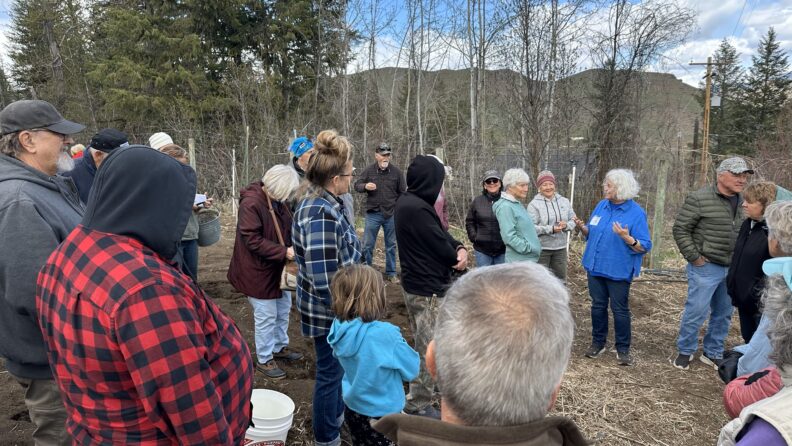
Okanogan County’s Master Gardener Suellen White held an informative workshop on raspberry pruning this weekend. The rain held out and there were at least 45 participants who joined in Twisp, Washington. Suellen’s impressive raspberry patch started about 50 years ago, and the canes have been transplanted several times throughout her gardens over that time. Her variety is assumed to be the common Meeker Red Raspberry, (or Rubus idaeus), since that was what was available when they were purchased half a century ago in Eastern Washington! Meeker are the easiest variety to maintain and are easily transplanted. They have an upright growth habit with flowering in May, the red raspberries are ripe in July. Suellen uses her red raspberry harvest for jellies, jams, or for grandchildren eating fresh off the vine! She has a trellis system using logs to keep the canes upright and tidy. Pruning the raspberry clump is important; if you don’t, they may become overcrowded, leading to weaker canes, smaller fruit, and increased susceptibility to pests and diseases. Pruning helps to improve air circulation, sunlight penetration, and nutrient distribution, ultimately resulting in healthier plants and a better fruit yield Raspberry bushes typically take two years to start producing fruit.
In the first year, the plant will grow canes (primocanes) and develop roots. In the second year, the canes mature into floricanes, which will then bear fruit. The floricanes then die and must be removed to keep your raspberry patch workable. Suellen demonstrated how to prune the tall and spent 2-year-old canes to the class. To maintain a productive patch, pruning, done in the fall or early spring, after the raspberries have been harvested and the canes are done for their lifespan, the brown and dry branches can be snipped off easily with pruners or by hand. Do not cut all the way to the ground, keep about 4-5in high in the clump. Suellen chips up the dead branches and uses the mulch right back onto the berry patch. This helps with weed control and keeps the soil moist when watering with drip tape. Watering this way is the preferred method, since overhead watering can cause fungal diseases and fruit rot. Suellen suggests watering 3 times a week, the raspberries need 1-2 inches of water per week. More may be needed in extreme temperatures or during fruit development. The remaining canes that will be fruiting this year, Suellen prunes to arm’s length, about 6ft tall, so harvesting the berries is done without the need for a ladder! These 2nd year producing canes will be obvious in the spring, since they will have started to bud. To prune effectively, make a simple cut just above a bud. She also recommends finding 4-5 of the healthiest branches in the clump and pruning away all of the others. This helps keep your raspberries manageable, and you will still get a larger and bountiful harvest.
To maintain your red raspberries, Suellen suggests a fertilizer of 16-16-16 every 6 weeks or so or using aged manure compost if that is available. Chicken manure is too hot with nitrogen and is not recommended. The Meeker Red raspberry is self-pollinating, but it helps to have honey or mason bees around to aid in this process. Suellen has mason bee houses to encourage the Mason bees to stick around! Raspberries love sun and well-drained soil but can also grow in clay and do fine, as Suellen has experienced. The Meeker Red Raspberry produces underground runners, called suckers, that pop up new sprouts everywhere in the spring. They can end up in any direction! If they appear in an unwanted section of your garden, simply take a shovel and dig them out easily. Then transplant to a more desirable area. Voila, more raspberry plants!
If you are interested in learning more about gardening, or are interested in becoming a Master Gardener, please email: angelyn.sheppard@wsu.edu If we have enough interest, the Okanogan County Master Gardeners may hold a demonstration class in your area!