
The three most important aspects of lawn care are fertilizing, mowing, and watering. Correctly done, these along with other maintenance practices will provide a healthy green lawn with a minimum of negative effects on the environment.
FERTILIZING
Use a balanced fertilizer with a 3:1:2 or 4:1:2 ratio of nitrogen (N), phosphorus (P), and potassium (K) which may be listed on the label as 21-7-14 or 32-8-16. Look on the label for slow-release forms such as ureaform, sulfur-coated urea, milorganite, and IBDU. Slow-release fertilizers are more expensive but are recommended because they release nitrogen over a longer period of time and produce more uniform turfgrass growth and color. Look on the label for slow-release forms such as ureaform, sulfur-coated urea, milorganite, and IBDU. Fertilize up to four times a year, or as needed to maintain a healthy-looking lawn. A good way to remember is to fertilize on the holidays of Memorial Day, 4th of July, Labor Day, and Halloween. Mulch mowing provides the equivalent of one or two fertilizer applications. If you only fertilize once a year, do it in the fall. Do not apply “winterizer” fertilizers until late October or early November.
MOWING
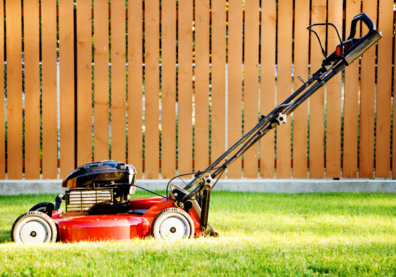
Sharp blades are necessary! Sharpen every 6 weeks or have an extra blade on hand and rotate sharpened blades every 6 weeks. Grasses should be cut at a height of 3-4 inches. Don’t cut more than 1/3 of the grass blade off at any mowing. Turfgrasses mowed at taller heights help shade and cool the soil. This results in less water use and helps prevent germination of weed seeds.
A mulching mower is an excellent way to return nutrients to the lawn. Clippings break down quickly, add nitrogen to the ground, and contrary to widespread belief, don’t contribute to thatch buildup. Leaving clippings on the lawn area also saves space in landfills.
WATERING
Irrigate lawns deeply, once or twice a week depending on the weather. Water should reach down at least 6 inches into the soil. Roots will not grow from moist soil into dry soil. Several hours after watering, check the soil with a probe or garden trowel to see how deeply the water has reached down into the root zone. Frequent shallow watering encourages shallow roots which are more susceptible to heat damage.
POWER RAKING
Thatch is the spongy layer between blades of grass and soil. Thatch should not exceed 1/2 inch. Remove thatch in early spring and only when it interferes with water and fertilizer getting to the roots. Power rakes, rotary mower attachments, or other mechanically driven thatch machines are superior to hand rakes and are available for rent.
AERATING
Aerating reduces soil compaction and improves water penetration. First, water the lawn well. The following day, use a core aerator to remove plugs of soil. Aerators can be rented at most rental businesses. Plugs should be left on the lawn, as they will break down and add additional organic matter. Water afterwards to ensure that water penetrates to the depth of the core space. This is a good time to fertilize. If soil texture needs to be improved, apply 1/2 inch of compost.
CHEMICAL WEED CONTROL
Herbicides come in two formulations: a liquid spray or a granular form mixed with fertilizer. Be careful when using herbicides containing the ingredient dicamba, which can damage nearby trees and shrubs. Successful weed kill is dependent on proper timing of herbicide application. READ THE PRODUCT LABEL. There are many different chemical combinations with similar names. Choose a product that lists the weed you wish to control and lists the location where you wish to use the product. September and October are the best months to control perennial broadleaf weeds like dandelions and clover.
Be aware of desirable plants that may be sensitive to herbicide and of any warnings concerning children and pets. Identify the weeds before you begin treatment. Some weeds respond best to pre-emergent herbicides which must be applied very early in the spring or late in the winter before the weeds germinate.
COMMON LAWN PROBLEMS
Dry Spots
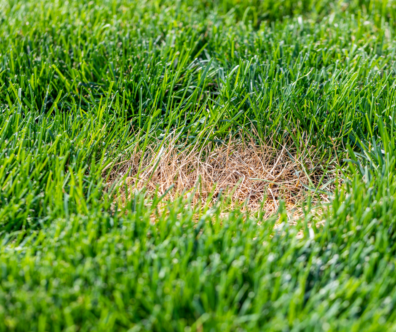
- Heavy foot traffic, hot, dry winds and heat can cause soil and thatch to become dry and compacted.
- Aerate with a machine or hand tools.
Burn Spots
- Dog urine – water area well.
- Fertilizer burn – water area well.
- Gas and oil spills – check lawn mowers for leaks. Don’t refill tanks on lawn.
It may take a year or more for turf to recover from burns.
Dull mower blades
Sharpen lawnmower blades every six weeks to prevent yellow, frayed grass blades.
Weedy grasses
Quack grass, annual bluegrass, bentgrass, and others may require treatment.
Sod webworm/lawn moths
Grubs feed on grass roots and crowns although damage is seldom severe. If grass blades are continually chewed off at base, reduce thatch and irrigate and fertilize properly. Further treatment may include parasitic nematodes, Bacillus thuringensis (B.t.) or appropriate insecticides.
Walla Walla County WSU Extension Bulletin #201