Plants Named For Animals, and More
by Carol Barany, Yakima County Master Gardener
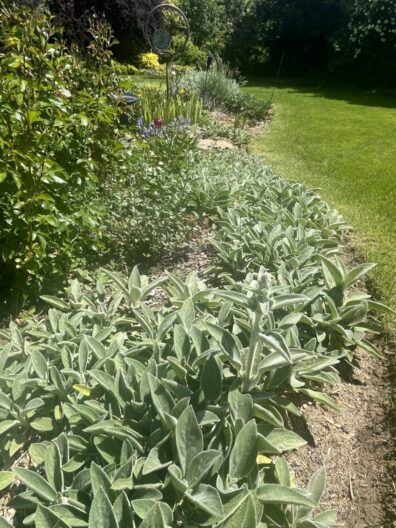
Last year, in an issue of our monthly newsletter for Yakima Master Gardeners, Jenny Mansfield recounted a stroll through her winter garden on the way to refilling the bird feeders. She noted that Lamb’s Ear (Stachys byzantina) was a droopy wet mess showing no signs of its signature soft fuzziness. Pig’s Squeak (Bergenia purpurascens) looked ragged and Catmint (Nepeta) and Hens and Chicks (Sempervirens) were covered in snow. Cardinal Vine (Ipomoea quamoclit) was spent, but Dragon’s Blood Sedum (Sedum spurium) still looked presentable over in the rockery.
Cuttings of her Turtle Vine (Callisia repens) were rooting in the greenhouse, where trays were being prepared for seeding Snapdragons (Antirrhinum majus).
Indoors, her houseplant collection included Monkey Monstera, Snake Plant, and Zebra Plant.
That was the first time she realized that many of her favorite plants wore animal names.
The list goes on. There’s Goat’s Beard, Cranesbill, Spiderwort, Butterfly Bush, Bear’s Breeches, and Foxglove. The longer I think about it, I can add Elephant Ear, Pussy Willow, Turtle Head, Tickseed, Canary Bird, Harebell, Trout Lily, Bee Balm, and Dog Wood.
How many others can you add to the list?
Many botanicals known most widely by their animal names, like Lamb’s Ears and Turtle Vine, bear a striking resemblance to the animals for which they were named. Butterfly Bush and Bee Balm were named for their unmistakable attractiveness to specific pollinators.
Jenny recalls sowing hundreds of Heuchera seeds in preparation for a Master Gardener plant sale a few years ago while thinking, “What the heck is a Heuchera?” It was the very plant she knew as ‘Coral Bells’, named for the color and shape of its dainty flowers. Jenny had been growing it for years.
Plants were studied long before recorded history, and every civilization had its own unique system of naming. With the Age of Exploration came conquest and plants were taken from their native habitats and carried across the globe into an arena of thousands of newly introduced plants.
The tender tropical Elephant Ear (Alocasia) could get mixed up with the tough as nails Pig’s Squeak (Bergenia), which is also called Elephant Ear. Getting their name wrong could be serious, especially if the plant was used medicinally.
Besides, with over quarter of a million different species of plants, not all of them have a common name.
To make sense of the mess, Carl von Linne used Latin to devise a botanical naming system he called binomial nomenclature. Carl even Latinized his Swedish last name to Linnaeus. We’ve been using his system since 1753.
In binomial nomenclature, the genus and species names together comprise the scientific name that every plant is given when first described by a scientist. These Latin names are recognized by botanists and gardeners no matter where you go in the world and what language you speak. The first begins with a capital letter and is the genus, a large group of related plants with common characteristics. Genus names are fascinating, some with roots in mythology or literature.
The second word of the name refers to species, and is lower case. It’s usually a Latin adjective, describing some aspect of the plant, such as its origin, color, habitat, size, or shape. Saxatalis and rupestrismean “of rocks”, while arenarius is “of sand”. Fuzzy plants are described as lanatus, hirtus, or lanuginosus, while those with silvery leaves may be argenteus, griseus, or cinereus.
Some plants require a third name which refers to the botanical variety. This form of the species has something naturally occurring and special about it, separating it from the more common form. Cultivars are new varieties of plants that resulted from intentionally crossing two separate species, and also require a third name.
In Scotland, the Harebell is also called Bluebell, Witches’ Thimble, and Fairy Bell.’ To avoid confusion, Linnaeus named it Campanula rotundifolia. ‘Campan‘ means ‘bell’, referring to bell shaped flowers. ‘Rotund‘ means ‘round’, ‘foli’ means ‘leaves’, and rotundifolia means ‘round-leaved’. If a new variety was discovered with white flowers rather than blue, ‘alba’ (meaning white) would be added at the end of the name. Campanula rotundifolia ‘alba’ has white, bell-shaped flowers, and round leaves.
Jenny has worried about correctly pronouncing all those proper plant names. How would you pronounce Eschscholzia (California poppy) or Zantedeschia (Calla lily)? Her advice is that while it is important to spell the terms correctly, don’t worry about pronunciation. Give it your best shot and speak with authority. Who will know if you make a mistake?
Linnaeus’ motto was ‘Omnia mirari etiam tritissima’, or ‘find wonder in everything, even the commonplace.’ Children love animals, so why not plant a garden with them where all the plants have animal names? It’s a natural way to introduce them to the wonder of gardening, and if you both learn to love Latin along the way, so much the better.