Originally published July 12, 2025 in the Yakima Herald-Republic. Minor edits have been made for web publication and accessibility.
by Carol Barany
Basil
It was 1985 and I had the first Cuisinart food processor on the block. My best friend Betsy was growing more basil (Ocimum basilicum) than she knew what to do with and suggested we use my new gadget to make pesto. “Sure,” I replied. A few moments later, I had to ask, “What’s pesto?”
My first taste of that sublime concoction, whirled up by my friend and me, is a memory that will last forever. Pesto is the very essence of summer, served in a spoon.
Next summer, I started growing basil of my own, and now it’s my favorite herb.
I wish it hadn’t taken me so long. Basil’s origins can be traced back to ancient India, where it’s held a rich cultural significance for at least 5,000 years. Its cultivation spread to the Mediterranean, particularly Greece and Rome, and then eventually to Europe and the Americas.
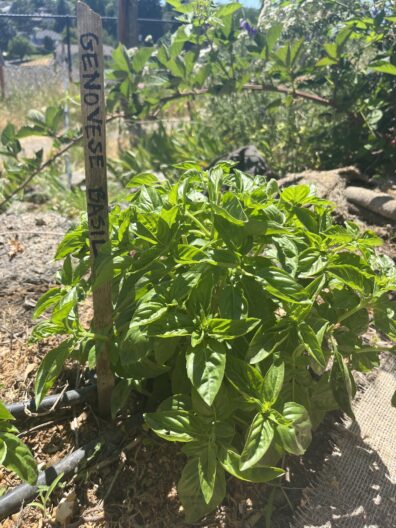
Cultivars are available with different nuances of taste, size, and appearance. Some have cinnamon, clove, lemon, or lime overtones. There are purple-leaved types such as ‘Dark Opal’ and ‘Rubin’ with foliage so beautiful that I cut it for floral bouquets. ‘Genovese’ is the basil cultivar produced in the Italian province of Genoa in the Ligurian region of Italy where pesto originated. It’s the variety I prefer for pesto.
Basil’s found a home in Yakima, where it thrives in our hot summers. We enjoy it while we can since its flavor will deteriorate once temperatures start dropping below 50 degrees. Covering your plants with row covers in the Fall could extend the season.
Unlike most herbs, basil requires rich soil, regular irrigation, and fertilizing. When the soil is dry down to the top of your first knuckle, it’s time to water. Adding a 2-3 inch mulch of grass clippings, straw, compost, or ground-up leaves retains soil moisture and suppresses weeds. Plants grown in containers (that’s how Betsy did it) will dry out faster than those in garden beds and need more frequent watering. Use containers with excellent drainage. Feed with a 5-10-5 fertilizer once a month and after every big harvest.
When temperatures really warm up, stem tips will form a square cluster of four leaves layered one on top of another, signaling that the plant is getting ready to flower. Pinching off just the tip doesn’t halt flowering but simply makes way for the next flower stalk. Cut at least 6 leaf nodes down the stem and stand back as the plant responds by producing tender new leaves.
To avoid bruising, handle basil leaves delicately. Store harvested stems in a glass of water on the counter rather than in the refrigerator. If you leave the stems in water long enough, they’ll root. You can pot them up to grow indoors for a while, though strong artificial light is needed to keep basil going for very long.
Basil looses much of its brilliant green color and flavor when air dried, making freezing a better preservation method. Mix ¼ cup chopped basil with a few teaspoons of olive oil, and drop dabs onto lined baking sheets or ice cube trays. Freeze, and then remove and pack into freezer containers.
Our basil is growing like gangbusters, and I made my first batch of 2025 pesto this week. I use the recipe that Betsy and I found in the original Silver Palate cookbook all those years ago.
PESTO
- 2 cups of firmly packed fresh basil leaves, washed and patted dry
- 4 big peeled garlic cloves
- 1 cup shelled walnuts
- 1 cup olive oil
- 1 ¼ cups grated Parmesan cheese
- Salt and pepper to taste
Combine the basil, garlic, and walnuts in the bowl of a food processor and chop. Leave the motor running and add the olive oil in a slow, steady stream. Shut the motor off and add the cheese, a big pinch of salt and a liberal grinding of pepper. Process again briefly until all ingredients are combined.
That’s it!
Make sure you eat some with a spoon as soon as it’s ready.
To store in the freezer, I spoon large dollops of pesto on a cookie tray and freeze until solid. I remove the dollops and place them in a container and keep them frozen until needed.
If you don’t already have a recipe in mind, a quick internet search will yield a wealth of creative ways to use pesto as a spread, sauce, or marinade that pairs delectably with meats, vegetables, pasta, and fish.