Grasses – The Long and Short of it
by Debra Kroon, WSU Yakima
County Master Gardener, 2003
This article discusses ornamental grasses. It does not cover lawn or turf grasses except to say downsize your lawn and turf as much as possible. Lawn and turf grasses are a mono-crop providing zero biodiversity and little benefit.
Grasses are an often overlooked or under considered heavy lifter in your garden space or planned design. They provide biodiversity and year-round interest, both for the human eye and for the myriad of wildlife inhabiting our gardens.
Biodiversity can be a rich array of native bunchgrasses, wildflowers, insects, birds, and mammals—many of which exist nowhere else in the world. These vibrant landscapes support not only ecological diversity, but also soil health, pollination, water retention, and carbon storage.
Grasses are environmentally friendly, sequester carbon, inhibit erosion control, improve water quality and retention through their extensive root systems. Turf grasses may do the same, especially with temperature regulation, which may lead to ‘Lawn Pride.’
Grasses form a primary food source and habitat for many animals, including large herbivores such as deer and elk, as well as small animals such as rodents and insects. They also provide shelter for ground-dwelling animals, such as rabbits and snakes, and birds.
Insect Support: Their dense foliage and upright growth create microhabitats where insects are protected from adverse weather conditions, predators, or disturbances. The clumps or bunches of grass also offer nesting sites for ground-nesting bees and other insects.
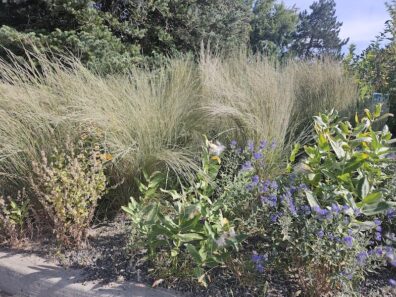
Native grasses are crucial for pollinators like bees and butterflies, providing not only nesting sites but also larval host plants. Certain warm-season grasses serve as larval host plants for specific pollinator species. Butterflies lay their eggs on the grass, and the emerging caterpillars feed on the leaves. For example, little bluestem (Schizachyrium scoparium) is the larval host plant for several skipper species and big bluestem (Andropogon gerardii) and switchgrass (Panicum virgatum) are the caterpillar host plants for banded skippers and satyrs. By incorporating these grasses into landscapes we provide crucial resources for the complete life cycles of these pollinators.
Nesting Sites: Grasses serve as vital nesting sites and provide essential cover for wildlife, including birds, insects, and small mammals. Different species of grass offer diverse nesting structures and concealment from predators, while also providing food sources for nesting animals. Many bird species, like robins, song sparrows, and wrens, utilize grass for nest construction, with coarse grass blades forming the main structure and finer grasses lining the nest. Ground-nesting birds, such as bobwhite quail and eastern meadowlarks, also rely on the dense cover of grasses for protection.
Winter Protection / Interest: Grasses, especially those with upright forms, provide a strong vertical element and interesting textures, especially when frosted or snow-covered. Many grasses retain their foliage through winter, offering shades of gold, rust, and bronze. The swaying of grass blades and seed heads in the wind adds a dynamic element to the winter landscape.
An emerging idea in gardening is the idea of Abundance! Consider the impact of encountering a swath of sunflowers, for example. Or a sea of rudbeckia, lavender, coneflowers or grass.
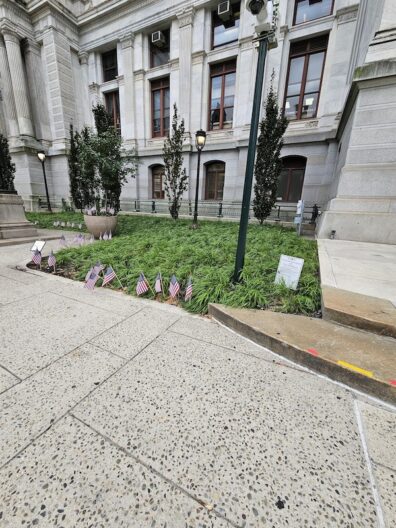
A recent trip to Philadelphia opened my eyes to using mass planting of Hakone grass around the old City Center. It was stunning and what a delightful alternative to lawn grass. Mass plantings command attention, but they also excite the insects that use them for pollination and habitat. Instead of traveling several hundred or thousands of feet to visit the next plant, they have all they need in one large ‘buffet’ area.
Piet Oudolf, a Dutch nurseryman, author and landscape designer, has used the method of abundant mass plantings in his many designs. You may get a look at some of Mr. Oudolf’s work at the Yakima County Master Gardener Fall Symposium, to be held on October 25 here in Yakima. You may check this link for more info: Fall Symposium
Choosing the Right Grasses. Lean-in to natives of North America as a first choice, but please do research before buying and planting. You need to know the difference between clumping and rhizome grass. In general, clumping grasses simply get bigger in girth as they grow. Depending on winter damage, some of their centers may die out. This is the time to simply divide and replant and share.
Rhizome grasses have an aggressive habit, which is to spread by underground roots. They are not easily contained and may drive you to frustration, or worse, over time. They do not belong in a well-tended perennial border plan.
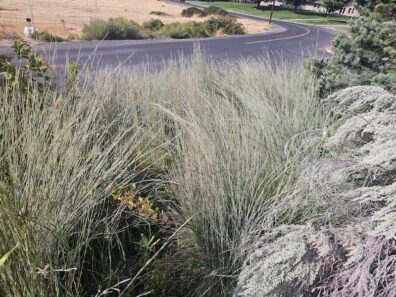
Let me leave you with a selection of five of my favorite grasses. Easily at the top of my list is Schizachyrium scoparium, Little Blue Stem. It naturalizes beautifully and provides a striking panorama year-round, beginning with its blue-gray foliage in the spring and slowly turning to a rich rust-red color in the fall. It is native, about 30 inches tall and is a clumper.
Helictotrichon sempervirens, Blue Oat Grass. This grass makes a great border grass, but also lends itself to mass planting. As its name suggests, the blades are gray-blue in color. It is also a native, a clumper and gets about 18 to 24 inches, including inflorescences (bloom).
Calamagrostis × acutiflora Feather Reed Grass. This is a hard-working grass that you will see often used in borders and large landscape projects. You will find it everywhere. Its growth is upright, clumping and will reach 3-1/2 to 4-1/2 feet in height.
Miscanthus sinensis ‘Morning Light’ is also known as Chinese Silver grass. Whoever named this grass got it right. It does look like the sun is shining on it. It has a rounded arching growth pattern, is clumping and will reach 4 to 5 feet in height. It is stunning in the garden.
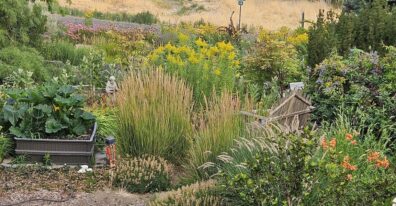
Pennisetum orientale ‘Karley Rose’ Fountain Grass is probably the most well known of the fountain grasses. It makes a good perennial substitute for the non-winter hardy purple fountain grass. Growth habit is clumping, with arching, flowing stems and purplish colored inflorescences. Overall height will be between 24 to 36 inches.