by Caroline Crowley, Master Gardener
No matter what you might hear from influencers and bloggers, gardeners generally don’t need a shed full of tools and expensive gizmos. The basics of a shovel, a trowel, a rake or two, a hose and sprayer, a five-gallon bucket, and a pair of hand pruners will get most of us pretty far, and certainly a beginner doesn’t need more.
Much of what else you might need depends on how you garden and what you grow. Someone growing annuals in patio pots probably doesn’t need more than a trowel. Those growing vegetables in large beds might find a hoe or broad fork useful. Seed starting requires small pots or flats and perhaps grow lights and a heating mat. Composters need a garden fork to turn the pile, and anyone growing fruit trees will need a pruning saw and a ladder.
Here’s a list of additional low-cost tools that go beyond the bare essentials but would still be useful to just about anyone tending a garden.
- Mini shovel. Bigger than a trowel and much smaller than a full size shovel, this is one tool I really can’t do without. It has a curved and pointed blade and a D-ring handle. At about two feet long, it’s small enough to carry in a five-gallon bucket or wheelbarrow easily, but big enough to transplant perennials. It’s perfect for spreading compost or other mulches. I don’t need to kneel to use it as I would with a trowel, and it’s easier on my wrist and hands, too. Since it’s so much shorter than a full-size shovel, it’s easy to grab and go. I truly love my mini shovel! Look for them anywhere that sells a good selection of garden tools.
- Scissors. A pair of inexpensive, sturdy scissors is incredibly handy in the garden. I probably use mine every single time I am out in the garden, not just for snipping string or twine, but also for cutting bouquets, deadheading, slicing open bags, cutting back perennials or cleaning up at the end of the season. When I started out gardening, I used to go into the house to get a pair of scissors when I needed them. It’s much more convenient to have a dedicated pair for the garden.
- Big basket. A five-gallon bucket is essential for liquids, but a large, broad basket is easier to load with leaves or garden trimmings, and it will hold more. Trug bins made of brightly-colored, flexible plastic are popular and come in a range of sizes. A large wicker basket also serves this purpose, and a good one will last for decades of heavy use or at least mine has. Both the trugs and the wicker baskets are a bit more expensive than other items on this list, but well worth it if you garden much at all. I use mine every time I work in my garden.
- Watering can. This is helpful for those areas of your garden where the hose doesn’t reach or applying liquid fertilizers or compost teas. A metal one that doesn’t tip over or blow around like the plastic ones tend to, and one that has a fixed handle that you don’t have to reach for every time you pick it up will save a lot of aggravation. Two gallons is a good size. Be sure it has a detachable “rose” (the part at the end of the spout with the little holes where the water pours out), so you can remove it to prevent clogging or to clean it if it does get clogged. Shop around until you find one that is well designed and it will last for years. Mine is twenty-five years old and going strong.
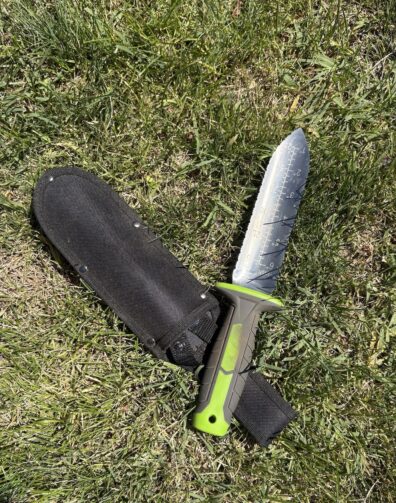
- Hori hori. This is a large, strong, Japanese garden knife. It is slightly curved and has a sharp serrated blade on one side and a straight knife blade on the other. That makes it perfect for pulling out weeds with tap roots, like dandelions, or sawing apart the root balls of perennials and many other heavy-duty cutting tasks. Once you get one, you’ll wonder how you managed without it.
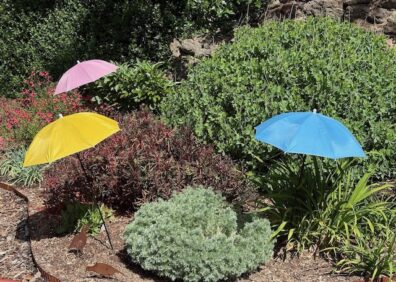
- Plant umbrellas. These are new favorites of mine. They are miniature umbrellas that you can stick in the soil to protect seedlings and transplants from the strong Yakima sunshine. I got a colorful pack of them last year from an online retailer and they seemed to really help plants that otherwise would have struggled. Plus they look adorable dotted throughout my garden.
- Gloves. Dirt is dirty! Beyond the cuts, scrapes, and splinters to which your bare hands are exposed, garden soil is known to carry the bacteria E. coli, which can cause serious illness and is potentially fatal. Additionally, the soil in our area may be contaminated with arsenic and other heavy metals. I know many gardeners like to feel the soil with their bare hands, but it isn’t wise. Gloves can help keep you safe from these hazards.
While it isn’t necessary to acquire a huge collection of specialized tools, smart choices like these can make your gardening efforts easier and more pleasant.
Happy June! Happy Gardening!