Leaves
by Master Gardener Carol Barany
Early November marks the time when gardeners grab their rakes and clippers and get to work cleaning up their yards.
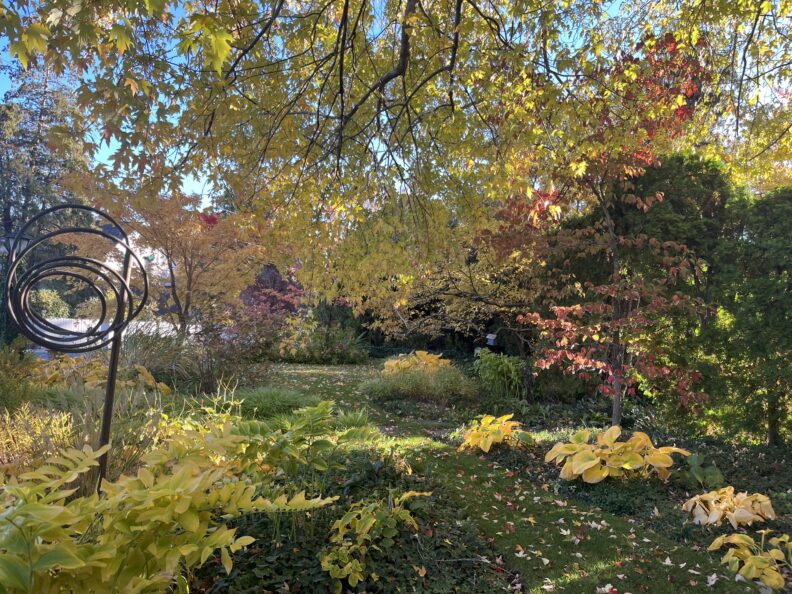
Have you noticed a shift in the best way to do it?
It all started in 1990 when Michigan State University began examining the effects of using a mower to mulch fallen autumn leaves into turf instead of raking and removing them. Their conclusions build a solid case to forget the rake and just keep mowing.
While those leaves benefit our lawns, scientists have suspected that fallen leaves had more far-reaching consequences.
We now have living proof.
Yakima Master Gardeners hosted a Fall Symposium on October 25 with presentations on year-round gardening.
If you were there, you may have felt the earth move under your feet.
Initiating the seismic shift, Chelan County Master Gardener and entomologist Julie Banken pointed to the results of a two-year study published earlier this year.
Dr. Max Ferlauto, Maryland’s state entomologist, and Maryland ecologist Dr. Karin Burghardt, quantified for the first time the negative impacts of fall leaf removal.
Their study included both low and high-maintenance areas in 20 pesticide-free residential Maryland yards.
In early March, they placed emergence traps over one square meter of earth in places where leaves had been raked away and in places where fallen leaves were undisturbed.
Every organism that emerged through June was counted, and the results were astounding.
Where leaves were left in place, almost 2,000 butterflies and moths, beneficial parasitic wasps, spiders, beetles, and flies emerged from that single square meter. Decomposing species such as earthworms and springtails were not counted, though there were plenty of them.
In areas where the leaves were removed, the average abundance of emerging butterflies and moths was reduced by 45%, spiders by 56%, and beetles by 24%. For butterflies and moths, the variety of species also dropped.
On the predator side, parasitoid wasps that feed on leaf miners and larvae also declined.
And it wasn’t over in June. Significant numbers of insects continued to emerge throughout the summer.
These results remind us that it’s not just all about pollinators. In domino fashion, the decline of predator insects can affect an entire food web. A small decline in a single insect species has the potential to impact populations of birds and other animals farther up the food chain.
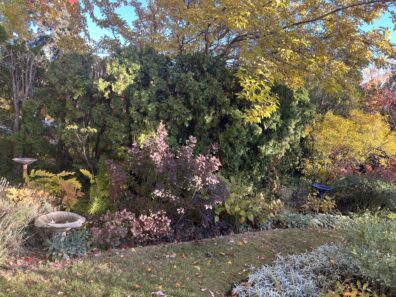
The Maryland research found that shredding leaves in the fall chewed up the insect species overwintering in them and was almost as bad as raking and discarding the leaves. I’ve long considered myself a world-class leaf shredder, so October 25 was a day of reckoning for me.
Ferlauto and Burghardt also found that regularly removing leaves impacts soil health. Landscapes with a history of leaving fallen leaves in place had higher levels of soil carbon, which is a good thing.
All of this is big news for gardeners.
On a recent ‘A Way to Garden’ podcast, New York Times garden columnist and host Margaret Roach had Max Ferlauto as her guest. Based on his recent research, Ferlauto offered recommendations to listeners for creating more ecological autumn leaf clean-up plans.
Ferlauto agreed that from a homeowner’s point of view, there are situations where it’s simply unsafe or impractical to leave all fallen leaves in place over an entire landscape. That being said, he assures us that even small changes can make positive impacts.
Here are some of his suggestions:
Leave whole leaves in garden beds, under shrubs, and along the back edges of your property.
Create “soft landings” for overwintering insects in areas under trees where leaves can be raked into small piles corralled by stones or logs.
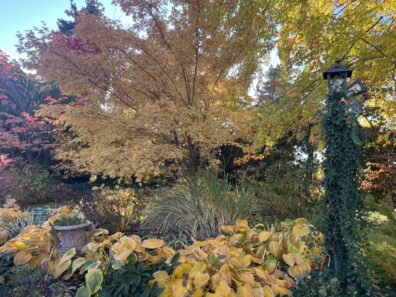
Instead of disposing of them, move leaves from areas where you don’t want them to new areas. Many insects are overwintering within that leaf material and can be moved to new homes for the winter.
Besides “leaving the leaves”, Julie Banken offered the Symposium audience some additional strategies for protecting over-wintering insects:
Try a “messier” approach. Leaving dried stems and seed heads standing until late spring offers vital shelter for cavity-nesting native bees, as well as pupating butterflies and moths. By waiting until after the last frost to remove the material, overwintering insects can emerge and complete their life cycle.
Piles of loosely packed fallen twigs and branches can shelter bumblebee queens and other essential invertebrates.
70% of native bee species nest in the ground. Leaving some patches of un-mulched soil allows ground nesting bees to burrow and overwinter safely.
Do not use pesticides.
The last presentation of the Symposium was a screening of the film “Five Seasons: the Gardens of Piet Oudolf.”
It confirmed everything we heard earlier in the day.
Oudolf is an internationally acclaimed garden designer best known in the United States for the Highline garden in New York City and the Lurie garden in Chicago.
One of the key features of Oudolf’s designs is that the plants he uses aren’t cut down in winter but remain visually interesting, at least to those who can accept some messiness.
In nature, plants die in winter, but they are not cut down, removed or otherwise “tidied up.” There is beauty in their slow decay as they replenish the soil with nutrients and provide homes and sustenance for wildlife and insects.
If you’ve been making a garden for insects and wildlife during the growing season, the insects and birds aren’t going away in winter. Cleaning up your garden in the fall impacts the creatures you are spending your summers trying to attract.
Even in winter when you may not be out there working, your garden is doing important work on behalf of the environment.
The stormy gale on October 25 blew clouds of leaves across the city. I wouldn’t be surprised if some of mine made it all the way to West Valley.
You can thank me next time you see me.