by Sue Bird, Yakima County Noxious Weed Board
Did you hear about North America’s Newest Weed Pest? It was found near Yakima!
We need everyone to help find, contain, and eradicate the parasite that attacks sunflowers, and has been found on tomatoes, eggplant, and tobacco plants.
Orobanche Cumana, also known as Sunflower Broomrape, is a member of a family of plants that lack chlorophyll. They rely on a host plant for nutrients and water, which depletes the energy and productivity of the host. There are four native Orobanche species in the northwest that grow on native plants such as sagebrush, buckwheat, ocean spray, and arbutus. A few other native varieties grow in other areas of the United States.
Orobanche cumana is not a native variety and is aggressively invasive.
2025 WSDA statement: Yakima, WA — The Washington State Department of Agriculture (WSDA) has confirmed the first-ever North American detection of Orobanche cumana, commonly known as sunflower broomrape, in Yakima, WA. This marks the first known occurrence of this destructive and highly invasive parasitic weed in North America.
The parasitic plant was discovered by a homeowner and later confirmed by the WSDA State Plant Pathology and Molecular Diagnostic Lab and USDA Animal and Plant Health Inspection Service (APHIS). Confirmation included both morphological and molecular analysis.
Sunflower broomrape is a devastating root parasite of sunflower (Helianthus annuus) and other members of Asteraceae (the sunflower family), leading to significant crop losses. The plant is incapable of photosynthesis and relies entirely on the host plant for water and nutrients.
This detection is especially concerning due to the aggressive nature of this parasitic weed and its potential to spread rapidly if left unmanaged. Sunflower broomrape poses a serious threat to commercial sunflower production and could cause significant impacts to growers, processors, exporters and the agricultural economy if not swiftly contained.
The WSDA Pest Program is working closely with USDA and local stakeholders to investigate the source, assess the extent of the infestation, and implement response measures to protect North American agriculture.Native to Eurasia, Orobanche cumana is a quarantine pest in many countries due to its devastating impact on sunflower production. Although O. cumana attaches to the host plants’ roots, it does produce distinctive above-ground, leafless flower stalks. A single plant can produce hundreds of thousands of microscopic seeds that remain viable in the soil for decades, making eradication difficult once established. ~WSDA Pest Alert Oct.1 2025
Washington State Department of Agriculture (WSDA)
Now we rely on the public, landowners, and gardeners to help us look for and eradicate Sunflower Broomrape. In the Fall of 2025, the Yakima County Noxious Weed Board and Washington State Department of Agriculture teamed up to survey a one mile radius of the site where Orobanche Cumana was found. No additional sites were found. However, the plant can be easily overlooked as a cool wildflower or an interesting plant. Orobanche seeds rely on a chemical signal from the host plant in the soil to start the germination process. It then attaches to the root of the host plant, forms a tubercle and takes all needed nutrients and water from the host to develop. This process takes a couple of weeks underground. It then emerges as an asparagus like stem, growing and flowering within a couple weeks within the root zone of the host. Lacking chlorophyll, the pants can survive in full shade and are very inconspicuous. O. cumana can grow up to 2 or more feet tall in sun or shade. Pale stems lack leaves and produce tubular flowers with bluish purple tips. Each flower forms a pod like a snapdragon seed pod, containing thousands of fine dust-like seeds. Seeds are viable for several decades in the soil and wait for a host to signal germination.
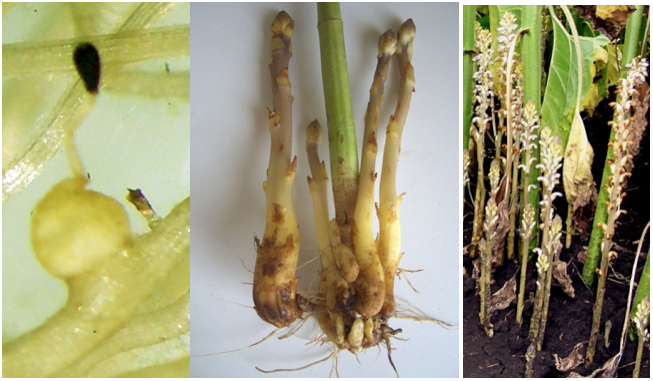
Photos sent to YCNWB from a lab, permissions to use as educational information.
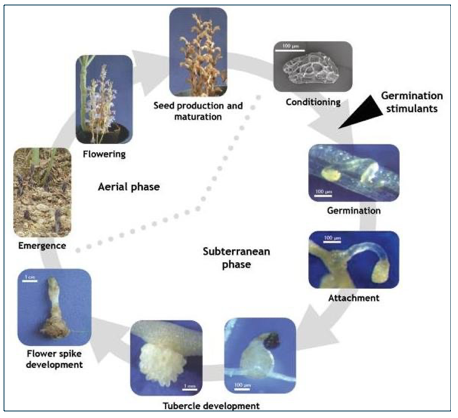
What to do if you suspect you have broomrape.
- Take pictures, especially stem and flower close-ups.
- Crop history and seed sources are valuable.
- Do not collect samples initially – possible seed spread.
- Contact – Yakima County Noxious Weed Board 509-574-2180
WSDA 1-800-443-6684 - WSDA or YCNWB will collect the plants to minimize potential spread. Treatment is determined by location with the landowner and WSDA.
Sue Bird YCNWCB
509-945-3357
susan.bird@co.yakima.wa.us