Christmas Cactus
by Master Gardener Carol Barany
While trees, shrubs, and other perennials have been shutting down as the days grow shorter, these same conditions trigger “short day” plants to bloom.
‘Tis the season for bright poinsettias and flowering Christmas cactuses.
The term “cactus” brings to mind hot and dry growing conditions. When it comes to Christmas cacti, nothing is farther from the truth. Christmas cactuses are Brazilian cloud forest natives, where the environment is cool, shaded, and relatively humid. There, these epiphytes flourish in the natural debris that accumulates in the forks of tree limbs.
To add to the confusion, it’s likely that the plant you thought was a Christmas cactus is really a Thanksgiving cactus. And if your plant blooms in April, it could really be an Easter cactus.
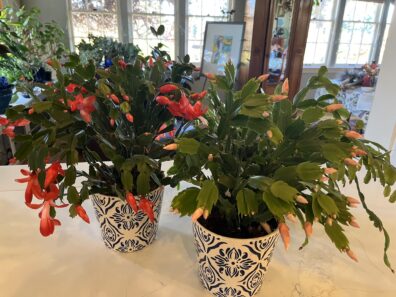
The “true” Christmas cactus, Schlumbergera x buckleyi, is a hybrid of Schlumbergera truncataandSchlumbergera russelliana, developed 150 years ago in England by William Buckley. Most commercial cultivars of holiday cactus are actually Schlumbergera truncata, commonly known as Thanksgiving cactus. Hatiora gaertneri is the Easter cactus.
All three are closely related and look very much alike.
To distinguish between the Thanksgiving and Christmas cactus, look at the shape of the cladophylls, the plant’s flattened stem segments. The Thanksgiving cactus has 2 to 4 saw-toothed hooks along the leaf margins. Stem margins on the Christmas cactus are more rounded.
Another distinguishing feature is the color of the pollen-bearing anthers in the center of the flowers. The Thanksgiving cacti are yellow, and purplish-brown on the Christmas cactus.
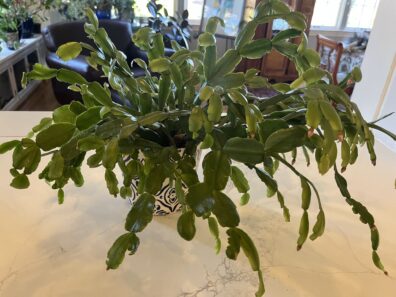
The Easter cactus has flaring, trumpet-shaped flowers with pointy petals which open at sunrise, close at sunset, and last for several weeks. The Easter cactus has even smoother stem edges than the Christmas cactus. Short bristles emerge from the tips of each stem of the Easter cactus, a feature lacking in the Christmas and Thanksgiving cacti.
All three are short day plants, meaning they must have a period of more than 12 hours of darkness each day to bloom. Easter cacti require 8-12 weeks of short days, which is why they bloom later in the spring. Thanksgiving and Christmas cacti require only 6 weeks of short days which is why they bloom earlier. The Thanksgiving cactus requires a somewhat shorter dark period than the Christmas cactus, which blooms closer to the winter solstice.
If these light requirements are met at another time of the year, the plant may bloom then.
This is the season when perplexed gardeners across America are calling their County Extension Offices asking, “Why are there no buds on my Christmas or Thanksgiving cactus?”
Holiday bloom depends on duplicating normal daylight exposure that comes with shorter days. Fourteen hours or more of continuous darkness each night is required for flower bud set, and can be inhibited by as little as two hours of artificial home lighting. And since daylight coming in through your windows can be changed by curtains or blinds, light levels can be just right for flowering at other times of the year.
Once buds are set, the photoperiod has no effect on flowering.
One option is to grow plants near a window in a room with only natural light exposure and no artificial light at night until buds are set.
I take the easy way out and move my plants outdoors into dappled shade after the last frost. When I bring them indoors in October, they have been naturally programmed to start forming flower buds at the right time.
Both of my Thanksgiving cacti are blooming now, and my Christmas cactus is setting buds. The Easter cactus is holding steady, waiting for a few more weeks of short days.
Indoors, holiday cacti need temperatures in the sixties and moderate humidity. Setting the flower pot on a pebble tray filled with water might help given Yakima’s low humidity.
Holiday cacti prefer an organic potting mix that should never dry out. Increase the amount of water when the plant is blooming. They love being fairly pot-bound and bright, indirect light. Full sun can cause the leaf segments to turn dark red as the plants begin to burn.
Fertilize plants monthly from the time new growth starts in late winter or early spring, and throughout the summer. Stop fertilization during the late summer for greater flower bud production in the fall.
It’s not unusual to hear that someone is growing a holiday cactus taken as a cutting from a plant their great-grandmother grew 100 years ago. Just pinch a “Y” shaped piece from one of the branches and stick it in a pot of sterile soil or vermiculite. It will root in no time, making a perfect gift.