In its native range from central Mexico to northern South America, the poinsettia grows as a jungle shrub the size of a small tree. One hundred years later, it’s morphed into a compact potted Christmas plant perfect for a dining room table.
This holiday season, Americans will buy more than 70 million of them. Of all the houseplants sold throughout the year, 85% of them are poinsettias. At the wholesale level alone, these plants contribute more than $250,000,000 to the economy.
It’s no wonder that they have their own holiday. Did you miss it? December 12 was National Poinsettia Day.
The plant we know botanically as Euphorbia pulcherrima was blooming for centuries in Mexico and Central America. Used by the Aztecs for dye and medicine, they named it“Cuetlaxochitl”, or“a flower that withers.”
After the Spanish conquest, 17th century Franciscan friars in Mexico linked it to Christmas, calling it “flor de nochebuena” or “Flower of Christmas Eve.” According to Mexican legend, a child too poor to buy a gift for baby Jesus gathered roadside weeds to place at the church alter on Christmas Eve. An angel told her any gift given in love is a precious gift. An amazed congregation witnessed the transformation of the weeds into brilliant red star flowers. ‘
In the late 1820s while serving as the first ambassador to Mexico from the United States, Joel Robert Poinsett clipped samples of the plant and introduced it to the United States on a trip home, earning him international recognition. The plant has been known as “poinsettia” ever since.
As a footnote, Poinsett may be remembered as a botanist who introduced the poinsettia to the United States and as a founder of the Smithsonian, but his diplomatic actions are now seen by some historians as less than honorable. Additionally, his role as Secretary of War under President Van Buren involved brutal policies against indigenous peoples.
In 1900, Albert Ecke emigrated to southern California from Germany and started an orchard and dairy. In the area were fields of naturalized poinsettias. He started selling the blooms as cut flowers from a roadside stand on Sunset Boulevard. There weren’t many flowers that bloomed naturally in November and December, and his “Christmas flowers” became popular even though they lasted just a few days in a vase.
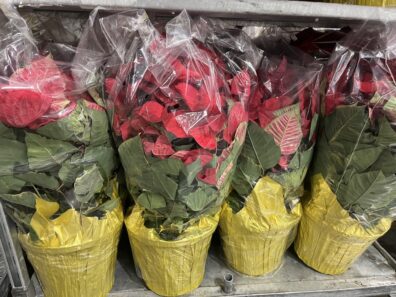
Over several decades, the Ecke family developed a grafting technique that turned a single stemmed jungle shrub into the plant we recognize today.
If you’re shopping for a poinsettia, choose a plant that isn’t losing leaves and has foliage right down to the soil line.
The brilliant red stars aren’t actually flowers, but are bracts, or modified leaves. The flowers are small, greenish, and clustered in the bract’s center. Each has a yellow nectary.
Take a good look at those true flowers. If they’re closed up and still green or reddish, this plant will likely last a long time. If you can see pollen, the plant is past its prime and will start losing those colorful bracts.
As spectacular as they are in December, Poinsettias fade fast after Christmas. Expect the plant to drop some of its bracts and leaves after the flowers shed their pollen.
When it comes to getting them to re-bloom again, poinsettias are notoriously tricky. It’s all about photoperiodism.
By 1938, research revealed that it wasn’t day length that triggered the seasonal flowering response of plants like holiday cactus and poinsettias as previously believed. It was the uninterrupted dark period. In some plants, if the critical period of darkness is interrupted by as little as a one-minute exposure to light from a 25-watt bulb, flowering will not occur.
It’s challenging for home gardeners to get short-day Poinsettias to re-bloom indoors, where artificial light extends the day. If you’re feeling lucky, following these steps may lead to a Poinsettia that will re-bloom next Christmas.
Make sure the foil wrapper has been removed from the pot. Drainage is important. Move the pot to a cool location with indirect light, and water when the top 1” of soil feels dry. The goal is to keep the plant alive, without stimulating new growth. When all danger of frost has passed, move the plant outdoors to a bright, morning sun location. Cut the stems back to about 6 inches, and repot the plant into a slightly larger container. As new shoots grow, pinch the tips of the stems to make the plant bushier. Stop pinching September 1. Water and fertilize regularly.
On October 1, or before nighttime temperatures drop below 40 degrees, bring the plant indoors. It will need 14 hours of continuous, uninterrupted darkness each night. Try an unused closet, or cover the plant with a box.
Bring the plant out for 10 hours of bright, indirect light during the day. Continue to water and fertilize.
By early November your plants should be developing color, and you can end the daily darkness routine and keep the plants in bright, indirect light. By the end of November, your Poinsettia should be re-blooming.
Given how much time it takes to coax a Poinsettia to re-flower, this advice could be the best you’ve ever ignored. You have my permission to add the plant to your compost pile, and buy a blooming one again next year.