Time to Plan and Plant Garlic
by Deborah Moucka, Yakima Master Gardener
As I was cooking up salsa from my tomato harvest this fall, I had the pleasure of reaching into the cool storage under the basement steps and pulling out some of my first-ever garlic crop.
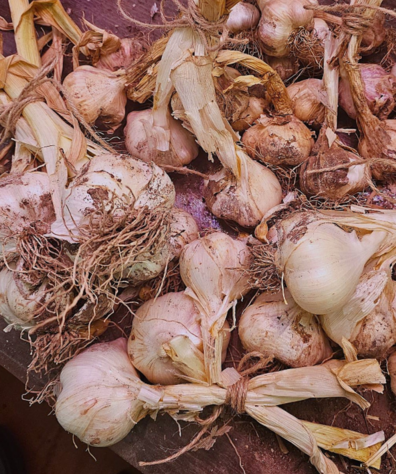
Last fall I had a delightful time investigating the world of garlic. I was pleasantly surprised at how straight-forward the process of growing is – beginning to end. So, here are the three main tips for getting your garlic into the ground this fall – 1) when to plant, 2) how to plant and, 3) what to plant. I’ll even throw in a few delicious ideas for what to do with your garlic crop, so you can think about how much to plant.
When to Plant. Garlic is unusual for many home gardeners, because its growth pattern spans 9 months from planting a clove to harvesting a bulb. Here in the shrub steppe, where we get freezing temps, garlic needs to get into the ground before the ground freezes. Typically, our first hard frost (lower than 28 degrees F) is mid-to-late October. This means garlic planting time is October 1st through November 15th. It has to set down roots, then go dormant. The dormant period triggers it to stop making leaves and start forming the bulb instead. Come spring and warm weather, it can then support rapid leaf growth needed to form large bulbs.
How to Plant. Garlic likes full sun, in well-drained loamy soil with ample organic material. Work in a couple tablespoons of 5-10-10 fertilizer, bone meal or fish meal several inches below where the garlic base will rest. Choose large bulbs. Separate the cloves and plant them root side down, pointed side up.
The cloves need to be planted 2” deep (elephant garlic’s larger cloves can be 2-4” deep). I like getting my hands dirty, so I use my thumb for the hole, making it fast and easy. A gardening dibble works well too.
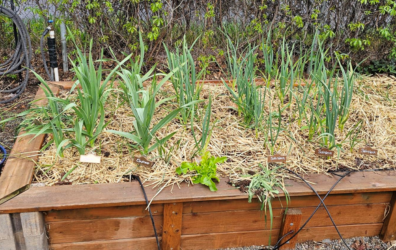
Experts differ on how far apart the cloves and rows should be. Typically, cloves can be about 4” apart, elephant garlic about 6” apart. You can see in my photo that the elephant garlic on the left is definitely larger and needed more room between the plants. Recommendations for distance between the rows is 10-18”, depending on how much gardening space you have. Again, elephant garlic likes more room to grow. You can see that I experimented with varying row distances for my first planting.
In mid- to late-November when the ground begins to freeze, mulch with 4-10” of straw (pine needles work too). This ensures that it won’t heave with the freezing and thawing. In the spring, when the tips begin the merge, pull it back and leave it between the rows to keep the weeds down.
What to Plant. This was the most fun part for me. Shopping for garlic can be a delicious and delightful adventure. Choosing hardneck garlic gives you richer, more pungent flavor with tall, flowing stalks, with varieties like Music, Romanian Red, Korean, and Spanish Roja. Softneck garlic forms larger bulbs, with softer flower stalks that can be braided and varietal names like Inchellum Red, California Red, Silverskin and California Early. If you like cooking, it’s worth spending a little time reading about the varieties. For example, Metechi has a spicy flavor and Killarney Red has a sweet, earthy flavor. (Don’t forget to label your rows if you’re planting more than 1 kind!) And then there’s the outlier – elephant garlic – which is actually a type of leek. But roasted and spread on sourdough bread, you will never get my family and friends to argue about its “name” or gastronomic value!
How Much? Last fall I bought my bags of softneck and elephant garlic for planting. Gave my thumb a good workout planting row after row of cloves. It seemed like a lot to me. Come this summer I harvested. Wow, it really seemed like a lot. I started cooking up my regular batches of homemade salsa and traditional basil pesto. And then I found this gorgeous French style preserved garlic in olive oil that’s delicious in everything from mashed potatoes to paninis. And then I found Pesto alla Trapanese (a Sicilian tomato and toasted almond pesto). And then… Well, my enthusiasm for all things homegrown garlic had dwindled my crop under the stairs and it wasn’t even replanting season yet. So, my last tip is have a great time planning and planting. And as my family is fond of saying, “There’s no such thing as too much garlic!”