Washington State University Extension Mason County helps people put research-based knowledge to work, improving their lives, communities, and the environment.
To realize this mission, faculty and staff plan, conduct and evaluate research and experience-based educational programs to improve the lives of Mason County residents.
WSU Extension Mason County also employs the assistance of hundreds of volunteers and community partners and provides access to the resources available at Washington State University and the National Land Grant University Extension System.
Partnerships
Mason County and Washington State University have a long-standing partnership in providing educational programs and research-based information to residents throughout the county. This partnership ensures that resources are committed from Federal allocations and University funds to keep important educational programs available in Mason County.
- Early Learning Coalition
- Shelton Timberland Library
- Mason Conservation District
- Mason County Health Department
- Hood Canal Salmon Enhancement Group
- Hood Canal Coordinating Council
- School Districts—Shelton, Pioneer and Hood Canal
- Saints’ Pantry Food Bank
- Mason General Hospital
- Washington Conservation Corps
- South Sound Reading Foundation
- Mason County Therapeutic Court
- Community Services Offices
- Blue Zones Activate Mason County
- Economic Development Council of Mason County
- Shelton Farmers Market
- United States Forest Service
- Washington State Parks
- Washington State Department of Agriculture

Dan Teuteberg, County director & 4-H Youth Development Specialist
360-427-9670 Ext. 686
WSU Extension Mason County
360-427-9670 Ext. 680
Facebook Pages
- Facebook pages:
- Mason County 4-H
- Mason County Noxious Weed Control
- Mason County WSU Master Gardeners
- WSU Small Farms Mason County
4-H Youth Development
State Fair Representation
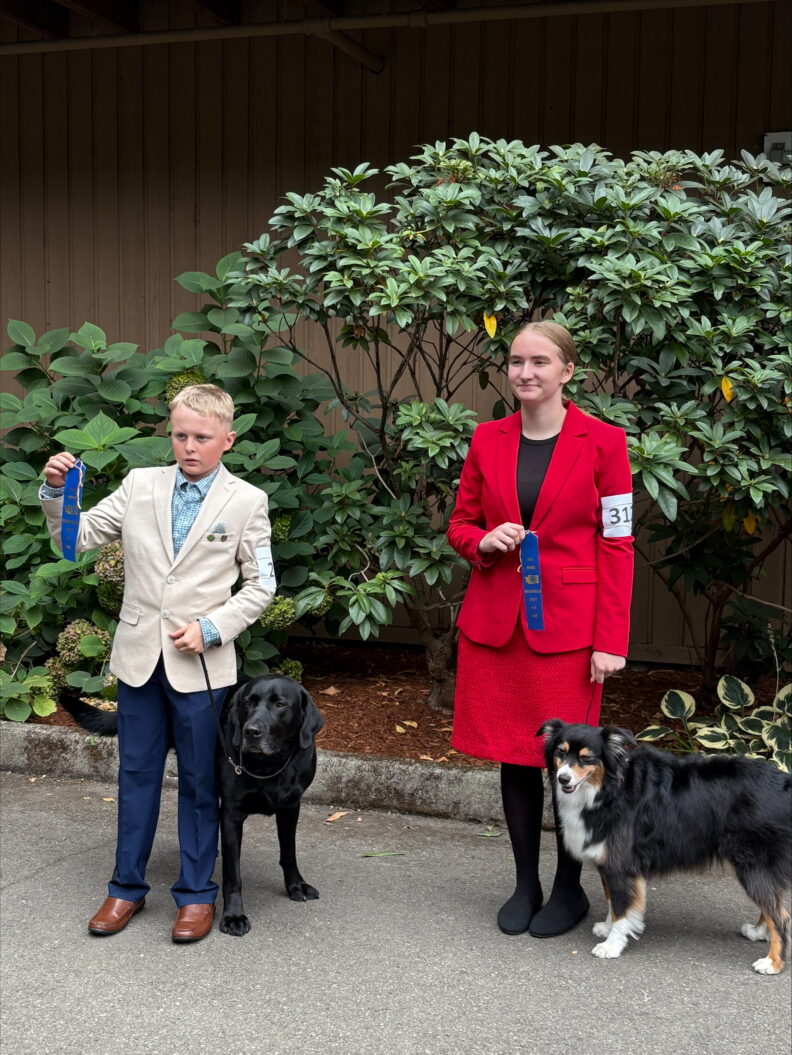
This fall, Mason County 4-H was proudly represented at the Washington State Fair by multiple youth who showcased the dedication and creativity fostered through our program. Violet Norrick of the Forest Adventures Club presented several still-life entries focused on creative arts, highlighting both skill and imagination. Natalie Seals of the Barn Bums Club, alongside her dog Milo, competed at the state level and earned a blue ribbon for their efforts. These opportunities reflect the time, commitment, and confidence our youth build through 4-H, and we are incredibly proud to see Mason County members representing our program on a statewide stage.
Strong Start to the 2025-26 4-H Year
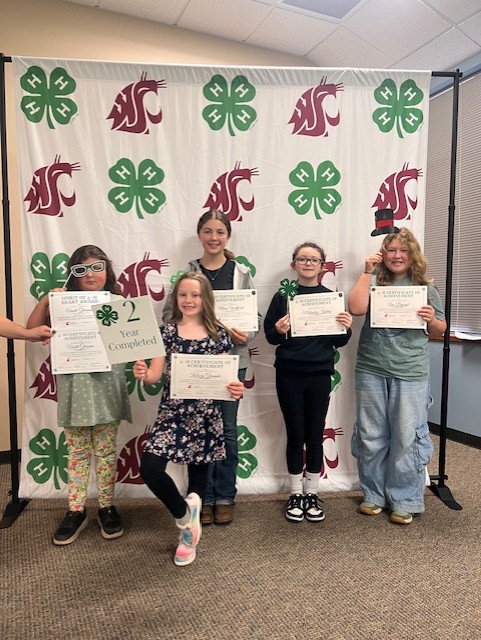
We officially kicked off the 2025–26 4-H year with a full house at our club kick-off meeting in October. The evening brought together leaders, families, and youth from across Mason County and marked an exciting milestone, all clubs were represented. This strong start carried into the Fall and Winter Clover Campaign at our local Tractor Supply, where clubs engaged with community members, shared information about their projects, and helped raise visibility for 4-H throughout the county.
Community Presence & Holiday Engagement
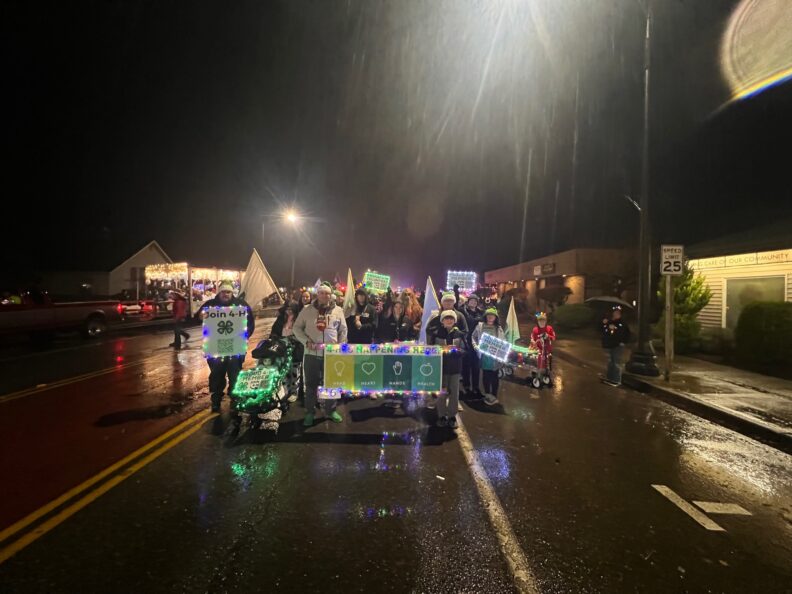
Mason County 4-H continued to stay active and visible in the community throughout the holiday season. A mix of club members and volunteers proudly represented 4-H in the local holiday parade, while our Tech Changemakers Club hosted a festive booth offering snacks and hot chocolate at the Christmas Tree Maze. These efforts helped keep 4-H front and center in Shelton, while providing youth with opportunities to practice leadership, teamwork, and community service in fun and meaningful ways.

Number Recap:
Master Gardener
Volunteers Awarded Grant from Community Foundation of South Puget Sound
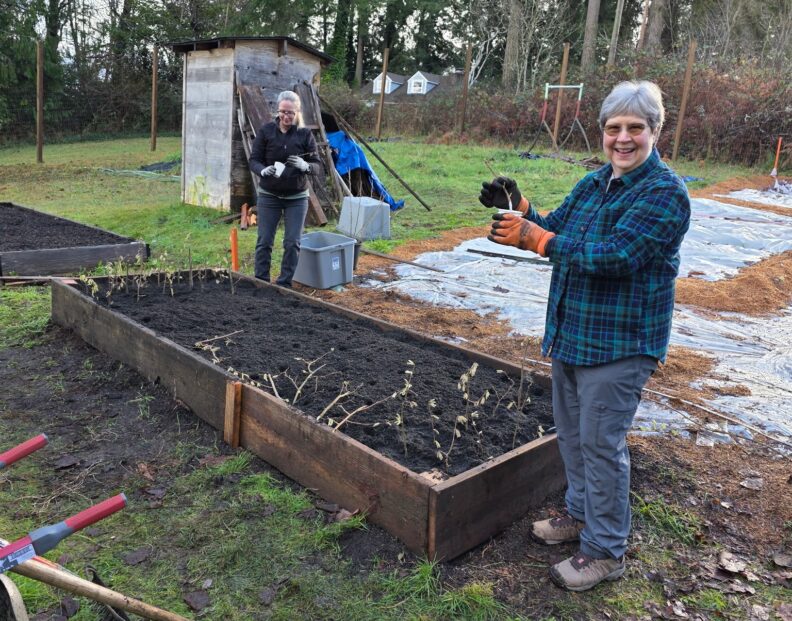
Native plants benefit our environment in many ways; they increase biodiversity, reduce water use, provide habitat and food for wildlife and pollinators, and can be used to mitigate pollution caused by stormwater runoff. Two hard-working groups of Master Gardener volunteers, passionate about increasing the use of native plants in home landscapes, have been coordinating to bring field-based educational workshops and work parties to Mason County residents. Their goal is to improve community knowledge about the benefits of native plants, identification, and propagation, and increase accessibility to native plant material. They are hosting this education through two in-person Demonstration Garden sites: the Native Plant Learning Center at Catalyst Park and the beds surrounding the Education Center at Theler Wetlands. Recently, our two groups were awarded $6,000 over two years from the Community Foundation of South Puget Sound to continue enhancing their work!
Successful Kickoff for Through the Garden Gate
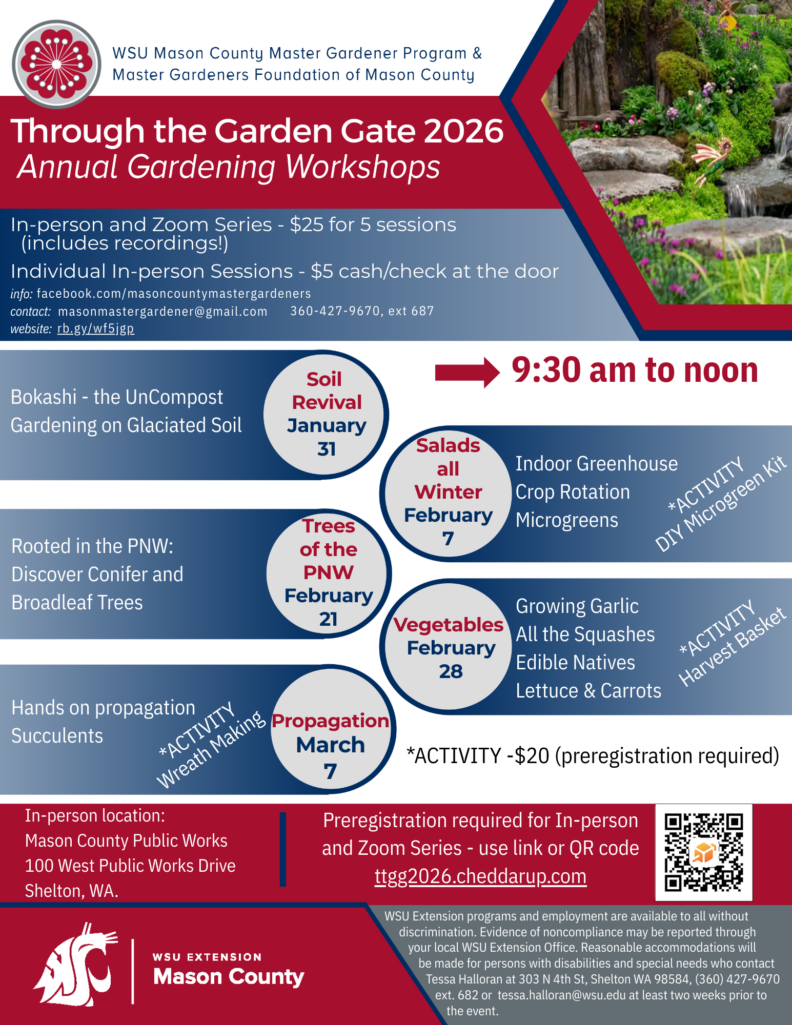
Our very popular hybrid Through the Garden Gate series is back again for 2026 with five sessions from January to March. We kicked off the series with 75 attendees who came to learn about Bokashi Composting and Gardening on Glaciated Soil. Our second session, Salads All Winter, which covered growing microgreens and hydroponic fruits and vegetables, attracted 78 attendees. We still have room for you and two more sessions to come! Join us for Trees of the PNW, Growing Vegetables, and Propagation. More information is available at extension.wsu.edu/mason/master-gardener/through-the-garden-gate.
Number Recap:
Small Farms
Septic Summer Planned for 2026
In partnership with Mason County Environmental Health, we are continuing our Be Septic Smart workshops in 2026 with Septic Summer! We plan to host three workshops in June, July, and August in Matlock, Hoodsport, and Belfair. Topics will include different types of septic systems, how they function, basic maintenance, best landscaping practices, local resources, and financial assistance. Participants will also be able to opt into receiving a copy of their current as-built. Current dates and locations are pending, but once registration is open, it will be available at extension.wsu.edu/mason/agriculture/classes.
Cultivating Success: Agricultural Entrepreneurship™
We have had 57 statewide participants join us for Cultivating Success: Agricultural Entrepreneurship™ this year, with 2 participants from Mason County and many from surrounding areas such as Kitsap and Thurston counties. This course is designed to be an in-depth farm and food business course, which walks participants through the necessary steps to create a business plan for their farm business. Participants join via Zoom for the first half of the course, where they learn from Extension and other organization professionals as well as farmer speakers. Then, they attend an in-person regional intensive, where they sit down with WSU Extension staff and local specialists to work through some of the more challenging aspects of their business plan such as Enterprise Budgets, Labor Management, and Risk Management.
Bigleaf Maple Syrup Workshop
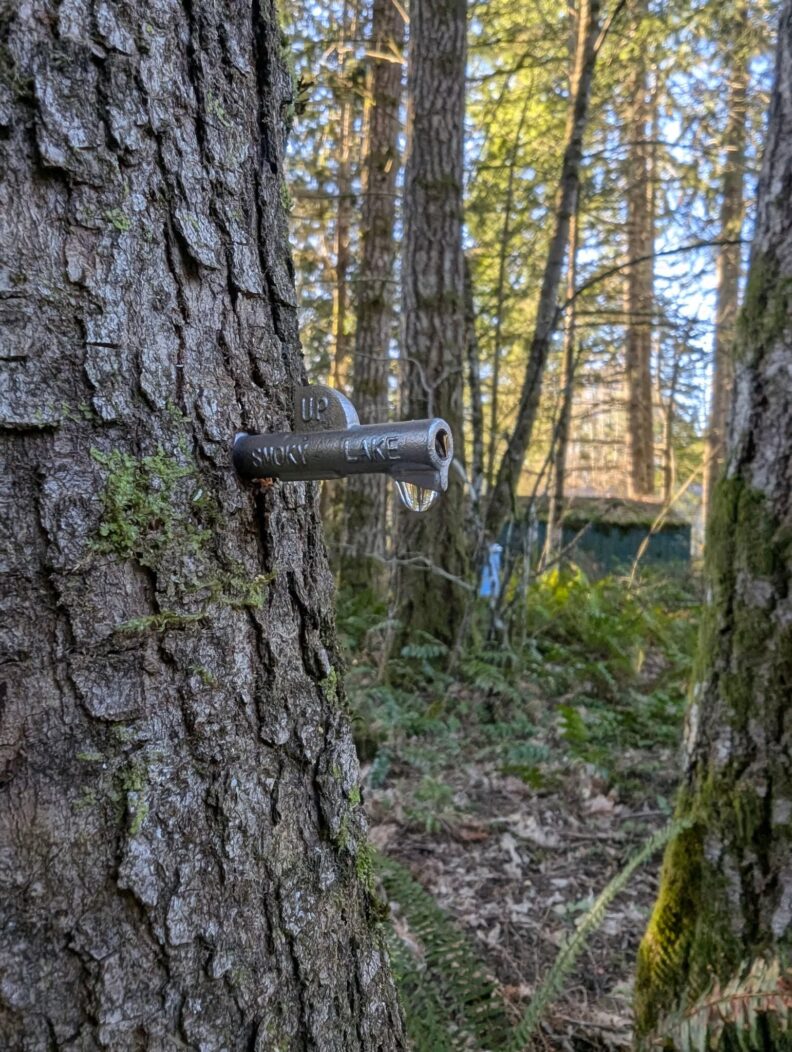
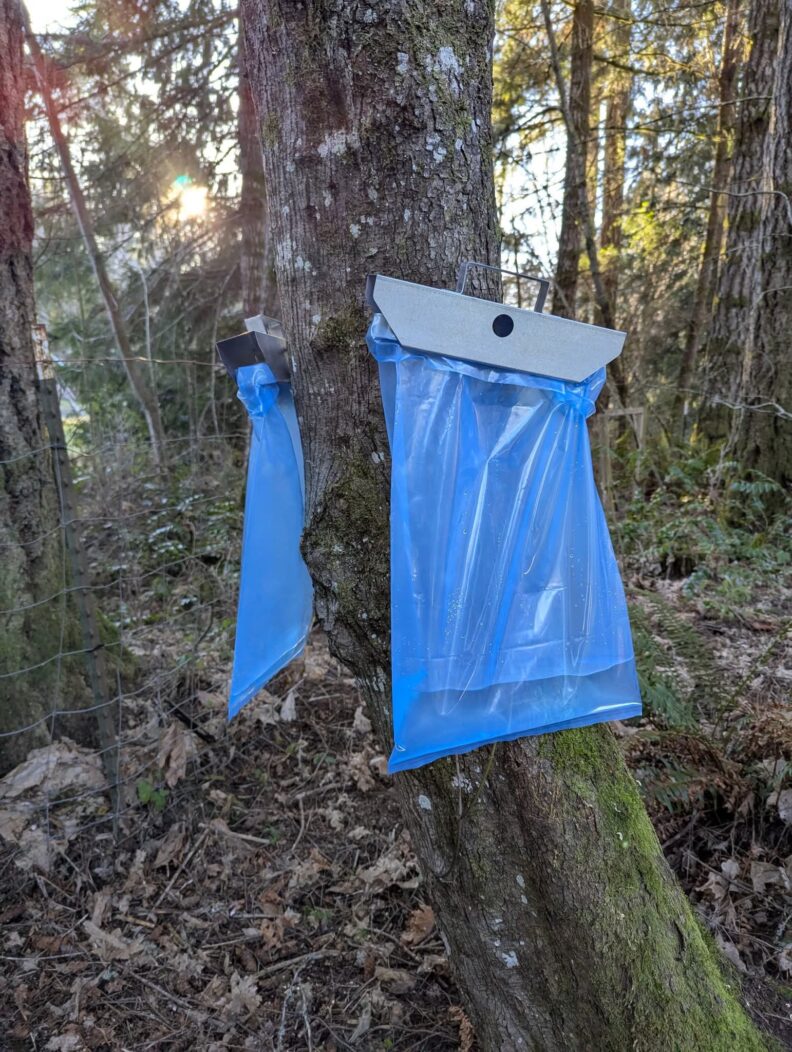
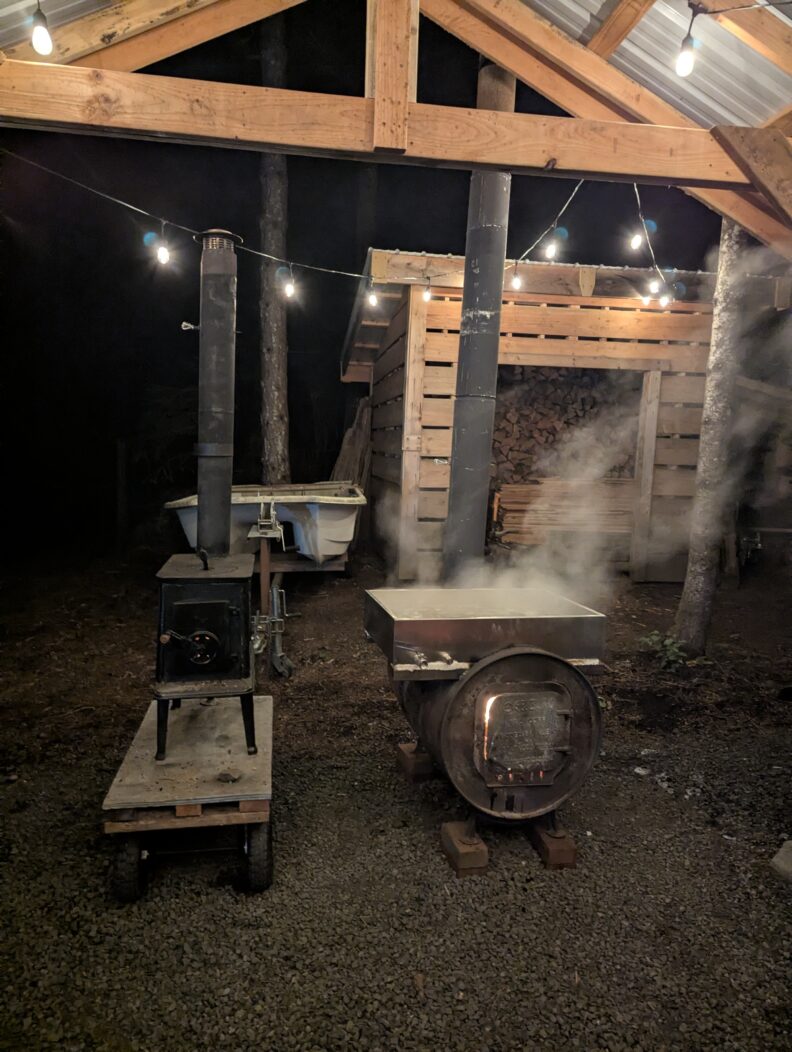
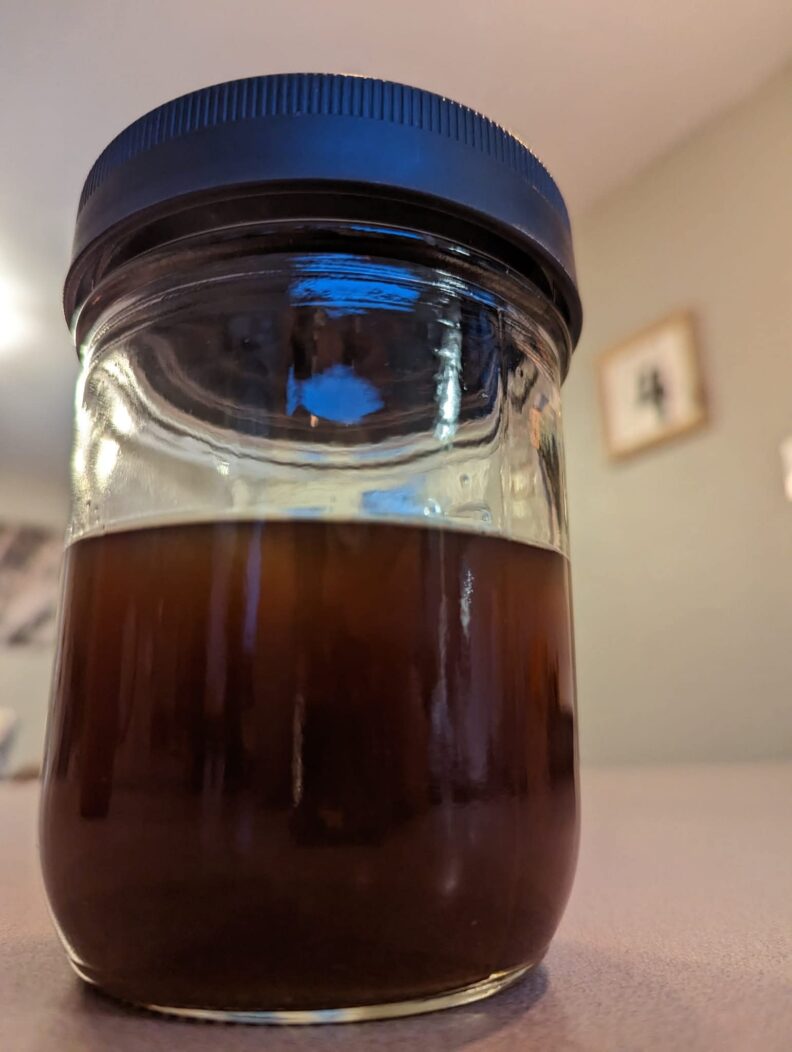
Did you know that you can make your own maple syrup right here in Mason County? The Bigleaf Maple tree calls this part of the Pacific Northwest their home. WSU Extension Forester, Patrick Shultz, and WSU Extension Mason County Director, Dan Teuteberg, hosted a Bigleaf Maple Sugaring workshop in December. Twenty-seven participants gained information on how to tap trees, supplies needed to collect and store sap, processing techniques, as well as the science behind making your own syrup. Participants even had a chance to drill a hole and place a spile into a tree! This hands-on workshop was a crowd pleaser and will be offered again in the fall of 2026!
Number Recap:
Noxious Weed Control
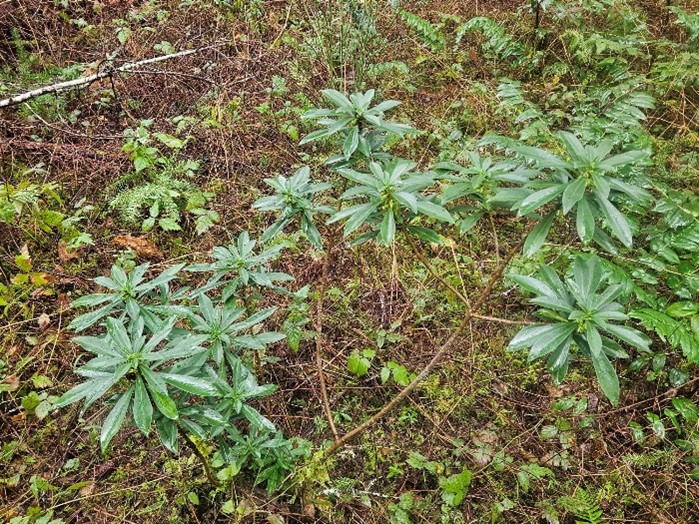
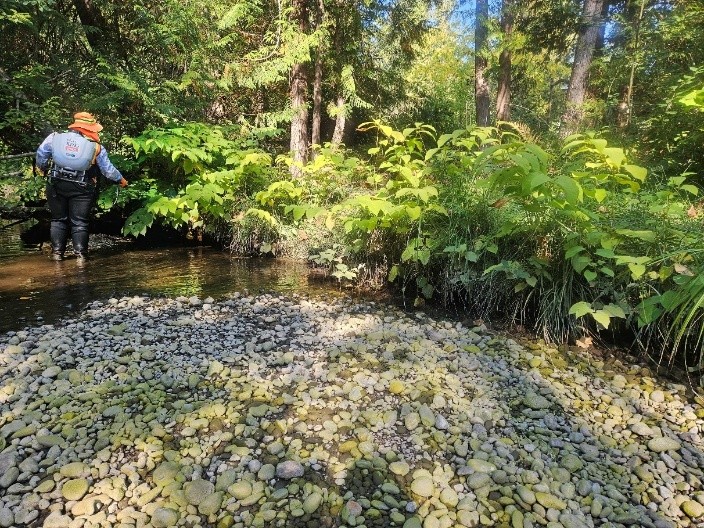
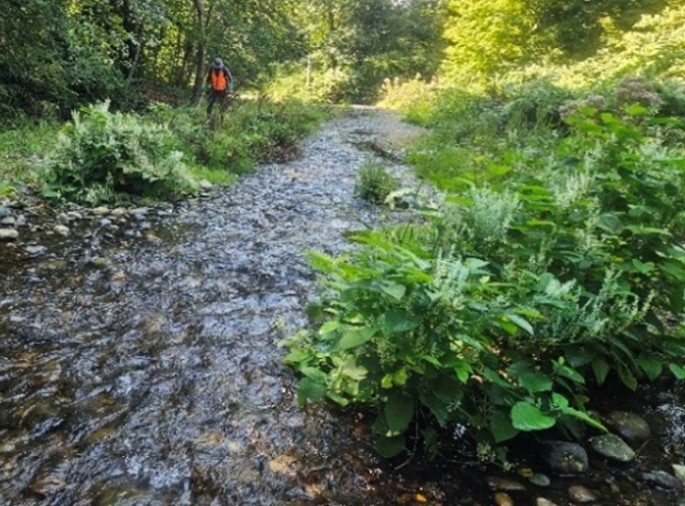
Our major weed control project in the fall is knotweed treatment. We assist public and private landowners control knotweed infestations on shorelines, creeks and upland sites in Mason County. Our 2025 work was focused at sites on Hood Canal, Case Inlet, North Bay, Finch Creek, Lilliwaup Creek, Sherwood-Anderson Creek, Coulter Creek, Mission Creek and Stimson Creek. We treated knotweed at 105 parcels for 85 landowners. We surveyed 8.7 creek miles and treated 5.23 creek miles for knotweed.
Through the fall and winter our program completed reports on the 2025 field season. We treated over 343 acres and surveyed over 475 acres for noxious weeds. We controlled 35 different invasive species at sites in the county.
Currently, we are working on survey and control of spurge laurel, shiny geranium and lesser celandine.
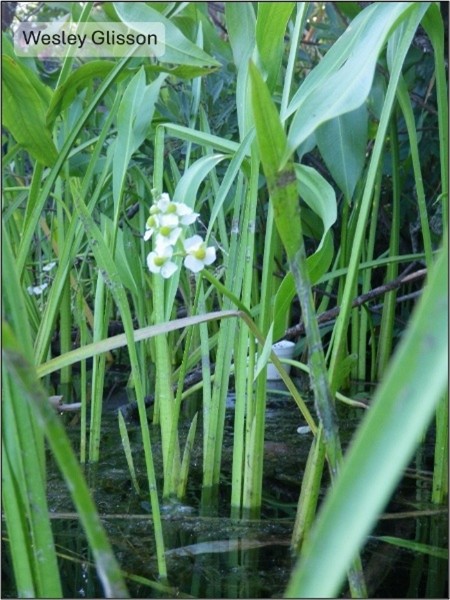
We’ve updated the 2026 Mason County Noxious Weed List. Delta arrowhead (Sagittaria platyphylla), sunflower broomrape (Orobanche cumana), and waterhemp (Amaranthus tuberculatus) were added as Class A noxious weeds and require eradication in the state.
Our main education and outreach event in the fall is Oysterfest. This is a great event that our program participates in annually. We had over 360 attendees stop by our booth to learn about noxious weeds. We also created a noxious weed identification game as part of the Oysterfest passport challenge. This helped attract new people to our booth and increase engagement with community members.
Numbers Recap:
Food Safety & Preservation
Skokomish Health Fair
WSU Extension participated in the 2025 Skokomish Health Fair providing a variety of program resources. A WSU Food Safety and Preservation staff member was on hand to answer questions and provide resources to current USDA research-based information. This is especially important in today’s world where information is readily available and not always accurate. Another focus was the importance of annual pressure gauge testing for those canners with a dial gauge. Dial gauge accuracy is critical for the safety of preserving low-acid foods such as vegetables and meat. Pressure gauges are tested free of charge at the WSU Extension office.
Other programs represented that day were 4-H, Master Gardeners and Small Farms.

Community Engagement
Community Service and Team Building
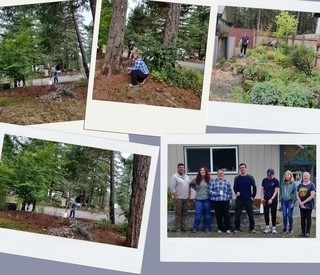
On September 12th, WSU Extension Staff held a day of service which also included team building and program planning. Staff chose Adopt-A Pet of Mason County as their community service project. The morning was filled with weeding, pruning, mowing, and concluded with a tour of the facility and lots of happy pups. This time also allowed staff the opportunity to discuss programming efforts and goals. The afternoon focus was team building, program planning and strengthening partnerships.
The month prior to the day of service, WSU Extension staff held a pet drive for Adopt-A-Pet. On the day of the event a trunk full of donated dog food, toys and supplies were delivered to some very thankful volunteers.
Our Team
Mason & Grays Harbor County Director & Youth Development Specialist
Office Manager & Food Safety & Food Preservation Assistant
4-H Program Coordinator
falyn.taylor@wsu.edu