Washington State University Extension Mason County helps people put research-based knowledge to work, improving their lives, communities, and the environment.
To realize this mission, faculty and staff plan, conduct and evaluate research and experience-based educational programs to improve the lives of Mason County residents.
WSU Extension Mason County also employs the assistance of hundreds of volunteers and community partners and provides access to the resources available at Washington State University and the National Land Grant University Extension System.
Partnerships
Mason County and Washington State University have a long-standing partnership in providing educational programs and research-based information to residents throughout the county. This partnership ensures that resources are committed from Federal allocations and University funds to keep important educational programs available in Mason County.
- Early Learning Coalition
- Shelton Timberland Library
- Mason Conservation District
- Mason County Health Department
- Hood Canal Salmon Enhancement Group
- Hood Canal Coordinating Council
- School Districts—Shelton, Pioneer and Hood Canal
- Saints’ Pantry Food Bank
- Mason General Hospital
- Washington Conservation Corps
- South Sound Reading Foundation
- Mason County Therapeutic Court
- Community Services Offices
- Mason Matters
- Economic Development Council of Mason County
- Shelton Farmers Market
- United States Forest Service
- Washington State Parks
- Washington State Department of Agriculture

Dan Teuteberg, County director & 4-H Youth Development Specialist
360-427-9670 Ext. 686
WSU Extension Mason County
360-427-9670 Ext. 680
Facebook Pages
- Facebook pages:
- Mason County 4-H
- Mason County Noxious Weed Control
- Mason County WSU Master Gardeners
- WSU Small Farms Mason County
4-H Youth Development
WSU 4-H Teen Conference
The 2026 WSU 4-H Teen Conference brought together youth leaders from across Washington at Washington State University in Pullman. Mason County was proudly represented by five outstanding teens who not only attended the conference but also took on leadership roles. Four members presented their nationally recognized Dementia Friends workshop, sharing the importance of creating dementia-friendly communities, while another served as both a Teen Facilitator and Conference Planning Committee member. Their dedication showcased the leadership, public speaking, and service skills that Mason County youth continue to develop through 4-H while building connections with peers from across the state.
2026 Grays Harbor & Mason County Summer Camp
This summer, Mason and Grays Harbor Counties once again partnered to provide an unforgettable week of 4-H Summer Camp. Thanks to the dedication of our volunteer Camp Committee, adult volunteers, and nearly 30 teen counselors, over 80 campers enjoyed a week filled with outdoor adventures, leadership development, and lifelong friendships. Summer Camp continues to be one of the most impactful experiences offered through 4-H, allowing youth to build confidence, independence, and teamwork while creating memories that last a lifetime.
Clover Kids: Bring a Friend Edition
This Summer we launched a Summer Clover Kids program welcoming new and returning families for afun-filled evening focused on creativity, friendship, and introducing youth to 4-H. Members of the Tech Changemakers (TCM) group partnered with a Mason County 4-H Council member to lead hands-on crafts and a paper airplane engineering competition. By encouraging participants to bring a friend, the event provided an engaging introduction to the 4-H program while allowing our teen leaders to mentor younger youth and share the many opportunities available through 4-H.
2026 Grays Harbor County Fair
Mason County 4-H members were proudly represented throughout the Grays Harbor County Fair, with youth participating in Still Life exhibits, Dog, Horse, and Rabbit projects, and many other competitive events. The fair provides youth with the opportunity to showcase months of hard work while developing valuable life skills including responsibility, communication, sportsmanship, and goal setting. We are incredibly proud of every member, volunteer, and family who helped make another successful fair season possible and represented Mason County with excellence.
Shelton YMCA Community Days
Mason County 4-H was excited to partner with the Shelton Family YMCA during this summer’s Community Days, creating new opportunities to connect with local families and share the many experiences available through 4-H. Through hands-on activities and conversations with community members, youth and volunteers helped introduce new families to our program while strengthening our partnership with another organization committed to positive youth development. Collaborations like these continue to expand the reach of 4-H and ensure more young people have access to meaningful educational and leadership opportunities.
Number Recap:
Master Gardener
Catalyst Park Food Bank Garden Tomato Trials
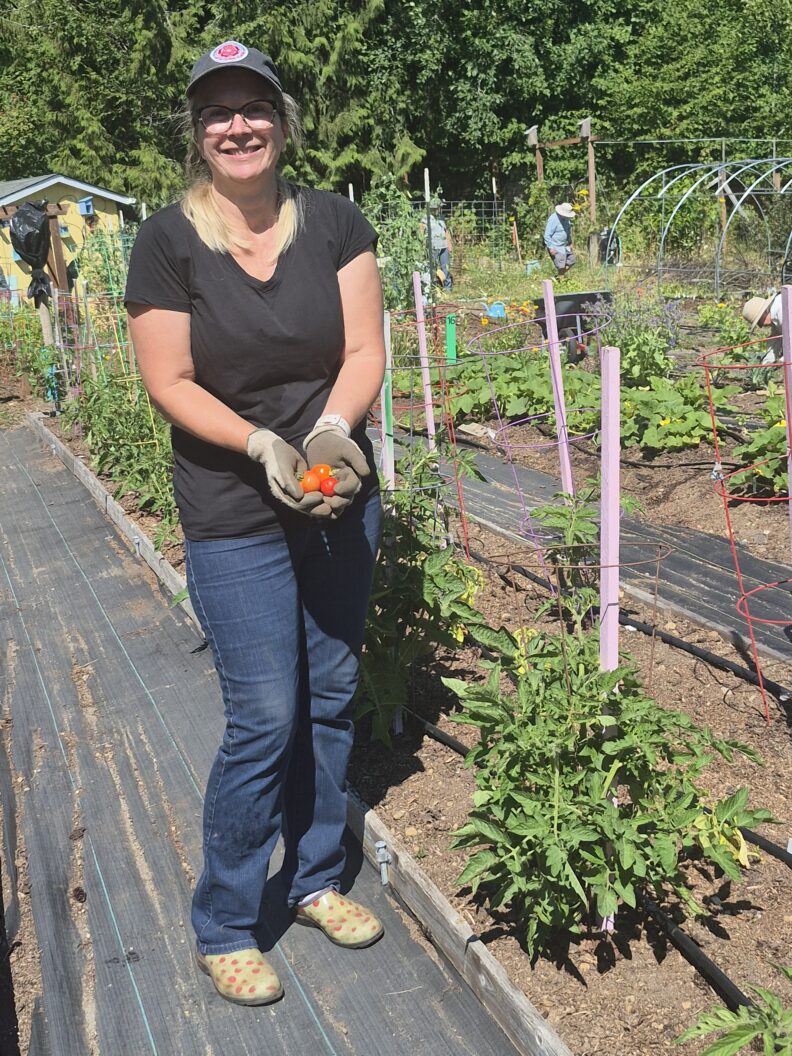
Tomato trials are currently underway at Catalyst Food Bank Garden! Three volunteers decided to grow tomatoes using different research-driven methods to see if there is a difference in production. The same tomato varieties were planted in each row; when they are picked, they will be weighed separately to determine if there is a difference in yield.
Intern Master Gardener, Dawn, used the “mudding in” technique for her tomatoes. The planting hole is filled with water, the tomato plant is placed into the water, and then soil is added back in. This technique is used to ensure there is plenty of moisture for the root ball and remedies plant stress from pot-bound roots.
Certified Master Gardener Karla chose to focus on healthy soil rather than planting techniques. Last fall she and two other volunteers planted a cover crop of cereal rye, vetch, winter field pea, clover, and phacelia. This was cut down to soil level in the spring prior to planting. Cover crops provide nutrients to the soil, prevent nutrient leaching, and supply a mass of green manure.
Lastly, Certified Master Gardener Diana planted her tomatoes using the lay down technique. The stem is buried horizontally, and the top few inches of the plant are bent up to be above ground. She also chose to cover the soil in black plastic, with two reasons behind it: 1) increase soil temperature around the roots and, 2) reduce weed pressure.
We’re excited to see the end results!
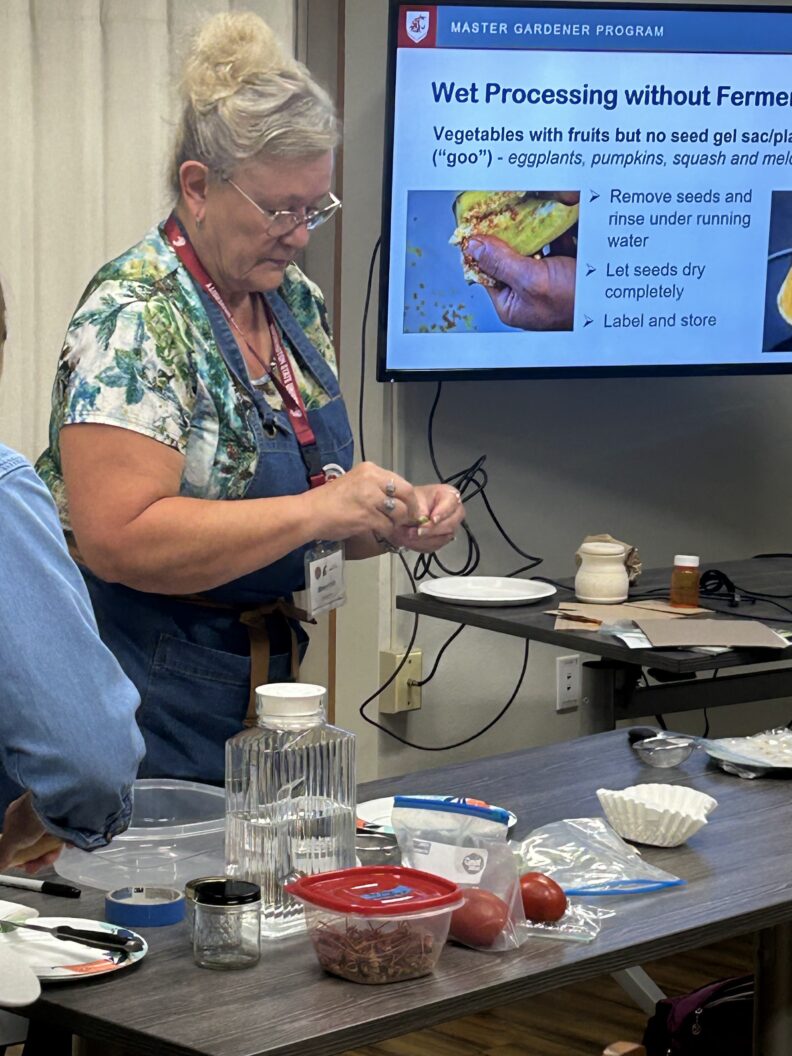
First Seed Saving Workshops at Timberland Regional Libraries
Master Gardener volunteers have been working hard to expand on the offerings of our new Seed Library collaboration with the Mason Conservation District and Timberland Regional Libraries. Certified Master Gardeners Gaye Rathburn and Diana Bell and Intern Master Gardeners Sheryl Hilt and Maddy Heilman hosted two free seed-saving workshops on August 7th in Belfair and August 14th in Shelton. Overall, we had 19 participants who were inspired to begin saving their own seeds and contributing to local food security efforts.
Number Recap:

Small Farms
Cultivating Success Launches New On-Demand Course
The Cultivating Success statewide team, under the WSU Food Systems program, has been hard at work developing a new on-demand, affordable, online course. Explore Your Farm Dreams, typically offered once per year as a three-hour live course, is now available for aspiring farmers and ranchers to take on their own time, year-round! For those who are wondering if they’re ready to begin their farming journey or early in the planning stages, this course is designed to help participants explore the development of a small farm enterprise and create a plan of action for achieving their small farm goals. This year, to celebrate the official course launch, the team offered a one-night live farmer panel on August 17th for all participants. The cost of the course is only $15, and can be accessed any time at cultivatingsuccess.wsu.edu/explore-your-farm-dreams-2
New Farm & Food Resources Maps Coming Soon
The WSU Extension Small Farms Program is partnering with the Mason Conservation District to develop an updated version of the Mason County Farm Fresh Guide and offer a new map focusing on Food Resources. The first represents for-profit local farms and food-hubs, and latter will showcase all our local not-for-profit farms, community gardens, and other important community food access resources. We are excited to offer these two distinctly different resource guides for residents of Mason County and hope that they inspire more individuals to become involved in our growing and diverse local food system.
A Community Presentations for Healthy Waters
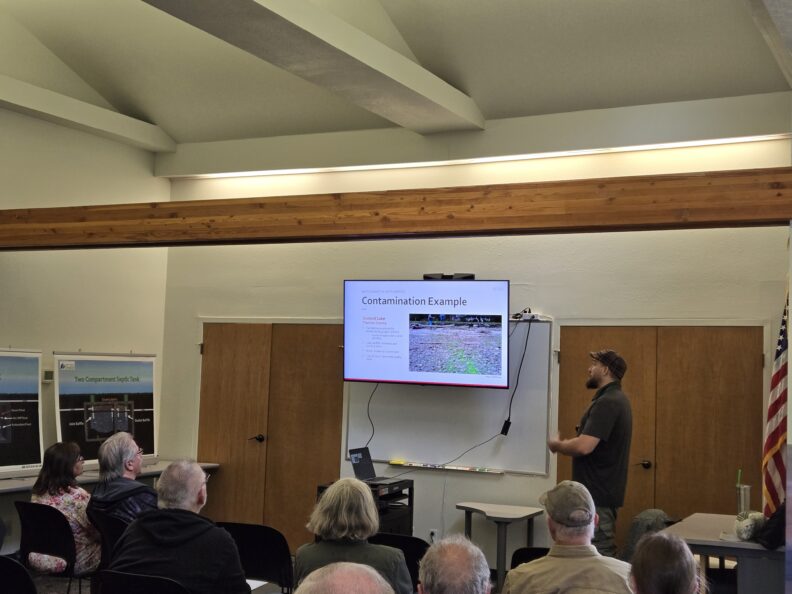
This summer, the Small Farms Program Coordinator continued collaborations with Mason County Environmental Health to offer Septic Summer education in addition to offering a talk for the LakeLand Village Community Club on “Landscaping for Lake Health.”
Twenty-one Septic Summer participants learned about different types of septic systems, how they function, basic maintenance, best landscaping practices, local resources, and financial assistance. Those who were interested also received copies of their as-builts. Out of our survey respondents, 100% said they had learned something new and 88% indicated that they plan on implementing something they learned from the class.
At the LakeLand Village Community Club, 36 attendees learned about landscaping practices that can help preserve lake health, such as reducing fertilizer and pesticide use, choosing appropriate plants for their landscape, managing runoff from impermeable surfaces, and controlling noxious weeds. The presentation covered many different native plants that serve dual purposes in the landscape, such as producing edible fruits while providing wildlife habitat, and reducing stress on the environment with lower requirements for inputs like water and fertilizer.
Number Recap:
Noxious Weed Control
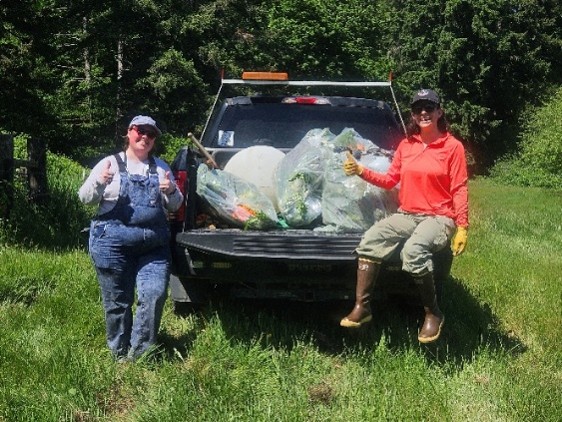
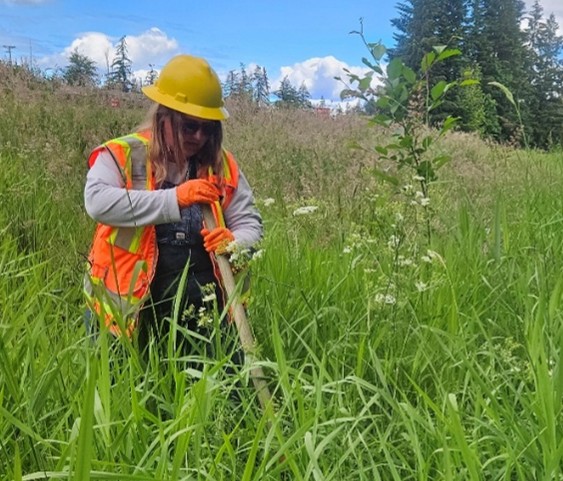
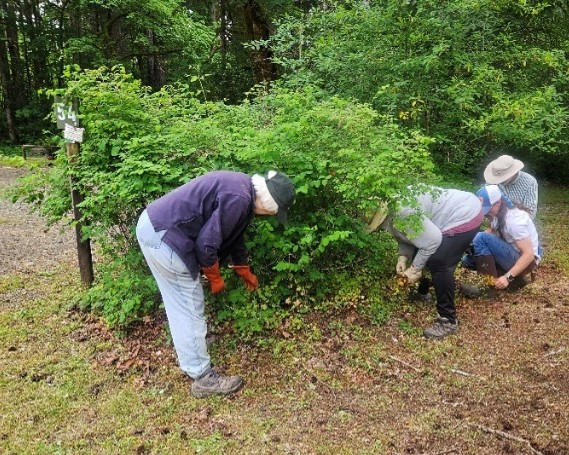
Summer is a fun and busy time for Mason County Noxious Weed Control Board (MCNWCB)! Our current work focuses on survey and control of noxious and invasive weeds at County-owned properties, private properties, Washington State Parks, and in the Olympic National Forest. We also provide technical assistance with noxious weed identification and control advice to private landowners and public land managers.
We provide important hands-on assistance to landowners by helping control high-priority class A and B designate noxious weeds. This summer we have focused on perennial pepperweed, poison hemlock, meadow knapweed, and giant hogweed.
MCNWCB partners with United State Forest Service to control invasive species in the Olympic National Forest. This year we have surveyed over 269 acres and treated over 130 acres for invasive species in the Olympic National Forest. High-priority species in this project area are herb Robert, tansy ragwort, wild basil savory, shiny geranium, false brome, and meadow knapweed.
We continue our work at State Parks in Mason County. This is a great opportunity for us to improve important recreation areas and educate visitors about noxious weeds. We’ve controlled spurge laurel, scotch broom, meadow knapweed, herb Robert, shiny geranium, perennial pepperweed and perennial sow thistle. MCNWCB worked with the volunteer group Friends of Schafer and Lake Sylvia State Park (FOSLS) to control herb Robert at Schafer State Park. While working there we located the high-priority noxious weed shiny geranium. We controlled the plants and educated the group about the impacts and identification of shiny geranium.
Numbers Recap:
Our Team
Mason & Grays Harbor County Director & Youth Development Specialist
Office Manager & Food Safety & Food Preservation Assistant
4-H Program Coordinator
falyn.taylor@wsu.edu