Originally published March 15, 2025 in the Yakima Herald-Republic. Minor edits have been made for web publication and accessibility.
by Phyllis Pugnetti
Three Sisters Gardens
Many people think ‘Three Sisters’ is a new concept in gardening. Actually, it’s an ancient practice that has been used by indigenous farmers throughout much of the Americas, from Canada to Chile. It’s more than just a farming method. It keeps the soil fertile, grows more food, and the food it does produce is high in protein, nutrition, and especially calories. The Three Sisters are the main staple crops that when eaten together will sustain human life. Today, Three Sisters remains important and is held sacred in many cultures.
The practice of Three Sisters is to plant corn, beans, and squash together. These are good companion plants with different, yet compatible needs for light, space, water, and soil nutrients. The look of Three Sisters farms varies based on the area where the farm is located. It’s a system that can be adapted to varied environments. A Three Sisters farm near the Great Lakes where the soil is fertile and there is plentiful rain will look far different than a farm in the arid Southwest. Regardless of how it looks, Three Sisters are always corn, beans, and squash.
Before the arrival of Europeans in the Americas there were very few animals that could be domesticated—no horses, donkeys, oxen, cows, pigs, sheep, goats, or chickens. Imagine how difficult it would be to feed yourself without any domestic animals for meat, milk, eggs, or to plow fields and carry heavy loads. There was no metal technology either. Farming or gardening without any metal tools made it a lot more difficult to grow enough food crops to keep people well fed.
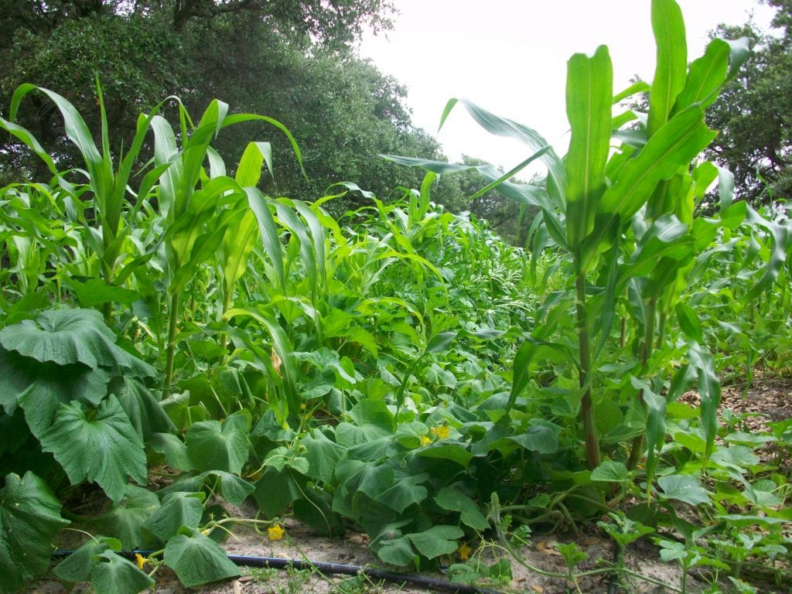
This is why the Three Sisters method was so important. In places where acres of land had to be cleared, without metal tools or large animals, it was easier to burn the trees and brush. The stumps and any bio-char that remained improved soil fertility. Then several rings of corn were planted around the stumps, with pole beans climbing the corn stalks which created a trellis. These circular plantings could be as much as 10-20 feet apart. The area between the circular beds was planted with squash allowing the long vines to cover the soil, reducing weeds.
Other Three Sisters farms may have separate fields of corn, beans, and squash and then the crops can be rotated each year. In places where there are groves of fruit trees, squash and beans might be grown up the trees using them as trellising, or they might grow between the trees to reduce weeds while the corn grows around the perimeter of the field. Again, these crops can be rotated between those growing around the trees and those on the perimeter. Some Three Sisters farms are laid out in a free form pattern of circles while others are laid out in a square grid.
Unfortunately many people report low yields with Three Sisters, mainly due to overcrowding. In a small backyard garden it’s easy to get carried away and plant too closely together. Squash may grow so aggressively that it chokes out the other plants. Corn planted too far apart results in poor pollination. The pole beans may be so heavy that they knock down the corn stalks. Avoiding overcrowding is definitely a key to success.
There are ways to incorporate Three Sisters into your yard or garden. Growing one circle as a demonstration garden or a child’s learning experience would be a fun project. If you have acreage, planting a large field using Three Sisters could be very successful, and at the end of the summer, your field would look like you stepped back in time. If you have raised beds you use Three Sisters to rotate crops from one bed to another.
The Three Sisters is an ancient practice that still has value today. It only takes a little creative thinking to make it work for you.