Tree of Heaven: Noxious and Invasive
by Susan Bird, Yakima County Noxious Weed Bureau
Tree of Heaven, Ailanthus altissima, once sold as an ornamental deciduous tree native to the temperate climates of central and northeast China, has become a noxious invasive species in the United States. Compounding the problem its invasive tendencies cause, Tree of Heaven is found to harbor an invasive insect, the Spotted Lanternfly (SLF) that threatens America’s food and forests.
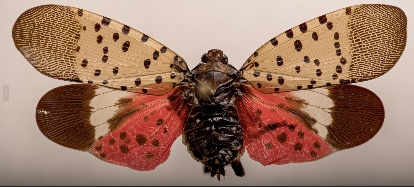
The SLF feeds on over 170 different plants, but favors grapes and hops. Live SLF has not been found west of Chicago, but they’ve rapidly spread across the eastern United States from the first discovery in Pennsylvania in 2014. Egg masses and dead adults have been intercepted on and in shipping materials in Oregon and California.
Tree of Heaven is found throughout the United States and was sold as an attractive, rapidly growing shade tree. However, if pruned or cut down, the persistent tree goes into survival mode and mass produces thickets of new growth, forming forests from its vigorous root system. There are over 7,000 locations in Yakima County known to have Tree of Heaven growing.
The roots of this tree can travel hundreds of feet, sprouting new trees in adjacent properties, roadsides, and alleyways.
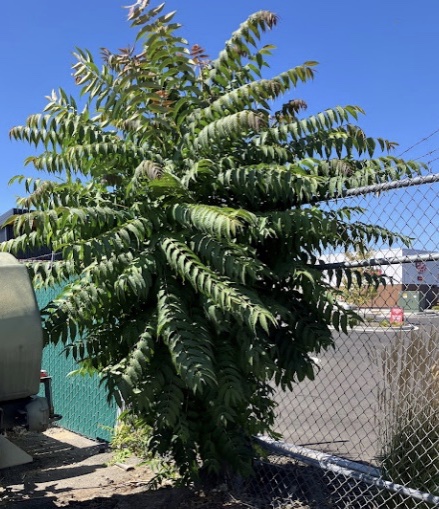
The young branches of Tree of Heaven emit an odor likened to rancid peanut butter or burnt popcorn.
The leaves of Tree of Heaven are compound and long, with up to 40 leaflets, giving it a palm-like appearance. The edges of the leaflets are smooth and toothless. When leaves fall from the branches, a v-shaped leaf scar is left on the branch.
The bark of Tree of Heaven has a slightly rough, crevassed, and cantaloupe rind-like appearance.
There are male and female trees and both bloom in the spring. However, only the female trees produce seeds. Seeds are in a paper samara like those of maple seeds. However, unlike the maple, the seeds of Tree of Heaven are in the center rather than on the edge of the samara. Seeds disperse in wind or disturbances, lodging and growing in pavement cracks and along foundations and roadways.
Controlling Tree of Heaven takes persistence. If you cut the tree down, a cut stump treatment must occur within 15 minutes or the stump will seal and not take in the herbicide. If you treat with a tree and brush herbicide, the tree should not be removed before a 60 day wait period. This allows the tree to move the herbicide to the roots and kill the root system.
There are other effective treatment options for Tree of Heaven.
If the trees are young, actively growing, and less than 20 feet tall, a foliar application of tree and brush herbicide can be applied to the foliage.
Basil bark oil with herbicide treatment can be applied to the bark from the ground up at the base of the tree. Completely cover the bark around the tree from the soil and up a few feet, depending on the height and circumference of the tree.
You can hack and squirt the herbicide around the cambium layer of the tree, leaving a few inches between each hack cut. Another option is to squirt concentrated herbicide into the hack marks within a few minutes of making the cuts.
If the tree is cut down, the fresh cut stump can be treated with a concentrated herbicide applied to the circumference of the stump and in a few inches. Make certain you apply the herbicide to the growth rings and outer few inches, if not the entire stump surface, within a few minutes of treatment. If you wait longer, the tree sap will seal the cut and the tree will not absorb the herbicide.
Stump injections with herbicide shells or drill injections using concentrated herbicides also work well.
Removal of trees should not be done prior to 60 days after treatment with bark or foliar applications.
If you are doing the treatment yourself, ALWAYS read and follow the label instructions on the herbicide.
In Washington State, the Washington State Department of Agriculture is recommending removal of Tree of Heaven along transportation corridors, interstate highways, railways, and river shipping corridors. This is being done in the hope of buffering our agricultural lands from the inevitable arrival of the Spotted Lanternfly.
The Yakima County Noxious Weed Bureau can assist landowners within these corridors with treatment of trees. However, it is the responsibility of the landowner to have the trees removed. Currently, this is voluntary and recommended but not required.
If you have any questions about the tree, its removal, or programs to remove it contact the Noxious Weed Bureau at (509) 574-2180.