Revolutionary Trees
by Carol Barany, Master Gardener
On this Fourth of July, who ever thought today’s gardening column would be a place to reflect on American history?
Last Saturday, retired forester and lifetime naturalist Bob Chicken led a group of tree-lovers through the Yakima Area Arboretum in celebration of America’s 250th Anniversary. In a fascinating talk titled ‘Revolutionary Trees,’ Bob shared stories of how trees became powerful symbols of freedom, resilience, and defiance against oppression in the foundational days of the American Revolution.
It was the first time I looked at our country’s history through the lens of its trees.
Early colonists depended on massive Eastern White Pines for construction projects and their own shipbuilding industry, but they faced competition. Because the United Kingdom had largely depleted its own forests, its Royal Navy relied heavily on the tall, strong, and rot-resistant white pines of New England for ship masts.
Bob shared an illustration of the HMS Victory, Admiral Nelson’s renowned flagship. Commissioned in 1765, construction depended on timber from 6,000 trees. The ship’s three main masts were 3 feet square at the base, 220 feet tall, and made from New England’s incomparable Eastern White Pine.
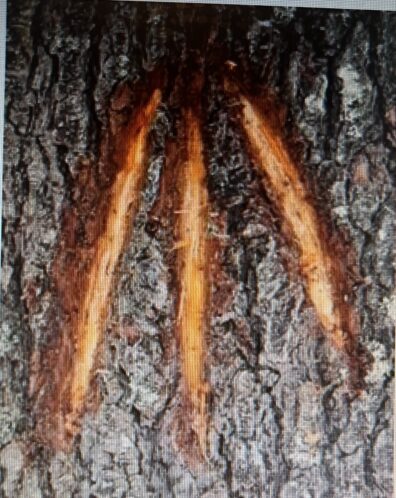
To control the supply of this vital commodity, the British Crown implemented the Broad Arrow policy in a series of White Pine Acts. King George I assumed ownership of the tallest Eastern White Pines, even trees growing on private colonial property. A band of surveyors was appointed to mark all white pines over 24 inches in diameter with a symbol of three hatchet slashes known as the ‘King’s Broad Arrow.’ They were shipped back to Britain on special barge-like vessels that could carry up to 50 pine trunks at a time.
It was a severe crime for colonists to cut these trees.
The Eastern White Pine was so valued by colonials that its seizure by the British sparked a substantial rebellion. New Hampshire’s Pine Tree Riot of 1772 was a revolt against royal control of pine trees and may have been the inspiration for the famous Boston Tea Party in 1773. That riot against England’s tax on tea significantly contributed to the start of the Revolutionary War.
When the Revolutionary War finally broke out, Britain lost access to New England timber reserves and had to rely instead on inferior wood from the Baltic region, severely impacting the Royal Navy’s ability to maintain its fleet.
Trees played other roles in our independence story. Because unauthorized public assemblies were dangerous, patriots found safety and cover under large, mature trees which served as the first public meeting halls.
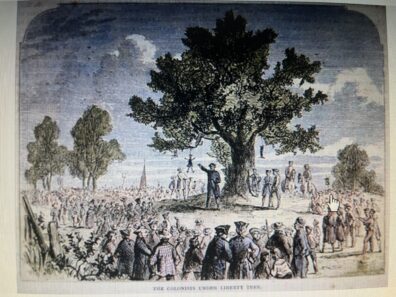
In 1765, the Sons of Liberty, a secret society advocating for the rights of colonists, began meeting in Boston to protest the Stamp Act. They gathered under a massive elm tree they named the Liberty Tree. Planted in 1646 and situated on a main road in and out of Boston, the Liberty Tree remained a central rallying point and an early staging ground for the war. It was a place to post meeting notices and grievances, tar and feather British officials, and hang effigies of despised tax collectors.
The British would eventually cut down Boston’s Liberty Tree. In defiance, patriots across the thirteen colonies designated their own local Liberty Trees. The iconic tree would be featured on revolutionary flags, such as the Pine Tree Flag flown at Bunker Hill, and on the flags flown on George Washington’s earliest naval vessels.
The war effort would profoundly alter the natural landscape. During the harsh winter of 1777-1778, the Continental Army at Valley Forge cut down an estimated 127,000 trees to build huts for shelter and causing severe deforestation.
Trees are the most complex and successful plants on earth. Since primates appeared 65 million years ago, trees have played an integral part in our development by providing food, shelter, safety, medicine, timber and fuel. For 370 million years, they have been essential to all life on earth, and were pivotal in the founding of our country. As we celebrate the Fourth of July, take at least a minute to honor and celebrate trees and commit to protecting them for at least another 370 million years.