Gardener’s Favorite Native Plant
by Debra Kroon, Master Gardener
If you have ever asked any gardener what their favorite plant might be, they would be hard-pressed to pick only one. A simple stroll through their gardens would prove this true. Just as they have settled on one plant, they turn around and, “oh, I really love this one, too! It really is my favorite.” Then you stroll a bit further and the same exclamation occurs and now this is their favorite plant. It is quite fun.
I decided to ask a few native plant gardeners in our Master Gardener Program what their favorite native plant might be. I am confident it caused a bit of consternation at having to decide, perhaps like choosing a favorite child. They rallied to the challenge. Here are a few responses:
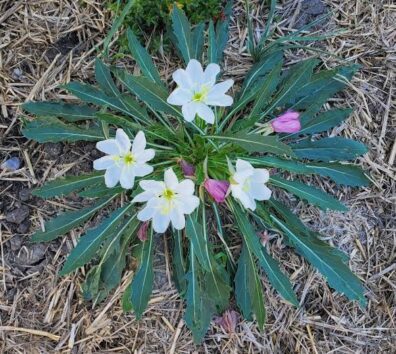
Debra Moucka writes “One of my favorite natives was an unexpected delicacy called Fragrant Evening Primrose. They were recommended for my Heritage garden. So, it was a delightful surprise when this plant with fuzzy gray-green leaves began parading its goblet-like white blooms in the evening and first thing in the morning. And soon, I found myself visiting my garden first thing in the morning and last thing in the day – much like the pollinators – for the fragrance as well as the beautiful appeal of blooms. Now, every year, I wait for them to emerge so I can once again enjoy my morning coffee and Primrose stroll, before we both duck away to hide from the Yakima heat of the day.”
Oenothera cespitosa, also known as Tufted Evening Primrose is a native to the Western United States.
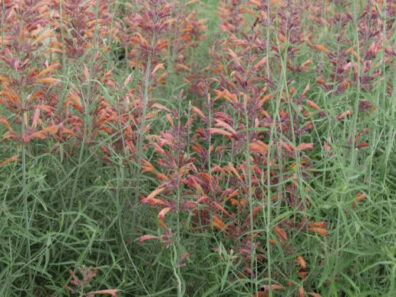
Lucy Stevens shares her favorite native: “After reading Nature’s Best Hope, by Douglas W. Tallamy, I was committed to using more Native plants in my garden. I learned about Sunset Hyssop (Agastache Rupestris) from the Heritage Garden Program here in Yakima. This plant is native to the hills of the Southwestern United States but does very nicely in our climate. I LOVE this plant. It is such an easy perennial that comes back better each year. Mine are about three feet by three feet with coral/pink flowers blooming all up and down the grey-leaved stems. They bloom from the beginning of July until late September. I don’t prune my down until very early spring, because the stems and dried flowers provide winter interest in the garden.
My favorite thing about this plant is that it attracts hummingbirds. It’s so wonderful to watch the birds drinking nectar from the long blossoms and occasionally having hummingbird wars over the territory.”
Fun Fact: This plant has a very lovely fragrance of licorice, anise or root beer, hence another name is licorice mint.
From Mikki Boughton, an MG intern this year, Coordinator with the Yakima County Heritage Garden Program through partnership with the North Yakima Conservation District: “There are so many great native plants and all for different reasons. How do you narrow it down? The smell of Bitterbrush in early spring? The bowing soft pink flowers of a Nodding Onion? The unassuming Snow Buckwheat that bursts into life in late summer? Mounding like a snowball ready to be thrown. Ultimately though, my favorite is Lupine. This is slightly cheating, as we have multiple types. It pays to know the difference. Some love a bit of shade, others full sun. All of them, though, are bright blue purple splashes in late spring. Look closely after a rain, and you will see a drop of water adorns the center of the leaves as if bedazzled by the sky. Sit long enough and you will find a Bumble Bee collecting nectar and pollen or a marmot having a midday snack. Whether you want an aesthetic garden or an ecological one, Lupine has a place in your space.”
And now I must choose a favorite. As predicted, this is a difficult task. As I write this I look out my window to enjoy the graceful, high-reaching Rudbeckia ‘Herbstonne’ (‘Autumn Sun’). Bees are busy working this plant now, but I often see birds visit as well. Especially in the winter for the seed caps.
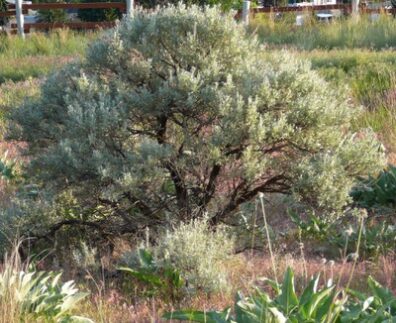
However, I am torn due to nostalgia. Growing up on the Columbia Basin, my two brothers and I enjoyed a wonderful 80 acre playground of unbroken land just across the road. It was filled with native big sagebrush (Artemisia tridentata). I do love big plants and fortunately we have the garden space to accommodate this big guy. While it provides habitat for native wildlife in its natural habitat, it also has cultural uses for Native Americans.
This sage is a multi-branched woody shrub that ages with twisted, gnarly trunks and a rounded shape. Leaves are small, gray-green or silvery-blue, covered in fine hairs that help trap moisture. It does produce tiny, yellow-green flowers in late summer to autumn. In spring you will find these spent clusters. If you are ambitious, you can trim these off. Fragrance? You bet! It is quite pungent, which some may find overpowering. But if you grew up playing day in and day out around this shrub, it is a wonderful scent. It is well suited to drought conditions as it has a very deep taproot and extensive root system, allowing it to reach deep for moisture It helps to prevent soil erosion.
These are just a very small sample of the many, many native plants that you might consider in your gardens. We are in our fourth consecutive year of drought in the Yakima Basin. Our use of water resources for our gardening practices needs to be reduced, or it may be forced. Here in Terrace Heights our water is carried through the Roza Canal system. We were shut down for 10 days to allow available water for agriculture later in the year. Who knows what 2027 will bring. Please do more than consider reducing your landscaping/garden water use.
Take action steps now. The Heritage Garden Program is a great place to start, along with attending free Master Gardener “Teachable Moments in the Garden” classes to learn more. Classes coming up that address some of these issues are:
- August 8, “Attracting Birds, Pollinators and Creatures to your Native Garden” with Mikki Boughton, Heritage Garden Coordinator – Location: Ahtanum Youth Park
- August 22, “Adopt-A-Monarch + Best Native Plants for Beneficial Insects and Pollinators” with Dr David James, WSU Associate Professor, Entomology – Location: Ahtanum Youth Park
- September 5, “Pollinators” with Don Flyckt – Location :Heirloom Garden, 1522 S 18th Avenue, Yakima.
- For all classes and more information, please go to our website: Garden Classes .