Autumn Leaves
by Carol Barany, Yakima Master Gardener
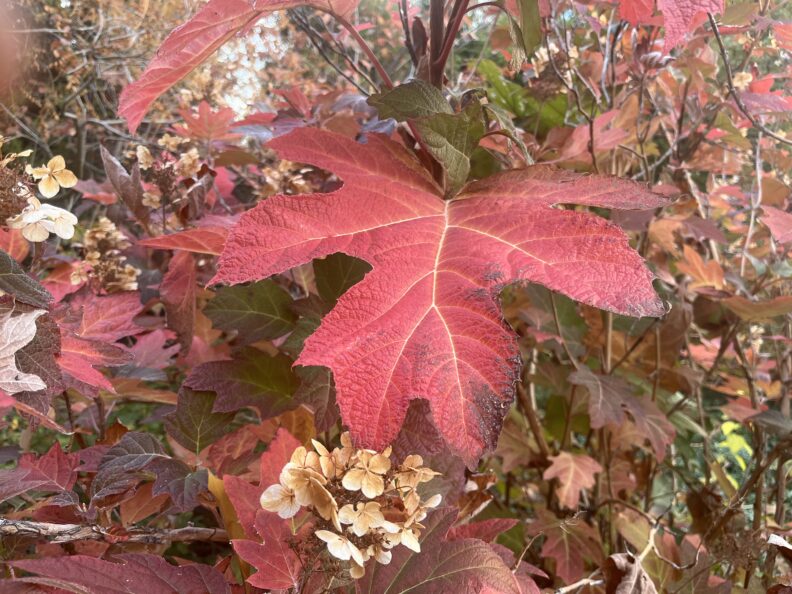
As we inch through autumn, the dazzling changes in the leaf colors of deciduous trees are so dramatic that the need to explain them seems universal.
Long before science could explain them, humans tried as best they could with epic explanations involving supernatural creatures.
In a Native American myth, hunters chased a great bear for months, all the way to the heavens, finally killing it in the autumn.
The bear’s blood dripped over the earth’s forests, coloring some of the leaves red. As the victorious hunters cooked the meat, fat dripped from the heavens, turning some of the leaves yellow.
Another legend has it that mythical Jack Frost colored the leaves, nipping them with his frozen fingers as he moved through the forest.
The science behind fall colors
Fall leaves change color because shorter days and cooler temperatures signal trees to stop producing chlorophyll, the dominant pigment that gives most leaves their green color. In the food manufacturing process, chlorophyll is continually used up, yet during the growing season it’s constantly replenished, assuring a high supply of food and greencolored leaves.
When nights grow longer, chlorophyll production slows and then stops. That’s when the other leaf pigments are unmasked and have their time to shine.
Carotenoid pigments are always present in the leaves but aren’t visible for most of the year because greater amounts of chlorophyll mask them. As chlorophyll green dwindles, thank carotenoids for brilliant yellows and oranges.
Carotenoids are also responsible for the yellowing of leaves at any time of the year if a nutrient deficiency or disease reduces normal chlorophyll production.
Red and purple anthocyanin pigments are actively produced in the fall, and trees expend precious energy to manufacture them.
A tree’s roots and branches can endure freezing temperatures, but leaves are not so durable. Any plant tissue unable to live through the winter must be sealed off and shed to ensure the tree’s survival.
In response to shortening days and declining sunlight intensity, the processes leading up to leaf drop and leaf coloring are intertwined. Sugars are trapped and chlorophyll disappears when a separation (abscission) layer of corklike cells develops at the base of each leaf stalk.
The flow of nutrients between leaves and stems, and eventually roots, is shut off, and chlorophyll can no longer be replaced. The clogged veins trap sugars in the leaves, promoting the production of anthocyanins. Once this separation layer is complete and the connecting tissues are sealed off, the leaf is ready to fall.
Finally, all that remains are the tannins, giving the season its brown finish. Unlike the other pigments, tannins don’t fade. All the nitrogen and phosphorus in the leaf remains are retained and ultimately play a major role in soil fertility.
During the winter, the insoluble brown leaf pigments are not washed away. Come spring, fungi attack the brown leaves, releasing the captured nitrogen and phosphorus into the soil. When the roots become active once again, they can use these nutrients.
Weather’s role in autumn color
Many of us remember the autumn of 2022. September and October were far warmer months than normal. Trees assumed it was still growing season, and the process to shut down and prepare for winter was delayed.
Then a sudden drop to freezing temperatures in mid-November killed the leaves instantly. On some trees, this took leaf color directly from green to brown, with no typical bright autumn hues in between. These unusual conditions prevented the complete development of the abscission tissue needed to release the leaves.
January found many Yakima trees still holding on to their dead leaves.
The measure of brilliance of an autumn season is related to weather conditions that occur in early to midfall. A succession of warm, sunny days and chilly but not freezing nights seems to be the recipe for the most spectacular color displays. In these conditions, abundant sugars are produced in the leaf, but cool nights and the abscission layer prevent these carbohydrates from moving out.
An early hard frost subdues brilliant colors by killing or severely injuring the leaves before the pigments reach their maximum development.
Windy and rainy fall weather is not a leaf peeper’s friend since these conditions tend to knock leaves down before they’re ready to give their full display of color.
The brilliance of autumn foliage rivals the finest flowers of any summer garden. Like so many of nature’s magnificent displays, fall color is fleeting. Get outside and enjoy it while it lasts. You can track regional changes online through the Washington Fall Foliage Map.