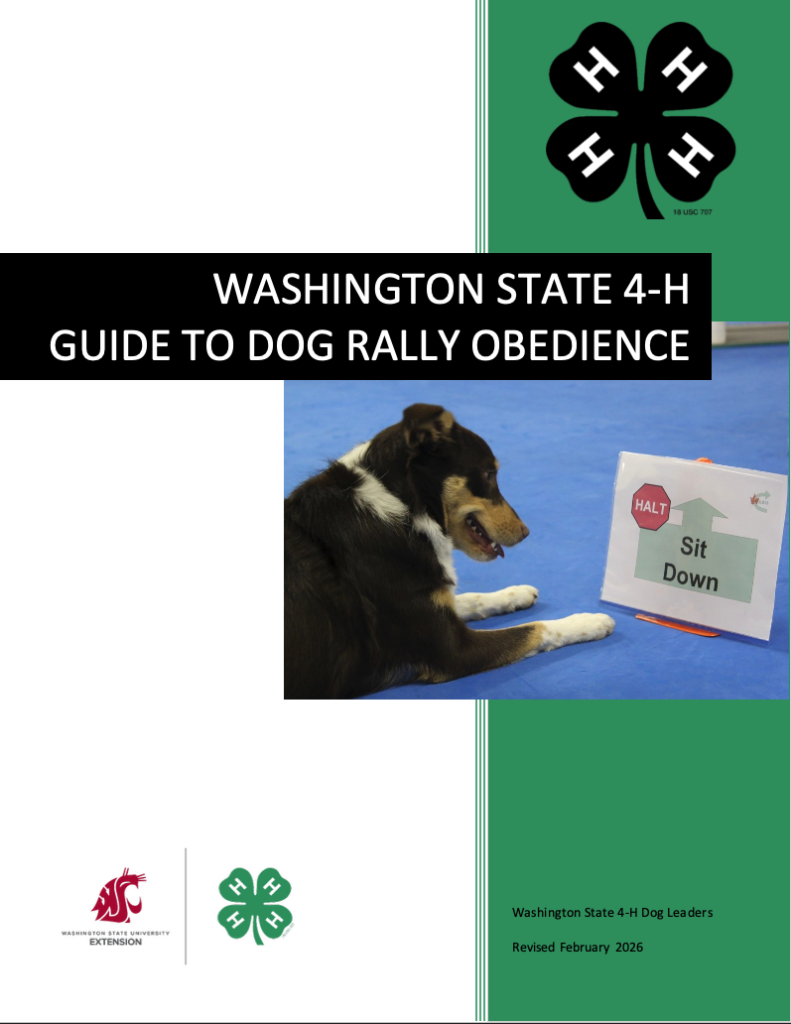
Washington State 4-H Guide to Dog Rally Obedience
Table of Contents
- Chapter 1: Introduction and General Rules
- Chapter 2: Rules for Performance and Judging
- Chapter 3: General Procedures
- Chapter 4: Class Descriptions, Jumps, and Exercises
- Chapter 5: Optional Classes
- Chapter 6: Glossary of Rally Terms
- Chapter 7: 4-H Rally Judges’ Guidelines
- Chapter 8: 4-H Rally Steward Guidelines
- Print this Document
Chapter 1: Introduction and General Rules
4-H Rally is a sport in which the dog and handler complete a course that has been designed by the Rally judge. There should be a sense of teamwork between the dog and handler both during the numbered exercises and between the signs; however, perfect heel position is not required. Unless otherwise specified in these rules, handlers are permitted to talk, praise, encourage, give additional commands and signals using one or both arms, clap their hands, pat their legs, and use any verbal means of encouragement. 4-H Rally is a companion sport to 4-H Obedience. Both require teamwork between dog and handler along with similar performance skills. Rally provides an excellent introduction to 4-H companion events for new dogs and handlers and can provide a challenging opportunity for competitors in other events to strengthen their skills.
Chapter 2: Rules for Performance and Judging
Standardized Judging
Standardized judging is of paramount importance. Judges are not permitted to inject their own variations into the exercise but will see that each handler and dog execute the various exercises exactly as described in these rules. A handler who is familiar with these rules should be able to enter the ring under any judge without having to inquire how that particular judge wishes to have an exercise performed and without being confronted with any unexpected requirements. No judge will require any dog or handler to do anything, nor penalize a dog or handler for failing to do anything that is not required by these rules.
Standard of Performance
The judge must carry a mental picture of the theoretically perfect performance for each exercise and score each dog and handler against this standard. This picture must comply with these rules and there should be a sense of teamwork between the dog and handler both during the numbered exercises and between the exercise signs; however perfect heel position is not required. The handler must move in a natural manner. The handler’s arms need not be maintained in any particular position. At any time during the performance, loud or harsh commands, intimidating signals, touching the dog, unless otherwise specified by these rules, or any physical corrections will be penalized. Roughness in handling, military precision or harsh commands by the handler must also be penalized. There shall be no penalty of less than one point.
Interference and Double Handling
A judge who is aware of any assistance, interference, or attempts to control a dog from outside the ring must act promptly to stop such double handling or interference and must penalize the dog substantially. If the judge feels the circumstances warrant, the dog will receive an NS or no-score for the exercise during which the aid was received.
Re-judging
If a dog has failed an exercise, it will not ordinarily be re-judged unless the judge feels the dog’s performance was prejudiced by peculiar and unusual conditions. Re-judging of the dog will be only on the exercise in question.
Explanations and Errors
After the class is finished, judges are not required to explain their scoring and should not enter a discussion with a dissatisfied exhibitor. Any person who thinks there may have been a numerical error or an error in identifying a dog may report the facts to one of the stewards, the judge, or superintendent so that the matter may be checked.
Compliance with Rules and Standards
The handler of each dog will be familiar with the 4-H Rally Rules applicable to the class in which the dog is entered.
Handlers with Disabilities
If an individual has a disability and needs reasonable accommodations, information can be found on the Reasonable Accommodation Policy page.
Information regarding performance and judging Handlers with disabilities can be found in the Washington State 4-H Guide to Obedience and the Washington State 4-H Dog Program Policies.
Order of Judging
Each handler is responsible for being ready at ringside when required and without being called. The judge’s first consideration should be the convenience of those exhibitors who are ready when scheduled and who ask no favors. If a request is made in advance of the class starting time, a judge may agree to judge a dog earlier or later than scheduled. If no such arrangement has been made, however, a judge should not hesitate to mark absent any dog and handler not ready to be judged when their time comes.
Use of Leash
All dogs must be kept on a leash except when performing in the Rally ring, warm-up ring or exercise area and must be brought into and taken out of the ring on leash. The leash must be made of fabric or leather and need only be long enough to provide adequate slack, unless stated otherwise in these rules.
Collars
All dogs in the Rally ring must wear a properly fitted collar approved by the judge. No special training collars, such as electronic collars or prong collars will be permitted. Nothing may be hanging from the dog’s collar.
Commands
Loud commands by handlers to their dogs create a poor impression of Rally and should be avoided. Commands the judge feels are excessively loud will be penalized. Any kind of whistling is prohibited.
Orders and Minimum Penalties
The orders for the exercises and the standards for judging are set forth in the following chapters. The lists of faults are not intended to be complete, but minimum penalties are specified for most of the more common and serious faults. There is no maximum limit on penalties. A dog that makes none of the errors listed may still receive an NS or no-score for other reasons.
Misbehavior
Dogs must always be under control when entering and exiting the ring. Any display of fear or nervousness by the dog or any uncontrolled behavior such as snapping, barking, or running away from its handler must be penalized according to the seriousness of the misbehavior, whether it occurs during or between stations or before or after judging. The judge may excuse the dog from further competition in the class. The judge must disqualify any dog that attacks or attempts to attack any person in the ring. Any dog that attacks another dog or that appears dangerous to other dogs must be excused.
Training and Warm-up on the Grounds
Warm-ups should be performed as far from the Rally rings as is reasonably possible and must not be disruptive to any dog or person. Physical or verbal disciplining of a dog will not be permitted, except to a reasonable extent in case of an attack on either a dog or a person.
Training and Disciplining in the Ring
The judge will not permit any handler to use excessive verbal commands, to move toward the dog to correct it, or to practice any exercise in the ring at any time. Any exhibitor who does so may be excused. A dog whose handler disciplines it in the ring will be excused from further competition in the class and must receive an NS or no-score.
Abuse of Dogs
The Event Superintendent will investigate any report of abuse or severe disciplining of dogs on the grounds or premises of a show, trial, or match. The judge must immediately report any abuse of a dog in the ring to the Event Superintendent.
Chapter 3: General Procedures
Armbands
Exhibitors shall be provided armbands or stickers, which must be worn on the upper left arm.
Signs and Holders
The designated wording and symbols must be used. Signs must be a minimum of 8½ by 11 inches and a maximum of 11 by 17 inches. Weather conditions should be considered when securing signs and holders. Colors used are optional. Twenty exercise sign holders are required plus one each for the Start and Finish signs and the Call marker. All sign holders or signs, not including those for Start, Finish, and the Call marker, will be clearly and sequentially numbered on the course, with numbers approximately three inches high. Signs with an asterisk, numbers 5, 6, 7, 8, 9, 10, 17, 18, 19, 103 and 299, may be used multiple times on a Rally course. Two of each of those signs must be available for the judge’s use. All other signs may only be used once on any course. Stationary exercises are any signs indicating a Halt or no forward motion.
AKC Rally Signs and Descriptions on AKC.org
Accessible AKC Rally Signs and Descriptions
Placement of Signs
Signs will be placed to the right of the handler’s path except for those indicating a change in direction, in which case the sign will be directly in front of the team to aid in that change. Exercises using cones may require entry with the sign on the left. Exact placement of signs is made by the judge while walking the course along the path that will be taken by the handlers.
Location of Performance in Relation to Signs
Except for exercises requiring entry with the sign on the left, exercises are performed near the designated signs, either directly in front or in front and to the left of the signs. For stations where the handler and dog are required to make a sidestep to the right, the sign shall be placed in the initial path of the handler and dog team, thus requiring the team to make a sufficient size sidestep to the right in order to pass the sign on the right.
Familiarization Time
The course for each class will be posted at the ring when the judge arrives. Prior to the start of each class, a 15-minute walkthrough will be allowed for handlers, without their dogs. After each two-hour period of judging, judges should allow an additional 10-minute walkthrough for the next two-hour block of dogs to be judged in the class. The judge must be available in the ring during this period to answer any questions the handlers might have. The judge may also choose to brief the handlers on the course during this period. Copies of the course may be given to exhibitors prior to the class, if available.
Judge’s Orders
The judge’s orders will be Are you ready? Followed by Forward. No other orders are necessary.
General Scoring
Scoring for all levels is based on a maximum score of 100 points. Times will be used only to break ties for Champion or Reserve Champion. The maximum number of points that can be deducted for any station is 10, with the exception of an NS or no-score performance. The sliding point scale is to assist judges in the scoring of each dog and handler team. A fault in traditional 4-H Obedience that would be evaluated and scored as a one-point deduction or more should be scored the same in Rally. There are no half point deductions in Rally.
The following deductions shall apply on a scale from 1 to 10:
Timing
All dogs will be timed. Times will be used only in the event of ties for Champion or Reserve Champion, as mentioned under General Scoring. Timing will begin when the judge gives the order Forward and will end when the dog and handler cross the Finish station. The original scores will not be changed. In the event that both the score and time are the same, the dogs will repeat the course and will be scored and timed again. The original scores will not be changed, but a plus sign will be added after the score of the dog winning the run-off. Times will be entered to the one-hundredth of a second on all runs. In the event of a timing malfunction, the timer will notify the judge and table steward immediately after the dog and handler have finished running the course. No time will be recorded for the team at that time. In the event of a tie at the end of the class involving a dog that does not have a time, the judge shall offer the handler the following options:
Timing Option 1
The ability to run the course again for time and score. If the dog’s score is better than the initial run, the team shall be considered to have won the tie with its original score and the time from the rerun. If the dog’s score is less than the original score from the first run, the team will be placed below its competitor with the same score. If there are multiple ties at the same score, the original scores shall be kept and the new tiebreaker scores and times shall be used to determine the winner of the run-off.
Timing Option 2
The team may keep its original score and accept the loss of the run-off.
Chapter 4: Class Descriptions, Jumps, and Exercises
Rally Novice Class
All signs are judged with the dog on leash. Rally Novice must have 10 to 15 signs, Start and Finish not included, with a minimum of three and a maximum of five stationary exercises per class.
Rally Intermediate Class
All signs are judged with the dog on leash. Rally Intermediate must have 12 to 17 signs, Start and Finish not included, with a minimum of three and a maximum of seven stationary signs. Intermediate courses will have a minimum of three Advanced level signs. There are no jumps in this class.
Rally Advanced Class
All signs are judged with the dog off leash, and all dogs must enter and leave the ring on leash. Rally Advanced must have 12 to 17 signs, Start and Finish not included, with a minimum of three and a maximum of seven stationary exercises. A dog is required to jump once in the Advanced class. Courses shall have a minimum of three Advanced level stations plus the one required jump.
Rally Excellent Class
All signs are judged with the dog off leash. All dogs must enter and leave the ring on leash. Rally Excellent must have 15 to 20 signs, Start, Finish and Call marker not included, with a minimum of three and a maximum of seven stationary exercises. Two jumping exercises must be used in the Excellent class utilizing one or two jumps. Courses shall have a minimum of two Advanced level stations and a minimum of three Excellent level stations, plus the two required jumps and the Sit Stay exercise per class. In Rally Excellent, handlers are not allowed to pat their legs or clap their hands to encourage the dog. Verbal encouragement, multiple commands and inaudible signals using one or both arms and hands are allowed; the handler’s arms need not be maintained in any particular position at any time. Handlers may not touch their dog or make any physical corrections.
Rally Master Class
All signs are judged with the dog off leash. The Master class must have 15 to 20 signs, Start and Finish not included, with a minimum of three and a maximum of seven stationary signs. Courses will have a minimum of four Master level signs plus the one required jump, numbers 301, 302 or 303, a minimum of three Excellent level signs and a minimum of three Advanced level signs. There are no retries for any of the signs on the Rally Master course. Unlike the Rally Novice, Intermediate and Advanced classes, the Rally Master class handlers are not allowed to pat their legs or clap their hands to encourage the dog without penalty. Verbal encouragement, multiple commands and inaudible signals using one or both arms and hands are allowed; the handler’s arms need not be maintained in any particular position at any time. Handlers may not touch their dog or make any physical corrections without penalty.
Rally Choice Class
All dogs are eligible to enter this class and may continue to compete indefinitely. There are no jumps in this class and all exercises are judged with the dog off leash. Verbal encouragement, multiple commands, and inaudible signals using one or both arms and hands are allowed; the handler’s arms need not be maintained in any particular position at any time. Penalties will be assessed for handlers clapping their hands, patting their legs, touching the dog or any physical corrections. Failure of the dog and handler to perform the sign correctly on the first attempt will result in a 10-point deduction for an IP or incorrectly performed sign, and the handler should move along without attempting a retry. The Choice course will have 15 to 20 signs, Start and Finish not included, with a minimum of three and a maximum of seven stationary signs. Courses will have a minimum of four Master level signs, a minimum of three Excellent level signs, and a minimum of three Advanced level signs. The course will be the same as the Master class, except the jump will be replaced with any other class sign.
Jumps
Any jump, or combination of broad jump, high jump, or bar jump, specified in these rules may be used, except four-foot-wide jumps may be used in place of five-foot-wide jumps. A complete description of the jumps used in Rally Obedience can be found in the Washington State 4-H Guide to Dog Obedience.
The dog’s jump height shall be given on the entry form. Entries will be arranged according to the jump height of the dogs, from either high to low or low to high.
High Jump and Bar Jump Heights
| Height of Dog at Withers | Height to be Jumped |
|---|---|
| Less than 10 inches | 4 inches |
| 10 inches to less than 15 inches | 8 inches |
| 15 inches to less than 20 inches | 12 inches |
| 20 inches and over | 16 inches |
Broad Jump
In the ring, broad jump hurdles will be arranged in order of size from smallest to largest. They will be evenly spaced, covering a distance equal to twice the height of the high jump set for each dog. Three boards will be used for a jump of 32 inches, two boards for a jump of 16 or 24 inches, and one board for a jump of eight inches. When decreasing the number of boards in the jump, the highest hurdle will be removed first.
Exercises
Send to Jump
Sign number 210 Send to Jump: The sign for this station will be placed at least 10 feet before the jump. The sign for this station and the one after it will be set so that the handler maintains at least a three-foot path away from the jump while the dog performs the jump and returns to the handler. The set up and performance of this sign should not be confused with sign number 103: Send Over Jump-Handler Passes By.
Note: After sending the dog to the jump the handler may pause as needed, but must not pass the jump until the dog has returned to the heel position.
Sit Stay Exercises
Sign number 298 Sit Stay: The judge will designate the area or person in charge of the leash prior to the excellent walkthrough. All exhibitors must be informed of where they need to go to retrieve their leash or from whom during the walkthrough. Immediately following the Finish Sign the handler and dog will go to the Sit Stay sign. The handler will sit the dog, command or signal the dog, or both, to sit stay. The handler will then walk at least 15 feet to retrieve the leash from any of the following; gate steward, judge, or designated area next to the ring exit, and return to heel position by walking around and behind the dog. The judge will order Exercise Finished at which time the judging of the Sit Stay Exercise will be complete. The handler will then attach the leash and exit the ring. The Sit Stay Exercise is not considered to be one of the stationary exercises on the course.
Chapter 5: Optional Classes
Rally Pairs Class
Rally Pairs class consists of competition by one handler working two dogs at one time through a Rally course. Scores will be based on a possible 200 points, with ties being broken by time. One or all the following class levels that can be offered at any 4-H event: Rally Novice, Rally Intermediate, Rally Advanced and Rally Excellent, excluding jumps.
Rally Pairs Class Scoring
All stations will be counted with a point value. The maximum point value that can be deducted at any one station will be 10 points per dog for a penalty of 20 total points. There will not be any NS or no-scores awarded for a performance. It is possible for a team to receive a negative score. All other Rally rules and regulations will apply for each class level offered as an optional class.
Rally Team Competition
For the optional Rally Team Competition, any of the regular Rally class levels may be offered. The Rally Team Competition will be four teams of any four dogs that are eligible under these rules. Five dogs may be entered, one to be considered an alternate, however the same four dogs will perform all the exercises. No dog may be entered on more than one team. There is a total possible score of 400 points for each team. All team members will run the course individually, with the team time running continuously. Time will start when the judge gives the first member of the team the Forward command from the Start sign. The subsequent dog for each team starts when the previous handler for the team passes the Finish sign without an additional command of Forward by the judge. Timing for each team will begin when the judge commands the first handler in the team to begin with the command Forward and will stop when the fourth handler from the team passes the finish line. If jumps are required, they will be based on the height of the smallest dog on each competing team.
Rally Team Scoring
All stations will be counted with a point value. The maximum point value, which can be deducted at any one station, will be 10 points. It is possible for a team to receive a negative score.
Chapter 6: Glossary of Rally Terms
- Brisk, briskly: Keenly alive, alert, energetic
- Command: Verbal order from handler to dog
- Deductions: Points that are subtracted from the total possible score
- Directly: Immediately, without deviation or hesitation
- Down: Dog lying in a prone position
- Finish: When commanded, signaled, or both to finish, the dog goes smartly to heel position and sits
- Front: A dog sits in front of the handler, close enough that the handler can touch the dog’s head
- Guiding Gently by the Collar: Control of the dog by holding any part of the collar with minimal pressure on the dog’s neck
- Handler Returns to Heel Position: The handler must return to heel position by walking around behind the dog, unless otherwise stated in these rules
- Heel Position: Dog is at the handler’s left side straight in line with the direction the handler is facing; the area from the dog’s head to shoulder is to be in line with the handler’s left hip; and the dog should be close to, but not crowding its handler so that the handler has freedom of motion at all times
- Incorrectly Performed Station or IP: One or more principal parts of a station not performed or performed incorrectly
- Lame: Irregularity or impairment of the function of locomotion, irrespective of the cause or how slight or severe
- Luring: The appearance of having a reward to tempt the dog along or into position. No reward needs to be present
- Natural Manner: Not artificial, free of affectation; what is customarily expected in the home or public places
- Order: Direction from judge to handler, either verbal or nonverbal
- Pause: A complete stop of forward motion by the handler
- Pivot: Turning in the circle occupied by the handler before they started the turn; a turn in place
- Pleading: Repeated urgent commands or signals to elicit the proper behavior from the dog while the dog remains unresponsive to handler’s commands or signals
- Repeat of Station or Retry: A station that is repeated in its entirety, including the approach, before beginning the next station
- Signal: Nonverbal direction from the handler to dog
- Sit: The dog has its rear and hocks on the ground
- Station Not Attempted by the Handler: A station skipped or missed by the handler before attempting the next station
- Training: As related to where a student to handler or teacher or judge relationship is established, with or without compensation
- Turn in Place: Turning in a circle that was occupied by the handler before they started to turn
- Withers: Highest point of the dog’s shoulder
Chapter 7: 4-H Rally Judges’ Guidelines
Purpose
Rally trials are a sport, and all participants should be guided by the principles of good sportsmanship both in and out of the ring. The performance of dog and handler in the ring must meet the requirements of the 4-H Rally Rules.
Responsibilities as a Judge
Judges must understand their responsibilities to the sport.
- Responsibility to Exhibitors: Judges are expected to be friendly and courteous to all who enter the ring. Without exhibitors, there would be no trials. For every experienced exhibitor there are many newcomers. The future of this sport is in the hands of the novice. After a judge completes an assignment and has turned in the judge’s book, it is appropriate for the judge to discuss an individual dog’s performance with the handler, if the handler requests this information. However, a judge should never continue a conversation with an angry or aggressive person.
- Responsibility to Spectators: Spectators form their opinion of the sport through seeing the actions of the judge, the handler, and the dog. Care must be taken to avoid any action that might reflect poorly on the sport. Judges should work to maintain spectator appeal in the sport while keeping foremost in mind the welfare and convenience of the exhibitor and the dog.
- Responsibility to the 4-H Program: Judges must never ignore or condone any type of abuse of a dog at any time. All judges are expected to take appropriate action when witnessing such conduct.
As a judge, you are required to meet these key criteria:
- Knowledge: Through experience and continuing study, you must demonstrate sound knowledge of the dogs you evaluate and score. Good judges never stop learning about the sport of Rally.
- Procedure: You must demonstrate sound judging procedure and ring control, plus a thorough knowledge of the 4-H Rally Rules and the Rally Judges’ Guidelines. Good procedure is essential. With it, a judge will inspire the confidence of exhibitors and spectators.
- Impartiality: It is essential that exhibitors have full faith in the impartiality and competence of judges. There is no room for even the suggestion that anything other than the work of the dog in the ring is involved in your decisions.
Ethics: Honesty Plus Common Sense
The judge must possess and project an unwavering air of integrity and ethical behavior that maintains the reputation of 4-H Obedience trials as being fair and properly judged. With common sense, judges can easily avoid situations that might raise ethical questions. Judges are presumed to be honest, competent, and dedicated. Nevertheless, it is all too easy to find yourself in uncomfortable or even inappropriate situations. These guidelines cannot cover every situation; they can, however, help you avoid improprieties or perceived improprieties. Some ethical rules are clear. For example:
- Never accepts payment or presents for past or future placements.
- Advise potential exhibitors not to enter under you when their presence or the presence of their dogs might give the impression of unfair advantage, such as a person with whom you own dogs, wholly or in part, dogs that have been regularly trained or instructed by you, your employer, your employee, or a relative.
These are only examples. The key is to avoid situations that might give the impression of impropriety.
4-H recognizes you cannot control who enters. This does not diminish the importance of appearances. Everything possible must be done to keep your reputation above reproach.
Knowledge
The 4-H Rally Rules are the basic guide to judging; however, not every possible fault or error is covered, only the more common and serious ones. The 4-H Rally Rules follow AKC Rally rules and clearly define the exercises and the standard by which they are to be judged. The 4-H Rally Rules set the standard for a perfect score of 100 points by which each dog’s performance is judged. The 4-H Rally Rules give the judge guidelines for how an exercise is to be performed. While Rally is not judged with the same precision as formal Obedience, Rally judges must make decisions based on a mental picture of the perfect performance within the framework of the 4-H Rally Rules. Judges are given full discretionary authority within the framework of the 4-H Rally Rules and they must exercise this authority impartially. Judges are required to make their own decisions and accept the responsibility this implies. If a decision depends on the exact wording of the 4-H Rally Rules, the judge is expected to consult the book before making the decision. A judge may not discard, modify, or require anything not specified in the 4-H Rally Rules. Scores for each exercise must be amply justified by the performance of the dog and handler.
Course Design
A Rally course should be designed to be fun, interesting, and enjoyable for the exhibitor, dog, and spectators. Courses should provide sufficient challenge without being overly complicated and designed to be completed by the average team in less than two minutes. This may vary slightly depending on the level. When designing courses, remember 4-H Rally is a skill-building class for all other 4-H events and should provide the dog and handler the ability to develop and master a variety of skills.
- Control and teamwork are best evaluated with courses that flow. The Rally judge should consider the dog and handler’s path when designing and setting the course.
- Grouping stationary exercises together causes a course to be choppy and tight while using multiple circular turns in the same direction may cause dizziness.
- Stations requiring specific angles of performance must be used to allow those angles to be executed correctly.
- Exercises using the pylons may share one or more pylons except for the Offset Figure Eight.
- All stations with a Fast or Slow must be followed by a Normal, except the Slow may be used as the last station.
- Adequate space must be allowed for all sizes of dogs to perform the stations properly inside the ring including the Start, Finish and Sit Stay signs.
- Separate entrance and exit gates allow for better traffic flow and time management.
- The first course of the day should be nested with multiple signs per holder, if possible, for the following class levels to allow for an efficient and easy course change between levels.
- If a course needs to be modified, note the changes on the course posted and the changes should be explained to the exhibitors at a judge’s briefing before, during or after the walk-through.
- Course Design is of significant importance to the sport.
- Judges should not use the same course repeatedly.
- Courses should be laid out in a clear and straightforward manner in an order that a handler who misses the walk through has a reasonable chance of qualifying by following the numbered stations.
Preparation for Judging
Be on time. The judge must arrive a minimum of 45 minutes prior to the scheduled start of judging, unless a prior judging assignment conflicts. Upon arrival, the judge will post the courses outside the ring.
Prior to the scheduled judging time, the judge will inspect the ring, which must meet all requirements of the 4-H Rally Rules. Size shall be determined by the judge pacing the ring. Checking the ring also requires the judge to:
- Examine signs and sign holders to ensure they are secure.
- Examine the distractions used in the Offset Figure Eight to determine that they can be seen and smelled but not consumed.
- Measure the jumps in the Advanced, Excellent and Master classes to ensure they meet the requirements.
- If the jumps are made of a material other than wood, they must meet all the requirements of the 4-H Rally Rules, including weight and flat finish.
Judging the Dogs
The judge has absolute control and unquestioned authority over all persons and dogs in the ring. With this authority comes the responsibility to be courteous and considerate. Be as systematic in your ring procedure from dog to dog as conditions permit. The Judge’s position should be kept in mind when designing the course. Position is important for three reasons: first, to properly evaluate the dog and handler; second, to establish consistency from team to team; and third, to ensure efficient time management. All dogs should be viewed from the same relative position on the course. Fronts and finishes are best judged from the front or from the side. When evaluating a down, the judge should be in position to see whether or not the dog has dropped completely.
Philosophy of Scoring
It is the judge’s responsibility to award appropriate scores to all the dogs. Unofficial scores, but not times, shall be posted ringside after each dog has completed the final exercise.
A judge should honor an exhibitor’s request to be excused.
Chapter 8: 4-H Rally Steward Guidelines
It is helpful to have at least two ring stewards during the event; one for timing and one for assisting exhibitors and judges. The main duties of Rally ring stewards are as follows:
- Assisting in setting up the Rally courses initially and from class to class as needed.
- Distributing armbands to exhibitors.
- Entering the class, armband number, and breed of dog on the scoresheets.
- Assuring that the jump height is correctly set for each dog in the Advanced, Excellent, and Master classes before the dog enters the ring.
- Ensuring handlers and dogs do not enter the ring until the judge so indicates.
- Ensuring that the next dog to be judged is immediately available. As soon as the judge begins judging the dog in the ring, the steward calls the next dog and ensures that the handler is ringside.
- Timer to be stationed in a position or place as specified by the judge prior to the running of each dog on the course.
- Making sure the timing of a run starts when the judge gives the order Forward and the time of the run ends when both the dog and handler cross the Finish station.
- Immediately recording the time on the scoresheet after each dog completes the course.
- Making sure that the time reported is in minutes, seconds, and hundredths. If there is a malfunction in the timing device when a dog is running a course, the steward will report the malfunction to the judge immediately after the dog and handler cross the Finish station.
- As needed, ensure that the leash is returned to the handler as the dog and handler complete the course, and that the dog is on leash when the team leaves the ring.
- Being aware of any problems with the dogs on course and being ready to follow instructions given by the judge.
- Adding the scores on the scoresheets.
- Informing the judge of any error on the scoresheets.
- Making sure the judge’s scoresheets are not displayed or exhibited to any other person at the event, unless specifically directed to do so by the judge.
Classes and Jumps
Novice
In the Novice class, exercises are performed on leash, and there are no jumps. The judge will give the order for the handler to begin the course. The ring and gate stewards should remain outside the ring but stay alert to any possible problems and be ready to follow whatever instructions the judge may give.
Advanced, Excellent, and Master
When issuing an armband in the Advanced, Excellent or Master classes, the table steward or gate steward should check the catalog to verify the height and distance the dog jumps. When a dog and handler enter the ring for the Advanced, Excellent or Master classes, the gate or ring steward should take the leash from the handler. When the dog has finished running the Advanced or Master course, the gate or ring steward should return the leash to the handler and ensure that the dog is on leash before it leaves the ring. It is essential that the ring or other stewards assigned to set jumps have a tape measure, steel ruler, or folding ruler to ensure accuracy in setting the broad jump. Stewards must arrange jumps quickly and accurately to ensure a minimal loss or waste of judging time.
Jumps
The steward will confirm with the handler the height the dog jumps. Rally Advanced, Excellent and Master classes will be run in jump height order, unless prior arrangements have been made by a handler with the judge to run a dog out of order. It is essential that ring stewards be familiar with the 4-H Rally Rules in order to set the jumps correctly in the event jump changes are required. Jump heights can be found in Chapter 4 Classes and Jumps.
Print this Document
You can use your browser’s Print Function to print a copy of this guide. You can also use your Print Function to save the image as a PDF.
- For a Windows PC or Linux, use CTRL+P
- For a Mac, use command+P
You may need to adjust your print settings (such as margins, scale, etc.) to print cleanly. If you notice any unexpected borders, deselecting “Background Graphics” from the print settings can help.