AKC Rally Signs and Descriptions

From AKC.org Rally Exhibitor Resources.

All Class Levels

The following signs may be used in all class levels. The principal parts are emphasized.
Sign NumberSign NameSign DescriptionImage of Sign
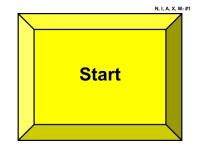
1StartIndicates the beginning of the course. The dog does not have to be sitting at the start. A bright yellow square sign with a beveled, three-dimensional border effect, outlined in black. The center contains the word “Start” in bold black text.
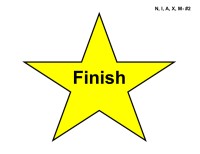
2FinishIndicates the end of the course - timing stops.A large five-pointed star filled with bright yellow and outlined in black. The word “Finish” appears in bold black text across the middle of the star.
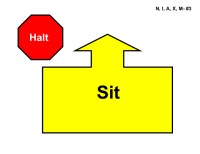
3Halt-SitWhile heeling, the handler halts and the dog sits in heel position. (Stationary)A composite sign on a light gray background featuring two elements. At the top left is a red octagon outlined in black with the word “Halt” in white text. Below and to the right is a larger yellow shape with a black outline resembling a block with an upward-pointing arrow at the top. Inside this yellow shape, the word “Sit” appears in bold black text.
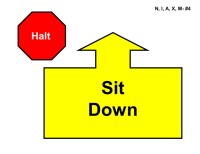
4Halt-Sit-DownWhile heeling, the handler halts and the dog sits in heel position. The dog must then down in heel position. (Stationary)A sign on a light gray background featuring two distinct elements. In the upper left corner is a red octagon outlined in black with the word “Halt” in white text. Below and slightly to the right is a large yellow shape outlined in black, resembling a rectangular block with an upward-pointing arrow at the top. Inside the yellow shape, the words “Sit Down” are centered in bold black text.
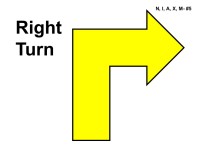
5Right Turn90° turn to the rightA large yellow arrow, outlined in black, shaped like a right-angle turn pointing to the right. The arrow occupies most of the right side of the image. On the left side the words “Right Turn” appear in bold black text.
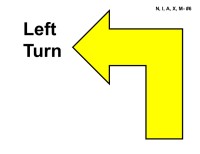
6Left Turn90° turn to the leftA large yellow arrow, outlined in black, shaped like a right-angle turn pointing to the left. The arrow occupies most of the right side of the image, extending toward the left. On the left side of the image the words “Left Turn” appear in bold black text.
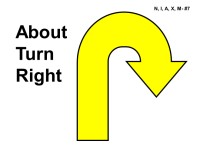
7About Turn-Right180° turn to the rightA light gray background with a large, curved yellow arrow outlined in black, shaped like a U-turn that curves upward and then points down toward the right. To the left of the arrow, the words “About Turn Right” appear in bold black text.
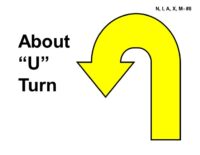
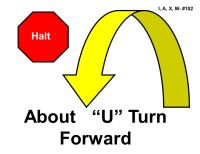
8About "U" Turn180° turn to the leftA large yellow U-shaped arrow outlined in black dominates the right side of the image, curving upward and then bending downward to form a U-turn pointing left. On the left side, bold black text reads “About ‘U’ Turn.”
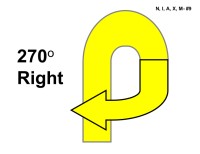
9270° Right TurnWhile heeling, the dog and handler make a tight 270° turn to the right.A compact, looping yellow arrow outlined in black, forming a tight turn that rotates approximately three-quarters of a full circle (270 degrees) to the right. The arrow curves around itself in a rounded shape. To the left of the arrow, the text “270° Right” appears in bold black lettering.
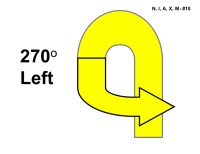
10270° Left TurnWhile heeling, the dog and handler make a tight 270° turn to the left.A compact yellow arrow outlined in black forming a looping shape that turns approximately 270 degrees to the left. The arrow curves around itself in a tight, rounded path. To the left of the shape, bold black text reads “270° Left.”
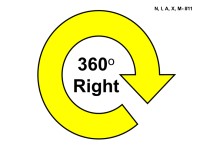
11360° Right TurnWhile heeling, the dog and handler make a tight 360° turn to the right.A large circular yellow arrow outlined in black forming a complete loop, indicating a full 360-degree turn to the right. The arrow curves smoothly into a circle with the arrowhead pointing along the clockwise direction. Inside the loop, centered text reads “360° Right” in bold black lettering.
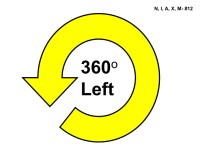
12360° Left TurnWhile heeling, the dog and handler make a tight 360° turn to the left.A large circular yellow arrow outlined in black forming a full loop, indicating a 360-degree turn to the left. The arrow curves around in a counterclockwise direction, with the arrowhead pointing along the leftward rotation. Inside the loop, bold black text reads “360° Left.”
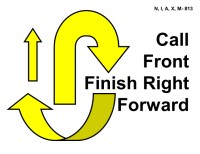
13Call Front–Finish Right–ForwardWhile heeling, the handler stops forward motion and calls the dog to front. The handler may take several steps backward. The dog must come and sit in front. Without the handler moving their feet, the dog must finish to the right. As the dog clears the handler’s path, the handler will heel forward before the dog returns to heel position. (Stationary)A set of yellow arrows outlined in black showing a movement sequence. A large central U-shaped arrow curves upward and then down toward the right, indicating a looping forward motion. To the left are two smaller arrows: one pointing straight upward and another curved arrow indicating a turning motion. To the right, bold black text reads “Call Front Finish Right Forward.”
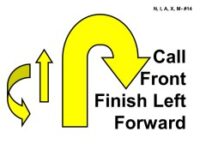
14Call Front–Finish Left–ForwardWhile heeling, the handler stops forward motion and calls the dog to front. The handler may take several steps backward. The dog must come and sit in front. Without the handler moving their feet, the dog must finish to the left. As the dog clears the handler’s path, the handler will heel forward before the dog returns to heel position. (Stationary)A large yellow U-shaped arrow outlined in black curves upward and then down toward the left, indicating a looping forward turn. To the left of the main arrow are two smaller arrows: one straight upward and one curved arrow showing an initial turn. Bold black text on the right reads “Call Front Finish Left Forward.”
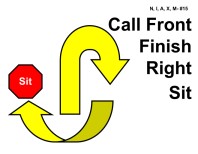
15Call Front–Finish Right–SitWhile heeling, the handler stops forward motion and calls the dog to front. The handler may take several steps backward. The dog must come and sit in front. Without the handler moving their feet, the dog must finish to the right and sit in heel position.
(Stationary)
A large yellow arrow outlined in black curves upward and then down toward the right, indicating a looping turn. To the lower left is a smaller curved arrow showing an initial motion. Near this smaller arrow is a red octagon with the word “Sit” in white text. To the right, bold black text reads “Call Front Finish Right Sit.”
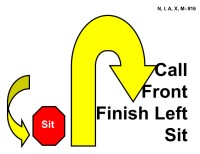
16Call Front–Finish Left–SitWhile heeling, the handler stops forward motion and calls the dog to front. The handler may take several steps backward. The dog must come and sit in front. Without the handler moving their feet, the dog must finish to the left and sit in heel position.
(Stationary)
A large yellow U-shaped arrow outlined in black curves upward and then down toward the left, indicating a looping turn. To the left of the main arrow is a smaller curved arrow showing an initial motion. Next to the smaller arrow is a red octagon labeled “Sit” in white text. Bold black text to the right reads “Call Front Finish Left Sit.”
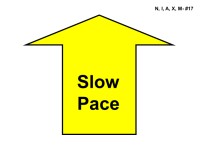
17Slow PaceThe dog and handler must slow down noticeably. This must be followed by a normal pace sign unless it is the last station on the course.A large yellow arrow outlined in black points straight upward, with a wide base and a roof-like triangular top. Centered inside the arrow, bold black text reads “Slow Pace.”
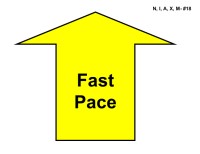
18Fast PaceThe dog and handler must speed up noticeably. This must be followed by a normal pace sign.A large yellow arrow outlined in black points straight upward with a wide rectangular base and a triangular tip. Centered inside the arrow, bold black text reads “Fast Pace.”
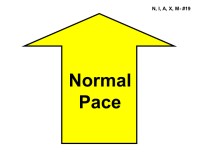
19Normal PaceThe dog and handler walk briskly. This sign is only used after a slow or fast pace sign.A large yellow arrow outlined in black points straight upward, similar in shape to the previous image. Centered inside the arrow, bold black text reads “Fast Pace.”
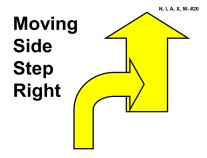
20Moving Side Step RightWhile heeling, the handler takes one step to the right, leading
with the right foot,
and continues heeling along the newly established line. The dog must move with the handler. This sign will be placed directly in line of the team’s path requiring the handler and dog to sidestep to the right to pass the sign.
A large yellow arrow outlined in black curves outward and then points upward, indicating a rightward side movement combined with forward motion. To the left of the arrow, bold black text reads “Moving Side Step Right.”
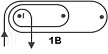
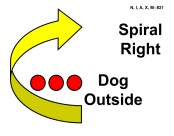
21Spiral Right-Dog OutsideThis sign requires three pylons placed in a straight line with spaces between them of approximately 6-8 feet. The dog and handler must turn to the right to move around each of the pylons.

21A:
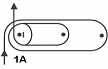
An elongated oval track shape outlined in black. Inside the oval are two small circular markers. At the left end of the oval, a circular highlighted point is labeled “1.” An arrow above the diagram points upward, indicating direction. Below the left side of the diagram, the label “1A” appears.

21B:
An elongated oval track diagram outlined in black with two small circular markers inside. At the right end of the oval, a circular highlighted point is labeled “1.” An arrow below the diagram points downward, indicating direction. Near the lower portion of the image, the label “1B” appears.
A large yellow curved arrow outlined in black forms a spiral-like shape turning to the right. Along the inside curve of the spiral are three small red circles arranged in a row. To the right, bold black text reads “Spiral Right” and below it “Dog Outside.”
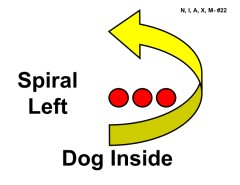
22Spiral Left-Dog InsideThis sign requires three pylons placed in a straight line with spaces between them of approximately 6-8 feet. The dog and handler must turn to the left to move around each of the pylons.

22A:
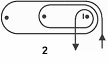
An elongated oval track outlined in black with rounded ends. Inside the oval are small circular markers, including one labeled “1.” At the right side of the diagram, two arrows indicate direction: one arrow points upward along the outer edge and another arrow points downward from the center. Below the diagram, the label “2” appears.
A large yellow curved arrow outlined in black forms a spiral-like shape turning to the left. Along the inside of the spiral are three small red circular markers arranged in a row. Bold black text to the left reads “Spiral Left,” and below it reads “Dog Inside.”
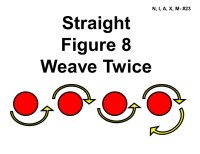
23Straight Figure 8 Weave TwiceThis sign requires four pylons placed in a straight line with
spaces between them of approximately 6-8 feet. The dog and handler will enter into the weave with the first pylon on their left side. They must complete the entire weave twice.
Four red circular markers are arranged horizontally in a row. A yellow curved arrow outlined in black loops around each marker in alternating directions, forming a figure-eight weaving pattern across the row. Bold black text above reads “Straight Figure 8 Weave Twice.”
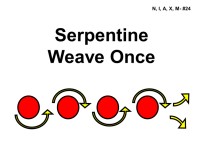
24Serpentine Weave OnceThis sign requires four pylons placed in a straight line with spaces
between them of approximately 6-8 feet. The dog and handler will enter into the weave with the first pylon on their left side. They must complete the entire weave once.
Four red circular markers are placed in a horizontal row. A yellow curved path outlined in black weaves back and forth in a serpentine pattern between the markers, showing a single pass through the sequence. Bold black text above reads “Serpentine Weave Once.”
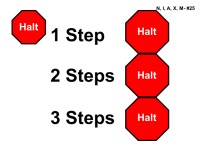
25Halt-1, 2 and 3 StepsWhile heeling, the handler halts and the dog sits in heel position. The handler takes one step forward, halts and the dog sits in heel position. The handler takes two steps forward, halts and the dog sits in heel position and then three steps forward, halts and the dog sits in heel position. The dog moves with the handler each time. (Stationary)Three red octagonal stop signs, each labeled “Halt” in white text, are arranged vertically along the right side. To the left, bold black text lists “1 Step,” “2 Steps,” and “3 Steps,” aligning with each corresponding stop sign to indicate halting after a specific number of steps.
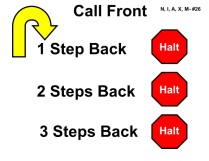
26Call Front–1, 2 and 3 Steps Backward-ForwardWhile heeling, the handler stops forward motion and calls the dog to front. The handler may take several steps backward. The dog must come and sit in front. The handler takes one step backward and halts. The dog must move with the handler and sit in front as the handler halts. The handler takes two steps backward and halts. The dog must move with the handler and sit in front as the handler halts. The handler takes three steps backward and halts. The dog must move with the handler and sit in front as the handler halts. The handler may command/signal the dog to finish. As the dog clears the handler’s path, the handler will heel forward before the dog returns to heel position. (Stationary)A yellow curved arrow outlined in black points downward and slightly forward, indicating a recall or front position. To the right are three red octagonal signs labeled “Halt.” Bold black text reads “Call Front,” followed by “1 Step Back,” “2 Steps Back,” and “3 Steps Back,” each aligned with a corresponding halt sign.
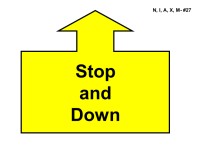
27Stop and DownWhile heeling, the handler stops forward motion and the dog downs in heel position. The dog must stay down until the handler moves forward. (Stationary)A large yellow shape outlined in black resembles a wide arrow with a flat top and extended sides. Centered inside the shape, bold black text reads “Stop and Down.”
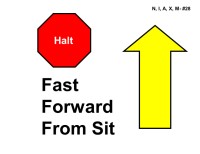
28Halt–Fast Forward from SitWhile heeling, the handler halts and the dog sits in heel position. The dog and handler then heel forward at a fast pace. This must be followed by a normal pace sign. (Stationary)A red octagonal sign labeled “Halt” in white text appears on the left. To the right of it is a tall yellow arrow outlined in black pointing straight upward. Bold black text reads “Fast Forward From Sit.”
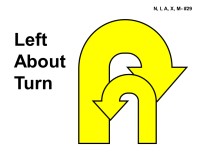
29Left About TurnWhile heeling, the handler will make an about turn to the left, while at the same time the dog must move around the handler to the right and into heel position.A large yellow curved arrow outlined in black forms a tight looping path that bends upward and then back around to the left, indicating a left about turn. A smaller inner arrow reinforces the turning motion inside the larger curve. Bold black text to the left reads “Left About Turn.”
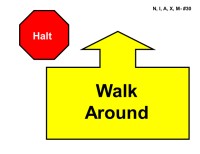
30Halt-Walk AroundWhile heeling, the handler halts and the dog sits in heel position. The dog must stay while the handler walks around behind the dog, returns to heel position and pauses. The handler must pause before heeling forward. (Stationary)A red octagonal stop sign labeled “Halt” in white text appears in the upper left. To the right is a large yellow arrow outlined in black pointing upward, attached to a wide rectangular base. Inside the base, bold black text reads “Walk Around.”
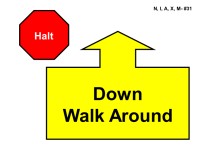
31Halt–Down–Walk AroundWhile heeling, the handler halts and the dog sits in heel position. The dog must then down and stay while the handler walks around behind the dog, returns to heel position and pauses. The dog and handler then heel forward. (Stationary)A red octagonal stop sign labeled “Halt” in white text appears in the upper left. To the right is a large yellow arrow outlined in black pointing upward, attached to a wide rectangular base. Inside the base, bold black text reads “Down Walk Around.”
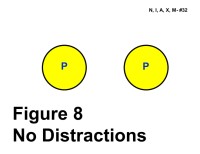
32Figure 8–No DistractionsThis sign requires two pylons spaced approximately 6-8 feet apart. The Figure 8 may be entered with the pylons on either the left or right side. The dog and handler will perform a complete figure 8 around the pylons, crossing the center line three times.Two yellow circular markers labeled “P” are positioned side by side near the top. Below them, bold black text reads “Figure 8 No Distractions.”
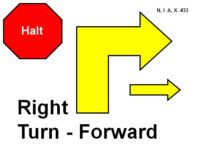
33Halt–Right Turn–ForwardWhile heeling, the handler halts and the dog sits in heel
position. The handler and dog turn right together and heel forward. (Stationary)
A red octagonal stop sign labeled “Halt” appears on the left. To the right, a large yellow arrow outlined in black forms a right-angle turn pointing to the right, with a smaller straight arrow extending forward from the turn. Bold black text reads “Right Turn – Forward.”
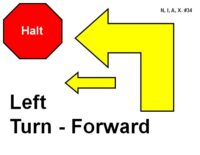
34Halt–Left Turn–ForwardWhile heeling, the handler halts and the dog sits in heel
position. The handler and dog turn left together and heel forward. (Stationary)
A red octagonal stop sign labeled “Halt” appears on the left. To the right, a large yellow arrow outlined in black forms a right-angle turn pointing to the left, with a smaller straight arrow extending forward from the turn. Bold black text reads “Left Turn – Forward.”
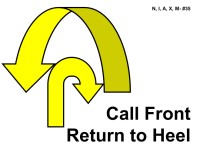
35Call Front–Return to HeelWhile heeling, the handler stops forward motion and may command/signal the dog to front. The handler may take several steps backward. The dog must come and sit in front. The dog must stay while the handler walks around behind the dog to return to heel position. The handler must pause before heeling forward. (Stationary)Two yellow arrows outlined in black show a looping movement pattern. One larger arrow curves forward and down, while a smaller inner arrow curls back toward the starting point, indicating a return movement. Bold black text reads “Call Front Return to Heel.”
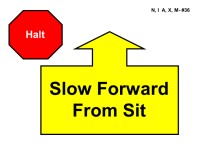
36Halt–Slow Forward From SitWhile heeling, the handler halts and the dog sits in heel position. The dog and handler then heel forward at a slow pace. This must be followed by a normal pace sign unless it is the last sign on the course. (Stationary)A red octagonal sign labeled “Halt” in white text appears on the left. To the right is a large yellow arrow outlined in black pointing straight upward, attached to a wide rectangular base. Inside the base, bold black text reads “Slow Forward From Sit.”
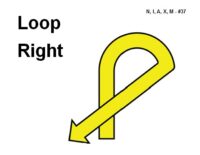
37Loop RightWhile heeling, the dog and handler loop right crossing over the original path.A large yellow arrow outlined in black forms a looped path that curves upward and around before crossing diagonally and pointing down toward the left. Bold black text reads “Loop Right.”
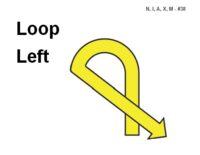
38Loop LeftWhile heeling, the dog and handler loop left crossing over the original path.A large yellow arrow outlined in black forms a looping path that curves upward and around before crossing diagonally and pointing down toward the right, indicating a left loop pattern. Bold black text reads “Loop Left.”
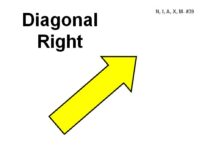
39Diagonal RightWhile heeling, the dog and handler make an open angle turn to the right. The dog must move with the handler. This sign will be placed directly in line of the team’s path.A single yellow arrow outlined in black points diagonally upward toward the right at an angle. Bold black text reads “Diagonal Right.”
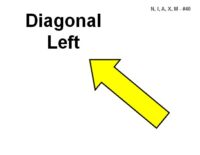
40Diagonal LeftWhile heeling, the dog and handler make an open angle turn to the left. The dog must move with the handler. This sign will be placed directly in line of the team’s path.A single yellow arrow outlined in black points diagonally upward toward the left at an angle. Bold black text reads “Diagonal Left.”
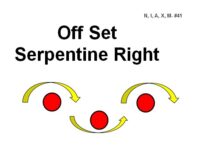
41Offset Serpentine RightThis sign requires three pylons. The center pylon will be offset to the right by 3-4 feet with the other two spaced approximately 6-8 feet apart. The dog and handler will enter into the weave with the first pylon on their right side. They must complete the entire serpentine together.Three red circular markers are arranged in a staggered pattern. A yellow path made of curved arrows outlined in black weaves around the markers in a rightward serpentine pattern, curving above and below each circle. Bold black text reads “Off Set Serpentine Right.”
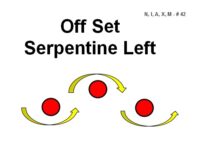
42Offset Serpentine LeftThis sign requires three pylons. The center pylon will be offset to the left by 3-4 feet with the other two spaced approximately 6-8 feet apart. The dog and handler will enter into the weave with the first pylon on their left side. They must complete the entire serpentine together.Three red circular markers are arranged in a staggered pattern. A yellow path of curved arrows outlined in black weaves around the markers in a leftward serpentine pattern, alternating direction as it curves around each circle. Bold black text reads “Off Set Serpentine Left.”

Intermediate, Advanced, Excellent, and Master Class Levels

The following signs may be used in the Intermediate, Advanced, Excellent, and Master Classes (except Sign 103 may not be used in the Intermediate or Master Classes). The principal parts are emphasized.
Sign NumberSign NameSign DescriptionImage of Sign
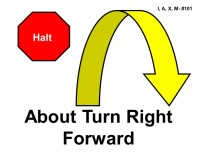
101Halt-About Turn Right-ForwardWhile heeling, the handler halts and the dog sits. The dog and handler turn 180° to the right together and heel forward. (Stationary)A red octagonal stop sign labeled “Halt” in white text appears on the left. To the right is a large yellow curved arrow outlined in black that loops downward and then forward to the right, indicating an about turn followed by forward movement. Bold black text reads “About Turn Right Forward.”
102Halt-About "U" Turn-ForwardWhile heeling, the handler halts and the dog sits. The dog and handler turn 180° to the left together and heel forward. (Stationary)A red octagonal sign labeled “Halt” appears on the left. To the right, a large yellow curved arrow outlined in black forms a wide U-shaped turn that bends downward and then forward to the right. Bold black text reads “About ‘U’ Turn Forward.”
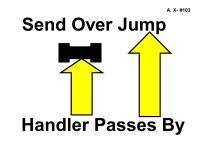
103Send over Jump–Handler Passes ByThe dog must clear the jump on the first attempt, in the proper direction without stopping, while the handler passes by without stopping.A horizontal black jump bar is centered above a yellow upward-pointing arrow. To the right is a second taller yellow arrow pointing straight upward. Bold black text reads “Send Over Jump” above and “Handler Passes By” below.
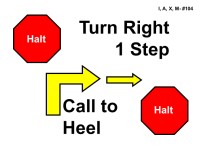
104Halt-Turn Right One Step-Call to Heel-HaltWhile heeling, the handler halts and the dog sits. The dog must stay sitting while the handler turns, takes one step to the right, halts and calls the dog to heel. The dog must then return to the handler to heel position and sit.(Stationary)A red octagonal sign labeled “Halt” appears in the upper left, and another “Halt” sign appears at the lower right. Between them is a yellow right-angle arrow outlined in black pointing to the right, with a smaller straight arrow inside it indicating a single step. Bold black text reads “Turn Right 1 Step” and “Call to Heel.”
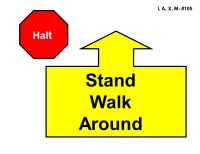
105Halt-Stand-Walk AroundWhile heeling, the handler halts and the dog sits. The dog must then stand and stay while the handler walks around behind the dog, returns to heel position and pauses.The dog and handler then heel forward. The handler may move forward with the dog to stand it. In the Intermediate and Advanced classes the handler may touch the dog to stand it. In the Excellent and Master classes the handler may not touch the dog to stand it. (Stationary)A red octagonal sign labeled “Halt” appears on the left. To the right is a large yellow arrow outlined in black pointing straight upward, attached to a wide rectangular base. Inside the base, bold black text reads “Stand Walk Around.”
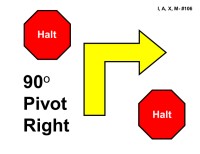
106Halt-90° Pivot Right-HaltWhile heeling, the handler halts and the dog sits. The dog and handler pivot 90° to the right together and the dog sits in heel position. (Stationary)A red octagonal “Halt” sign appears in the upper left, and another “Halt” sign appears in the lower right. Between them is a large yellow right-angle arrow outlined in black pointing to the right, indicating a 90-degree pivot. Bold black text reads “90° Pivot Right.”
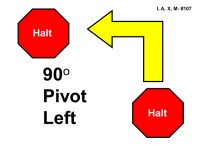
107Halt-90° Pivot Left-HaltWhile heeling, the handler halts and the dog sits. The dog and handler pivot 90° to the left together and the dog sits in heel position. (Stationary)A red octagonal “Halt” sign appears in the upper left, and another “Halt” sign appears in the lower right. Between them is a large yellow right-angle arrow outlined in black pointing to the left, indicating a 90-degree pivot. Bold black text reads “90° Pivot Left.”
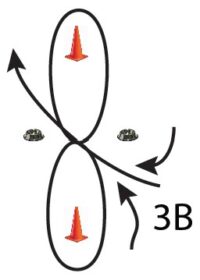
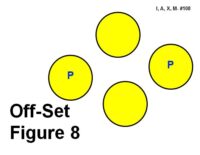
108Offset Figure 8This sign requires two pylons spaced about 6 –8 feet apart. The two distractions will be placed to the sides about 5-6 feet apart. The Figure 8 may be entered with the pylons on either the left or right side. The dog and handler and will perform a complete Figure 8 together around the pylons, crossing the center line three times without disturbing the distractions. Dog safe toys will be used for distractions.

108A:
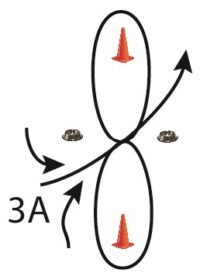
Two vertically aligned oval loops are drawn in black, one above the other, forming a figure-eight shape. Each loop contains an orange traffic cone. Small gray bowl-like markers sit on either side of the center crossing point. Black arrows indicate a path entering from the lower left, crossing through the center, circling the top loop, and continuing along the pattern. The label “3A” appears near the lower left.

108B:
A similar figure-eight layout with two vertically stacked oval loops outlined in black, each containing an orange traffic cone. Small gray bowl-like markers sit near the center on both sides. Black arrows indicate a path entering from the right, crossing through the center, looping around the top oval, and continuing downward. The label “3B” appears near the lower right.
Four yellow circular markers are arranged in an offset cluster pattern, with two positioned higher and two lower. Two of the circles contain a blue letter “P.” Bold black text reads “Off-Set Figure 8.”
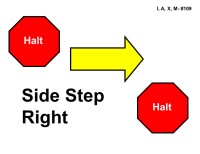
109Halt-Side Step Right-HaltWhile heeling, the handler halts in front of the sign and the dog sits. The dog and handler move one step directly to the right together. The handler halts and the dog sits in heel position. This sign will be placed directly in line of the team’s path requiring the dog and handler to sidestep to the right to pass the sign. (Stationary)A red octagonal sign labeled “Halt” appears on the left, and another “Halt” sign appears on the lower right. Between them is a yellow arrow outlined in black pointing horizontally to the right, indicating a side step movement. Bold black text reads “Side Step Right.”
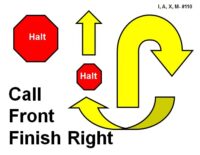
110Halt-Call Front-Finish RightWhile heeling, the handler halts and the dog sits. Without the handler moving their feet, the dog must then come and sit in front. Without the handler moving their feet, the dog must finish to the right and sit in heel position. (Stationary)A red octagonal “Halt” sign appears on the left, and a smaller “Halt” sign appears near the center. A small yellow arrow points straight upward near the top. The main element is a large yellow curved arrow outlined in black that loops downward and around to the right, indicating a finishing movement. A smaller curved arrow at the bottom shows the initial call front motion. Bold black text reads “Call Front Finish Right.”
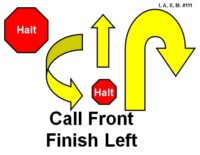
111Halt-Call Front-Finish LeftWhile heeling, the handler halts and the dog sits. Without the handler moving their feet, the dog must then come and sit in front. Without the handler moving their feet, the dog must finish to the left and sit in heel position. (Stationary)A red octagonal “Halt” sign appears on the left, with a smaller “Halt” sign near the center. A small yellow arrow points straight upward near the top. A large yellow curved arrow outlined in black loops downward and around to the left, indicating a finishing movement to the left. A smaller curved arrow on the left shows the initial call front motion. Bold black text reads “Call Front Finish Left.”
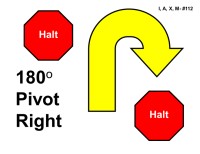
112Halt-180° Pivot Right-HaltWhile heeling, the handler halts and the dog sits. The dog and handler pivot 180° to the right together and the dog sits in heel position. (Stationary)A red octagonal “Halt” sign appears on the left, and another “Halt” sign appears on the lower right. Between them is a large yellow curved arrow outlined in black that bends upward and then turns sharply to the right, indicating a 180-degree pivot. Bold black text reads “180° Pivot Right.”
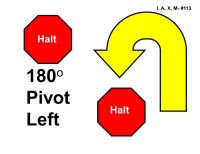
113Halt-180° Pivot Left-HaltWhile heeling, the handler halts and the dog sits. The dog and handler pivot 180° to the left together and the dog sits in heel position. (Stationary)A red octagonal “Halt” sign appears on the left, and another “Halt” sign appears on the lower center-right. Between them is a large yellow curved arrow outlined in black that bends upward and then turns sharply to the left, indicating a 180-degree pivot. Bold black text reads “180° Pivot Left.”
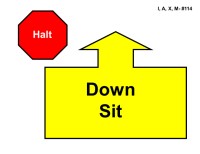
114Halt-Down-SitWhile heeling, the handler halts and the dog sits. The dog must then down and sit. (Stationary)A red octagonal sign labeled “Halt” appears on the left. To the right is a large yellow arrow outlined in black pointing straight upward, attached to a wide rectangular base. Inside the base, bold black text reads “Down Sit.”
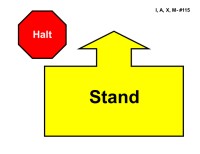
115Halt-StandWhile heeling, the handler halts and the dog sits. The dog must then stand in heel position. The handler may move forward with the dog to stand it. In the Intermediate and Advanced classes the handler may touch the dog to stand it. In the Excellent and Master classes the handler may not touch the dog to stand it. (Stationary)A red octagonal sign labeled “Halt” appears on the left. To the right is a large yellow arrow outlined in black pointing straight upward, attached to a wide rectangular base. Inside the base, bold black text reads “Stand.”
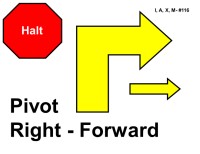
116Halt-Pivot Right-ForwardWhile heeling, the handler halts and the dog sits. The dog and handler pivot 90° to the right together and heel forward. (Stationary)A red octagonal “Halt” sign appears on the left. To the right is a large yellow right-angle arrow outlined in black pointing to the right, indicating a pivot. A smaller straight arrow extends forward from the turn. Bold black text reads “Pivot Right – Forward.”
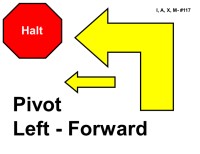
117Halt-Pivot Left-ForwardWhile heeling, the handler halts and the dog sits. The dog and handler pivot 90° to the left together and heel forward. (Stationary)A red octagonal “Halt” sign appears on the left. To the right is a large yellow right-angle arrow outlined in black pointing to the left, indicating a pivot. A smaller straight arrow extends forward from the turn. Bold black text reads “Pivot Left – Forward.”
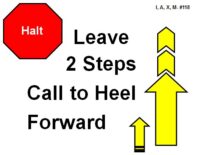
118Halt-Leave 2 Steps-Call to Heel-ForwardWhile heeling, the handler halts and the dog sits. The dog must stay while the handler takes two steps forward and pauses. The handler begins to heel forward and commands the dog to heel. The dog must speed up noticeably to return to heel position. (Stationary)A red octagonal sign labeled “Halt” appears on the left. To the right is a large yellow arrow outlined in black pointing straight upward, with two smaller stacked chevron arrows above its midpoint indicating forward movement. Near the base is a small upward-pointing arrow. Bold black text reads “Leave 2 Steps Call to Heel Forward.”
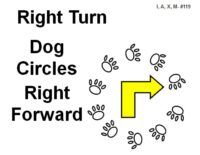
119Right Turn-Dog Circles Right-ForwardWhile heeling, as the handler turns right the dog circles around the handler to the right returning to heel position and heeling forward. The handler may pause as needed.A yellow right-angle arrow outlined in black points to the right at the center. Surrounding it is a circular arrangement of black paw prints forming a loop. Bold black text along the left reads “Right Turn Dog Circles Right Forward.”
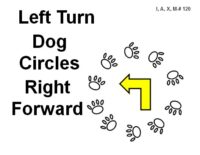
120Left Turn-Dog Circles Right-ForwardWhile heeling, as the handler turns left the dog circles around the handler to the right returning to heel position and heeling forward. The handler may pause as needed.A yellow right-angle arrow outlined in black points to the left at the center. Around it is a circular pattern of black paw prints forming a loop. Bold black text along the left reads “Left Turn Dog Circles Right Forward.”
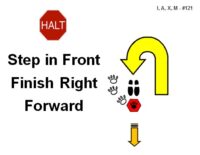
121Halt-Step in Front-Finish Right-ForwardWhile heeling, the handler halts and the dog sits. The handler steps in front to face the dog. Without the handler moving their feet, the dog must finish right. As the dog clears the handler’s path, the handler will heel forward before the dog returns to heel position. (Stationary)A red octagonal sign labeled “HALT” appears in the upper left. To the right is a large yellow curved arrow outlined in black that bends downward and then loops to the right, indicating a finishing movement. Below the arrow are two black footprint shapes and several small paw print icons leading toward a small red hexagonal marker. Beneath that is a small yellow arrow pointing downward with short horizontal lines above it. Bold black text reads “Step in Front Finish Right Forward.”
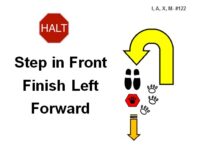
122Halt-Step in Front-Finish Left-ForwardWhile heeling, the handler halts and the dog sits. The handler steps in front to face the dog. Without the handler moving their feet, the dog must finish left. As the dog clears the handler’s path, the handler will heel forward before the dog returns to heel position. (Stationary)A red octagonal sign labeled “HALT” appears in the upper left. To the right is a large yellow curved arrow outlined in black that bends downward and loops to the left. Below the arrow are two black footprint shapes and several paw print icons arranged nearby, along with a small red hexagonal marker. A small yellow downward-pointing arrow with short horizontal lines above it appears beneath. Bold black text reads “Step in Front Finish Left Forward.”
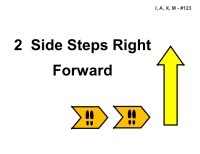
1232 Side Steps Right-ForwardWhile heeling, the handler will take two side steps to the right, leading with the right foot, and continue heeling along the newly established line. The dog must move with the handler. This sign will be placed directly in line of the team’s path requiring the dog and handler to sidestep to the right to pass the sign.Two short yellow arrows outlined in black point to the right, each with small double-chevron markings indicating repeated steps. To the right is a taller yellow arrow pointing straight upward. Bold black text reads “2 Side Steps Right Forward.”

Excellent and Master Class Levels

The following signs may be used in the Excellent and Master Classes (except Sign 210 and 298 may not be used in the Master Class). The principal parts are emphasized.
Sign NumberSign NameSign DescriptionImage of Sign
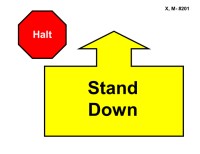
201Halt-Stand-DownWhile heeling, the handler halts and the dog sits. The dog must stand and then down without the handler moving their feet or touching the dog. The dog must remain down until the handler moves forward. (Stationary)A red octagonal sign labeled “Halt” appears in the upper left. To the right is a large yellow arrow outlined in black pointing straight upward, attached to a wide rectangular base. Inside the base, bold black text reads “Stand Down.”
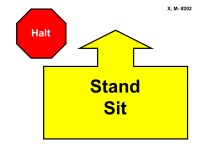
202Halt-Stand-SitWhile heeling, the handler halts and the dog sits. The dog must stand and then sit without the handler moving their feet or touching the dog. The dog must remain sitting until the handler moves forward. (Stationary)A red octagonal sign labeled “Halt” appears in the upper left. To the right is a large yellow arrow outlined in black pointing straight upward, attached to a wide rectangular base. Inside the base, bold black text reads “Stand Sit.”
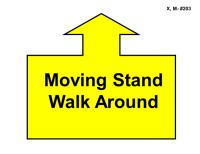
203Moving Stand-Walk AroundWhile heeling, the dog must stand and stay as the handler, without pausing, walks around behind the dog, returns to heel position and pauses. The dog and handler then heel forward. (Stationary)A large yellow arrow outlined in black points straight upward, attached to a wide rectangular base. Inside the base, bold black text reads “Moving Stand Walk Around.”
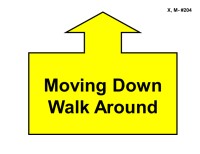
204Moving Down-Walk AroundWhile heeling, the dog must down and stay as the handler, without pausing, walks around behind the dog, returns to heel position and pauses. The dog and handler then heel forward. (Stationary)A large yellow arrow outlined in black points straight upward, attached to a wide rectangular base. Inside the base, bold black text reads “Moving Down Walk Around.”
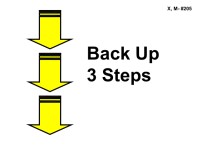
205Backup 3 StepsWhile heeling, the dog and handler reverse direction walking backward at least 3 steps together and then continue heeling forward. The dog must remain standing throughout.Three yellow arrows outlined in black are stacked vertically, each pointing downward. Bold black text to the right reads “Back Up 3 Steps.”
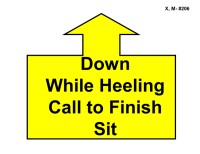
206Down While Heeling-Call to Finish-SitWhile heeling, the dog must down and stay as the handler, without pausing, continues about 6 feet to the Call sign and turns to face the dog. Without moving their feet, the handler may command/signal the dog to finish. The dog must finish to the right or left and sit in heel position. (Stationary)A large yellow arrow outlined in black points straight upward, attached to a wide rectangular base. Inside the base, bold black text reads “Down While Heeling Call to Finish Sit.”
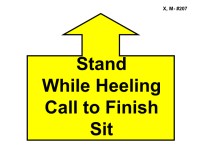
207Stand While Heeling-Call to Finish-SitWhile heeling, the dog must stand and stay as the handler, without pausing, continues about 6 feet to the Call sign and turns to face the dog. Without moving their feet, the handler may command/signal the dog to finish. The dog must finish to the right or left and sit in heel position. (Stationary)A large yellow arrow outlined in black points straight upward, attached to a wide rectangular base. Inside the base, bold black text reads “Stand While Heeling Call to Finish Sit.”
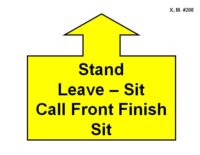
208Stand-Leave-Sit-Call Front-Finish-SitWhile heeling, the handler will stop forward motion; the dog must stand and stay. The handler will walk about 6 feet to the Call sign and turn to face the dog. The dog must then sit, come and sit in front. Without moving their feet, the handler may command/signal the dog to finish. The dog must finish to the right or left and sit in heel position. (Stationary)A large yellow arrow outlined in black points straight upward, attached to a wide rectangular base. Inside the base, bold black text reads “Stand Leave – Sit Call Front Finish Sit.”
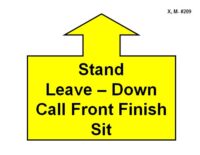
209Sand-Leave-Down-Call Front-Finish-SitWhile heeling, the handler will stop forward motion; the dog must stand and stay. The handler will walk about 6 feet to the Call sign and turn to face the dog. The dog must then down, come and sit in front. Without moving their feet, the handler may command/signal the dog to finish. The dog must finish to the right or left and sit in heel position. (Stationary)A large yellow arrow outlined in black points straight upward, attached to a wide rectangular base. Inside the base, bold black text reads “Stand Leave – Down Call Front Finish Sit.”
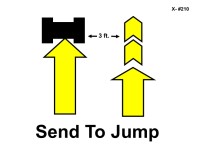
210Send to JumpAt the sign the dog must leave the handler to jump. The dog must clear the jump on the first attempt, in the proper direction without stopping. The handler must remain at least 3 feet away from the jump and may not pass the jump until the dog has returned to heel.
position.
A black jump bar is positioned horizontally near the top left, with a bold “3 ft.” marking indicating space between the jump and the handler. Below the bar, a large yellow arrow outlined in black points straight upward toward the jump. To the right, a second vertical yellow arrow with two stacked chevrons indicates forward motion. Bold black text reads “Send To Jump.”
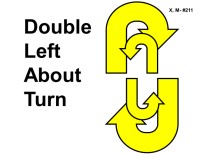
211Double Left About TurnWhile heeling, the handler will make an about turn to the left, while at the same time the dog must move around the handler to the right and into heel position. The handler will take two or three steps before the dog and handler complete the left about turn a second time.
second time.
Two large yellow curved arrows outlined in black are stacked and intertwined vertically. Each arrow forms a U-shaped turn bending to the left, indicating consecutive turns. Bold black text to the left reads “Double Left About Turn.”
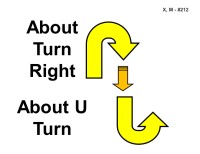
212About Turn Right-About U TurnWhile heeling, the dog and handler turn 180° to the right, take two or three steps forward and then turn 180° to the left.Two separate yellow arrow diagrams outlined in black are shown vertically. The top arrow curves downward and to the right, indicating a right about turn, with a small downward-pointing arrow beneath it. The bottom arrow forms a broader U-shaped turn. Bold black text reads “About Turn Right” and “About U Turn.”
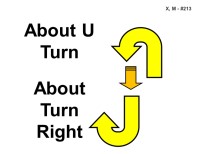
213About U Turn-About Turn RightWhile heeling, the dog and handler turn 180° to the left, take two or three steps forward and then turn 180° to the right.Two yellow curved arrows outlined in black are displayed vertically. The top arrow forms a U-shaped turn, curving upward and around to the left, indicating an about U turn. Below it, a downward-pointing arrow leads to a second curved arrow that turns to the right. Bold black text reads “About U Turn” and “About Turn Right.”
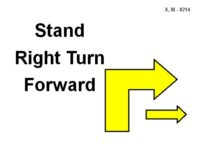
214Stand-Right Turn-ForwardWhile heeling, the handler stops and without touching the dog, the dog stands in heel position. The dog and handler turn right together and then heel forward. (Stationary)A large yellow right-angle arrow outlined in black points to the right, indicating a turn, with a smaller straight arrow extending forward from the turn. Bold black text reads “Stand Right Turn Forward.”
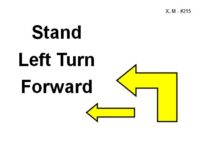
215Stand-Left Turn-ForwardWhile heeling, the handler stops and without touching the dog, the dog stands in heel position. The dog and handler turn left together and then heel forward. (Stationary)A large yellow right-angle arrow outlined in black points to the left, indicating a turn, with a smaller straight arrow extending forward from the turn. Bold black text reads “Stand Left Turn Forward.”
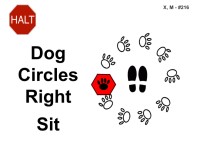
216Halt-Dog Circles Right-SitWhile heeling, the handler halts and the dog sits. The dog circles around the handler to the right, returns to heel position and sits. (Stationary)A red octagonal sign labeled “HALT” appears in the upper left. To the right is a circular arrangement of black paw prints forming a loop. Inside the loop are two black footprint shapes and a red paw-print marker. Bold black text reads “Dog Circles Right Sit.”
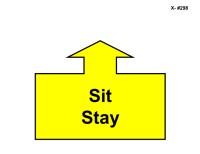
298Sit StayThe dog must remain in the sit position while the handler gets the leash, walks around behind the dog to return to heel position and until the judge says "Exercise Finished."A large yellow arrow outlined in black points straight upward, attached to a wide rectangular base. Inside the base, bold black text reads “Sit Stay.”
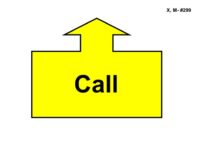
299CallThis sign will be used as a marker for associated signs.A large yellow arrow outlined in black points straight upward, attached to a wide rectangular base. Centered inside the base, bold black text reads “Call.”

Master Class Level

The following signs may be used in the Master Class. The principal parts are emphasized.
Sign NumberSign NameSign DescriptionImage of Sign
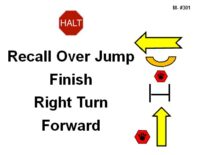
301Halt-Recall Over Jump-Finish-Right Turn-ForwardThis sign will be placed at least 8 feet before the jump. While heeling, the handler halts and the dog sits in front of the jump. The handler will leave the dog, walk to the other side, stand in front of the jump and turn to face the dog. The dog must remain sitting until called over the jump. The dog must clear the jump on the first attempt, in the proper direction without stopping, come and sit in front. Without moving their feet, the handler may command/signal the dog to finish. The dog must finish to the right or left. As the dog clears the handler’s path, the handler will move to the newly established line, turn right and heel forward before the dog returns to heel position. (Stationary)

Sign 301A must be used with Sign 301:
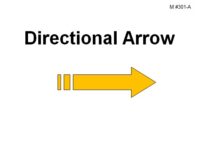
A single yellow arrow outlined in black points horizontally to the right. Near the base of the arrow are two short vertical bar markings. Bold black text above reads “Directional Arrow.”
A red octagonal sign labeled “HALT” appears in the upper left. To the right is a sequence of symbols showing a training pattern: a yellow left-pointing arrow at the top, a curved yellow arrow beneath it indicating a turn, a red hexagonal marker with a paw print, a horizontal jump bar, another red paw-print marker below the bar, and a large yellow arrow pointing straight upward. Bold black text reads “Recall Over Jump Finish Right Turn Forward.”
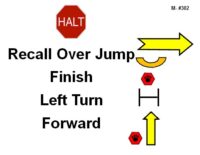
302Halt-Recall Over Jump-Finish-Left Turn-ForwardThis sign will be placed at least 8 feet before the jump. While heeling, the handler halts and the dog sits in front of the jump. The handler will leave the dog, walk to the other side, stand in front of the jump and turn to face the dog. The dog must remain sitting until called over the jump. The dog must clear the jump on the first attempt, in the proper direction without stopping, come and sit in front. Without moving their feet, the handler may command/signal the dog to finish. The dog must finish to the right or left. As the dog clears the handler’s path, the handler will move to the newly established line, turn left and heel forward before the dog returns to heel position. (Stationary)

Sign 302A must be used with Sign 302:
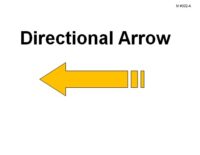
A single yellow arrow outlined in black points horizontally to the left. Near the base of the arrow are two short vertical bar markings. Bold black text above reads “Directional Arrow.”
A red octagonal sign labeled “Halt” appears in the upper left. To the right is a vertical sequence of symbols illustrating a training pattern: a yellow right-pointing arrow at the top, a curved yellow arrow beneath it indicating a turn, a red hexagonal marker with a paw print, a horizontal jump bar, another red paw-print marker below the bar, and a large yellow arrow pointing straight upward. Bold black text reads “Recall Over Jump Finish Left Turn Forward.”
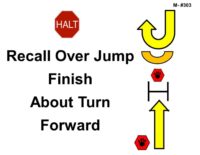
303Halt-Recall Over Jump-FinishThis sign will be placed at least 8 feet before the jump. While heeling, the handler halts and the dog sits in front of the jump. The handler will leave the dog, walk to the other side, stand in front of the jump and turn to face the
dog. The dog must remain sitting until called over the jump. The dog must clear the jump on the first attempt, in the proper direction without stopping, come and sit in front. Without moving their feet, the handler may command/signal the dog to finish. The dog must finish to the right or left. As the dog clears the handler’s path, the handler will make an about turn and heel forward before the dog returns to heel position. (Stationary)

Sign 303A must be used with Sign 303:
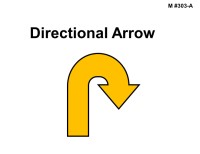
A single yellow arrow outlined in black forms a curved U-shape, bending upward and then turning right, indicating a U-turn direction. Bold black text above reads “Directional Arrow.”
A red octagonal sign labeled “Halt” appears in the upper left. To the right is a vertical sequence of symbols illustrating a training pattern: a large yellow U-shaped arrow showing an about turn at the top, a curved yellow arc beneath it indicating the turn path, a red hexagonal marker with a paw print, a horizontal jump bar, a second red paw-print marker below the bar, and a large yellow arrow pointing straight upward at the bottom. Bold black text reads “Recall Over Jump Finish About Turn Forward.”
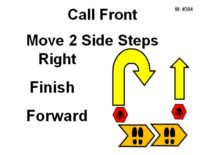
304Call Front-Move 2 Side Steps Right-Finish ForwardWhile heeling, the handler stops and calls the dog to front. The handler may take several steps backward. The dog must come and sit in front. The handler will take two steps to the right and the dog must move with the handler. When the handler stops moving the dog must sit in front. Without moving their feet, the handler may command/signal the dog to finish. The dog must finish to the right or left. As the dog clears the handler’s path, the handler will heel forward before the dog returns to heel position. (Stationary)Bold black text reads “Call Front Move 2 Side Steps Right Finish Forward.” To the right, a large yellow curved arrow outlined in black bends upward and then loops downward to the right, indicating the finish movement. A separate tall yellow arrow points straight upward, showing forward motion. Two red hexagonal markers with paw prints appear near the arrows. At the bottom, two yellow rectangular step markers with black footprints indicate two side steps to the right.
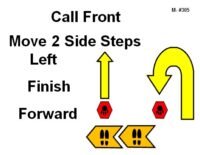
305Call Front-Move 2 Side Steps Left-Finish ForwardWhile heeling, the handler stops and calls the dog to front. The handler may take several steps backward. The dog must come and sit in front. The handler will take two side steps to the left and the dog must move with the handler. When the handler stops moving the dog must sit in front. Without moving their feet, the handler may command/signal the dog to finish. The dog must finish to the right or left. As the dog clears the handler’s path, the handler will heel forward before the dog returns to heel position. (Stationary)Bold black text reads “Call Front Move 2 Side Steps Left Finish Forward.” To the right, a large yellow curved arrow outlined in black bends upward and loops downward to the left. A tall yellow arrow points straight upward for forward movement. Two red hexagonal paw-print markers appear near the arrows. At the bottom, two yellow rectangular step markers with black footprints indicate two side steps to the left.
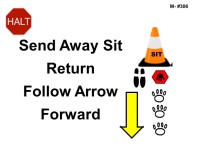
306Halt-Send Away Sit-Return-Follow Arrow ForwardThe pylon will be placed approximately 6 feet away from the sign. While heeling, the handler halts and the dog sits. When sent, the dog must go to the area of the pylon stop and sit with its attention on the handler, but it need not sit squarely. The dog must stay while the handler returns to heel position. The handler may return to heel position by going directly to heel or walking around behind the dog. The handler must pause before heeling forward in the direction of the arrow.

Sign 306A must be used with Sign 306:
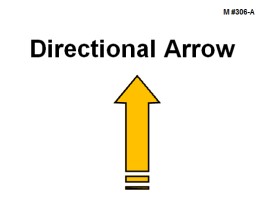
A single yellow arrow outlined in black points straight upward. Near the base of the arrow are two short horizontal bar markings. Bold black text above reads “Directional Arrow.”
A red octagonal “Halt” sign appears in the upper left. Bold black text reads “Send Away Sit Return Follow Arrow Forward.” To the right, an orange traffic cone labeled “SIT” is placed above a cluster of black paw prints indicating a path. A red hexagonal paw-print marker appears near the paw prints. A wide yellow arrow outlined in black points downward, indicating the direction to follow.
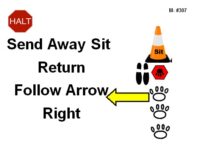
307Halt-Send Away Sit-Return-Follow Arrow RightThe pylon will be placed approximately 6 feet away from the sign. While heeling, the handler halts and the dog sits. When sent, the dog must go to the area of the pylon stop and sit with its attention on the handler, but it need not sit squarely. The dog must stay while the handler returns to heel position. The handler may return to heel position by going directly to heel or walking around behind the dog. The handler must pause before heeling to the right in the direction of the arrow. (Stationary)

Sign 307A must be used with Sign 307:
A single yellow arrow outlined in black points horizontally to the right. Near the base of the arrow are two short vertical bar markings. Bold black text above reads “Directional Arrow.”
A red octagonal sign labeled “Halt” appears in the upper left. Bold black text reads “Send Away Sit Return Follow Arrow Right.” To the right is an orange traffic cone labeled “Sit” above a small black platform. Below the cone are black footprint shapes and a red hexagonal marker with a paw print. A series of black paw prints trail downward. A yellow arrow outlined in black points horizontally to the right, indicating the direction to follow.
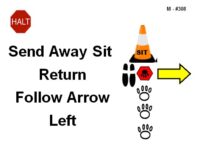
308Halt-Send Away Sit-Return-Follow Arrow LeftThe pylon will be placed approximately 6 feet away from the sign. While heeling, the handler halts and the dog sits. When sent, the dog must go to the area of the pylon stop and sit with its attention on the handler, but it need not sit squarely. The dog must stay while the handler returns to heel position. The handler may return to heel position by going directly to heel or walking around behind the dog. The handler must pause before heeling to the left in the direction of the arrow. (Stationary)

Sign 308A must be used with Sign 308:
A single yellow arrow outlined in black points horizontally to the left. Near the base of the arrow are two short vertical bar markings. Bold black text above reads “Directional Arrow.”
A red octagonal sign labeled “Halt” appears in the upper left. Bold black text reads “Send Away Sit Return Follow Arrow Left.” To the right is an orange traffic cone labeled “SIT” positioned above a small black platform. Below the cone are black footprint shapes and a red hexagonal marker with a paw print. A vertical trail of black paw prints continues downward. A yellow arrow outlined in black points horizontally to the left, indicating the direction to follow.
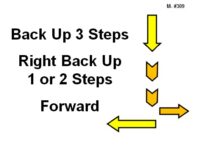
309Backup 3 Steps-Right Backup 1 or 2 Steps-ForwardWhile heeling, the dog and handler reverse direction walking backwards at least 3 steps, and without stopping, take one or two steps backwards 90° to the right and then heel forward. The dog must move with the handler.Bold black text reads “Back Up 3 Steps Right Back Up 1 or 2 Steps Forward.” To the right is a large yellow arrow outlined in black pointing straight downward, indicating backward movement. Beneath it are two smaller stacked downward chevron arrows representing additional backward steps. At the bottom, two horizontal arrows appear: one pointing left and one pointing right, indicating directional movement before proceeding forward.
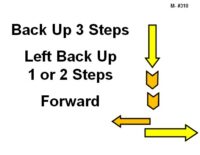
310Backup 3 Steps-Left Backup 1 or 2 Steps-ForwardWhile heeling, the dog and handler reverse direction walking backwards at least 3 steps, and without stopping, take one or two steps backwards 90° to the left and then heel forward. The dog must move with the handler.Bold black text reads “Back Up 3 Steps Left Back Up 1 or 2 Steps Forward.” To the right is a large yellow arrow outlined in black pointing straight downward, indicating backing up. Beneath it are two smaller stacked chevron arrows showing additional backward steps. At the bottom are two horizontal arrows: one shorter arrow pointing left and a longer arrow pointing right, indicating lateral movement followed by forward travel.
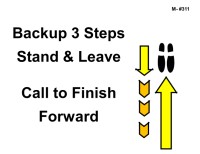
311Backup 3 Steps-Stand and Leave-Call to Finish-ForwardThe Call sign will be placed approximately three feet away from this sign. While heeling, the dog and handler reverse direction and walk backwards at least 3 steps. The handler may pause to stand and leave the dog. The dog must stand and stay until called. The handler will walk to the Call sign and turn to face the dog. Without moving their feet, the handler may command/signal the dog to finish. The dog must finish to the right or left. As the dog clears the handler’s path, the handler will heel forward. (Stationary)Bold black text reads “Backup 3 Steps Stand & Leave Call to Finish Forward.” To the right is a vertical sequence of symbols: a long yellow arrow pointing upward indicating forward movement; three small stacked chevron arrows below it indicating backup steps; a pair of black footprints near the top; and a small curved yellow arrow showing a finishing turn. Together, the symbols depict backing up, standing and leaving, then returning to finish and proceed forward.
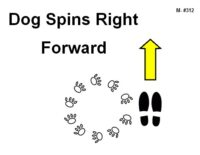
312Dog Spins Right-ForwardWhile heeling, the handler stops and the dog, without sitting, spins in a circle to the right alongside the handler. When the dog returns to heel position, the dog and handler heel forward.Bold black text reads “Dog Spins Right Forward.” A circular pattern of black paw prints forms a loop, illustrating a spin to the right. To the right of the circle are two black footprint shapes. A tall yellow arrow outlined in black points straight upward, indicating forward movement after the spin.
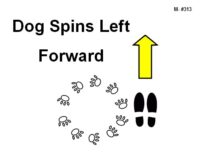
313Dog Spins Left-ForwardWhile heeling, the handler stops and the dog, without sitting, spins in a circle to the left alongside the handler. When the dog returns to heel position, the dog and handler heel forward.Bold black text reads “Dog Spins Left Forward.” A circular pattern of black paw prints forms a loop, illustrating a spin to the left. To the right of the circle are two black footprint shapes. A tall yellow arrow outlined in black points straight upward, indicating forward movement after the spin.
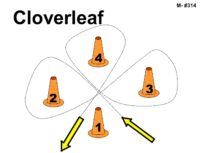
314Cloverleaf
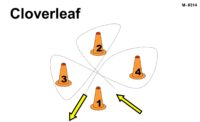
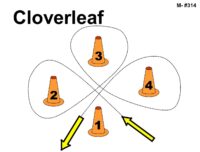
This sign requires the pylons be spaced approximately 6 feet apart. The dog and handler must complete the cloverleaf by crossing the center line four times. The four pylons will be numbered sequentially. The number “1” pylon will be placed to the handlers left, and indicates the entry and exit points for performance of this sign. This is a change of direction sign and upon exiting the team may go in any direction to the next sign.

Bold black text reads “Cloverleaf.” Four orange traffic cones labeled “1,” “2,” “3,” and “4” are arranged in a loose diamond shape, with cone 1 at the bottom center, cone 2 at the top, cone 3 on the left, and cone 4 on the right. Dotted curved paths loop around each cone in overlapping arcs, forming a cloverleaf-style pattern that crosses in the center. Two yellow arrows outlined in black near the bottom indicate entry and direction of travel—one angled down-left and one angled up-right.

Bold black text reads “Cloverleaf.” Four orange cones labeled “1,” “2,” “3,” and “4” are arranged with cone 1 at the bottom center, cone 2 on the left, cone 3 at the top, and cone 4 on the right. Dotted looping paths form a symmetrical cloverleaf pattern, with larger rounded loops around each outer cone and a central crossing point. Two yellow directional arrows at the bottom show the path entering from the lower left and exiting toward the right.

Bold black text reads “Cloverleaf.” Four orange cones labeled “1,” “2,” “3,” and “4” are arranged with cone 1 at the bottom center, cone 2 on the left, cone 3 on the right, and cone 4 at the top. Dotted curved paths create overlapping loops around the cones, forming another cloverleaf-style route with a central crossover point. Two yellow arrows at the bottom indicate direction, with one angled down-left and another angled up-right, showing entry and exit flow.
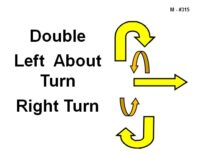
315Double Left About Turn-Right TurnWhile heeling, the handler will make an about turn to the left, while at the same time the dog must move around the handler to the right and into heel position. The handler will take two or three steps before the dog and handler complete the left about turn a second time. The dog and handler then turn right and heel forward.Bold black text reads “Double Left About Turn Right Turn.” To the right, a sequence of yellow arrows outlined in black illustrates the movement: a large inverted U-shaped arrow at the top indicates the first left about turn, followed by a smaller curved arrow continuing the turn motion. A horizontal arrow points to the right, indicating a right turn. Below, another curved arrow continues the turning sequence, ending with a U-shaped arrow at the bottom showing the second left about turn.
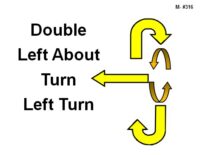
316Double Left About Turn-Left TurnWhile heeling, the handler will make an about turn to the left, while at the same time the dog must move around the handler to the right and into heel position. The handler will take two or three steps before the dog and handler complete the left about turn a second time. The dog and handler then turn left and heel forward.Bold black text reads “Double Left About Turn Left Turn.” To the right is a similar sequence of yellow arrows outlined in black: a large inverted U-shaped arrow at the top shows a left about turn, followed by smaller curved arrows indicating continued motion. A horizontal arrow points to the left, indicating a left turn. The sequence ends with another curved U-shaped arrow at the bottom, completing the double left about turn pattern.
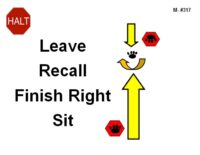
317Halt-Leave-Recall-Finish Right-SitWhile heeling, the handler halts and the dog sits. The dog must stay while the handler leaves and walks approximately 15 feet to the Call sign, turns and faces the dog. When called, the dog must go directly to the handler and sit in front. Without moving their feet, the handler may command/signal the dog to finish. The dog must finish right and sit in heel position. (Stationary)A red octagonal sign labeled “HALT” appears in the upper left. Bold black text reads “Leave Recall Finish Right Sit.” To the right, a vertical sequence of symbols shows the movement: a downward-pointing yellow arrow at the top, a small curved arrow indicating a turn, and a large upward-pointing yellow arrow for forward motion. Two red hexagonal markers with paw prints appear near the path. Black paw prints and a pair of black footprints indicate the movement sequence and final position.
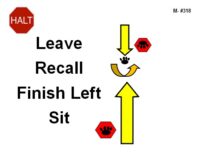
318Halt-Leave-Recall-Finish Left-SitWhile heeling, the handler halts and the dog sits. The dog must stay while the handler leaves and walks approximately 15 feet to the Call sign, turns and faces the dog. When called, the dog must go directly to the handler and sit in front. Without moving their feet, the handler may command/signal the dog to finish. The dog must finish left and sit in heel position. (Stationary)A red octagonal sign labeled “HALT” appears in the upper left. Bold black text reads “Leave Recall Finish Left Sit.” To the right, a vertical sequence of symbols shows a downward-pointing yellow arrow at the top, a small curved arrow indicating a turning motion, and a large upward-pointing yellow arrow for forward movement. Black paw prints and black footprint shapes mark the path, and two red hexagonal markers with paw prints indicate key positions along the sequence.
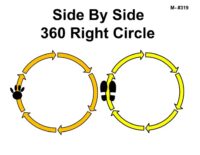
319Side by Side 360° Right CircleWhile heeling, the dog and handler will stop forward motion and make a 360° side by side right circle.Bold black text reads “Side By Side 360 Right Circle.” Two large circular paths are shown side by side, each formed by connected yellow arrow segments pointing in a clockwise direction. On the left circle is a black paw print marker indicating the dog’s position, and between the circles are two black footprint shapes representing the handler. The diagram shows both moving in parallel through a full 360-degree right (clockwise) circle.
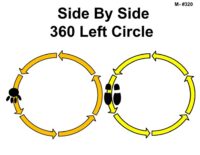
320Side by Side 360° Left CircleWhile heeling, the dog and handler will stop forward motion and make a 360° side by side left circle.Bold black text reads “Side By Side 360 Left Circle.” Two large circular paths are shown side by side, each composed of yellow arrow segments pointing counterclockwise. On the left circle is a black paw print marker indicating the dog’s position, and near the center between the circles are black footprint shapes representing the handler. The diagram shows both moving together through a full 360-degree left (counterclockwise) circle.
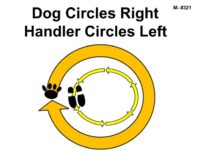
321Dog Circles Right Around Handler-Handler Circles LeftWhile heeling, the dog and handler will stop forward motion. The dog must circle right around the handler and the handler will circle left at the same time the dog is moving right. The dog and handler heel forward. This is a 360° circle with the dog and handler moving in opposite directions.Bold black text reads “Dog Circles Right Handler Circles Left.” A large circular ring formed by thick yellow arrow segments surrounds a smaller inner circle of lighter yellow arrow segments. The outer circle indicates a clockwise path (dog circling right), while the inner circle shows a counterclockwise path (handler circling left). A black paw print marker appears on the outer circle, and a pair of black footprint shapes appears on the inner circle, showing the separate but simultaneous movement paths.
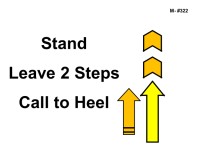
322Stand-Leave 2 Steps-Call to HeelWhile heeling, the handler stops and the dog stands in heel position. The dog must stand and stay while the handler takes two steps forward and pauses. The handler begins to heel forward and commands the dog to heel. The dog must speed up noticeably to resume heel position. (Stationary)Bold black text reads “Stand Leave 2 Steps Call to Heel.” To the right, a vertical sequence of symbols shows two small stacked chevron arrows at the top indicating two steps, followed by a larger upward-pointing yellow arrow representing returning to heel position. Additional small markings near the base of the arrow emphasize forward movement and positioning.