For a printable version of this webpage: Rhubarb
Rhubarb
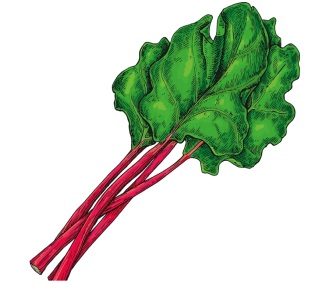
Throughout history, rhubarb has been used for both culinary and medicinal purposes. Rhubarb is technically a vegetable but is usually served in desserts as a fruit. Rhubarb blends well with other fruits such as strawberries. The leaves of rhubarb contain poisonous oxalic acid salts and should not be eaten. Although you can eat rhubarb raw, you probably won’t enjoy it. It has a sour, brutally bitter taste, so most people prefer to cook it with sugar.
Nutrition
Rhubarb provides a fair amount of vitamin A and vitamin C, as well as potassium. Cooked with sugar, it provides 140 calories per 3-1/2 ounce serving. Without sugar, the same serving provides a mere 16 calories.
Selection
Field-grown rhubarb is rich, dark red in color, with coarse green foliage and a very tart flavor. It can be purchased with leaves attached or removed. The leaves are not edible but, if attached, they are a good guide to freshness. Stalks should be firm, crisp, and cherry red or pink in color. Pink color is indicative of hothouse-grown rhubarb. Before processing, rinse rhubarb, scrub stalks with clean vegetable brush under running water.
Storage
Rhubarb stalks can be washed and stored for two to four weeks in a refrigerator. To maximize storage, wrap stalks to retain moisture but allow to breathe using foil, plastic wrap, or a similar product.
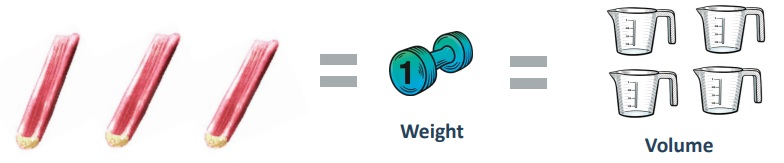
Measurements
Freezing
- Select firm, young tender, well-colored stalks.
- Wash, trim and cut into 1-inch pieces.
- Pack dry into freezer containers or bags.
- Pack into moisture/vapor-proof freezer containers or freezer-weight plastic bags.
- Label, seal and freeze.

Tip: Rhubarb can also be cooked into sauce, cooled and frozen.
Drying
Preparation:
Wash and trim. Discard leaves. Slice diagonally into one-inch slices.
Pretreatment:
Steam for 1 – 2 minutes or until slightly tender, but not soft.
Drying Procedure:
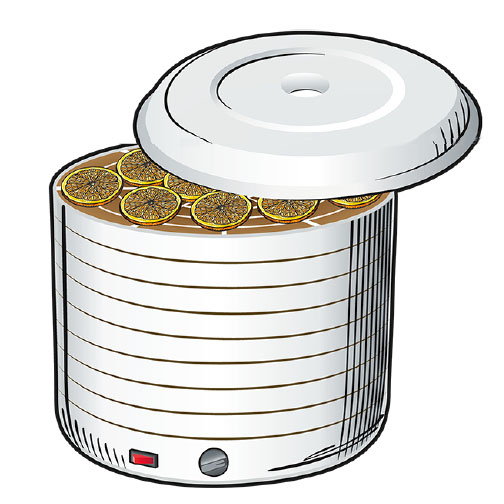
- Spread on drying trays in a single layer
- Dry at 140° F until brittle, crisp.
- Package in moisture/vapor-proof containers. Label.
- Store in a cool, dark, dry place.
Strawberry Rhubarb Leather:
- 1 cup rhubarb
- ¼ cup water
- 2 cups strawberries, sliced
- ½ cup sugar
Combine finely chopped rhubarb and water in a saucepan. Simmer over medium heat for about 5 minutes. Add strawberries and sugar. Puree mixture in a blender or food processor until smooth. Pour puree on fruit leather trays that have been lightly oiled.
Dry at 140°F. until leathery and pliable. Remove from trays while still warm and roll. Package in moisture/vapor proof containers. Label. Store in a cool, dark, dry place.
Water Bath Canning
Jam/Jellies/Preserves
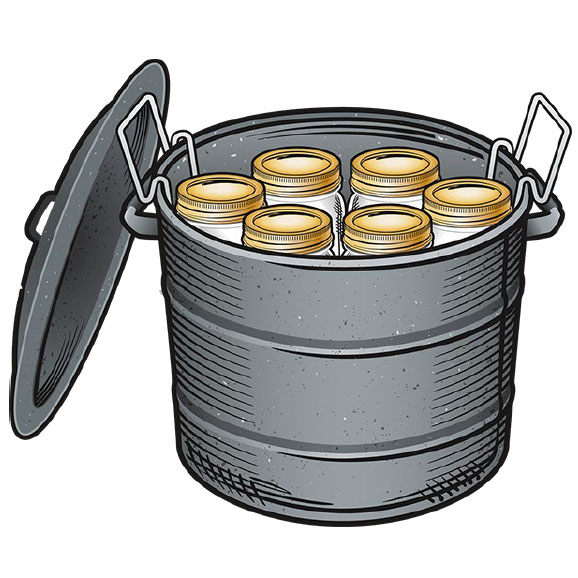
Rhubarb can be made into a variety of fruit spreads, most often in combination with other fruits such as strawberries. Recipes for jams, jellies and preserves can be found in commercial pectin packages. Options are available for full sugar, low sugar and freezer jam products. Recipes using pectin have been carefully formulated and should be followed exactly. Cooked fruit spreads must be processed in a boiling water canner for storage at room temperature.
Stewed Rhubarb
An average of 10-1/2 pounds is needed per canner load of 7 quarts; an average of 7 pounds is needed per canner load of 9 pints.
Directions. Trim off leaves. Wash stalks and cut into 1/2-inch to 1-inch pieces. In a large saucepan add 1/2 cup sugar for each quart (4 cups) of fruit. Let stand until juice appears. Heat gently to boiling. Fill hot jars without delay, leaving 1/2-inch headspace.
Remove bubbles. Wipe rim with clean, damp paper towel. Adjust two-piece lids and process in boiling water canner according to directions below.
Once processing is complete, turn off heat, remove canner lid and wait 5 minutes before removing jars. Let cool at room temperature, undisturbed, for 12 to 24 hours and check for seals. Wipe jars, remove rings, label, and store in a cool, dry place.
Processing Directions for Stewed Rhubarb:
| Style of pack | Jar Size | 1–1,000 ft | 1,001–3,000 ft |
| Hot | Pints or Quarts | 15 minutes | 20 minutes |
Preserve Skagit Crop Sheets describe three food preservation techniques—freezing, drying, and boiling water canning—consistent with USDA Food Preservation and Food Safety recommendations. Pressure canning for low acid foods such as meats and vegetables is not included.
Additional resources and recipes, as well as information on Pressure Canning, can be found on the WSU Skagit Food Preservation Website https://extension.wsu.edu/skagit/fam/food-preservation/ or the National Center for Home Food Preservation https://nchfp.uga.edu/index.html.
Copyright 2022 WSU Skagit Extension. Any opinions, findings, conclusions, or recommendations expressed on this fact sheet are those of the author(s) and do not necessarily reflect the view of the USDA. WSU Extension programs are available to all without discrimination