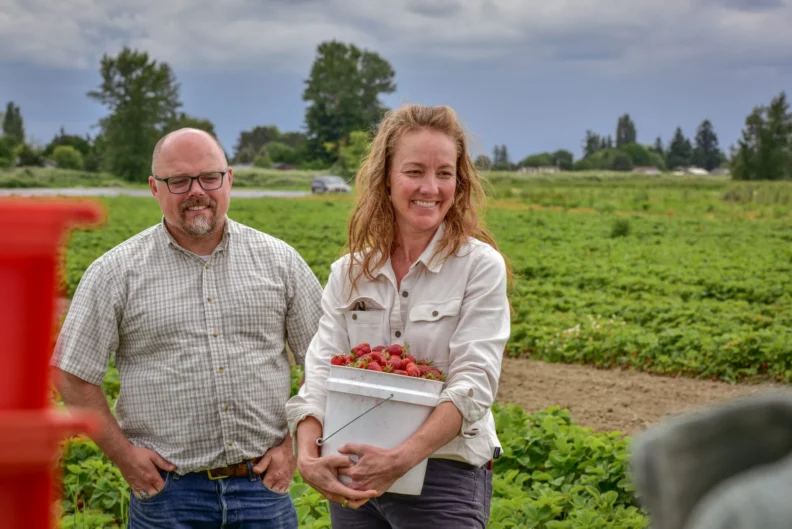
On a Wednesday in early December, about thirty Skagit County farmers gathered at Shawn O’Donnell’s Irish Pub. There was laughter, some weariness, and an unspoken gravity in the air. They weren’t there to talk about yields or equipment, but about something larger—the passage of work, of wisdom, of land itself—from one generation to the next.
As Genuine Skagit Valley Director Blake Van Roekel reminded the room, “When land changes hands, that’s when it’s most vulnerable.” She wasn’t just speaking about property lines, but about continuity—the thin thread that ties a farmer’s life’s work to the hope that someone else will carry it forward.
Much like an athlete facing the moment between mastery and teaching, farm succession demands both humility and courage. It’s not simply about estate planning or business ownership. It’s about grace—letting go, while ensuring that the values rooted in that soil don’t erode with time.
The meeting’s panel—Elizabeth Bragg, Anne Schwartz, Kai Ottesen, and Jason Vander Kooy—embodied that truth. Schwartz, reflecting on the sale of her Rockport farm to Bragg, put it plainly: “The survival of agriculture in this valley is something that is completely precious to me.” Bragg’s reply carried both gratitude and promise: “You’ve seeded not just the next generation, but also the next after it.”
That quiet exchange held the essence of this work—the unseen handoff that keeps farming alive in Skagit County.
At the Western Regional Agricultural Stress Assistance Program, this is more than a technical challenge or policy priority; it’s a human one. The farmers in that pub are not simply producers—they are stewards of cultural and ecological memory. Through our regional partnership with Washington State University Skagit County Extension and others like Genuine Skagit Valley and Skagitonians to Preserve Farmland, WRASAP supports farmers in managing not only the paperwork and planning of succession, but the emotions, identity shifts, and relational strain that often accompany it.
Because succession isn’t just about who owns the land next—it’s about ensuring that those who inherit it can thrive without losing themselves in the process. Agricultural stress is real, and transitions like these often bring it sharply into focus. When we make space—like at gatherings such as this one—for farmers to share, grieve, and plan together, we honor both the soil and the soul of farming life.
The farmer’s journey isn’t just about what is planted, but about the invisible harvest—the endurance, the mentoring, the grace of handing over the reins with love and integrity. And in that handoff, something sacred endures.