Skagit County Agricultural Crops
Agriculture in the News

Apples
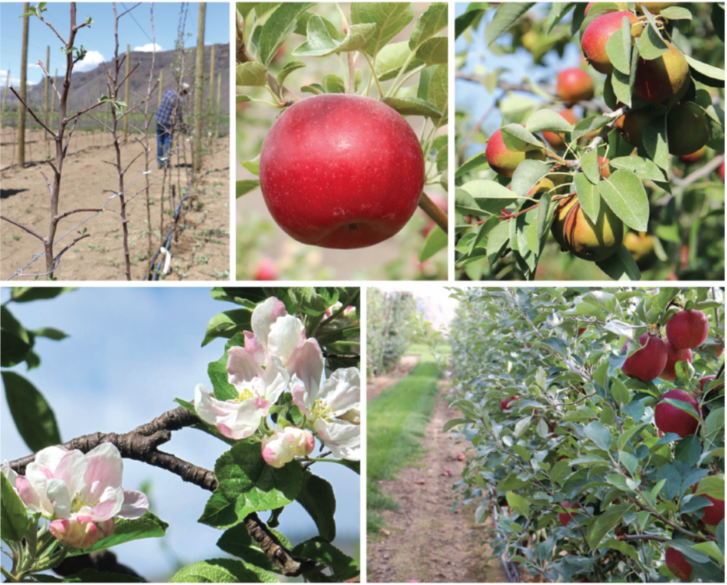
Apple acreage in Skagit County is on the decline. The 2021 Skagit crop showed average yields and average quality with a moderate pricing structure. Our coastal climate allows us to grow varieties that are different from those grown in the large apple-producing regions of central Washington. Varieties grown here such as Jonagold, Gravenstein, Spartan, Akane and Honey Crisp are excellent apples to consume, but with no apple processing facilities in Skagit County, shipping the apples back and forth across the mountain passes makes commercial production unprofitable. In 1998 Washington State Department of Agriculture added Skagit to the list of counties quarantined against apple maggot. WSU Skagit County Extension initiated the formation of the Skagit County Horticultural Pest and Disease Board to develop programs to prevent the pest from infesting commercial orchards. To date, no apple maggots have been found in commercial orchards.
Blueberries
Harvested by hand and machine, about half the crop is sold for fresh market, and half is processed. Yields and quality in this area are high relative to traditional production areas in the Midwest and eastern North America. New cultivars are replacing older ones and production is modernizing so the industry remains competitive on a national and international stage. The county produces some organic blueberry, but most growers are not certified organic due to high disease and pest pressure.
Blackberries
Skagit County leads in-state blackberry production, and the acreage of this crop has expanded in recent years due to a rise in fresh market opportunities. Winter hardiness is an important barrier to cultivating blackberries in northwest Washington with semierect cultivars (e.g., ‘Celestial’) being more adapted than trailing cultivars (e.g., ‘Marion’). Blackberry/red raspberry hybrids such as ‘Tayberry’, ‘Boysen’, and ‘Logan’ are also cultivated on a small scale for local markets.
Bulb Crops
Approximately 700 acres of tulips and daffodils are grown in Skagit County. They are sold for both cut flowers and bulbs and shipped throughout the U.S. and Canada. About 20 million bulbs are harvested each summer in Skagit County. About 75 million cut flowers are grown in greenhouses and fields, accounting for over 50% of overall sales. About 500 acres of tulips are grown in the Valley, which represents 75% of U.S. commercial production. Skagit County is known worldwide for its Tulip Festival, which occurs the entire month of April. The Tulip Festival began in 1984 and now brings an estimated 300,000 visitors and $65 million in revenue to the county.
The bulb industry averages about $20 million in annual gross income, $3 million of which is in bulb sales. Since 1968, flower prices have increased three times, while bulbs have only doubled, but prices have decreased steadily since 2000. There are now only two bulb-growing farms in the region. Iris production was discontinued in 2016.
Brussels Sprouts, Cauliflower and Broccoli
All Skagit County Brussels sprouts, cauliflower and broccoli are grown for fresh market. Head quality is exceptionally high in this region. Approximately 60% to 80% of the Brussels sprouts, broccoli and cauliflower grown in Skagit is consumed in Oregon, Washington, and British Columbia. Skagit farmers grew about 2,500 acres of Brussels sprouts, cauliflower and broccoli this year. Farmers in the Skagit Valley maintained acreages for these important rotational crops in largely for the disease suppression that brassica crops provide via biofumigation.
Chickens and Eggs
Washington is ranked 19th in the nation for egg production. Two companies produce the majority of the eggs in Skagit County: National Foods and Wilcox Farms. These two farms account for hundreds of millions of eggs being produced in Skagit County and Washington State.
In 2024 the retail price for a dozen eggs in the United States was rose from $1.97 to $3.23 U.S. dollars. Setting a new peak that hasn’t been seen since 2015.
The sole Washington-owned chicken processor in the state, Draper Valley Farms, is located in Mount Vernon. The company employs approximately 500 people and has sales around 80 million dollars.
In the United States, the price for a pound of fresh whole chicken cost consumers an average of $2.06 which, has increased over previous years.
Cucumbers
The lone large scale commercial pickle cucumber processor in Washington State is Gielow Pickles located at the Port of Skagit County with headquarters located in Lexington, MI. According to their website, “Making pickles is in our blood. When our family began making pickles in the early 1900’s, our goal was to make the highest quality pickle at a competitive price. Today, our goal remains the same. The use of automated packaging equipment, direct contact with growers across America, and the buying power of the market leaders enables Gielow Pickles to accomplish our goal.”
Potatoes
Potato acreage consists primarily of fresh market reds, whites, yellows, purple, fingerlings and some chipping potatoes. Skagit potatoes are in demand for their high quality. Late blight disease is a constant threat to the industry; however, due to a study of all the growers in Skagit and northern Snohomish counties, WSU Skagit County Extension was able to determine that Potato Virus Y (PVY) and Silver Scurf continues to be more of a problem for area growers. Researchers at WSU NWREC and WSU Skagit County Extension are now working on these issues. Because of the need for a three-year rotation, there is limited ground available for the 11,000 acres of potatoes currently grown in Skagit County. Overall production remained relatively constant for potatoes despite consolidation of the industry. There were over 2000 acres of potatoes that were not harvested in 2024 based on heavy rains throughout the harvest season.
Raspberries
Most of the raspberry acreage in Skagit County is now harvested by hand for the fresh market due to a major reduction in raspberry production for processing beginning around 2010 and a switch from raspberry to blueberry production. Most of the raspberry production in Washington State is concentrated in Whatcom County with key cultivars including ‘Meeker’, ‘Kulshan’, and ‘WakeField’. Important fresh market cultivars for Skagit County includes ‘Prelude’, ‘Tulameen’, and some producers are trialing proprietary genetics.
Seed Crops
A large variety of vegetable seed crops are grown in the Skagit Valley; the top 3 in both acreage and farmgate value are spinach, cabbage and beet seed. Skagit and Snohomish counties produce nearly 75% of the US supply of spinach and cabbage seed and nearly 95% of the U.S. table beet seed. Skagit County is known as a significant world contributor with approximately 8% of the world’s spinach seed, 25% of the world’s cabbage seed, and 25% of the world’s beet seed. Other vegetable seeds produced in Skagit County include arugula, broccoli, Chinese cabbage, coriander, mustard, parsley, parsnip, rutabaga, swiss chard and turnip.
Vegetable seed production is highly technical and often involves long rotation intervals— sometimes stretching beyond a decade. Skagit County farmers have developed innovative tools and cultural practices along with a close relationship with Washington State University research scientists and Extension professionals to be proactive in managing specialty seed crops challenges.
Vegetable seeds from the Skagit County are marketed all over the world. The need for isolation distances to prevent contamination from cross-pollination keeps the vegetable seed acreage below 5,000 acres in Skagit County. Skagit-based seed companies contract some of their acreage with Snohomish, Island, Whatcom, and Clallam County growers. To protect these areas, seed companies joined together in the 1940s to designate where the crops would be grown. On the first Monday in March and again in June, the seed companies meet at WSU NWREC for the annual pinning days that determine which crop/variety will be planted and where. It is this spirit of cooperation that keeps the seed industry growing in Skagit County.
Beet and spinach seed yields were average in 2024 due to wetter conditions.
Of the cabbage that survived the winter of 2023/2024 seed harvest was above average due to wetter weather conditions.
There are nine vegetable seed companies in Skagit County: Sakata, Illinois Foundation, McDonald, Rijk Zwaan, Schafer, Skagit Seed Services, Syngenta, Universal and Vikima Seeds USA.
Some turf and forage grasses for seed are also grown in Skagit County; production varies widely depending upon market volatility.
Strawberries
Skagit County produces high quality strawberries that historically were sold on the processing market. Strawberry acreage is decreasing in Skagit County and elsewhere in Washington State due to shifting markets, difficulty securing labor, and the disbanding of the in-state strawberry commission. Many growers are shifting to day-neutral, fresh market cultivars to capture more of the fresh market. Important processing cultivars are ‘Puget Reliance’, ‘Totem’, ‘Tillamook’, ‘Hood’, and ‘Sweet Sunrise’. ‘Albion’ is the top fresh-market, day-neutral cultivar.
Wine Grapes
The marine climate in the Skagit Valley is similar in many ways to the fine-wine-producing areas of France and Germany. Research conducted from 1976 to 1988 at WSU NWREC produced several white wine grape varieties, which have already proven successful in area vineyards. More recent research involves projects in evaluating new wine grape varieties, and rootstock trials evaluating potential for earlier maturity in ‘Pinot Noir’ grapes.
Currently, there are 7 wineries producing 25,000 cases of wine on approximately one hundred acres valued at over $1 million.