One Invasive and One Native: Both Lovely, Both Deadly…
by Susan Bird, Yakima County Noxious Weed Board
The goal of Yakima County Noxious Weed Board is to educate the public to prevent exposure and illness from dangerous plants.
Two of the world’s most deadly plants have lovely white flowers and grow abundantly in Central Washington. Beware! Both have toxins that can be absorbed through the skin if handled. Picking or handling the plants without protective gloves, or working near them, especially in the heat when the plants release vapors into the air, can cause illness or death.
Poison Hemlock…
…an invasive from central Europe, readily naturalizes and can be found throughout the Yakima River basin. It has tiny white flowers forming an umbral, similar to dill, parsnip or carrot. It is often confused with Wild Carrot, Wild Parsnip, or Queen Anne’s Lace.
Poison Hemlock grows in terrestrial and dry locations as well as it does in irrigated and wet areas. All parts of the plant are toxic, even after it is dry. Right now, in arid areas, the plants have dried and gone to seed. In wet or irrigated areas, Poison Hemlock will continue to grow and bloom throughout the summer.
Here’s how to differentiate between Poison Hemlock and Queen Anne’s Lace. Look for dense, hair-like fuzz covering the stems and a purple to red spot in the center of the flower cluster. If it is hairy, and has the spot in the flower head, it’s Queen Anne’s lace. A key to remember which one is which is to remember “the Queen has hairy legs”!
Queen Anne’s Lace has hairy stems. It will also have a mild carrot smell. Poison Hemlock is hairless and does not have a carrot scent. Remember: don’t touch without protective gloves!
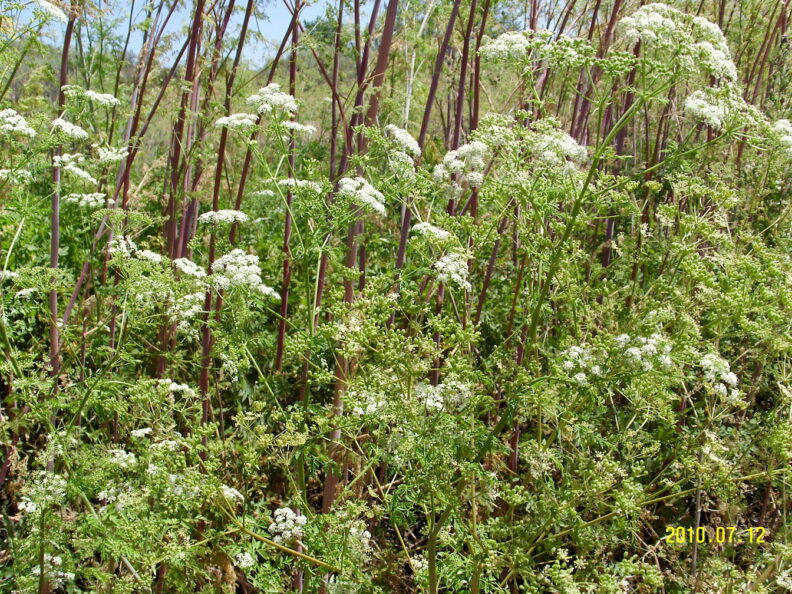
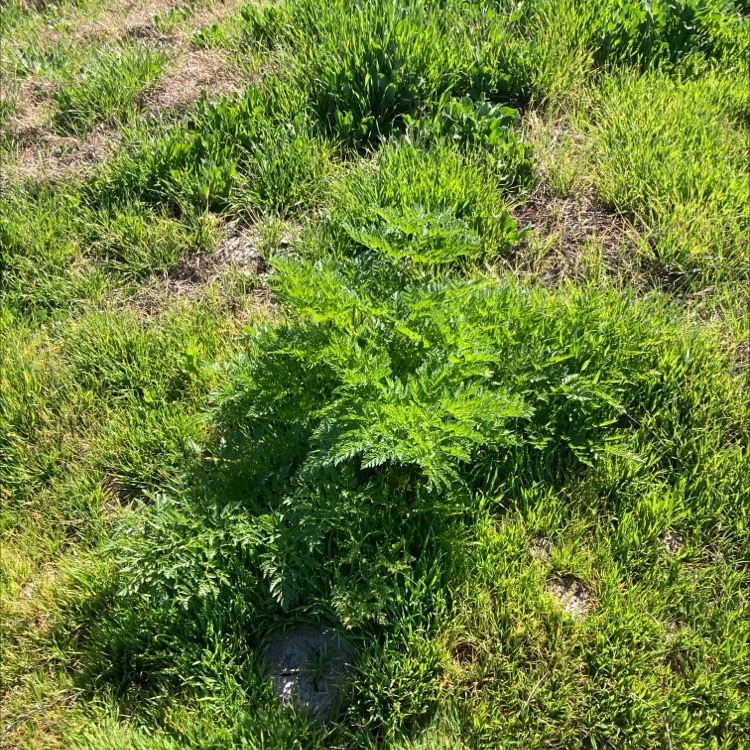
The basal rosette of the Poison Hemlock plant looks like carrot leaves. After the plant bolts (shoots up floral stems from the basal rosette that will go to seed), the stems have tiny purplish splotches along the length of the stem which helps to further identify the plant.
Water Hemlock…
…is a native that can be found in swampy areas around our lakes and reservoirs, slow moving creeks, and canal banks. It likes its roots wet and will grow in subby (not mud, not fluid water, but in between), wet, or muddy areas. It will go dormant in the absence of water once established. The roots and seeds of established Water Hemlock plants float and reproduce downstream. Water Hrmlock can be found on many of the smaller canal systems in the upper valley, along the Yakima River system, and in smaller irrigation canals in the lower valley. It is becoming common near holding and settling ponds. All parts of the plant are toxic, even when dry. The roots of water hemlock develop fibrous pockets that contain a viscous white to yellow fluid. This is the most concentrated toxin. If the roots of the plant are broken or crushed, the water they are growing in will become toxic. The slower the water moves, the less diluted and more toxic the levels in the water will be.
Most animals avoid these two plants unless it’s mixed into their feed, or they are exposed along the waterways they drink from. An animal drinking from a water source where water hemlock is growing is likely to step on and crush the roots, contaminating the water. Animals may also consume the toxin when they take accidental bites of the plants growing mixed into grasses and forbs where they range. One bite will kill a cow or horse, while it takes much less for smaller animals and humans.
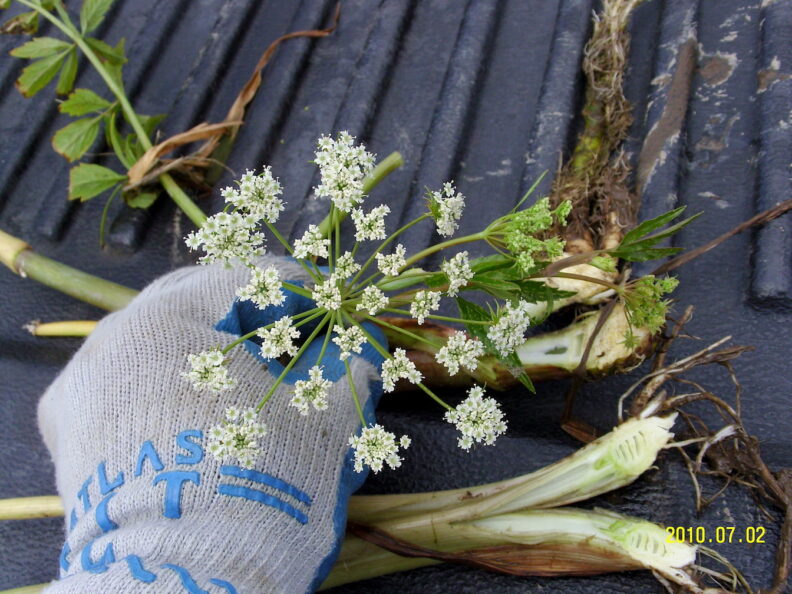
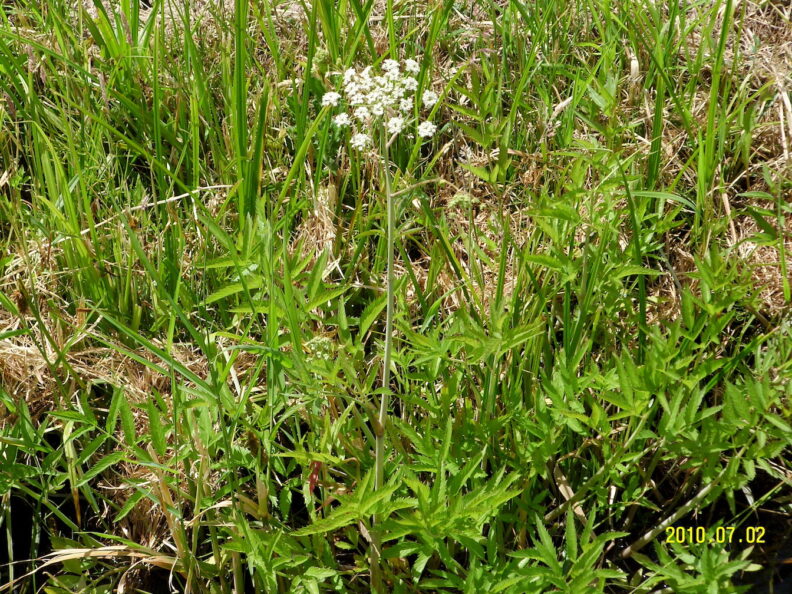
Both hemlocks are selenium accumulators in a selenium deficient area. If animals are deficient selenium, they are more likely to consume either of the hemlock species.
If you are hiking or working in areas where hemlock plants grow, wear protective clothing. Avoid these areas in hot and humid weather, and avoid picking the flowers and touching the plant’s leaves and stems.
To remove hemlock from your land, wear protective clothing and gloves when you dig out and bag the plants. Get as much of the roots as possible and dispose of all plant material as garbage that goes to the landfill and NOT VEGETATIVE WASTE! If you decide that an area with hemlock needs to be mowed, wear a dust mask, long sleeves and long pants as well as a face covering to prevent inhaling dust from mowing.
There are multiple herbicide options to control Poison and Water Hemlocks. Keep in mind that animals are MORE likely to feed on a plant that has been sprayed with herbicide due to the salts in the herbicide. Remove animals from the areas where hemlocks are known to grow until the plants can be removed. Do not pick the flower! Simply sniffing the flowers can cause severe reactions.
If you have questions or believe you have one of the hemlocks, please call our Office (509)-574-2180
Sue Bird
Susan.bird@co.yakima.wa.us
Yakima County Noxious Weed Board
1213 S 18th St. Yakima WA 98901