by Deborah Moucka, Master Gardener
This time of year my various flower gardens are in their full glory. Bursting with blooms. Buzzing with bees. Butterflies are flitting around. I can count on the profusion of purple catmint spilling over onto the walkway in the backyard. That the hummingbirds will nestle up to the firecracker penstemon. And the hostas will uncurl luxuriously in the shade of my corner garden.
What I don’t know, and wait for with baited breath, is what my “take a chance” contribution will produce in the veggie garden this year. When my husband built raised beds for me four years ago, I decided that each year I would have some fun and take a chance on something completely new. Something that I knew little or nothing about. Something I could learn from. Something that had the opportunity to surprise me. Something, that if it failed miserably, would not be a heart breaker.
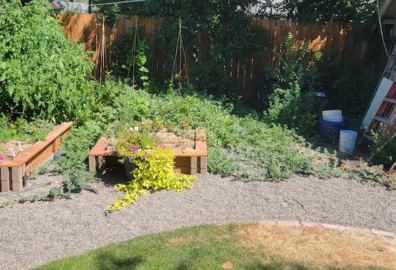
A big part of my “take a chance” approach is to give Mother Nature the opportunity to teach me something. And boy has she. The year I naively planted what I thought was a cantaloupe, it was a big surprise. I’d never planted, nor had I even seen growing, cantaloupe. I just wanted those luscious, juicy peachy colored melons to gobble down. Well, it started in the corner of the raised bed and grew and grew and grew. Out of the raised bed. Pretty soon it was winding its way toward the gardening shed. How much bigger could it possibly get? Across the walkway. Past the gardening shed. SURPRISE! When the melons started to appear, it was actually a watermelon. My husband called it the “waterloupe” that ate Yakima! My little “take a chance” was overwhelming a whole corner of the yard, but it was producing delicious fruit.
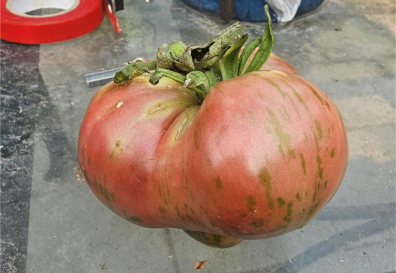
The next year a tomato name beckoned me. Alongside my beloved cherry and Early Girls, I planted a Berkeley Tie Die heirloom tomato. I was intrigued by something that harkened back to my youth. (Guess how old I am if I’m thinking fondly of tie dye?) As I daily monitored its growth, it was a challenge to stake up. But there, indeed, were these gorgeous little nascent tomatoes that looked like they’d been freshly pulled out of vats of Ritz dye! At harvest time, it’s tangy, but sweet flavor was also a surprise.
The goal of taking a chance is to have no reservations about failing. When you have high expectations about how your tried-and-true traditional veggie crops will be, sometimes you can be disappointed. But a take-a-chance crop can just be for the fun of it. A chance to see every day what happens.
Last fall I decided my take-a-chance would be garlic. I bought elephant and soft neck. Planted them in carefully labeled rows before winter set in. And waited to see what Mother Nature had in store.
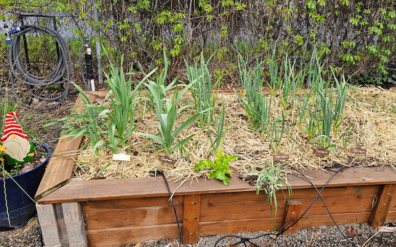
In early December the first shoots were appearing above the straw insulation of the bed. Winter winds and rain, a little snow, frosty nights and the shoots grew taller. By mid-March they were delightful rows. Late May, they reminded me of miniature corn fields in the Midwest where I grew up.
Now, the bottom leaves are beginning to turn brown, which I understand is the time to start harvesting. And then, I’ll be able to roast the elephant garlic and slather it on crusty French bread.
When I plugged the garlic starts into the ground in November, I had no idea what would evolve. Through the winter I didn’t know if they would survive. So, it’s been a fun adventure to learn along with the garlic how its life cycle progresses.
Have all my take-a-chance veggies been a success? No! I planted zucchini that didn’t pollinate, planted lettuce too late and it bolted, planted carrots in soil that was too tough for the poor little things to grow. But every one of the chances was also a chance for me, as a gardener, to grow. Take a chance and see what fun surprises Mother Nature has in store for your garden!