
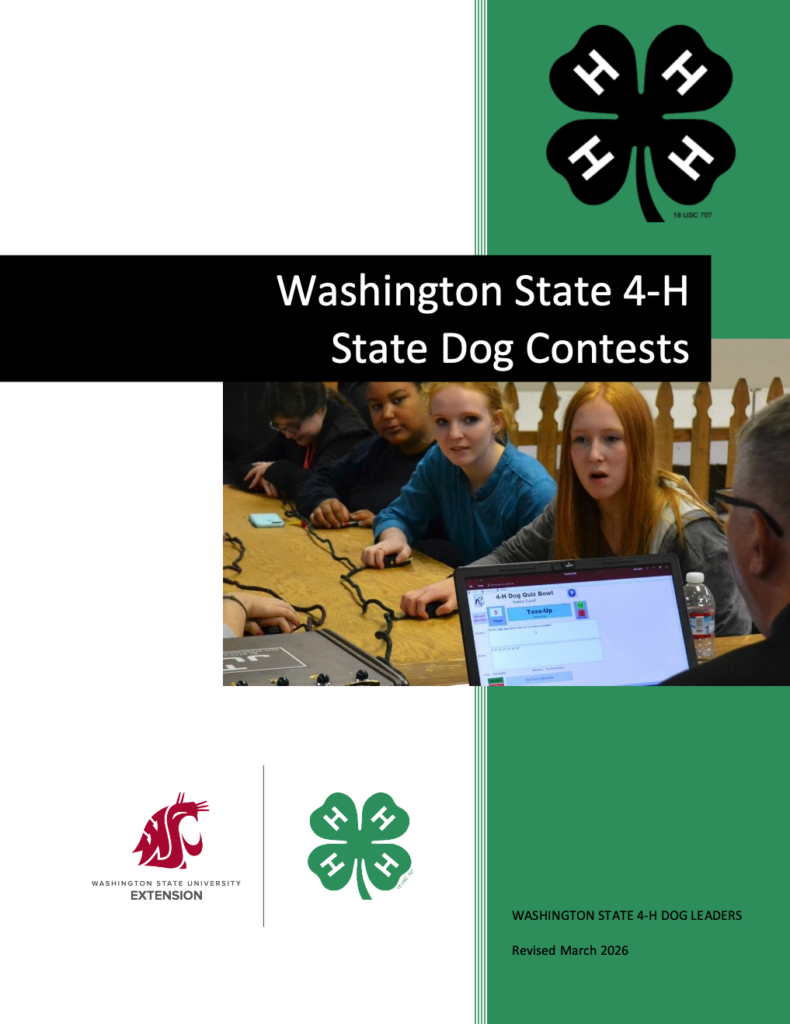
State 4-H Dog Contests
Table of Contents
-
Dog Judging Contest
- Objectives
- Contest Rules
- Placement Classes
- Oral Reasons
- Scoring Oral Reasons
- Written Reasons
- Scoring Written Reasons
Dog Judging Contest
Objectives
The purpose of the 4-H Dog Judging Contest is to increase 4-H members problem solving and discretionary abilities. It is also designed to challenge 4-H members to increase their knowledge of their chosen project area.
Contest Rules
- Contestants must be 4-H members enrolled in the dog project and approved by the 4-H Extension Staff of their respective county.
- All participants must follow the Washington State 4-H Dog Program Policies Dress Code.
- There will be no talking or collaborating during the contest. Contestants observed talking will be disqualified. Questions are to be directed to the monitors or designated helpers only.
- Under no circumstances are the tests or contestants to leave the contest area without permission. Contestants who leave the contest area without permission will be disqualified. If a contestant needs to go to the restroom, their test will be given to a monitor before they leave the contest area and given back to them when they return to the contest area.
- Use of a number two pencil is required for the State Judging Contest.
- For contests using a scantron system, contestants will follow the scantron sheet instructions provided on the clipboard. Scantron sheets will have a preassigned exhibitor number. For contests using placement cards, there is to be a place for the contestant to write their exhibitor number on the placement card. Placement cards submitted without an exhibitor number will be disqualified.
- Contestants will fill in the bubble or square in the column under the correct class number on the scantron sheet or placement card. Once a contestant has marked their final placement for a class on their scantron sheet or placement card, it must be highlighted by a monitor before moving on to the next class. After a placement has been highlighted by a monitor, a contestant must see the superintendent to make a correction if they made an error marking the scantron sheet or placement card.
- If any column on the scantron sheet or placement card is left blank, the contestant will receive a zero for that class but will not be disqualified from the entire contest.
- All electronic devices, including but not limited to, calculators, tablets, and cell phones are prohibited unless it is being used as a medical device. If a contestant’s phone should ring, or if they are observed using electronic devices during the contest, the contestant will be disqualified.
- If an individual has a disability and needs reasonable accommodations, information can be found on the Reasonable Accommodation Policy website.
Placement Classes
- Placement classes are to be the only focus of the contest. Oral Reasons, and if given, Written Reasons are to be part of the placement classes.
- Placement classes can be on any number of things, including but not limited to toenail clippers, clothing, baiting, leads, kennels, obedience, showmanship, breed, i.e., what breed would be best for a situation, etc. Each class must be different but may be related, i.e., Class one may be choosing a lead for a dog, and Class two may be choosing the correct Showmanship outfit to go with the same dog. Make sure to bring the items for the contestants to be able to pick up and feel, or pictures of items in a class, such as hairstyles. The correct placement of the class should be supported by the text written in the 4-H Dog Project Manual by AKC, Washington State 4-H Guide to Dog Showmanship, Washington State 4-H Guide to Dog Obedience, Washington State 4-H Guide to Agility, Washington State 4-H Guide to Rally Obedience, and the Washington State 4-H Fair Premium book.
- Each placement class is to be worth 50 points.
- There should be at least one adult volunteer per class to mark the contestant’s choice with a highlighter. The volunteer at each station should be able to answer any questions that the contestants may have.
Oral Reasons
- Ideally, there should be at least three judges from different counties if at the State Fair, or one judge for each age group if at a county event. There may be more if needed.
- Contestants may bring their placement written on a small sheet of paper for their presentation, but no notes.
- Contestants should memorize what they will say to the judge.
- Contestants will present their placements to the judge in a clear voice.
- Junior contestants will have the option to do oral reasons at the State Fair, time permitting. Their oral reasons scores will not affect their total overall score.
Scoring Oral Reasons
The following are points to be considered by the persons evaluating oral reasons:
- Knowledge of Subject: 40%
- Use of Appropriate Terms: 25%
- Presentation: 20%
- Organization of Reasons: 15%
Each area has four columns marked E for excellent, G for good, F for fair and N for Needs work.
The point breakdowns are as follows:
Knowledge of Subject
Total if all Excellent is 20 points| Criteria | Excellent | Good | Fair | Needs Work |
|---|---|---|---|---|
| Saw Major Strengths | 7 | 5 | 3 | 1 |
| Weakness | 6 | 4 | 2 | 1 |
| Important Differences | 7 | 5 | 3 | 1 |
Use of Appropriate Terms
Total if all Excellent is 12.5 points| Criteria | Excellent | Good | Fair | Needs Work |
|---|---|---|---|---|
| Descriptive adjectives | 6 | 4 | 2 | 1 |
| Correct names of parts | 6.5 | 4.5 | 2.5 | 1.5 |
Presentation
Total if all Excellent is 10 points| Criteria | Excellent | Good | Fair | Needs Work |
|---|---|---|---|---|
| Grooming | 1.5 | 1 | .5 | 0 |
| Posture | 1.5 | 1 | .5 | 0 |
| Poise, Confidence | 2 | 1.5 | 1 | 0 |
| Eye Contact | 1.5 | 1 | .5 | 0 |
| Clear, audible voice | 2 | 1.5 | 1 | 0 |
| Diction or English | 1.5 | 1 | .5 | 0 |
Organization
Total if all Excellent is 7.5 points| Criteria | Excellent | Good | Fair | Needs Work |
|---|---|---|---|---|
| Introduction | 2.5 | 1.5 | 1 | .5 |
| Logical order | 2.5 | 1.5 | 1 | .5 |
| Conclusion | 2.5 | 1.5 | 1 | .5 |
Judges are to mark the appropriate box after the contestant gives their reasons. The points on the scorecard can either be calculated by the judge or taken to the person in charge of adding up the points.
Please double-check your scorecard order against this template; there are multiple versions of the scorecard, and the order may vary, but the judged items are the same.
Written Reasons
Written Reasons are not given at the state level due to time constraints but are encouraged at the county level. This helps members to develop their writing skills.
The Written Reasons class is to be part of the placement classes. Contestants are to write their reasons on the paperwork provided.
Scoring Written Reasons
The following are points to be considered by the persons evaluating written reasons. The percentage and breakdown are approximations and are intended to be used as guidelines.
- Knowledge of Subject: 40%
- Use of Appropriate Terms: 25%
- Presentation: 20%
- Organization of Reasons: 15%
Quiz Bowl
Objectives
The purpose of the Dog Quiz Bowl contest is to provide an opportunity for youth enrolled in the 4-H dog project to demonstrate their knowledge of dog related subject matter in a competitive setting where attitudes of friendliness and fairness prevail. It is also hoped that these contests will provide an educational experience for both participants and spectators.
General Rules
Team Members and Eligibility
- Team members must be 4-H members enrolled in the dog project and approved by the 4-H Extension Staff of their respective counties, and are limited to Intermediate and Senior members.
- Age groups are based on the current Washington State 4-H Policies and Procedures as published for the current 4-H year.
Teams
- Each county is invited to enter one Intermediate and one Senior 4-H Dog Quiz Bowl team in the State 4-H Dog Quiz Bowl Contest. The Team members shall be selected in a manner determined by each county.
- At the State Dog Quiz Bowl Contest, counties that do not have enough qualified members to fill a team may combine members with another county to constitute a team. No county may have members on more than one team at each age level.
- Each team shall consist of four team members, an alternate and, optionally, a coach. The alternate shall not be seated at the panel and may not participate in the match unless:
- One of the regular team members is unable to participate in a contest.
- The moderator disqualifies one of the regular team members.
- If an alternate is seated following the removal of a regular team member, the team member removed becomes the alternate and becomes ineligible to return to that match. The team member removed and the alternate remain eligible to participate in further matches unless the team member is excused from the contest.
- A team may play with a minimum of three players. In the event that a team shall have three players, the fourth position shall be vacant and the team may not earn a team bonus.
- All Dog Quiz Bowl teams are to remain in the contest area until they are eliminated.
- No team member may talk out of turn. Should a team member talk out of turn, the moderator shall warn the member. If the member talks out of turn again during the match, the moderator shall excuse the member for the remainder of the match. The team may replace the excused member with an alternate member if one is available.
- No team member may argue with a ruling of the moderator or referee judge. Should a team member become argumentative, the moderator shall excuse the member for the remainder of the match. The team may replace the excused member with an alternate member if one is available.
- Any member that has been excused from two matches may not return as a member to any subsequent match.
- No one may aid the team member answering the question in any way.
- The coach must be an adult who is currently enrolled as a 4-H Leader or Teen Leader who is not a member of a participating team. The same coach must be used for a team for the entire tournament. Coaches may not be changed between matches.
Conduct
- Team members must abide by the rules of the contest, the Washington State 4-H Dog Program Policies, and the Washington State 4-H Fair.
- All participants must follow the Washington State 4-H Dog Program Policies Dress Code.
- Poor sportsmanship, interference with a moderator or judge’s decision, use of profane language, interference from leaders, parents, or spectators will result in forfeiture of the match and all points earned in the match.
Cell Phones and Other Electronics
Team members and coaches are not allowed to bring any items into the contest area with them, including but not limited to, scribing materials, recording devices, cell phones, or other electronic devices, unless being used as a medical device.
Equipment
Game Panels: An appropriate device will be used which will provide a clear indication of the first team member to respond to a question.
Time Recorders: A stop watch or other appropriate timing device will be required unless a software application is used that includes built-in timers.
Signal Device: This signal device shall be used by the time keepers and shall have a distinctly different sound from that associated with the game panel, unless a software application is used that includes built-in timers with signaling.
Score Keeping Devices: A blackboard, flip chart, electronic light display, or other appropriate display device will be used to maintain team scores visible to the team member, and if possible, to the spectators.
Equipment Failure
It shall be the responsibility of each team member to check that all equipment is operating correctly at the start of each match. If the device being used ceases to function or is believed to be malfunctioning during a match, a time out may be called by a team member, moderator, or coach. If it is determined that there is an equipment malfunction, the faulty part or parts will be repaired or replaced and play resumed. Scores accumulated up to the point of the time out shall stand unless the referee judge and moderator deem it advisable to recall points for the two questions asked immediately prior to the equipment failure. In that case, two additional questions will be asked.
Officials
Moderator
The moderator shall assume the direction of the matches, ask all questions, designate team members to answer questions, and accept or reject all answers unless the question or answer is challenged. The moderator shall indicate when a team member has exceeded the allocated time in which to answer a question. The moderator may ask the referee judge to rule on the accuracy and appropriateness of any question or answer at any time. The moderator will declare the match winner and shall be in control of the match at all times.
Referee Judge
At least one referee judge shall be used. The referee judge must be a knowledgeable dog person. The referee judge may rule individually or jointly on the acceptability of any question or answer.
Time Keeper
At least one individual shall indicate to the moderator the expiration of the time allowed in which to respond to a question. A referee judge may serve as time keeper. If a software application is used to present questions and manage the match, any built-in timer may be used by the moderator and a separate time keeper will not be necessary.
Score Keeper
At least one individual shall keep score for each team member. The individual maintaining team scores shall do so in such a manner that all points awarded or taken from each team may be checked and that the scores are clearly visible to the moderator and team members.
Sources
The sources of materials used for the development of the questions will be from the references listed below. Once a question has been approved and added to the official Dog Quiz Bowl Questions, they become their own authoritative source.
- All Washington State 4-H Dog Publications
- 4-H Dog Project Manual by AKC
- The AKC Complete Dog Book, 20th Edition
- All AKC official rules and regulations publications regarding registrations, dog shows, performance, or companion events
- Any National or Washington State 4-H official publications, including websites
- Quiz Bowl Contest Rules and Guidelines by Texas A&M 4-H Extension
Type of Questions
Toss-Up Questions
- Any team member may respond
- Each question is worth one point
- An incorrect response will result in the loss of one point for the team
Toss-Up Questions with Bonus Attached
- Any team member may respond
- Will have a bonus question attached
- Each question is worth one point
- An incorrect response will result in the loss of one point for the team
Bonus Questions
- Directed to the team correctly answering the Toss-Up Question
- Will be more difficult than toss-up question
- Team captain, or member designated by team captain, will answer the question
- All parts of the question must be answered correctly before any points are awarded
- Each question is worth two points
- An incorrect response will not result in the loss of points for the team
One-on-One Questions
- Two rounds of One-on-One questions shall be asked during the match
- Only one member of each team will be eligible to respond to a question
- Will rotate with each question beginning with the number one player on each team, the number two, and so on
- Each question is worth two points
- An incorrect response will result in a loss of one point for the team
Organization of Questions
To encourage full team participation, each match will be divided into two parts based either on time or number of questions.
The first part will be Toss-up questions to which any team member may respond. Between one-fourth and one-third of the questions will be toss-up with attached Bonus Questions.
The second part will be One-on-One Questions, which are directed to one member of each team. The two One-on-One rounds do not need to be consecutive but may be separated by Toss-Up Questions.
There shall be a maximum of 25 questions per round, including eight One-On-One questions. Bonus questions are not included in the total. Alternate questions should also be included. If the final bracket is for teams with one loss each, the number of questions must be increased to 31.
The moderator will make an effort to avoid asking the same question more than one time in the contest and may discard a previously asked question and substitute a new question should that be necessary. The referee judge may also rule to discard such questions. The moderator may consult with the referee judge if it is felt that the question to be asked is ambiguous or the answer provided is in error. Should the referee judge agree, the question will be discarded and a replacement question shall be asked.
Match Procedures
Starting the Contest
- Teams are seated at their panels and must keep the same position on the panel throughout the entire game. Each team member is given the opportunity to check the equipment.
- The designated team captain is seated nearest the moderator in position number one.
- The game is started by the moderator when the first question is announced.
Asking a Question: General Overview
- A question begins when the moderator announces Question or This is the question. Any accidental activation of a buzzer before the question begins will not be penalized. Instead, the buzzer will be reset and the game will continue.
- The moderator will read each question until the reading of the question is completed or until such time as a team member activates a buzzer.
- No part of any question will be repeated, nor will any additional information be given to the team member.
Buzzer is Activated
- To answer a question, a team member must activate a buzzer before the five second time period has elapsed following the completion of a question.
- If a buzzer is activated during the reading of any question, the moderator will immediately cease reading the question.
- The team member activating the buzzer shall have five seconds, after being recognized by the moderator, to begin the answer to the question.
- The repeating of the question by the team member shall not be considered the initiation of an answer.
- It shall be the responsibility of the moderator and the referee judge to determine if an actual answer is started within the five second time period.
- If a team member activates a buzzer and an answer has not been started within the five second time period, there will be a one-point penalty against the team.
Incorrect Answer
- If the answer to a Toss-Up or One-on-One question is begun during the five second time period and the answer is incorrect, the moderator shall give the correct answer and there will be a one-point penalty against the team.
- If an incorrect answer to any question is given, whether it is complete or incomplete, the question shall not be used again during that match.
- If a Bonus question is attached to an incorrectly answered Toss-up question, the Bonus question shall be discarded.
Correct Answer
If a question is answered correctly within the five second time period, that team shall be awarded one point for a Toss Up or One-on-One question, and two points for a Bonus Question.
Clarification Of Answer
The moderator may ask for clarification of an answer if a question is read to completion but may not ask for clarification if the reading of the question is interrupted by a buzzer.
No Response to Question
- If no team member activates their buzzer within the five second time period following the completion of a question, the moderator shall read the answer and there shall be no points lost or awarded to either team.
- If a Bonus question is attached to an unanswered Toss-up question, the Bonus question shall be discarded.
Toss-Up Question
- The moderator will clearly indicate the start of Toss-Up questions.
- The point values of a Toss-Up Question are as follows:
- Correct Response = one point
- Incorrect Response = loss of one point
- No Response = no points lost or awarded
Toss-Up with a Bonus Question
- The moderator will clearly indicate when a Bonus question is attached to a Toss-Up question.
- If a Bonus question is attached to a correctly answered Toss-up question, the moderator will read the Bonus question and a 10 second discussion period will be permitted for Team consultation to determine the answer. The end of the 10 second period is signaled by the Timer. At the signal from the Timer, a five second time period is then permitted for the Team Captain or designee to begin the answer.
- All parts of the Bonus questions must be answered correctly with no partial points permitted, regardless of the number of parts of the question answered correctly.
- The point values of a response to Bonus Question are as follows:
- Correct Response = two points
- Incorrect Response = no loss or gain of points
- No Response = no points lost or awarded
One-on-One Questions
Asking a Question by Type
- The moderator shall clearly indicate the start of One-on-One questions.
- One-on-One questions shall be addressed to one member of each team, beginning with the number one team member of each team and progressing with subsequent questions to the number two, three, and four team members, respectively.
- The moderator shall indicate prior to the reading of each question which two team members are eligible to respond.
- If any team member other than the two designated team members responds, there will be a two-point penalty for the team that responded.
- If a team member responds two times to questions directed to another team member, they shall be replaced at the panel by an alternate. If no alternate is available, the remainder of the match will be played with less than the full team and all questions normally addressed to the eliminated team member will be addressed only to the opposing team member.
- There will be no Bonus questions asked during the One-on-One period of the match.
- The point values of One-on-One questions are as follows:
- Correct Response = two points
- Incorrect Response = loss of one point
- No Response = no points lost or awarded
Completing the Contest
- The moderator will continue reading questions until all questions have been asked. If a question is discarded due to either incorrect reading by the moderator or a decision of the referee judge, it will be replaced by another question so that the total number of questions to be asked remains constant.
- Following the final question, the team with the highest number of points will be declared the winner of that match.
- In the event of a tie after the designated number of questions, five additional Toss-up questions will be added. If a tie remains after the overtime, the first team to win a point or gain a one-point advantage due to a penalty against the opposing team, will be declared the winner.
- Once the moderator has declared a winner based on the scores, there shall be no protests.
Team Participation Bonus
- To encourage full team participation, bonus points will be awarded in each match to the teams who have each team member correctly respond to at least one question other than bonus questions. This bonus shall be worth two points to the first team to qualify and one point to the second team. To obtain these bonus points, each member of the team seated at the time must have correctly answered a question.
- Card markers will be used to indicate the first correct answer by a team member. When a team member has given their first correct answer, they shall display the card marker at their position for the remainder of the match.
Team Awards
- A first and second place team in each age category will be declared.
- Team winners will be determined by a double elimination contest; no team will be eliminated until they have lost two matches.
Time Outs
- Time outs, of any type, are only allowed after a question has been answered and before the next question is started.
- Any team member or the moderator may call for a time out for equipment failure, for clarification of a rule, or to allow for unexpected problems.
- Team captains are given three one-minute time outs, which can be used for rule clarification, equipment check, to boost team morale, discuss team strategy, etc.
- Coaches are allowed one, two-minute time out during the match to visit with their team. A coach’s time out should be used to preserve the positive youth development experience of the quiz bowl. A coach is not allowed to encourage their team to protest during their coach’s time out. If a coach behaves in a way that undermines positive youth development or is unsportsmanlike, the coach will be dismissed from the contest.
- Coaches may also call a time out for clarification of a rule. There is no limit on the number of times a coach can call this type of timeout; see abuse provision below.
- Teams may not call a protest, unofficial or official, immediately following a coach’s time out.
- Abuse of time-out provisions may result in one or more of the following:
- Dismissal of team member, coach, or both.
- Dismissal of the entire team with forfeiture of any points or standing.
Protests
- Any team member may declare an unofficial protest to a question or answer to a question, but only at the time a question is read, or the answer is given. Once an unofficial protest has been made, the team lodging the protest has a 10 second consultation period to declare an official protest. The team captain buzzes in and announces the team’s intent to lodge an official protest.
- When an official protest is made, play will be suspended until the protest is resolved. Any type of question or answer to any type of question may be protested. The protesting team will then be given two minutes to support their protest.
- The decision in all cases is final. The moderator and the referee judge will consider the protest and must agree on the acceptability or rejection of any question or answer, and the subsequent action to be taken. If no referee judge is present, the moderator and at least one other contest official must agree on the action to be taken. A one-point penalty against the team will be assessed if the protest is not upheld.
- Depending on the situation, the moderator will take one of the following actions as is deemed appropriate:
- A question is protested before an answer is given and the protest sustained: discard the question. A substitute question will be read.
- A question is protested after an answer is given: the moderator and referee judge will determine the validity of the protest of the question. The question may then be discarded at no loss of points and a substitute question will be read, or the question may be allowed with the appropriate gain or loss of points.
- An answer is protested: the moderator and referee judge will determine the validity of the protest. Points will be added or subtracted as appropriate.
- There shall be no protest once the reading of the next question has begun or the moderator has declared a winner based on the scores.
- Abuse of protest provisions may result in one or more of the following:
- Dismissal or replacement of the team captain.
- Dismissal of the entire team with forfeiture of any points or standing.
- No source of information is infallible. There may be answers given to questions which are in agreement with the approved sources, which are in fact erroneous or out of date. Every effort shall be made to eliminate such questions, but in the event of such occurrence, the referee judge and moderator may agree to:
- Accept the answer and give an explanation of the correct or up-dated information for future use of the question.
- Accept only the correct answer.
- Replace the question to the appropriate team members.
- Spectators, parents, and visitors may not protest any question, answer, or procedure during the contest. They may submit any suggestions, complaints, or protests in writing to the contest officials at the conclusion of the contest. Spectators engaging in unsportsmanlike conduct or disruptive behavior will be asked to leave the contest area.
- If a score is protested, the official scorekeeper’s records are reviewed. If used, the scoreboard attendant’s record is unofficial and posted merely as convenience for the participants and coaches where appropriate.
Skill-a-Thon Contest
Objectives
The primary objective of the Washington State 4-H Dog Skill-a-Thon Contest is to provide an opportunity for 4-H members to demonstrate knowledge and understanding of animal science and management related to dogs in a competitive setting. 4-H members are also given the opportunity to expand their knowledge about dogs and be recognized for their understanding of the many aspects of dog care and training, as well as the roles of dogs in society.
The Skill-a-Thon offers age-appropriate quizzes and stations that are designed to test 4-H members’ knowledge of dogs. Some stations may include visual diagrams or equipment or hands-on activities to demonstrate a dog-related task. The contest superintendent strives to provide an educational experience for participants and spectators.
Contest Rules
- Contestants must be 4-H members enrolled in the dog project and approved by the 4-H Extension Staff of their respective county.
- All participants must follow the Washington State 4-H Dog Program Policies Dress Code.
- This is a contest in which individuals compete. There will be no team entries.
- There is no limit to the number of individuals that each county may enter in this contest.
- Each participating county is requested to provide contest helpers as follows:
- an adult volunteer to help score the contest,
- an adult volunteer to serve as a station monitor or group leader.
- All challenges to the contest, including stations, official’s decisions or results, must be submitted in writing to the State Fair Manager at the Washington State 4-H Fair or the contest Superintendent at county fair within 24 hours of the contest.
- Contestants that do not comply with the rules will be disqualified.
- Coaches or spectators engaging in unsportsmanlike conduct or disruptive behavior will be asked to leave the contest area.
- All electronic devices, including but not limited to tablets, calculators, and cell phones, are prohibited unless being used as a medical device. If a contestant’s phone should ring, or if they are observed using electronic devices during the contest, the contestant will be disqualified.
If an individual has a disability and needs reasonable accommodations, see our Reasonable Accommodation Policy.
Judges
Official judges will work with the contest superintendent to place the stations. Judges are responsible for evaluating the individual contestants on the appropriate scorecards and submitting the scorecards to the superintendent at the conclusion of the contest.
Contest Phases
- The Quiz Phase of the contest will include questions from the Washington State 4-H Dog Showmanship Questions Study Guide.
- Juniors: 10 questions
- Intermediates: 20 questions
- Seniors: 30 questions
- The Station Phase of the contest will consist of a series of stations or tables where contestants will respond to the requirements of the station. Stations can be the same or different among age groups, i.e. Juniors can do some of the intermediate stations, etc., but age level should be taken into consideration.
- Juniors: three stations
- Intermediates: six stations
- Seniors: nine stations
- Examples of stations that may be used include, but are not limited to:
- Breed Identification: breeds must be recognized by AKC by January firstof the current year; miscellaneous and foundation stock are not to be included
- Care and Behavior
- Equipment Identification: includes care, grooming, training. handling, showing, and dog sports
- Nutrition and Feed Identification
- Health and Diseases
- Insects and Parasites
- Anatomy and Physiology: includes external parts, skeletal, internal organs, parts of the gastrointestinal tract, and reproductive organs
Scoring
- Each question in the quiz phase is to be worth two points.
- Each station in the station phase is to be worth 50 points.
- Ties in the overall contest will be broken in the following order:
- Highest score in the Quiz Phase; if still tied, then
- Highest total score in the Station Phase; if still tied, then
- The scores at each station, in order, may be used.
- Ties within any phase of the contest are to be broken using the overall score first and then the same sequence as above.
- Contest stations will be available for viewing for a limited time following the contest, and official keys will be displayed at each station.
General Guidelines
Below are some suggested topics used for Skill-a-Thon stations. The format of questions can be matching games, multiple choice, short answers, or a demonstration of a skill, etc. Questions can be asked with visual aids such as models, microscopic slides, pictures, or computer screens. Each station should take less than four minutes to complete. Adult volunteers at each station are helpful to keep things moving smoothly and keep score.
Animal Behavior, Care, Safety, and Restraint
- How to properly restrain a dog using a dog model
- How to trim nails, clean ears, and look for fleas
- How to maintain clean and sanitary conditions for dogs
- How to groom and muzzle a dog
- Identify equipment such as collars, leashes, and different grooming tools
- Demonstrate knowledge of specific canine science vocabulary
Health and Disease
- Identify internal and external parasites of the dog
- List characteristics of a healthy dog: normal body temp, pulse, respiration, etc.
- Identify the external anatomy of a dog
- Identify the internal anatomy of a dog
- Identify common canine diseases
- Explain how diseases are transmitted and prevented
- Identify toxins
- Perform first aid for dogs
- Identify different types of feet, eyes, bites, forequarters, hindquarters, ears, tails
Breed Identification
- Identify different breeds
- Demonstrate understanding of the history and purpose of certain breeds, groups, or both
Famous Dogs, Working Dogs, and Dog Sports
- Identify famous canines
- Identify dogs with jobs such as guard dogs, sled dogs, service dogs, etc.
- Match fun facts about dogs in general or specific breeds
- Different dog sports
Other Advanced Topic Categories
- Nutrition and feed for different ages and stages of dogs
- Genetics and reproduction
- Finding the right dog, breeder, or both
Sources
- 4-H Dog Project Manual by AKC or American Kennel Club
- Washington State 4-H Dog Showmanship Questions Study Guide
- Washington State 4-H Guide to Dog Showmanship
- Washington State 4-H Guide to Dog Obedience
- Washington State 4-H Dog Program Policies
- Welcome to 4-H
- Baker Institute for Animal Health CPR for Your Dog or Cat
- The Complete AKC Dog Book, 20th Edition; page 765 for anatomy diagrams, pages 803-852 for further diagrams and anatomy definitions
- AKC.org: breed information