Washington State 4-H Guide to Dog Showmanship
Chapter 1: Purpose of 4-H Showmanship Events
The purpose of 4-H Showmanship is to prepare and evaluate a 4-H member’s ability to properly care for and exhibit their animal. This includes the animal’s condition, cleanliness, and grooming. 4-H Showmanship classes are judged on a member’s ability to present their dog to its best advantage before a judge by demonstrating proper breed presentation, ring etiquette and procedures, knowledge of dog anatomy, breed history and standard, care and health, and the 4-H dog program.
Chapter 2: How to Prepare for a 4-H Showmanship Event
Learn About Your Breed
Although 4-H Showmanship is not a competition where the dog is judged against its breed standard, it is important for you to understand conformation and your official breed standard to learn how to properly present your dog to a judge.
Every breed is shown differently and the best way to find out how to show your breed is to:
- Study your breed standard, or the breed standard that most resembles your dog if you have a mixed breed. The breed standard is a written description of how an ideal specimen of a specific breed should look, move, and behave. The Breed standard is like a blueprint against which every dog is judged in conformation. More information on specific handling of each breed can be found in the AKC Junior Showmanship Judging Guide. AKC Breed Standards and the AKC Junior Showmanship Judging Guide can be found on the American Kennel Club website at AKC.org.
- Watch videos of your breed being shown in conformation, paying close attention to how the feet are placed, how the bite is shown, and if the handler holds the head or tail. If watching a class of dogs on TV or at a show, notice how fast the dogs are moved and how the handler holds the lead. You will need to gait your dog at a speed that makes your dog look its best. Videos can be found for each breed standard on AKC.org, or internet video sites.
- If you have a rare breed that is not recognized by AKC, you can check other breed registries, including but not limited to the United Kennel Club at ukcdogs.com, American Rare Breed Association at arba.org, or national parent breed clubs for a breed standard.
- Ask your 4-H leader to recommend a reputable breeder, professional handler, or other knowledgeable person for you to talk to about your breed.
- If you have a mixed breed dog, you must choose a breed that your dog most resembles and show them according to that breed standard. When entering a showmanship event, you should put an X after the breed of dog so the judge knows it is a mixed breed.
- If you have a rare breed, or rare breed mix that does not have an AKC standard but does have a standard in another registry, you should provide the information to the Superintendent prior to the 4-H Showmanship event.
Choose a Show Lead and Collar
Show leads and collars come in a variety of styles, materials, and colors. Show leads are generally thinner and lighter weight than most obedience leads, making them easier to roll up into your hand, keeping lead work neat and tidy. Members should select a suitable show lead and collar that fits properly and provides adequate control of the dog. The most common types of show leads and collars are described as follows:
- Slide Clip Leads, commonly referred to by the brand name Resco, are a one-piece collar and lead combination. This lead gives a fair amount of control and can be a good choice for a small to medium dog. Slide clip leads are available in various lengths and colors. Please note that Resco also makes a swivel or spinner, a one-piece martingale, and snap style leads.
- A Martingale is a type of collar or collar and lead combination designed to prevent dogs from backing out of their collar using a two-loop system that tightens slightly under pressure without choking. The collar portion may be made of chain, nylon, or leather. The limited-slip design makes them ideal for breeds with narrow heads, such as sighthounds or dogs that are prone to escape. They can also be used as a training aid for dogs that pull. When fitting your dog for a martingale, make sure that the two metal rings of the collar portion do not touch when tension is applied to the lead.
- Slip Collars and Leads have two separate parts: the collar and the lead. The collar is a slip collar like those used in obedience, but is usually made of fine chain, nylon, or leather. Leads come in a variety of different lengths and are made of nylon or leather, with either a snap or a loop that can be attached to the slip collar.
Grooming and Overall Appearance of Your Dog
Grooming is an important part of 4-H Showmanship. It demonstrates a member’s knowledge of their breed and ability to care for their dog. Members are encouraged to talk with knowledgeable people such as breeders, professional groomers, professional handlers, and 4-H leaders, to help them learn how to groom their dog according to its breed standard.
Members are responsible for participating in their dog’s grooming, even if the dog has complex grooming needs or is professionally groomed. It is recommended that members ask the groomer to leave some of the grooming for you. Examples of age-appropriate grooming tasks may include cleaning ears, minor trimming, or maintaining toenails. Members should work with their 4-H leader to determine realistic goals for grooming their dog.
Members may choose to have their dogs in a short clip if it is more suitable for their family lifestyle, without being penalized by a judge.
Dog coats are not to be dyed or sprayed in any unnatural colors. Dogs should not be groomed in any special clips that are not customary for the breed.
You will receive a score for your dog’s grooming in the following categories:
- Dogs must be clean, bathed, thoroughly brushed, and free of mats and parasites. Eyes should be free of any matter. The coat and skin should appear in good condition and the dog should be a healthy weight.
- Feet must be trimmed in the correct manner for the breed with more emphasis on effort than skill, with consideration given to the age and experience of the member.
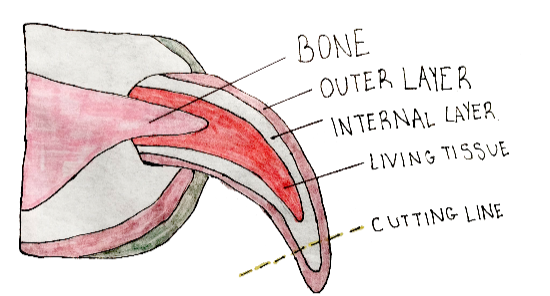
- Toenails must be properly trimmed or filed. Proper nail length is achieved by regularly trimming, filing, or grinding to prevent the quick from growing too long.
- Ears must be clean, free of mites, odor, and buildup. Ears should be trimmed in the correct manner for the breed with more emphasis on effort than skill, with consideration given to the age and experience of the member.
- Teeth must be clean and free of tartar. Missing, broken, yellowed, or misaligned teeth will not be penalized. It is recommended that teeth be cleaned regularly to prevent tartar buildup.
Exhibitor Appearance, Etiquette, and Poise
In a 4-H showmanship event, you should prepare yourself as carefully as you prepare your dog. Handlers will be evaluated on their appearance, etiquette, and poise. Handlers must be properly dressed and groomed as described in the Washington State 4-H Dog Program Policies Dress Code. Hair should be secured so it does not obstruct your or the judge’s view of the dog. Shoes should be closed-toe, flat, and suitable for the gaiting speed of the dog. Handlers should observe proper ring etiquette and be courteous to the judge, steward, and other exhibitors. Use of bait and toys is done quietly, so as not to distract the other exhibitors and dogs. Handlers must pick up anything that is dropped and should avoid conversation with other exhibitors except when necessary. Handlers should demonstrate neat and proper use of the collar and lead, without jerking or forceful corrections.
Chapter 3: Handling Skills
Gaiting
Gait is defined by the pattern of footsteps at various rates of speed, each pattern distinguished by a particular rhythm and footfall. The walk, gallop, and trot are the most common gaits. The amble, pace, and canter are also types of gait. The two types of gait acceptable in the show ring are the walk and the trot. Your dog should move at the proper gait for its breed.
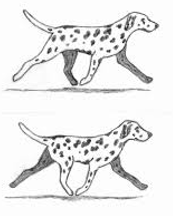
The pace is a two-beat lateral gait where the front and rear legs on the same side of the body move together; right front leg with right rear leg and left front leg with left rear leg, as shown in the top image. It is considered an inefficient, incorrect, and undesirable gait.
The trot is a rhythmic two-beat diagonal gait where the front and rear legs on diagonally opposite ends of the body move together; right front leg with left rear leg and left front leg with right hind leg, as shown in the bottom image. With only two feet on the ground at a time, the dog must rely on forward momentum for balance. At a normal trot, when the weight is transferred from one pair of legs to the other, there is a slight period of suspension as the body is propelled forward. This is referred to as spring. If a dog is of proper proportion, the imprint of the hind feet will cover the tracks of the front feet.
Each handler must learn what gait is correct for their dog and breed. With a small dog you can walk. You must determine what gaiting speed best shows your dog’s movement. It is helpful to have someone watch you gait your dog and tell you at what speed your dog looks best. If you go too fast, your dog will gallop or canter; too slow and they will pace, meaning the legs on the same side are moving together. At the proper speed, your dog will move smoothly with its legs reaching forward efficiently. This is called reach and drive.
Learning to Gait Your Dog
- Hold the lead in your left hand next to the dog, neatly gathering the excess lead in your hand where it is out of sight. Avoid wrapping the lead around your hand which can cause injury if the dog pulls. The lead should not be held so tightly that it chokes the dog.
- Most handlers will bend their arm at the elbow in an L shape, holding their elbow about waist high with their hand level or slightly higher than their waist. Your free hand should swing naturally at your side.
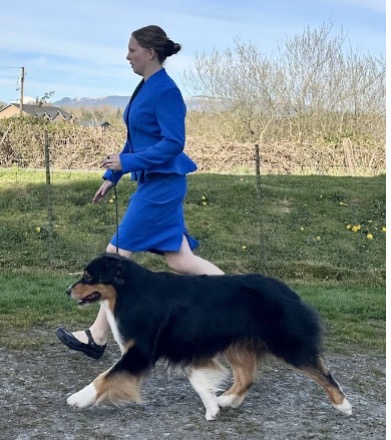
- You should take longer, smoother strides than a normal run. Practice making your own steps fluid and natural. Avoid extra movement with your legs or arms. Remember that the goal is to move smoothly beside your dog without distracting from their presentation.
- Work with your leader and club members to develop your technique. Mirrors are a good training tool. If you do not have access to mirrors, having someone video you during practice can be helpful, too.
- It is important to differentiate between obedience and showmanship by avoiding the use of obedience commands like Heel. Instead, encourage your dog to follow you by saying Let’s go, C’mon, etc. It is important to be consistent with whatever words you use.
- While forging, when the dog moves ahead of the handler, is undesirable in obedience heeling, it is desirable in showmanship handling, where it is referred to as moving out. It is important not to correct your dog for gaiting ahead of you. As long as your dog maintains a proper gait, moving out is encouraged. Tossing out treats can be an effective way to shape and control the behavior.
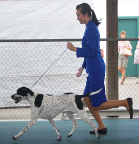
- Be patient! When you begin training your dog to gait, use positive reinforcement such as verbal encouragement, praise, and food rewards, while avoiding harsh corrections or jerking on the lead. If your dog gallops, canters or gets a bit goofy and wants to play, give a verbal cue like easy or slow, and begin again. Dogs that are happy workers are easier to train than those that are taught to just comply. If you consistently do this every time, your dog will learn what you want.
- Make sure you position the collar and lead high up under the chin before you start gaiting the dog.
- If your breed is shown on a taut lead, you will need to place your dog’s collar high up under the chin where the muzzle meets the body, and right behind the ears between the head and neck.
- If your breed is shown on a loose lead, you will need to rotate the collar so that the lead comes out from under the dog’s chin on the right side.
- Your dog will gait on your left side around the ring. You will move counterclockwise in a big circle. You should use the whole ring if you have a large or medium-sized dog. With a smaller dog it is acceptable to make a smaller circle.
- Your dog should stay away from your body and be next to or ahead of you while gaiting, so as not to interfere with your natural movement.
- A lagging dog may gait too slowly to best demonstrate their structure and movement.
- When gaiting your dog, it is preferable that the dog look straight ahead instead of at you to allow the judge to see your dog’s full profile in motion. When training your dog, it may be helpful to throw a treat or a toy out straight ahead as he is gaiting so that your dog learns to look ahead and not back at you. This can also help a lagging dog move out faster. Remember that throwing the bait or toys in the ring is not allowed, but it is a good practice technique.
- Crowding or running up on the dogs in front of you can happen if you do not use proper timing and control. When group gaiting, leave enough space between you and the dog in front of you to avoid getting too close.
Courtesy Turns
Courtesy turns are an optional turn made by the handler and dog before starting an individual gaiting pattern. Courtesy turns are used for creating space for lining up, settling down, and moving the dog into its gaiting speed. When using a courtesy turn, you should move quickly and smoothly, without pulling the dog out of position or blocking the judge’s view of the dog.
Pattern Gaiting
Pattern gaiting refers to the pattern a judge will ask you to perform during your individual exam. The pattern may be as simple as a down and back, or as complex as a T, depending on the age and experience of the class being judged. The Down and Back and Triangle patterns are recommended for younger, less experienced 4-H members. The T and the L patterns are appropriate for more advanced handlers because they require more complicated handling skills such as changing lead hands and gaiting the dog on their right side. The purpose of a gaiting pattern in conformation is for the judge to evaluate the front, rear, and side movement of the dog.
Pattern gaiting is slower and more deliberate than gaiting around the ring. Consider what the judge is looking for in each part of the pattern. Your dog’s speed may vary for coming and going and for side movement.
- When performing any pattern, you should align your dog, not yourself, with the judge before you move away. Every effort should be made to move in a straight line. When the event takes place outdoors or without mats to follow, it is helpful to focus on a spot straight out from the judge in the direction they send you and gait your dog straight toward that spot.
- To perform a gaiting pattern without a courtesy turn, begin by making a tight left turn into the dog, aligning your dog with the judge and gaiting towards the end of the ring, in one seamless movement.
- When using a courtesy turn at the start of a gaiting pattern, begin by moving your dog to the corner of the ring behind the judge. If there is not sufficient space to make your turn behind the judge, a courtesy turn can be made directly in front of the judge. Make a tight about turn to the right, away from your dog, align your dog with the judge, and begin gaiting towards the end of the ring in one seamless movement.
- When moving your dog away from or towards the judge, you want to gait your dog at a speed that will allow the legs to move in a straight line from their body to the ground.
- When you are gaiting your dog in a pattern that shows side movement, you want your dog’s front and rear legs to stride out with full extension.
- Any time you are gaiting your dog, you want your dog to move smoothly, showing the best reach and drive their conformation allows.
- It is not recommended to carry bait in your free hand unless you can hide it while you are moving. You can pull it out of your pocket when you are near the end of your pattern or the end of the line so you can use it for free stacking.
- When you return to the judge at the end of the pattern, it is recommended that you stop about four feet from the judge if you are showing a small to medium-sized breed, and about six feet if you are showing a large breed.
- Do not crowd the judge or get too close. Leave enough space between you and the judge to allow them to walk around your dog or get closer to see the expression. The handler should remain near the head of the dog while the judge is looking at different presentations.
- You may angle the dog to show profile or bring the dog in straight to the judge to show expression. See what techniques are best used with your breed and why.
- While the dog is usually gaited on your left, some patterns, like the L and the T, require gaiting the dog on the right side. Practice moving the lead smoothly between your hands as you turn, and make sure your dog is comfortable gaiting on both sides.
Down and Back Pattern
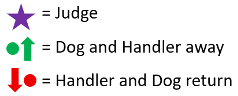
A Down and Back Pattern allows the judge to see the dogs front and rear movement. As with any gaiting pattern, the Down and Back can be done with or without a courtesy turn.
- At the end of the ring, make a courtesy turn or a tight left turn, whichever is best suited for your dog, and return to the judge.
- Watch and listen for the judge’s signal to stop as you approach. If the judge does not indicate for you to stop either verbally or with a hand signal, you should stop at an appropriate distance from the judge and perform a free stack.
Down and Back Pattern Example

Down and Back Pattern Key
Triangle Pattern
A triangle pattern allows the judge to see the dog’s movement from several sides, and it allows the handler to demonstrate smooth movement at the corners. As with all patterns, you may begin with or without a courtesy turn.
- Begin the Triangle pattern by moving directly away from the judge parallel to the edge of the ring. At the end of the ring, make a 90 degree turn toward your dog and continue across the back of the ring to the far corner. At the corner, make a courtesy turn or tight left turn, whichever is best suited for your dog, and return diagonally to the judge.
- Keep the dog on the inside of the triangle to avoid any unnecessary hand changes.
- Watch and listen for the judge’s signal to stop as you approach. If the judge does not indicate for you to stop either verbally or with a hand signal, you should stop at an appropriate distance from the judge and perform a free stack.
Triangle Pattern Example
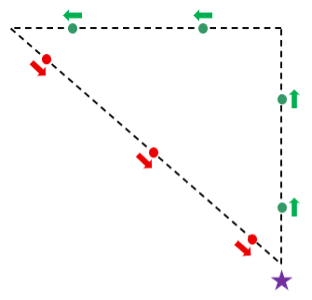
Triangle Pattern Key
The L Pattern
The L pattern allows the judge to see the dog’s movement from multiple sides, while challenging the handler to move the lead from hand to hand, always keeping the dog in the judge’s view.
- Begin the L pattern by moving directly away from the judge. At the end of the ring, make a 90-degree left turn toward your dog and continue the full length of the ring.
- When you reach the corner, turn towards your dog and switch the lead to your right hand, turning the dog’s head toward you as you turn around so that the dog is on your right side. Retrace your steps to the other side of the ring.
- When you reach the next corner of the ring, switch the lead back to your left hand, turning the dog’s head toward you so the dog is on your left side for the return trip to the judge.
- Handlers may choose to make a 90-degree right turn instead of a hand change on the return trip to the judge.
- Watch and listen for the judge’s signal to stop as you approach. If the judge does not indicate for you to stop either verbally or with a hand signal, you should stop at an appropriate distance from the judge and perform a free stack.
L Pattern Example
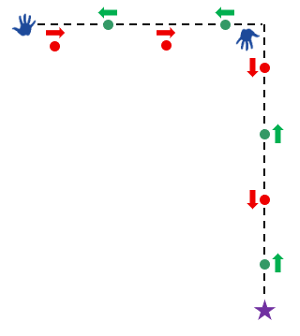
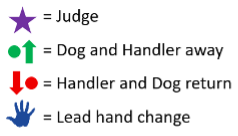
L Pattern Key
The T Pattern
The T pattern allows the judge to see the dog’s movement from multiple sides, while allowing the handler to demonstrate several lead hand changes, and that the dog is trained to gait on either side of their body.
- The judge will ask you to start in the center of one side of the ring. Begin the T pattern by moving directly away from the judge. At the end of the ring make a 90-degree left turn toward your dog and continue in this direction to the corner of the ring. When you reach the corner, turn towards your dog, switch the lead to your right hand, turning the dog’s head toward you as you turn around so that the dog is on your right side, and continue across the top of the ring. When you reach the opposite corner, turn towards your dog, switch the lead back to your left hand, turning your dog’s head toward you as you turn around so that the dog is on your left side and gait back to the point directly across from the judge, make a 90-degree left turn and return to the judge.
- Watch and listen for the judge’s signal to stop as you approach. If the judge does not indicate for you to stop either verbally or with a hand signal, you should stop at an appropriate distance from the judge and perform a free stack.
T Pattern Example
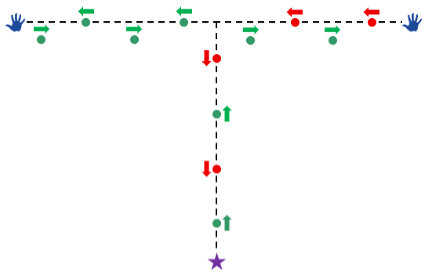
T Pattern Key
Pair Gaiting
The purpose of pair gaiting in 4-H showmanship is to allow the judge a side-by-side comparison of how two handlers present the front and rear movement of their dogs. Pair gaiting is performed with two dogs side by side between two handlers, requiring one handler to move away from the judge with the dog on their right side, and the other handler to return to the judge with the dog on their right side. This pattern is reserved for more experienced handlers.
- At the judge’s direction to take the dogs down and back, the handlers will line up their dogs between them. It is appropriate for one of the handlers to ask the other if they are ready.
- Dogs should be spaced three to four feet apart while gaiting to allow for comparison. Avoid moving dogs too close together so they do not distract or interfere with each other.
- Every effort should be made by both handlers to move their dogs at the same speed, without either dog walking, running, or pacing.
- Both handlers will need to switch lead hands at the end of the ring so that the dogs remain side by side between the handlers coming back.
- The two handlers will return to the judge and free stack their dogs.
- Unless the judge asks you to face one way or another, it will be up to you to decide how to present your dog when you return to the judge. For safety reasons, it is not advisable to face the dogs toward each other when presenting them to the judge.
Pair Gaiting Example
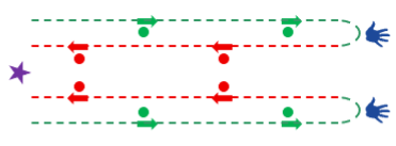
Pair Gaiting Key
Stacking
Stacking is the term used for presenting a dog in a precise, stationary pose that allows the judge to evaluate the structure and balance of a dog according to the breed standard.
It is important to learn a combination of hand stacking and free stacking techniques. Learn to stack your dog from either side, front and rear. Your goal should be to be able to properly stack your dog in five seconds.
Learning to Hand Stack Your Dog
- The left side of your dog is considered the show or judge’s side. You will begin by facing your dog on its right side.
- While holding the collar or lead with your left hand, walk your dog to a gradual stop and use the word stand or stay. If your dog sits, you may need to place your left hand at the stifle or knee to encourage the dog to stay standing. Avoid lifting the dog under its stomach. This will cause your dog to roach its back. If your dog sits, you can also try walking your dog in a tight circle and restarting.
- When you begin training your dog to stack, use positive reinforcement such as praise and food rewards, while avoiding harsh corrections or jerking on the lead. Continuing to say stand or stay during this phase will help reinforce the concept you are teaching your dog.
- Be patient! Release and reward with bait when your dog stands for a few seconds. Slowly increase the distance between the bait and the dog’s nose and the time between food rewards to teach the dog to stand for longer periods of time.
- To properly stack your dog, you must have control of the head. Without head control, the dog’s body will follow any movement of the head. Head control is achieved by holding the collar or head under the jaw, with your lead tucked neatly in your hand, while you stack each leg.
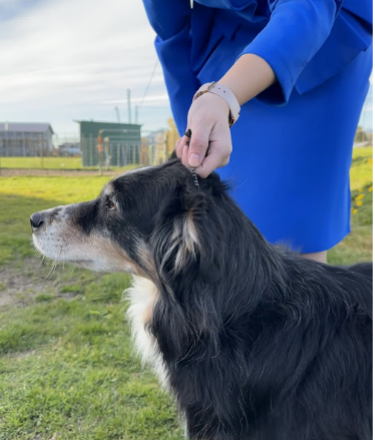
- If you are holding the collar, adjust the collar high up under your dog’s chin where the muzzle meets the body and between the head and neck, just behind the ears.
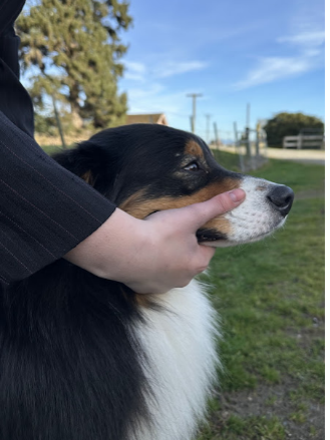
- If you prefer to hold the head, position your hand under the lower jaw without wrapping your fingers around the muzzle.
- The excess lead should be held or presented neatly, either in the palm of your hand at the collar, or draped around your neck if you are kneeling on the ground or if you have a small breed to present on the table. There are many different and acceptable methods of holding or draping your lead. The objective is to have a smooth and neat presentation, rather than a sloppy lead dangling on the ground or on your dog.
- Wrapping your fingers around the collar and holding up the dog’s head will help you maintain proper head and shoulder positioning. Try to avoid stringing the dog up by the lead to stack by holding the lead instead of the collar. This does not provide good head control and will allow your dog to move. This method should only be used on small breeds or with dogs that have already been taught how to stack.
- Head control can also be achieved with the use of bait. This method works well with puppies or dogs that are food motivated. Allowing the puppy or dog to nibble on the bait can help to distract them while you position their legs. If you are using bait to hand stack your dog, you will need to place your lead around your neck to allow you to hold the bait in your right hand in front of your dog’s nose. Learn the proper baiting position for your dog. Hold the bait at the proper level to present your dog’s head.
- Once your dog understands the concept of standing and staying in position, you can begin stacking the legs. Legs are stacked beginning on the judge’s side with the left front leg, followed by the right front leg, left rear leg, and finishing with the right rear leg.
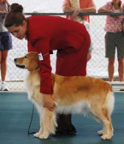
- With the collar or head held in your right hand, use your left hand to stack the left front leg, lifting at the elbow and placing the leg directly under the shoulder to create a straight line from the withers through the wrist, to the ground. You can reach over the top of your dog’s shoulder or under your dog to stack the left front leg. Work with your 4-H leader to determine which method should be used for your dog and why.
- To stack the right front leg next to you, you will need to switch the hand holding the collar or head to your left hand and use your right hand to stack your dog’s right leg. The front legs should be shoulder width apart and parallel with the toes facing forward, unless otherwise specified for your breed.
- Due to their size, small breeds that are presented on a table can be stacked using only the left hand, without needing to switch the hand holding the collar or head. Work with your 4-H leader to determine the best technique for you and your dog.
- Some dog’s front feet turn outward, pointing east or west, or turn inward causing their elbows to point outward. In most breeds, both are considered faults. Although the dog’s structure is not being judged in 4-H Showmanship you will want to show the judge that you know how to minimize the fault by stacking your dog with an emphasis to hide the fault. If your dog’s front feet do not naturally point forward, you can try twisting the leg slightly, setting the foot in the proper position on the ground and shifting the dog’s weight over the leg before you let go of the elbow to help keep the foot positioned properly.
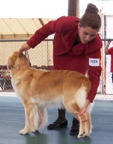
- You will use your left hand to stack both the rear legs. To stack the rear legs, switch the hand holding the collar or head to your right hand and with your left hand, lift the left rear leg at the hock joint, placing the foot, creating a straight line from the hock to the ground, unless otherwise specified for your breed. Repeat the process for the right rear leg. The rear legs should be set slightly wider than the front unless otherwise specified for your breed.
- Cow-hocking is a common fault in dogs. A cow-hocked dog will have rear legs that turn inward at the hocks with the feet pointing outward, creating a cow-like stance. Using the same principles to hide a fault with the front legs, twist the hock slightly so it is straight up and down as you place it on the ground and shift the dog’s weight over the leg before you let go of the hock.
- If your dog moves his feet during the stack, remove the bait and restart, reinforcing the word stand or stay
- If your dog is posting or leaning back and causing the front legs to angle backward instead of being straight up and down, check to see if the legs are stacked properly. Posting can happen if the rear legs are set too far back or the front legs are set too far forward. If the legs are set correctly, lure the dog forward with the bait to encourage the dog to shift its weight over its front.
- As you and your dog learn the art of hand stacking, you may begin to notice your dog choosing to place its feet in a properly stacked position without any prompting from you. When hand stacking your dog, you will only need to place the feet that are out of position, using the same order as stated above; Left front, right front, left rear, and right rear.
- Once your dog has learned to stay in the stacked position, you can practice holding the collar or lead and use bait to present the head or expression.
- It is important to note that not all dogs need to be hand stacked. Some breeds are traditionally baited into a stance, rather than being hand stacked. Work with your 4-H leader to determine proper stacking techniques for your breed.
Learning to Free Stack Your Dog
Free stacking is a technique used by handlers to guide their dog into a standing pose without touching the dog, as one would when hand stacking. Free stacking is most commonly performed when the handler and dog return to the judge after completing an individual gaiting pattern or when returning to the end of the line.
- To begin teaching your dog to free stack, stand in front of your dog with your lead in your left hand, keeping the lead loose and down near your side.
- Hold a high-value treat or toy in your right hand level with your dog’s nose and lure your dog forward into a standing position. When your dog is standing, give the command to stand or stay. Reward your dog for standing and staying in position for a few seconds, even if the foot placement is not perfect. With practice, your dog will learn to place their feet properly and you can gradually increase the time between rewards to build duration.
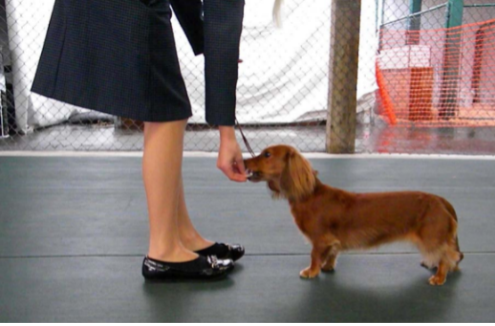
- Your dog will move its feet wherever the bait goes. If you move the bait to the dog’s right, the left leg moves forward and toward the center or crosses over making the dog’s right leg fall naturally in place next to the left leg. You can position the dog’s front legs by moving the bait right or left. Once the front is in place, say stand or stay, and reward the dog with the bait. The back legs will usually fall into place when the dog moves forward.
Front Cross-Over Stacking Method
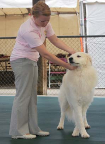
- Some handlers with giant breeds will free stack by using their hands to move the dog’s head and front from side to side while walking their dog into a stack. The cross-over stack allows the feet to cross into a nice front stacked position, allowing the front to line up with the rear leg placement.
- You could also use your lead to move the dog from side to side as they are moving forward in the same cross-over manner as you did with the bait. The rear legs will usually fall into the correct place when you walk your dog forward a couple of steps.
Table Stacking
Small breeds are usually presented to the judge on a table for the individual exam. Check with your 4-H leader to find out whether your dog should be stacked on a table.
View the current list of AKC table breeds.
You will need to practice with your dog so they feel comfortable stacking on the table without the fear of falling. Many methods can be used to place your dog on a table. Work with your leader to determine what is right for you.
- Ensure the table is stable by applying pressure with your hand to the table top. If it moves, request that the table be repositioned.
- If your dog is too large or heavy for you to lift onto the table safely, the dog should be examined on the ground or on a ramp, if available.
- If it is easier, you can use the scoop method. Scoop the dog up with both arms from the front and back and place it onto the table.
- Small, long-coated, or lightweight breeds can be picked up by supporting their front under the chin or chest, and the rear under the hindquarters, and put on the table in one smooth, quick motion. This method helps to keep the carefully brushed coat in place. Avoid lifting any dog by its tail, as this could cause injury.
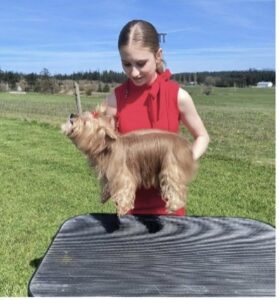
- Another method for placing a small dog on the table is to place your right hand under the chin and your left arm over the top of your dog and around the ribcage, holding it close to your body and placing it on the table.
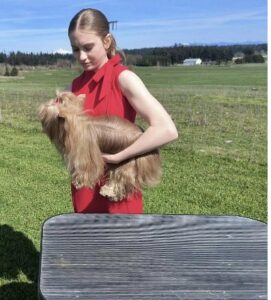
- When you first introduce your dog to stacking on a table, place them in the center, far enough away from the edge to avoid falling. As you practice and the dog gains confidence, you will aim to place your dog in the center at the front of the table, ideally with their front feet within two inches of the edge.
- Be patient! Reward your dog for standing for a few seconds at a time on the table to build confidence. Gradually increase the time on the table to build duration. Once your dog is comfortable on the table, you can practice hand stacking using the methods described in Learning to Hand Stack Your Dog.
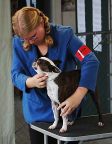
- You may drape the lead around your neck to free up your hands to pick up and stack your dog or for more control, you can hold the collar with the excess lead held neatly in your hand. Whatever method you choose, keep the lead neat, without letting it hang across your dog or the table.
Ramp Stacking
Just as some breeds are stacked on a table, others can be stacked on a ramp for the judge’s individual exam, if one is available. You will need to practice with your dog so they feel comfortable stacking on the ramp. Check with your 4-H leader to find out whether your dog should be stacked on a ramp.
View the current list of AKC ramp breeds.
In 4-H Showmanship, ramps may be used as an alternative for members who are unable to physically lift and present their table dog on a table. Leaders are encouraged to use ramps as a tool to help members progress to table stacking as they grow in size and experience.
- Always have your dog enter and exit the table portion using the ramp to prevent injury.
- Stack your dog in the center at the front of the table portion of the ramp, ideally with their front feet within two inches of the edge.
- You may drape the lead around your neck to free up your hands to pick up and stack your dog or for more control, you can hold the collar with the excess lead held neatly in your hand. Whatever method you choose, keep the lead neat, without letting it hang across your dog or the table.
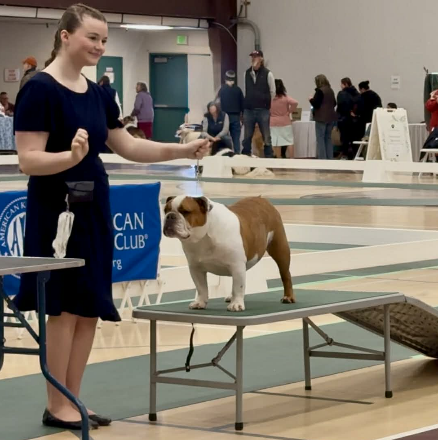
AKC Table and Ramp Breeds
Sporting
- Cocker Spaniel
- English Cocker Spaniel
- Nederlandse Kooikerhondje
Non-Sporting
- All American Eskimos
- Bichon Frise
- Boston Terrier
- Coton De Tuelear
- French Bulldog
- Lhasa Apso
- Lowchen
- Miniature Poodle
- Norwegian Lundehund
- Schipperke’Shiba Inu
- Tibetan Spaniel
- Tibetan Terrier
- Xoloitzcuintli (toy and miniature)
Hounds
- Basenji (or ramp)
- All Beagles
- Petit Basset Griffon Vendeen
- All Dachsuhunds
- Portuguse Podengo Pequeno
Working
- Danish-Sweedish Farmdog
Herding
- Cardigan Welsh Corgi
- Lancashire Heeler
- Miniature American Shepherd
- Mudi (or ramp)
- Pembroke Welsh Corgi
- Pulik (or ramp)
- Pumi
- Pyrenean Shepherd
- Shetland Sheepdog
- Swedish Vallhund
Toy
- All toy breeds on table
Miscellaneous Breeds
- Alaskan Klee Kai
- Bolognese
- German Spitz (small and medium)
- Peruvian Inca Orchid (small and medium)
At the discretion of the judge through all levels of competition including group and Best in Show judging.
Note: Ramps can be used in emergency situations to judge any breed. See Use of Ramps: Clarification for emergency use information.
- American Water Spaniel
- Boykin Spaniel
- Field Spaniel
- NS Duck Tolling Retriever
- Welsh Springer Spaniel
- Basenji (or table)
- Basset Fauve de Bretagne
- Grand Basset Griffon Vendeen
- Norwegian Elkhound
- Whippet
- German Pinscher
- Portuguese Water Dog
- Standard Schnauzer
- American Staffordshire Terrier
- Irish Terrier
- Miniature Bull Terrier (ground/table)
- Soft Coated Wheaten Terr. (through 8/5/26)
- Staffordshire Bull Terrier
- Finnish Spitz
- Australian Cattle Dog
- Entlebucher Mountain Dog
- Finnish Lapphund
- Icelandic Sheepdog
- Mudi (or table)
- Norwegian Buhund
- Polish Lowland Sheepdog
- Puli (or table)
- Norrbottenspet (misc.)
Applies to all conformation competition associated with AKC conformation dog shows or at any event at which an AKC conformation title may be earned.
Note: Breeds not listed must be judged on the ground.
- Clumber Spaniel
- English Springer Spaniel
- Lagotta Romagnolo
- Sussex Spaniel
- Basset Hound
- Cirneco Dell’etna
- Kerry Blue Terrier
- S.C. Wheaten Terr (eff. 8/5/26)
- Bulldog
- Chinese Shar-pei
- Chow Chow
- Keeshon
- Spanish Water Dog
Background
The appropriate place to individually examine dogs during breed judging is designated by each parent club and AKC does not pre-empt their authority in this regard. The current list of table and ramp breeds may be found on the AKC website.
Table Breeds
Designated table breeds must be examined on an examination table. If re-examination is necessary for a table breed, they must be placed back on the table. For re-examination, a maximum of two dogs may be placed on the table at the same time. No other breeds may be examined or otherwise judged on an examination table.
Ramp Breeds
A judge requesting the use of a ramp must give notice to the show superintendent/show secretary prior to judging. AKC approval is not required. Breeds designated as ramp optional may be examined on the ground (table if applicable) or on a ramp during breed, group and Best in Show judging at the sole discretion of the judge and not the exhibitor. The entire entry in that breed is to be examined on the ground (table if applicable) or on a ramp. Breeds designated as ramp mandatory must be judged on the ramp through all levels of conformation competition. The requirement to place a table breed back on the table for re-examination does not apply to ramp optional or ramp mandatory breeds. The ramp will be available at the discretion of the judge for all ramp optional breeds through all levels of competition including group and Best in Show judging.
All Other Breeds
Breeds not designated as either table or ramp breeds may only be examined on the ground. Exception: Miniature Bull Terriers may be examined on the ground, on a table or on a ramp.
Emergencies
In emergency situations, with the approval of the Show Chair, breeds customarily examined on the ground may be examined on a ramp, not on a table. An emergency is defined as a temporary condition that arose immediately prior to or at a dog show. Convalescence from a medical procedure, illness and recuperation from injuries are examples of conditions that are not emergencies. The emergency use of a ramp may be allowed on a day and may be extended to include a cluster as well as judging either a group and/or Best in Show.
When a ramp is used for non-ramp breeds in an emergency, the superintendent is to post appropriate signs at the ring and at the superintendent’s office that must include notice that exhibitors are entitled to a refund of their entry fee. Field Staff is directed to report all instances of the emergency use of a ramp to Events and Judging Operations. If there is need thereafter, the following weekend for example, as in the past, formal accommodation must be requested from Judging Operations.
AKC complies with the Americans with Disabilities Act and wants to provide to all the opportunity to participate in its events.
However, according to the “Fitness to Judge Policy” as published in the Rules, Policies and Guidelines for Conformation Dog Show Judges, approved May 2007, “It is essential that a dog show judge be physically capable of performing the functions necessary to properly judge dogs.” A judge must have:
- The flexibility to examine all parts of a dog’s anatomy where each breed is presented (i.e., on the ground, on a ramp or on a table).
- The capability of measuring or weighing a dog and examining on the ground, table or ramp where applicable.
Showing Bite, Teeth, and Mouth
Members are required to show their dog’s bite, teeth, mouth, or all parts, according to their breed standard. The bite refers to how the dog’s front teeth meet, specifically the upper and lower incisors located between the canine teeth. Check with your 4-H leader or the AKC Oral Exam Chart below to determine the proper oral exam requirements for your breed.
- Start by placing the lead in your right hand under your dog’s jaw, with your index finger secured under the collar to prevent the dog from backing away. Lift the head up, pointing the muzzle toward the judge with your head out of the judge’s view. Keeping the dog’s mouth closed, use your left hand over the top of the muzzle to gently lift the upper lip. You may need to use your right thumb to draw the lower lip down to expose the lower teeth, making sure the incisors between the canine teeth are visible.
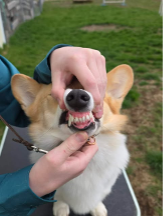
- Some breed standards require presentation of the teeth and mouth. Teeth refers to the premolars and molars, and the mouth refers to opening the dog’s mouth to allow the judge to count teeth or check pigment.
- If your breed standard requires you to show teeth, you will begin by showing the bite, then the premolars and molars on each side of the dog’s mouth, with the muzzle closed. You will need to turn the dog’s head towards the judge to show each side of the mouth. Gently lift the upper lip while pulling the lower lip down and back to expose the premolars and molars.
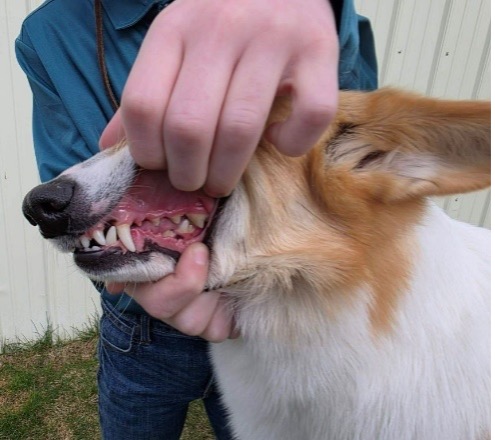
- If you have a breed that requires presentation of the full dentition or proper tongue or mouth pigment, you will need to show the bite, teeth, and the mouth. After you have shown the bite and teeth, grasp the upper and lower jaws and gently open the mouth with the muzzle pointed towards the judge.
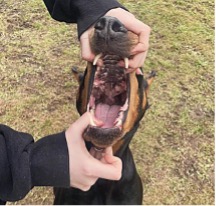
- If your breed standard requires you to show teeth, you will begin by showing the bite, then the premolars and molars on each side of the dog’s mouth, with the muzzle closed. You will need to turn the dog’s head towards the judge to show each side of the mouth. Gently lift the upper lip while pulling the lower lip down and back to expose the premolars and molars.
- If you have a breed that requires presentation of the full dentition or proper tongue or mouth pigment, you will need to show the bite, teeth, and the mouth. After you have shown the bite and teeth, grasp the upper and lower jaws and gently open the mouth with the muzzle pointed towards the judge.
AKC Conducting Oral Exams
From American Kennel Club Conducting Oral Exams
The proficient judge alters their examination technique from breed to breed based on the priorities as defined by the standard. It should never be identical from breed to breed to breed. To do so requires interpretation of the written word as to what the standard is attempting to convey to you as the judge. The manner in which a breed’s approved standard is written will define what would constitute conducting a breed specific examination. Close inspection of a breed’s approved standard will determine the appropriate oral exam to conduct when judging that breed, which is an essential component of the breed specific exam.
Oral exams can be generally divided into four (4) categories which individually or in combination will constitute the proper oral exam for a breed:
- Bite – checking the front
- Teeth – checking the fronts and sides
- Mouth – involves opening the mouth to count teeth or check pigment. Always used in combination with a “bite” or “teeth” exam depending on the breed
- Thumb exam – used for smaller, short muzzled breeds that call for an undershot jaw
Bite
This exam is proper when the standard only refers to the alignment of the bite; scissors, level, undershot or overshot, as a preference, fault or disqualification.
This requires the exhibitor or judge separating the front of the lips to display the meshing of the incisors and canines.
Teeth
This is required for any breed that references missing teeth or dentition. This includes disqualifications for missing teeth, and any reference to full dentition or a full complement of teeth as a preference or fault due to a lack thereof.
This requires the exhibitor or judge to separate the front of the lips to display the meshing of the incisors and canines AND the flews on each side of the mouth so the judge may observe the pre-molars and molars on the upper and lower jaw for each.
Note: While a standard may not reference full dentition, some parent clubs may recommend exams beyond checking the bite (front) due to unique characteristics (i.e. upper incisors fitting snugly in back of the lower canine teeth on each side), to inspect for wry mouths, and/or address language that references all teeth (i.e. Teeth – sound, strong and evenly spaced). Please consult with parent club for specific techniques.
Mouth
Required for any breed that includes a standard disqualification for pigmentation or missing teeth that require checking the M-3s. If the M-3s are excluded from the DQ by the standard (Leonbergers),opening the mouth is not required. It is used in combination with the “bite” and/or “teeth” exam depending on the language within the standard.
Breeds that include a DQ for pigmentation of the mouth but do not reference missing teeth or full (complete) dentition would involve displaying the “bite” and then opening the mouth to check for pigment of the mouth and/or tongue. An example would be the Chinese Shar-Pei which states the bite should be scissors with deviation from being a major fault but also includes that a spotted pink tongue is a major fault and a solid pink tongue is a disqualification. In this case, it is not necessary to “check the sides” as dentition is it not referenced in the standard and the entries are likely not used to this procedure and the lack of familiarity could lead to issues.
Breeds that do include DQ’s for missing teeth will require that the front and sides be displayed in addition to opening the mouth so the judge can effectively observe the molars. This is necessary whether the applicable disqualification refers to a specific missing tooth or teeth, or whether it relates to a number of missing teeth.
To count teeth, or determine full/complete dentition one must know the construct of the oral cavity which includes 42 teeth:
- 12 Incisors – In front of the mouth, six upper and six lower
- 4 Canines – Behind the incisors, two upper and two lower
- 16 Premolars – Behind the canines, eight upper and eight lower
- 10 Molars – Behind the premolars, four upper and six lower
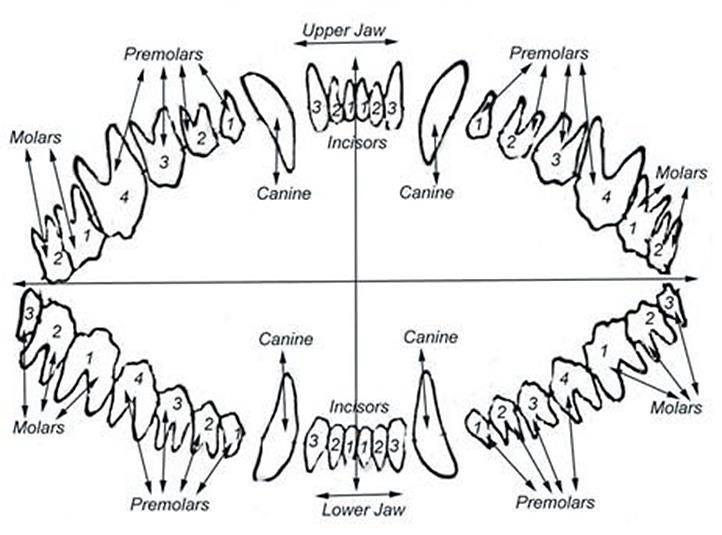
The tried and true method for counting teeth which is taught by all parent clubs for breeds that include disqualification for missing teeth is to “count by zones”. To count by zones, one must know the types of teeth, and the numbers and locations for each. It is not possible to complete this task competently without this general knowledge.
Thumb Exam
Involves the judge running the flat of his/her thumb outside of the top lip OR inside the lips of the dog to feel for the proper alignment of the jaw. This procedure is appropriate in smaller, undershot breeds with short muzzles. This is the preferred means to conduct the oral exam for these breeds as it isnot necessary to pry open the mouth and doing so may be problematic and cause the breed to react by squirming or trying to get away. It is recommended that the thumb exam is conducted at the end of the individual examination. A few examples of where this procedure is used would be Japanese Chin, Pugs and Pekingese.
Note: Please be reminded, many exhibitors prefer to open their dog’s mouth themselves for examination. It is recommended that all judges ask the exhibitor to display the bite/teeth/open the mouth as appropriate for that breed. However, you have the authority to personally open the dog’s mouth. In breeds where appropriate, the judge must personally conduct the thumb exam.
Oral Exam Chart by Breed
The search can be used to find your breed. Y indicates Yes for that breed, N indicates No.F = Check Front (Incisors & Canines)
S = Check Sides (Premolars & Molars)
O = Open Mouth
T = Thumb Exam
| Breed | F | S | O | T |
|---|---|---|---|---|
| Barbet | Y | N | N | N |
| Bracco Italiano | Y | N | Y | N |
| Brittanys | Y | N | N | N |
| Lagotto Romagnolo | Y | Y | N | N |
| Pointers | Y | N | N | N |
| Pointers (German Shorthaired) | Y | Y | N | N |
| Pointers (German Wirehaired) | Y | Y | N | N |
| Retrievers (Chesapeake) | Y | N | N | N |
| Retrievers (Curly Coated) | Y | N | N | N |
| Retrievers (Flat Coated) | Y | N | N | N |
| Retrievers (Golden) | Y | Y | N | N |
| Retrievers (Labrador) | Y | Y | N | N |
| Nederlandse Kooikerhondje | Y | Y | N | N |
| Nova Scotia Duck Toll. Retrievers | Y | Y | N | N |
| Setters (English) | Y | N | N | N |
| Setters (Gordon) | Y | N | N | N |
| Setters (Irish) | Y | N | N | N |
| Setters (Irish Red & White) | Y | N | N | N |
| Spaniels (American Water) | Y | N | N | N |
| Spaniels (Boykin) | Y | N | N | N |
| Spaniels (Clumber) | Y | N | N | N |
| Spaniels (Cocker) | Y | N | N | N |
| Spaniels (English Cocker) | Y | N | N | N |
| Spaniels (English Springer) | Y | N | N | N |
| Spaniels Field | Y | Y | N | N |
| Spaniels (Irish Water) | Y | N | N | N |
| Spaniels (Sussex) | Y | N | N | N |
| Spaniels (Welsh Springer) | Y | N | N | N |
| Spinoni Italiano | Y | N | N | N |
| Vizslas | Y | N | N | N |
| Weimaraners | Y | Y | N | N |
| Wirehaired Pointed Griffons | Y | N | N | N |
| Wirehaired Vizsla | Y | Y | Y | N |
| Afghan Hounds | Y | N | N | N |
| American Foxhounds | Y | N | N | N |
| American English Coonhounds | Y | N | N | N |
| Azawakh | Y | Y | N | N |
| Basenjis | Y | N | N | N |
| Basset Fauve de Bretagne | Y | Y | N | N |
| Basset Hounds | Y | N | N | N |
| Beagles | Y | N | N | N |
| Black & Tan Coonhounds | Y | N | N | N |
| Bloodhounds | Y | N | N | N |
| Bluetick Coonhounds | Y | N | N | N |
| Borzoi | Y | Y | N | N |
| Cirneco dell’Etna | Y | N | N | N |
| Dachshunds | Y | N | N | N |
| English Foxhounds | Y | N | N | N |
| Grand Basset Griffon Vendeen | Y | N | N | N |
| Greyhounds | Y | N | N | N |
| Harriers | Y | N | N | N |
| Ibizan Hounds | Y | N | N | N |
| Irish Wolfhounds | Y | N | N | N |
| Norwegian Elkhounds | Y | N | N | N |
| Otterhounds | Y | N | N | N |
| Petits Bassets Griffons Vendeens | Y | N | N | N |
| Pharaoh Hounds | Y | N | N | N |
| Plotts | Y | N | N | N |
| Portuguese Podengo Pequeno | Y | N | N | N |
| Redbone Coonhounds | Y | N | N | N |
| Rhodesian Ridgebacks | Y | N | N | N |
| Salukis | Y | N | N | N |
| Scottish Deerhounds | Y | N | N | N |
| Sloughi | Y | Y | N | N |
| Tree Walker Coonhounds | Y | N | N | N |
| Whippets | Y | N | N | N |
| Akitas | X | N | N | N |
| Anatolian Shepherd | X | N | N | N |
| Alaskan Malamutes | Y | N | N | N |
| Bernese Mtn. Dogs | Y | Y | N | N |
| Black Russian Terrier | Y | Y | Y | N |
| Boerboel | Y | Y | N | N |
| Boxers1 | Y | Y | N | N |
| Bullmastiffs | Y | N | N | N |
| Cane Corsos | Y | Y | Y | N |
| Chinook | Y | Y | N | N |
| Danish-Swedish Farmdog | Y | N | N | N |
| Doberman Pinschers | Y | Y | Y | N |
| Dogo Argentino | Y | Y | N | N |
| Dogue De Bordeaux | Y | N | N | N |
| German Pinscher | Y | Y | N | N |
| Giant Schnauzers | Y | Y | N | N |
| Great Danes | Y | Y | N | N |
| Great Pyrenees | Y | N | N | N |
| Greater Swiss Mountain. Dogs | Y | N | N | N |
| Komondorok | Y | Y | Y | N |
| Kuvaszok | Y | Y | N | N |
| Leonbergers | Y | Y | N | N |
| Mastiffs | Y | N | N | N |
| Neapolitan Mastiff | Y | Y | N | N |
| Newfoundlands | Y | N | N | N |
| Portuguese Water Dogs | Y | N | N | N |
| Rottweilers | Y | Y | Y | N |
| Saint Bernards | Y | N | N | N |
| Samoyeds | Y | N | N | N |
| Siberian Huskies | Y | N | N | N |
| Standard Schnauzers | Y | Y | N | N |
| Tibetan Mastiff | Y | Y | N | N |
| Airedale Terriers | Y | N | N | N |
| American Hairless Terriers | Y | N | N | N |
| American Staffordshire Terriers | Y | N | N | N |
| Australian Terriers | Y | N | N | N |
| Bedlington Terriers | Y | Y | N | N |
| Border Terriers | Y | N | N | N |
| Bull Terriers | Y | N | N | N |
| Cairn Terriers | Y | N | N | N |
| Cesky Terriers | Y | Y | N | N |
| Dandie Dinmont Terriers | Y | N | N | N |
| Fox Terriers (Smooth) | Y | N | N | N |
| Fox Terriers (Wire) | Y | N | N | N |
| Glen of Imaal Terriers | Y | Y | N | N |
| Irish Terriers | Y | N | N | N |
| Kerry Blue Terriers | Y | N | N | N |
| Lakeland Terriers | Y | N | N | N |
| Manchester Terriers (Standard) | Y | Y | N | N |
| Miniature Bull Terriers | Y | N | N | N |
| Miniature Schnauzers | Y | N | N | N |
| Norfolk Terriers | Y | N | N | N |
| Norwich Terriers | Y | N | N | N |
| Parson Russell Terriers | Y | Y | N | N |
| Rat Terrier | Y | N | N | N |
| Russell Terrier | Y | N | N | N |
| Scottish Terriers | Y | N | N | N |
| Sealyham Terriers | Y | N | N | N |
| Skye Terriers | Y | N | N | N |
| Soft Coated Wheaten Terriers | Y | N | N | N |
| Staffordshire Bull Terriers | Y | N | N | N |
| Teddy Roosevelt Terriers | Y | N | N | N |
| Welsh Terriers | Y | Y | N | N |
| West Highland White Terriers | Y | N | N | N |
| Affenpinschers | Y | N | N | N |
| Biewer Terriers | Y | N | N | N |
| Brussels Griffons | N | N | Y | |
| Cavalier King Charles Spaniels | Y | N | N | N |
| Chihuahuas | Y | N | N | N |
| Chinese Crested - Hariless | Y | N | N | N |
| Chinese Crested - Powderpuff | Y | Y | N | N |
| English Toy Spaniels | N | N | N | Y |
| Italian Greyhounds | Y | N | N | N |
| Havanese | Y | N | N | N |
| Japanese Chin | N | N | N | Y |
| Maltese | Y | N | N | N |
| Manchester Terriers (Toy) | Y | Y | N | N |
| Miniature Pinschers | Y | N | N | N |
| Papillons | Y | N | N | N |
| Pekingese | N | N | N | Y |
| Pomeranians | Y | N | N | N |
| Poodles (Toy) | Y | N | N | N |
| Pugs | N | N | N | Y |
| Russian Tsvetnaya Bolonka | Y | N | N | N |
| Russian Toy | Y | N | N | N |
| Shih Tzu | Y | N | N | N |
| Silky Terriers | Y | N | N | N |
| Toy Fox Terrier | Y | N | N | N |
| Yorkshire Terriers | Y | N | N | N |
| American Eskimo Dogs | Y | Y | N | N |
| Bichons Frises | Y | Y | N | N |
| Boston Terriers | Y | N | N | N |
| Bulldogs | Y | N | N | N |
| Chinese Shar-Pei | Y | N | Y | N |
| Chow Chows | Y | N | Y | N |
| Coton de Tulear | Y | Y | N | N |
| Dalmatians | Y | N | N | N |
| Finnish Spitz | Y | N | N | N |
| French Bulldogs | Y | N | N | N |
| Keeshonden | Y | N | N | N |
| Lhasa Apsos | Y | N | N | N |
| Löwchen | Y | Y | N | N |
| Norwegian Lundehunds | Y | N | N | N |
| Poodles | Y | N | N | N |
| Schipperkes | Y | N | N | N |
| Shiba Inu | Y | Y | N | N |
| Tibetan Spaniels | Y | N | N | N |
| Tibetan Terriers | Y | N | N | N |
| Xoloitcuintli - Hairless | Y | N | N | N |
| Xoloitcuintli - Coated | Y | Y | N | N |
| Australian Cattle Dogs1 | Y | Y | N | N |
| Australian Shepherds | Y | Y | N | N |
| Bearded Collies | Y | Y | N | N |
| Beauceron | Y | Y | Y | N |
| Belgian Laekenois | Y | Y | Y | N |
| Belgian Malinois | Y | Y | N | N |
| Belgian Sheepdogs | Y | Y | N | N |
| Belgian Tervuren | Y | Y | N | N |
| Bergamasco Sheepdogs | Y | N | N | N |
| Berger Picard | Y | Y | N | N |
| Border Collies | Y | Y | N | N |
| Bouviers des Flandres | Y | N | N | N |
| Briards | Y | N | N | N |
| Canaan Dogs | Y | N | N | N |
| Cardigan Welsh Corgis | Y | N | N | N |
| Collies | Y | N | N | N |
| Entlebucher Mountain Dogs | Y | N | N | N |
| Finnish Lapphunds | Y | N | N | N |
| German Shepherd Dogs | Y | Y | N | N |
| Icelandic Sheepdogs | Y | Y | N | N |
| Lancashire Heelers | Y | N | N | N |
| Miniature American Shepherds | Y | Y | N | N |
| Mudi | Y | Y | N | N |
| Norwegian Buhunds | Y | Y | N | N |
| Old Englsh Sheepdogs | Y | N | N | N |
| Pembroke Welsh Corgis | Y | N | N | N |
| Polish Lowland Sheepdog | Y | N | N | N |
| Pulik | Y | Y | N | N |
| Pumi | Y | Y | N | N |
| Pyrenean Shepherds | Y | Y | N | N |
| Shetland Sheepdogs | Y | Y | N | N |
| Spanish Water Dogs | Y | Y | N | N |
| Swedish Vallhund | Y | Y | N | N |
| Alaskan Klee Kai | Y | N | N | N |
| Bolognese | Y | Y | N | N |
| Czechoslovakian Vlcak | Y | Y | N | N |
| Dutch Shepherds | Y | Y | N | N |
| German Spitz | Y | Y | N | N |
| Japanese Akitainu | Y | Y | N | N |
| Kai Ken | Y | Y | N | N |
| Norrbottenspets | Y | Y | N | N |
| Peruvian Inca Orchid - Hairless | Y | N | N | N |
| Peruvian Inca Orchid - Coated | Y | Y | N | N |
| Portuguese Podengo | Y | N | N | N |
| Pyrenean Mastiff | Y | Y | N | N |
| Small Munsterlander | Y | Y | N | N |
| Yakutian Laika | Y | N | N | N |
Chapter 4: Ring Procedures
Handlers will be assigned an armband number. The armband is worn on your left arm with the number visible. The ring steward will signal you to enter the ring to start the class. Handlers and dogs will enter the ring in the order they are called. Judging begins the moment you enter the ring with your dog.
- Gait around the ring and line up in the place designated by the judge.
- When you stop, leave at least three to four feet between yourself and the dog in front of you.
- Line up straight behind the first dog. If you are the first handler and dog team to enter, it is your responsibility to lead the group into the ring and to stop where the steward or judge has directed.
- Stack your dog, keeping your attention on both your dog and the judge. If the judge is looking at arm band numbers, be sure yours is visible.
- Bait your dog quietly. Do not wave the bait around or make unnecessary motions with your baiting hand. Show it to get your dog’s attention and hold it still when the dog is in the proper position. Do not throw bait in the ring. If you drop bait, pick it up.
- The ring may be rearranged in order of gaiting speed. If the ring order is not prearranged, the judge may ask more advanced handlers to put themselves in speed order; faster gaiting dogs will move to the front and slower dogs to the rear.
- The judge may divide large classes into smaller groups.
- After the last dog has been examined and returned to the end of the line, the judge may ask handlers to stack fronts or rears, pair gait, go around the ring individually or in groups, or ask you to gait to a designated point in the ring and present your dog.
- Demonstrate good sportsmanship. Accept your ribbon politely, thank the judge, and leave the ring. Be gracious and congratulate the other 4-H members, too.
Individual Examination
The judge will evaluate your ability to present your dog according to what is proper for its breed, keeping in mind that a mixed-breed dog should be presented according to the breed standard you have chosen to represent your dog. If you declare your dog to be a Labrador Retriever mix, then the judge will expect you to present your dog as a Labrador Retriever. The judge will evaluate you on your stacking technique, showing the bite, teeth, or mouth, depending on your breed, the overall appearance and grooming of your dog, and gait presentation.
- The judge will call each handler out one at a time for an individual examination, watching how you move your dog from the line to the designated spot. Be prepared for the judge to give you a signal that it is your turn.
- If you have a table or ramp breed, proceed to the table or ramp at the judge’s signal.
- Stack your dog using the procedures outlined in Learning to Hand Stack Your Dog, always starting with the left front foot on the show side. Stack quickly and smoothly and ensure all four legs are in the proper position. For efficiency of movement, only place the feet that are out of position.
- If your dog becomes uncooperative, be patient and do your best to keep the dog stacked. The judge will recognize your effort.
- Once you are confident with your dog’s stack, complete your presentation by positioning yourself and baiting your dog to show your dog’s profile. Make eye contact with the judge to let them know you are ready for them to approach and examine the dog.
- The judge will approach you and your dog from the front to check the front quarters, feet placement, expression, head, and neck.
- The judge will ask you to show the bite, teeth, or mouth. You show the judge the proper bite presentation for your dog’s breed. The judge will evaluate the cleanliness of the teeth without penalizing missing, broken, yellowed, or misaligned teeth.
- It is your responsibility to hold your dog’s head to prevent your dog from moving out of place while the judge examines your dog. As a courtesy, you should warn a judge if your dog is shy or uncomfortable with being touched before they begin the physical exam. If needed, you can ask the judge if you can show the ears and nails, however if the dog is too shy for physical examination, the judge will deduct points from your score.
- You should also let the judge know if your dog is on any medication that may impact the exam. If the dog’s ears are greasy because you are treating an ear infection, you should tell the judge so as not to get penalized for dirty ears. You should let the judge know if you are treating a hot spot or allergy and be able to name the medication.
- The judge will thoroughly examine your dog’s grooming and cleanliness. The judge will check your dog’s ears, nails, and coat, as outlined in Grooming and Overall Appearance of Your Dog.
- The judge will lift the dog’s leg to examine the toenails and may not place it back in the proper position.
- After the judge has finished the physical examination and steps away from the dog, you should move the foot back into the proper position. All four feet should be back in place and stacked after the judge examines your dog and steps back to look at the dog’s profile again.
- If you have a table dog, place your dog on the ground in the direction you will be moving after the judge has finished their examination. You may quickly brush the coat if needed. Taking a comb or brush into the ring is permissible if you have a place to keep it without it interfering with your presentation. Some handlers will place a comb in their armband, hair, or pocket.
Individual Gaiting and Ring Patterns
After the judge has completed their individual exam of your dog, they will ask you to do a gaiting pattern to evaluate your ability to show proper gait presentation and speed for your breed and dog as outlined in Pattern Gaiting.
- Complete the pattern requested by the judge smoothly and efficiently.
- Courtesy turns, if used, are done correctly.
- Demonstrate efficiency of movement with smooth, appropriate hand changes.
- Present the dog in a free stack to the judge at the end of the pattern.
Group Gaiting
The judge will have the entire class gait around the ring together. If you are the first exhibitor in line, it is expected that you ask the person behind you if they are ready. Do not start until the next few people behind you are ready.
- Gait at an appropriate speed for your breed and dog.
- Maintain adequate spacing between you and the dog in front of you to avoid crowding. Pause a few seconds after the handler in front has moved away before you begin gaiting.
- Do not pass other dogs and handlers.
- If you are behind a slower moving dog, use proper timing by waiting until you are out of the judge’s sight, slowing down or even stopping to allow more space to build in front of you before you begin gaiting. This will allow you to move your dog at the proper speed when you pass in front of the judge, without running up on the dog ahead of you.
Presentation in Line and Spacing
The judge will evaluate each handler’s presentation in line with emphasis on stacking, spacing, and timing.
- Maintain adequate spacing between you and the dog in front of you. Do not crowd others.
- Do not block areas of the ring where individual patterns are being judged, particularly the corners.
- Demonstrate good timing and awareness by relaxing or stacking your dog at the appropriate time. The timing of your stack is very important. Know when the judge is looking down the line and have your dog stacked.
- Continue to check your dog’s foot placement from time to time to make sure your dog has not moved his feet. If your dog is standing correctly and the feet are where they should be, offer a reward. Try to stand still to encourage your dog to do the same. If you fidget, your dog may move around, too.
- When in line, use a combination of hand and free stacking techniques to keep your dog alert, interested and attentive. Try to present two or three different pictures or positions to the judge when they glance down the line.
- When directed by the judge, allow your dog to relax in line while the judge is performing individual exams. Relaxing your dog means you do not have to keep your dog in a perfect stack while the judge is focused on exams. This is a good time to bait, free stack, or play quietly with your dog to keep your dog happy and attentive while you are waiting for your turn. Interacting with your dog in the ring is encouraged as long as you are not a distraction to others.
- Be aware of what is happening in the ring. Move up in line as each handler moves out for their individual exam and be prepared for your turn.
- You should have your dog stacked and ready when the dog in front of you is making their last go around to the end of the line.
- It is helpful to know who is the last person in line. When the last handler and dog are called out for their exam, the rest of the class should get their dogs lined up with the first dog, stacked and ready for any further directions from the judge.
- Your dog should appear posed, interested and under control. You and your dog should show confidence in the ring.
- If movement to the dog’s other side is needed, a simple step around the front of your dog to the other side is allowed. Strive to present all sides of your dog without adding unnecessary movement or distractions from you. The goal is to move smoothly and present your dog efficiently.
Knowledge Questions
The judge will ask you five knowledge questions as part of your 4-H Showmanship class. These questions are asked to evaluate a member’s knowledge of dogs and the 4-H program. All questions will be sourced from the Washington State 4-H Dog Showmanship Study Guide.
Questions are specific to the member’s age level. You will be asked one question from each of the following categories:
- Parts, Bones, and Anatomy: You will be asked to point to a specific part on your dog or on a diagram. More experienced handlers may also be asked to give a verbal definition of a part or bone of a dog. If you are asked to show a part on your dog, make sure to show it on the judge’s side so that they can see where you are pointing. If your dog has long hair, make sure your hands can be seen.
- Breed History and Standard: You will be asked a question about your dog’s breed history and standard. Examples include, but are not limited to, the AKC breed group, purpose or origin of your breed, or characteristics such as bite and coat color specific to your breed standard.
- Care and Health: You will be asked a question about the care and health of dogs, on topics such as parasites, diseases, vaccinations, or first aid.
- 4-H General Knowledge: You will be asked a question on 4-H knowledge such as the 4-H emblem, motto, pledge, designated age divisions, club meetings, or club officers and their duties.
- 4-H Dog Project Knowledge: You will be asked a 4-H related question specifically pertaining to the dog project. You may be asked about Dog Program Policies, dress code, or events you can participate in with and without your dog.
Chapter 5: 4-H Showmanship Judges’ Guidelines
The Danish System of Judging
The Danish System of judging will be used for 4-H Showmanship. All 4-H exhibitors are judged on their scoresheet. Blue is ranked excellent, indicating a high degree of achievement toward the elements set in the standard for the contest. Red is ranked good in relation to the standard or expected achievement for the class or contest. White is ranked satisfactory or for the standard or expected achievement for the class or contest.
Point division for ribbon awards is as follows:
- Blue Ribbon: 85 to 100 points
- Red Ribbon: 70 to 84.5 points
- White Ribbon: 0 to 69.5 points
Qualifications
4-H Showmanship Judges should exhibit the following qualifications:
- Demonstrate impartiality and skill in separating the handling ability of the exhibitors they judge from any other consideration.
- Successfully demonstrate the ability to conduct a ring in a consistent, professional, and safe manner that will instill confidence in exhibitors and spectators.
- Utilize proper ring procedures to ensure the safety and consistency, equitable treatment and enjoyment of all exhibitors and their dogs.
- Possess a genuine interest in promoting positive learning experiences for children. Judges should be teachers by example; prompt, courteous, patient, and properly attired.
- Knowledge of the appropriate presentation for the breeds they are to judge. This includes table or ramp presentations, if applicable. A list of breeds will be made available upon request from the judge prior to the event.
- Review the Washington State 4-H Guide to Dog Showmanship and demonstrate an understanding of the expectations of 4-H Showmanship.
- Understand that 4-H Showmanship classes are judged solely on the ability of the 4-H member to properly care for and exhibit their dog to a judge, not the conformation of the dog.
Safety
Exhibitors will vary in degrees of age and experience. Dogs will vary in size, breed, temperament, and training. Judges will need to establish safe ring conditions and make every effort to ensure the safety of the exhibitors and their dogs during the competition.
- If an exhibitor’s dog is unmanageable, judges may offer guidance or seek guidance from the superintendent or person in charge.
- The handler should warn the judge if their dog is too shy or reserved for physical examination. The handler may show the required parts: teeth, ears, and feet. If the judge cannot place their hands on the dog for the individual exam and to check for mats and cleanliness, the handler is to receive a deduction in Overall Appearance and Exam.
- A dog may be excused from the ring if:
- The dog is considered unmanageable and the exhibitor is unable to control the dog.
- The dog is aggressive toward the judge, other exhibitors, or other dogs.
- If the dog is distracting or disrupting other dogs or exhibitors with menacing behavior.
- Only admit the number of exhibitors that can be safely examined into the ring at one time. Judges should divide the class into smaller groups when:
- The safety of the dogs and exhibitors is compromised.
- The exhibitors need more room to gait and show their dogs.
- The length of time it would take to judge the class would be too demanding for the dogs and exhibitors.
- Judges should arrange competitors or have advanced exhibitors arrange themselves in the order of gaiting speed, if not already done.
Responsibilities of the Judge
The judging routine should be consistent with procedures commonly used in the conformation or Junior Showmanship ring in AKC. The number of exhibitors, the size of the ring, the age and experience of the handlers, the ring conditions, the weather, the time of day and time restrictions will all influence the way you set up your ring and what procedures you should use. The responsibilities of a judge in a 4-H Showmanship event are described below.
- Make every effort to evaluate the class of exhibitors in:
- Proper exhibitor appearance, etiquette, and poise.
- Proper breed presentation and the ability of the handler to present their dog to the judge to its best advantage. Mixed breeds, purebred, spayed and neutered dogs may be exhibited. Mixed breeds should be handled and presented as the breed they most closely resemble. Some freedom of expression or expertise should be allowed to the exhibitors.
- The dog’s grooming, condition, and cleanliness.
- Check the ears for cleanliness.
- Check the coat for cleanliness and for evidence of care throughout the year.
- Check to see that the dog’s toenails have been trimmed. An attempt should be made to trim the nails with more emphasis on effort than skill, with consideration to the age and experience of the exhibitor.
- Knowledge of ring procedures and handling skills.
- Exhibitors should use the whole ring and not cut corners. Small breeds may make a smaller circle.
- Exhibitors should be stacked and ready when the last dog returns to the lineup.
- Strive to evaluate exhibitors appropriately and consistently.
- Use the same judging routine for all exhibitors in the ring, giving equal time to each. Watch all exhibitors from start to finish.
- Signal the next exhibitor in line to come out and stack for their individual presentation on the ground, table, or ramp, if available. If an exhibitor is unable to safely lift or present their table dog on the table, they should be allowed to present the dog on the ground or ramp, if available. The judge should let the 4- H member make that decision.
- Request the exhibitor to show the bite, teeth, mouth, or all parts, according to the breed standard. The judge may use discretion or help younger 4-H members to present the bite. Help may include holding the dog’s head for the exhibitor to present the bite. The judge should note the condition of the teeth according to the age of the dog. Missing or yellow teeth shall not be considered; however, plaque buildup can be penalized.
- Evaluate the dog and handler as a team for overall presentation, timing, and poise.
- Is the dog responsive to the handler?
- Do the dog and handler work as a team?
- Does the dog appear posed or interested?
- Is the dog moved correctly to the best of its ability?
- Are the dog’s main faults being minimized?
- Are major strengths being presented?
- Do both the dog and handler appear relaxed and confident?
- Is the dog presented with an apparent minimum of effort using proper timing and poise?
- Offer the option for exhibitors to relax their dogs in line while the other exhibitors are being examined for large classes. This does not mean dogs can lie down or the exhibitors can sit and talk to each other. Glancing down the line from time to time to see what the exhibitors are doing is recommended to see if they are keeping their dogs interested and happy.
- Ask one question from each of the five categories listed below. The event superintendent may provide a list of appropriate questions for each age and experience level for you to choose from, or questions they have preselected for the event.
- Parts, Bones, and Anatomy
- Breed History and Standard
- Care and Health
- 4-H General Knowledge
- 4-H Dog Project Knowledge
- Consider the following additions to your judging routine by asking exhibitors to:
- Stack their dogs facing into the ring to present fronts or facing the outside of the ring to present rears.
- See profiles or walk down the line again to see fronts and expressions.
- Pair gait their dogs.
- Do another gaiting pattern.
- Go around the ring individually or as a group.
- Return for a call back in the event of a tie and bring those exhibitors back in the ring for a runoff.
- Avoid the following:
- Asking exhibitors do any patterns other than the down and back, the triangle, the L, or T.
- Creating unnecessary movement.
- Trying to trick exhibitors into making mistakes.
Judging Patterns
Use only those patterns outlined in the 4-H Showmanship manual in Pattern Gaiting. Generally, the less experienced and the younger exhibitors will do the easier patterns.
- The Down and Back pattern is recommended for Cloverbud members.
- The Down and Back and Triangle patterns are good choices for Juniors and first-year members of all ages to understand and accomplish effectively.
- For more experienced Intermediate and Senior members, any of the four patterns can be used. It is recommended to use the down and back or triangle patterns during preliminary rounds. For semi-final, tie breakers or final rounds you may want to advance to a more technical pattern such as the L pattern or T pattern. This should be left to the judge’s discretion.
- The judge should not cause unnecessary movement or awkwardness for the handlers. For example, when examining a group gaiting around the ring, the judge should be inside the circle so as not to create unnecessary movement for the handlers. Weaving in and out of line to cause the handlers to run around their dogs is discouraged. When the dogs are stacked in-line do not move behind the line unless you are going to ask a handler to move in a Down and Back individually or as a pair.
- Whichever method the exhibitor chooses to use, the emphasis should be on how they accomplish the following objectives:
- Moving smoothly, with the least amount of movement and distraction
- Keeping their dog in a stack.
- Not interfering with the judge’s view of the dog.
- Continuing to present their dog to the judge.
Chapter 6: References
- The Winning Edge by George Alston; Show Ring Secrets: This book is written for the amateur exhibitor who already knows the basics of showing a dog. It is for those that are truly interested in the sport of dogs.
- Show Me! A Dog Showing Primer by D. Caroline Colie: This book explains the basics of dog showing, written for novice exhibitors and has helpful advice for experienced handlers.
- WSU 4-H Dog Program
Showmanship Knowledge Topic List
The Knowledge Topic List is the standard by which Showmanship questions have been created for the 4-H Dog program in Washington State.
Judges at the State Fair must use questions from the designated questions bank. Use at the county level is optional. Judges should keep in mind the age and experience of the members when choosing questions from the questions bank.
Sources
Sources are limited to the following:
- The Complete Dog Book by AKC, 20th Edition; AKC
- AKC.org
- 4-H Dog Project Manual by AKC; 4-H Manual
- Welcome To 4-H
- Washington State 4-H Dog Program Policies
- Washington State 4-H Guide to Dog Showmanship
- Washington State 4-H Guide to Dog Obedience
- Washington State 4-H Dog Quiz Bowl Rules
- Washington State 4-H Dog Judging Contest
- The Complete Dog Book for Kids by AKC; Kids AKC is no longer used as a source for new questions, but questions may remain in use if they are still relevant to the 4-H dog program.
In all areas Intermediates must also know Junior topics and Seniors must know all topics.
Parts, Bones, and Anatomy
From The Complete Dog Book by AKC, 20th Edition
Juniors (Parts)
- Muzzle
- Back
- Tarsus or Hock
- Elbow
- Stifle or Knee
- Skull
- Lip
- Withers
- Digits or Toes
- Hip
- Cheek
- Shoulder
- Stop
Intermediates (Parts)
- Metacarpus or Pastern
- Crest
- Flew
- Loin
- Brisket
- Point of rump
- Forearm
- Point of shoulder
- Carpus or Wrist
- Metatarsus
Seniors (Bones)
- Orbit or Eye socket
- Occiput
- Atlas
- Axis
- Cervical Vertebrae
- Thoracic Vertebrae
- Lumbar Vertebrae
- Pelvis
- Femur
- Fibula
- Tibia
- Ribs
- Ulna
- Radius
- Humerus
- Scapula or Shoulder blade
Breed History and Standard
From AKC.org. See the Breed History and Standard Study Guides below for information.
Juniors
- AKC Breed Group
- Origin of breed
- Purpose of breed
Intermediates
- Breed uses today
- Breed height standard
- Breed weight standard
- Breed bite standard
Seniors
- Breed temperament
- Breed color
- Breed coat types
- Breed ear set
- Breed tail set
- Breed faults
- Breed disqualifications
- Grooming required for conformation competition
Breed History and Standard Study Guides
- Which AKC breed group is your dog’s breed in?
- What country does your breed originally come from?
- What is the original purpose of your dog’s breed?
- What is your breed used for today?
- Does your breed have a height standard? If yes, what is it?
- Does your breed have a weight standard? If yes, what is it?
- What is the correct bite for your breed as defined by the AKC Breed Standard?
- Describe the desired temperament for your breed as defined by the AKC breed standard?
- What are the acceptable coat colors for your breed as defined by the AKC Breed Standard?
- What are the acceptable coat types for your breed as defined by the AKC Breed Standard?
- Describe the correct ear set for your breed as defined by the AKC Breed Standard.
- Describe the correct tail set for your breed as defined by the AKC Breed Standard.
- Does your AKC Breed Standard have any characteristics or traits that would be considered a fault? If yes, name one.
- Does your AKC Breed Standard have any disqualifying faults that could make a dog ineligible for further competition in conformation? If yes, name one.
- What type of grooming is required for your breed?
- According to the AKC Breed Standard, how should your dog be groomed for conformation competition?
- What is the difference between a fault and a disqualification in an AKC Breed Standard?
- Answer: A fault is an undesirable quality or trait with varying degrees of penalty, whereas a disqualification is a condition that makes a dog ineligible to further compete in conformation
- What are two conditions, regardless of breed, that disqualify a dog from further conformation competition?
- Answer: Blindness, Deafness, missing a limb, Cryptorchidism, Spayed, neutered, or surgically altered
Care and Health
From 4-H Dog Project Manual by AKC. See the Care and Health Study Guides below for information.
The Complete Dog Book for Kids by AKC is no longer used as a source for new questions, but questions may remain in use if they are still relevant to the 4-H dog program.
Juniors
- Safety around dogs
- Basics of care for dogs and puppies
- Feeding your dog
- Signs of Illness
- Common external parasites
- No symptoms and/or treatments may be asked of Juniors
Intermediates
- Raising your puppy or adult dog
- Foods to Avoid
- Canine body condition
- Vaccinations
- Common signs of stress
- Common parasites, symptoms, and treatment
- Signs of heatstroke
- Common household poisons
Seniors
- Nutrition
- Common health problems
- Checking vital signs
- Rescue breathing and CPR
- Treatment of Heatstroke
- Other first aid procedures; broken bones, burns, bleeding, ear or eye injuries, electric shock, frostbite, hypothermia, poisoning, shock
- What to do in case of a dog fight
Care and Health Study Guides
- Question: What is the best way to approach a dog you do not know?
- Answer: From the front or the side
- Question: What should you do if you see dogs fighting?
- Answer: Get an adult
- Question: Give one reason why you should always ask an owner if you can pet their dog?
- Answer: The dog may be on duty as a handicapped person’s assistance dog; The dog may be injured; The dog may be ill or sick; The dog may be afraid of children
- Question: Give me two examples of things a puppy needs to grow up healthy.
- Answer: Food, Clean water, Exercise – play time, Grooming, Training, Socialization, Veterinary care
- Question: Good nutrition comes from feeding a balanced diet. True or False?
- Answer: True
- Question: What does your dog always need access to?
- Answer: Clean water
- Question: Name two things that should be done regularly to keep your dog well-groomed.
- Answer: Brushing, Bathing, Nail trimming, Ear cleaning, Brushing teeth
- Question: Why is brushing your dog’s coat important?
- Answer: It helps remove dead hair and mats
- Question: Why is it important to brush your dog’s teeth?
- Answer: To clear away plaque
- Question: How often should you take your adult dog to the veterinarian?
- Answer: Once a year
- Question: Name two of the most common types of dog food.
- Answer: Dry (Kibble), canned, and semi moist
- Question: Name one reason why many owners prefer to feed their dog kibble (dry) food rather than soft or canned food.
- Answer: Less expensive than other options or helps keep teeth clean
- Question: How many times a day should you feed your puppy?
- Answer: 3-4 times a day
- Question: How many times a day should you feed your adult dog?
- Answer: 1-2 times a day
- Question: Anytime your dog shows symptoms of illness, you should call your veterinarian. True or False?
- Answer: True
- Question: Name two signs that your dog may be sick and needs to go to the veterinarian.
- Answer: Vomiting, Diarrhea, Constipation, Abnormal temperature, Coughing, Gagging, Trouble breathing, Discharge from eyes, nose, mouth, Loss of appetite, Increased thirst, Pain, Shivering, Difficulty going potty, Problems walking, Restlessness
- Question: What should you do if a dog has a discharge that looks like yellow or green pus coming from the eyes?
- Answer: Call your veterinarian
- Question: Name two external parasites common to dogs.
- Answer: Flea, tick, lice, mites
- Question: In 21 days, one flea can produce 1,000 or more fleas. True or False?
- Answer: True
- Question: Why is it important to check your dog for fleas?
- Answer: Fleas can carry tapeworm
- Question: Why is it important to check your dog for ticks?
- Answer: Ticks can carry diseases
- Question: If you have ticks in the area where you live, it is important to check your dog carefully for ticks every day. True or False?
- Answer: True
- Question: When checking your dog’s body for ticks, where are two places you should pay special attention to?
- Answer: Ears, Toes, along the back, groin, and armpits
- Question: What are nits?
- Answer: Lice eggs
- Question: Mites are so small that they can only be seen under a microscope. True or False?
- Answer: True
- Question: Mites live on and, in the skin, hair, and pores of the dog. True or False?
- Answer: True
- Question: Why is structured play time an important part of raising a puppy?
- Answer: It improves the puppy’s intelligence and ability to solve problems
- Question: What is it called when you expose your puppy to a wide variety of new things, animals, and people?
- Answer: Socialization
- Question: At what age is socialization critical to a puppy’s development?
- Answer: In the first 3 months of life
- Question: In general, how much exercise does a puppy need?
- Answer: 15-30 minutes, twice a day
- Question: Walking, swimming, chasing a ball, and participating in a sport for which your dog was bred, are all good forms of […] for adult dogs.
- Answer: Exercise
- Question: Name two benefits that regular exercise can provide for a dog.
- Answer: Builds strong muscles, joints, and bones, improves flexibility, helps with digestion, strengthens the heart, helps maintain weight, helps puppies get good sleep, reduces or prevents behavior problems, gives more energy, helps to build a strong bond with owner
- Question: Regular exercise helps a dog build strong muscles, joints, and bones. True or False?
- Answer: True
- Question: Providing your dog with regular exercise can help you build a strong bond with your dog. True or False?
- Answer: True
- Question: Name two simple rules to help make housetraining successful.
- Answer: Control what and when a puppy eats, keep a consistent schedule, provide regular exercise, reward the puppy for going potty outside
- Question: Keeping a consistent feeding schedule and providing regular exercise can help make housetraining your puppy successful. True or False?
- Answer: True
- Question: Rewarding your puppy for going potty outside will help make housetraining successful. True or False?
- Answer: True
- Question: Name two potentially deadly foods you should never feed your dog
- Answer: Alcohol, Apple cores (seeds), Cooked bones, Caffeine, Chewing gum, Candy, Toothpaste, Chocolate, Grapes, Raisins, Macadamia Nuts, Onions, Chives, Garlic, Uncooked Yeast Dough
- Question: Name two foods that, although may not be deadly, can cause digestive problems for some dogs.
- Answer: Avocados, Baby Food, Cat Food, Fat from meat, Raw fish, Dairy products, Human vitamins, Peaches, Plums, Pears, Salt, Sugar
- Question: Tell me why you should not feed corn on the cob to your dog?
- Answer: It can cause an intestinal blockage
- Question: Why are apple seeds poisonous to dogs?
- Answer: Seeds can cause cyanide poisoning
- Question: Why should small, cooked bones never be given to your dog?
- Answer: They can splinter and get lodged in the throat or intestines
- Question: What is the potentially deadly ingredient in chocolate?
- Answer: Theobromine
- Question: What is the potentially deadly ingredient that some chewing gum, candy, and toothpaste contain?
- Answer: Xylitol
- Question: Why should onions, garlic, or chives never be given to your dog?
- Answer: They can cause damage to red blood cells
- Question: Why is caffeine toxic to dogs?
- Answer: Caffeine is a stimulant and can cause heart palpitations or death
- Question: Eating what kind of fruit can lead to vomiting, diarrhea, and life-threatening kidney failure?
- Answer: Grapes or Raisins
- Question: What food can cause weakness, vomiting, tremors, and hypothermia if ingested by a dog?
- Answer: Macadamia Nuts
- Question: Name two foods that are poisonous to dogs.
- Answer: Chocolate, Grapes, Raisins, Garlic, Onions
- Question: How would you describe the body condition of a dog with easily palpable ribs with minimal fat covering?
- Answer: Ideal
- Question: How would you describe the body condition of a dog with ribs that are difficult to feel due to a heavy fat cover?
- Answer: Too Heavy
- Question: Why are regular vaccinations from your veterinarian important to your dog’s health?
- Answer: Vaccinations can help prevent your dog from getting serious, sometimes fatal illnesses
- Question: What does DHPP stand for?
- Answer: Distemper, Hepatitis, Parvovirus, Parainfluenza
- Question: Name two serious and sometimes fatal illnesses that may be prevented by regular vaccinations.
- Answer: Distemper, Hepatitis, Leptospirosis, Parvovirus, parainfluenza, Coronavirus, and Rabies
- Question: What vaccination may be given to help prevent a dog from becoming infected with Kennel cough?
- Answer: Bordetella
- Question: Vaccinations schedules may vary based on where you live and your dog’s individual risk factors. True or False?
- Answer: True
- Question: What are two common signs of stress in dogs?
- Answer: Change in activity level, avoiding eye contact, licking lips, pacing, panting, sweaty paws, diarrhea, shaking (as if to shake off water), shedding, trembling, turning away, urination, yawning
- Question: What do you call an organism that lives on or inside a host?
- Answer: Parasite
- Question: Name two internal parasites common to dogs.
- Answer: Hookworms, Roundworms, Tapeworms, Whipworms, and Heartworms
- Question: Name an internal parasite that is not a worm.
- Answer: Giardia
- Question: What causes the infection of the intestines known as
- Answer: Protozoan
- Question: How is Giardia acquired?
- Answer: Through contact with infected feces or drinking infected water
- Question: Name two symptoms of Giardia in dogs.
- Answer: Diarrhea with or without mucus, vomiting, weight loss, lack of energy
- Question: Which internal parasite looks like whitish piles of spaghetti?
- Answer: Roundworms
- Question: Which internal parasite can appear as white seeds or grains of rice in an infected dog’s feces?
- Answer: Tapeworm
- Question: Name the two internal parasites that puppies can be born with.
- Answer: Hookworms and Roundworms
- Question: Name the internal parasite that can be acquired by licking or sniffing contaminated ground.
- Answer: Whipworm
- Question: Which internal parasite can enter a dog’s bloodstream from the bite of an infected mosquito?
- Answer: Heartworm
- Question: : What are two of the most common ways a dog can become infected with worms?
- Answer: Contaminated water, Contaminated food, Contaminated soil or dirt, Eating rodents or rabbits
- Question: What is another name for Roundworms?
- Answer: Ascarids
- Question: A cough that does not go away, shortness of breath, distended abdomen, and tires easily are signs a dog may have what internal parasite?
- Answer: Heartworm
- Question: How does a veterinarian test for internal parasites, such as roundworms?
- Answer: Fecal sample
- Question: How does a veterinarian test for a Heartworm infection?
- Answer: Blood test
- Question: What is the best method to avoid parasite infection?
- Answer: Prevention
- Question: What is a good way to check your dog for fleas?
- Answer: Use a fine comb or flea comb to check the skin on the back near the tail
- Question: What might you see on your dog’s skin or bedding that could indicate he has fleas?
- Answer: flea dirt
- Question: Name two symptoms that may be caused by a flea infestation
- Answer: Itching, scratching, biting, hair loss, inflamed skin, flea dirt
- Question: What parasite can be transmitted to your dog by fleas?
- Answer: Tapeworm
- Question: Name two serious illnesses that ticks can carry.
- Answer: Rocky Mountain Spotted Fever and Lyme Disease
- Question: Name two symptoms that may be caused by a lice infestation.
- Answer: Dry coat, hair loss, excessive scratching, nits
- Question: What is the name for lice eggs?
- Answer: Nits
- Question: What do nits look like?
- Answer: Small, white dots attached to hairs on your dog
- Question: Dogs that are severely infested with lice may suffer blood loss, resulting in what medical condition?
- Answer: Anemia
- Question: What parasite can cause anemia due to loss of blood if left untreated?
- Answer: Lice (Fleas accepted)
- Question: What external parasite can only be seen under a microscope?
- Answer: Mites
- Question: What parasite might cause a dog to shake their head and rub their heads on the ground?
- Answer: Ear mites
- Question: Tell me one way your dog could get heatstroke.
- Answer: Being left in the car; Over
exercising on hot days; outdoor kennel or dog house without enough shade and ventilation
- Answer: Being left in the car; Over
- Question: Name four symptoms of heatstroke.
- Answer: Temperature of 104° or higher, Rapid breathing and pulse, Increased heart rate, Shock, Listless, Diarrhea, Vomiting, Staggers, Excess panting, drooling
- Question: What is the first thing you should do if you suspect your dog has ingested something poisonous?
- Answer: Call your veterinarian or Poison Control Hotline
- Question: Name four symptoms of poisoning.
- Answer: Seizures, collapse, severe vomiting, diarrhea, bloody diarrhea, drool, foams at mouth, swollen, red eyes, trembling, swollen tongue, burned lips, bleeding from mouth or anus, bruising, dilated pupils, shock, increased thirst, or increased urination
- Question: Name two items you might have in your house that are poisonous to dogs?
- Answer: Human medications or prescriptions including but not limited to Tylenol, Advil, ibuprofen, acetaminophen, and industrial cleaners such as bleach
- Question: Why is it important to keep human medications and cleaning products where your dog cannot get them?
- Answer: They are poisonous to dogs
- Question: Name two items you might keep in your garage that are poisonous to dogs?
- Answer: Automotive products (Antifreeze, Gasoline), Insecticides (slug bait), Pesticides (rat poison
- Question: Why should Insecticides, Pesticides, and Automotive products like antifreeze, be safely stored where your dog cannot get them?
- Answer: They are poisonous to dogs
- Question: Name two plants that are poisonous to dogs
- Answer: Azaleas, Lillies, Tulips, Sago Palm
- Question: What do you call the process of providing or getting the food necessary for growth and good health?
- Answer: Nutrition
- Question: Name four categories of nutrients
- Answer: Protein, Fat, Carbohydrates, Vitamins, Minerals, and Water
- Question: What nutrient supplies amino acids that are necessary for the body to build healthy tissue?
- Answer: Protein
- Question: Why do dogs need fat to function normally?
- Answer: Fats supply energy and transport nutrients in the body
- Question: What nutrient helps food pass through the body?
- Answer: Fiber
- Question: What nutrient provides a source of energy?
- Answer: Carbohydrates
- Question: Name the process by which food is converted into energy?
- Answer: Metabolism
- Question: What nutrients help regulate metabolism?
- Answer: Vitamins
- Question: Where do minerals come from?
- Answer: Soil
- Question: What nutrients make up a dog’s muscles, bones, and tissues?
- Answer: Minerals
- Question: Name four major minerals.
- Answer: Calcium, Chloride, Magnesium, Phosphorus, Potassium, Sodium, Sulfur
- Question: What nutrients help build strong bones and teeth?
- Answer: Minerals
- Question: What nutrients help regulate body temperature and prevent dehydration?
- Answer: Minerals
- Question: Give two signs your dog may be suffering from an allergy.
- Answer: Red, irritated skin, Itchy skin, Hair loss, Sneezing, Coughing, Irritated eyes, Diarrhea
- Question: Why is it important to have a dog checked by a veterinarian if the dog is showing signs of an allergy?
- Answer: Some illnesses can mimic signs of allergies
- Question: Name two things in a dog’s outdoor environment that could be a source of allergies.
- Answer: Trees, Grass, Weeds, Pollen
- Question: Name two things inside a dog’s home that could be a source of allergies.
- Answer: Certain foods, Dust, Mold
- Question: Name a problem usually seen in older dogs that often occurs due to loss of cartilage, which causes abnormal rubbing of bone against bone.
- Answer: Arthritis
- Question: What problem can develop following a fracture of a bone, or repeated stress on a joint?
- Answer: Arthritis
- Question: Name two symptoms that could indicate Arthritis.
- Answer: Dog appears to be in pain, stiffness, lameness, slow gait, has trouble getting up from a laying position, licks joints
- Question: What might your veterinarian ask you to bring to the appointment if your dog is experiencing ongoing diarrhea?
- Answer: Stool or Fecal sample
- Question: What could happen to a dog with ongoing diarrhea if there is not clean water available?
- Answer: Dehydration
- Question: What is another term for infectious tracheobronchitis?
- Answer: Kennel cough (canine cough or canine infectious cough accepted as an answer)
- Question: What is the classic symptom of kennel cough?
- Answer: A dry, honking type cough
- Question: What other symptoms, besides a cough, may be present in a dog with kennel cough?
- Answer: Sneezing or discharge from eyes or nose
- Question: Name one of the most common bacteria that can cause kennel cough.
- Answer: Bordetella
- Question: Why is it necessary to isolate a dog diagnosed with kennel cough from uninfected dogs?
- Answer: Kennel cough is highly contagious
- Question: What might you notice about a dog’s nose that could indicate an illness?
- Answer: Yellow or green discharge
- Question: Why is it important to check vital signs if your dog has a medical emergency?
- Answer: Vital signs provide a measure of how the body is functioning
- Question: Name the four main vital signs.
- Answer: Temperature, respiration rate, pulse rate, and blood pressure
- Question: What is the first step in determining if your dog needs medical attention?
- Answer: Check the color of your dog’s tongue, gums, and inner eyelids
- Question: What color should the tissue of the tongue, gums, and inner eyelids be in a healthy dog?
- Answer: Pink
- Question: What is the term for gently pressing the upper gum for 2 seconds, then releasing the pressure to see if the color returns to normal?
- Answer: Capillary Refill Time
- Question: What is the range of a normal respiration rate for a resting dog?
- Answer: 10-20 breaths per minute
- Question: How would you count a dog’s breaths?
- Answer: Using a timer, count each time the chest rises and falls
- Question: How could a dog’s respiration rate indicate the dog is injured or in pain?
- Answer: The respiration rate may be higher or lower than normal
- Question: What is the range of a normal pulse rate for a resting dog?
- Answer: 60-140 beats per minute (bpm) (varies by size of dog)
- Question: Where is the best place to check a dog’s pulse?
- Answer: Press gently on the femoral artery, on the inside of the upper thigh where the leg joins the body
- Question: What is the range of a normal temperature for a dog?
- Answer: 100° to 102.5°
- Question: What items do you need to take your dog’s temperature?
- Answer: Rectal thermometer, lubricating jelly, clean cloth or tissue, rubbing alcohol, and a helper
- Question: Without a stethoscope to listen to the heartbeat, what is the best way to measure a dog’s heart rate?
- Answer: Take the dog’s pulse
- Question: What two steps should you take if a dog becomes unresponsive and stops breathing?
- Answer: 1. Clear the dog’s airway of debris, foreign objects, blood, or mucus; 2. Call your veterinarian
- Question: How is rescue breathing performed on a dog?
- Answer: Enclose the dog’s mouth with your hand and hold closed, place your mouth over the nose to make an airtight seal, breath 4-5 rapid, gentle breaths into the nose, watch for the chest to expand and repeat every 3-5 seconds.
- Question: What should you do If an unconscious dog does not begin breathing after you have cleared the airway?
- Answer: Rescue breathing (artificial respiration also accepted) for a maximum of 20 minutes
- Question: When performing rescue breathing on a dog, how can you tell if the dog is receiving air into the lungs?
- Answer: The chest will expand (rise and fall accepted)
- Question: How many rapid, gentle breaths into the nose are given at a time when performing rescue breathing on a dog?
- Answer: 4-5 breaths
- Question: How often do you repeat your breaths when performing rescue breathing on a dog?
- Answer: Every 3-5 seconds
- Question: What is the maximum length of time you should do rescue breathing on an unresponsive dog?
- Answer: 20 minutes
- Question: What does CPR stand for?
- Answer: Cardiopulmonary Resuscitation
- Question: How would you check a dog’s heartbeat?
- Answer: Place the dog on its right side and put your hand by the dog’s left elbow on the lower chest
- Question: If you have not been trained in CPR, who should you call for immediate assistance if a dog’s heart has stopped beating?
- Answer: Veterinarian
- Question: Which side should you place an unconscious dog on to perform CPR?
- Answer: On its right side
- Question: How are compressions given when administering CPR to a dog?
- Answer: Steady downward pressure and release
- Question: What are two ways to treat a dog suffering from heatstroke?
- Answer: Move immediately to a cool place, immerse in tepid (slightly cool) water (not ice water), mist water on the dog, apply a cold compress to the head, cover with a towel and pour water over the dog to keep it cool
- Question: What is the first thing you should do if a dog is showing signs of heatstroke?
- Answer: Take the dog’s temperature
- Question: You should stop cooling a dog suffering from heatstroke when its body reaches what temperature?
- Answer: 103°
- Question: What should you do immediately after administering first aid to your dog for heatstroke or any other medical emergency?
- Answer: Call your veterinarian
- Question: Who is the best person to provide first aid training to dog owners?
- Answer: Veterinarian or Veterinarian Technician also accepted
- Question: Why should first aid training be provided in person?
- Answer: So that you can be observed to make sure you are doing procedures correctly
- Question: What is the term for managing a medical emergency until you can get a dog to the veterinarian?
- Answer: First Aid
- Question: In the event of a medical emergency, what is the best way to assess how the dog is functioning?
- Answer: Check vital signs
- Question: What is the first thing you should do if a dog is choking?
- Answer: Try to remove the foreign object from the throat
- Question: What technique, originally developed for humans, can also be used to treat a dog that is choking?
- Answer: Heimlich Maneuver
- Question: What is another term for a broken bone?
- Answer: Fracture
- Question: What are symptoms of a fracture?
- Answer: Pain, swelling, lameness, or bone protruding through the skin
- Question: What is the best way to transport a dog that may have a broken back or neck after being hit by a car or suffering a long fall?
- Answer: Place the dog on a flat board (plywood accepted), blanket, towel, or coat
- Question: Name two items that could be used as a stretcher to transport an injured dog?
- Answer: Blanket, coat, towel, board
- Question: What is the best way to transport a small, injured dog?
- Answer: Place the dog in a box
- Question: What can happen if a severely injured dog is moved improperly?
- Answer: It could cause further injury or even paralysis
- Question: If your dog is bleeding externally, how would you stop it?
- Answer: Apply gentle pressure for a full 10 minutes with a clean cloth or gauze pad or your hand if there is nothing else available
- Question: What should you do if your dog is bleeding heavily and soaking through the pad being used to apply pressure?
- Answer: Add more layers, Do NOT remove the pad
- Question: What should you do once you have a bleeding wound under control?
- Answer: Wrap a bandage or medical tape around the pads or cloth and take the dog to the veterinarian
- Question: How would you treat a minor wound such as a small cut, tear, or scrape?
- Answer: Clean gently with mild soap and water and use an antibiotic ointment to prevent infection
- Question: What should you look for if you suspect your dog has suffered a burn?
- Answer: Look for the cause of the burn
- Question: How is burn treatment determined?
- Answer: By severity of the burn
- Question: What products should never be used to treat a burn in dogs or humans?
- Answer: Butter or petroleum jelly (Vaseline)
- Question: What is the first thing you should do before treating a dog with a burn?
- Answer: Muzzle the dog for safety
- Question: How would you treat a dog with a burn?
- Answer: Apply a cool, wet cloth to the burn
- Question: Once you have treated a dog with a burn, what is the best way to keep the wound clean and protected?
- Answer: Apply a loose bandage
- Question: : Name two symptoms that a dog may be having a problem with its eyes.
- Answer: Frequent or excess tearing, Squinting, Swollen eyelid, Frequent Rubbing, Cornea looks gray, red eye, Protruding eye, Blood in eye, Dilated pupils
- Question: What might excess tearing, squinting, and frequent rubbing of the eyes be symptoms of?
- Answer: Eye injury
- Question: Name two symptoms a dog may have an ear injury or infection
- Answer: Shaking head, scratching ear, holding head or ear in abnormal position, tilting head from side to side, discharge from ear, trouble with balance
- Question: What are two symptoms of electric shock?
- Answer: Burns around mouth, burns on tongue, respiratory distress, mouth or tongue appears gray, loss of consciousness
- Question: If a dog appears to have suffered an electric shock, what should you ask an adult for help with?
- Answer: Checking for live wires to prevent further injury
- Question: What is the first step in treating a dog that appears to have suffered an electrical shock?
- Answer: Check for breathing and perform CPR if necessary
- Question: Why is it important to take a dog to the veterinarian immediately after treating any serious medical event?
- Answer: Life threatening events can occur after treatment
- Question: What is hypothermia?
- Answer: Loss of body heat resulting in a severe drop in body temperature
- Question: What are the symptoms of hypothermia?
- Answer: Temperature below 95°, shivering, pale gums
- Question: How would you treat a dog with hypothermia?
- Answer: Bring dog indoors or someplace warm, cover with warm towels or blankets, warm the dog until the body temperature reaches 100°
- Question: What is frostbite?
- Answer: When ice crystals form in living tissue
- Question: What body parts are most likely to be affected by frostbite?
- Answer: Paws, ears, and tip of tail
- Question: What should you do if you suspect your dog has suffered frost bite?
- Answer: Call your veterinarian
- Question: What is the best way to treat frostbite?
- Answer: Provide the dog with rest and wrap problem areas with a warm towel
- Question: What is the best way to treat frostbite on a dog’s foot?
- Answer: Put the foot in slightly warm water (never HOT water)
- Question: What happens when a dog’s blood pressure is too low and there is not enough blood flowing through the body?
- Answer: The dog goes into shock
- Question: Give two common reasons a dog may vomit.
- Answer: Motion sickness (car ride), overeating, change in diet, eating something that disagrees with them
- Question: Name two conditions, when in combination with vomiting, indicate a dog should be taken to a veterinarian?
- Answer: Diarrhea, bloody diarrhea, pain, lethargy, refuses to eat, not moving, pale gums, above normal temperature, swollen abdomen
- Question: Bluish or gray gums, slow capillary refill time, labored breathing, unresponsiveness, cool extremities, and a lower body temperature are symptoms of what condition?
- Answer: Shock
- Question: What should you do if a dog has symptoms of shock?
- Answer: Check the dog’s vital signs and take the dog to the vet immediately
- Question: Name two items you could use to make an emergency muzzle.
- Answer: Panty hose, cotton bandage, necktie, rope
- Question: What is the recommended way to tie an emergency muzzle?
- Answer: Take a long piece of rope, pantyhose, bandage, or necktie and tie a loose knot in the middle, leaving a large loop; slip the loop over the dog’s nose and tighten gently, but firmly, about halfway up the nose; bring the ends down and knot under the dog’s chin; then bring the ends back behind the ears and tie again.
- Question: Name four items you should always have in your canine first aid kit.
- Answer: Tweezers, Scissors, Nail Clippers, Muzzle (or something to use as a muzzle), Bandages, Roll of adhesive bandage, square gauze pads, antiseptic cream, cotton balls, antihistamine, hydrogen peroxide, charcoal tablets, prescription medication
- Question: Name TWO items you should have in your canine first aid kit that should only be used under the instruction of your veterinarian
- Answer: Antihistamine, hydrogen peroxide, charcoal tablets or activated charcoal
- Question: What are two signs your dog may exhibit that would indicate the overuse of flea and tick sprays, powders, and shampoo products?
- Answer: Trembling, weakness, drooling, vomiting, loss of bowel control
- Question: What is the best way to remove tar and grease from your dog’s coat?
- Answer: Soak the area with vegetable or mineral oil to break up the tar and wash with a mild soap and water
- Question: What are the TWO most important phone numbers you should have in case your dog ingests a poisonous substance?
- Answer: Poison Control Center and your veterinarian
- Question: What information would be most helpful to your veterinarian if your dog has ingested a poisonous substance?
- Answer: The label or container of the substance the dog has ingested
- Question: What should you do if your dog ingests rodent or gopher poison?
- Answer: Call your veterinarian or Poison Control
- Question: What two steps should you take in the case of a dog fight?
- Answer: Alert an adult immediately and do not interfere or try to separate dogs
- Question: What is the best way for an adult to separate dogs that are fighting?
- Answer: A bucket of water or hose
4-H General Knowledge
See the 4-H General Knowledge Study Guides below for information.
Juniors
- Emblem
- Colors
- Pledge
- Motto
Intermediates
- Age groups
- Membership
- Activities
- Club meetings
- Member expectations
- Club officer positions
Seniors
- History
- Who brings 4-H to you
- Programs
- Leaders
- Project areas
- Teen events
- Club officer duties
- Rewards and Recognition
4-H General Knowledge Study Guide
- Question: What do the four H’s on the emblem stand for?
- Answer: Head, Heart, Hands, Health
- Question: What is the 4-H emblem?
- Answer: A green four-leaf clover with a white H on each leaf
- Question: What does the color green stand for in the 4-H emblem?
- Answer: Life, springtime, youth (must only name one)
- Question: What does the color white stand for in the 4-H emblem?
- Answer: Fresh, clean (must only name one)
- Question: What are the 4-H colors?
- Answer: Green and white
- Question: When saying the 4-H pledge, what do you pledge your head to?
- Answer: Clearer thinking
- Question: When saying the 4-H pledge, what do you pledge your heart to?
- Answer: Greater Loyalty
- Question: When saying the 4-H pledge, what do you pledge your hands to?
- Answer: Larger Service
- Question: When saying the 4-H pledge, what do you pledge your health to?
- Answer: Better Living
- Question: When saying the 4-H pledge, to whom do you pledge your head, heart, hands, and health to?
- Answer: Club, community, country, world
- Question: What is the 4-H motto?
- Answer: To make the best better
- Question: What does it mean to make the best better?
- Answer: To constantly improve or try do better
- Question: Name the four 4-H age groups.
- Answer: Cloverbud, Junior, Intermediate, Senior
- Question: What is the name of the youngest 4-H age group and the ages of its members?
- Answer: Cloverbud, between 5 -7 years old
- Question: : What 4-H age group is designated for members between the ages of 8 and 10 years old?
- Answer: Junior
- Question: What 4-H age group is designated for members between the ages of 11 and 13 years old?
- Answer: Intermediate
- Question: What is the name of the oldest 4-H age group and the ages of its members?
- Answer: Senior, between 14-18 years old
- Question: Name two specific 4-H age groups and the age requirements for those members
- Answer: Cloverbud 5-7 years, Junior 8-10 years, Intermediate 11-13 years, and Senior 14-18 years
- Question: What age group would a member who is 9 years old on October 1st be in?
- Answer: Junior
- Question: What age group would a member who is 12 years old on October 1st be in?
- Answer: Intermediate
- Question: What age group would a member who is 15 on October 1st be in?
- Answer: Senior
- Question: Name one way a person can join 4-H.
- Answer: Contact a local 4-H leader or the county extension educator
- Question: What is the youngest age a person must be on October 1st to join 4-H?
- Answer: 5 years old
- Question: Name two activities you can take part in through 4-H.
- Answer: Project Work, Demonstrations and Public Presentations, Record Keeping, Recreation, Club Projects, County Contests, Exhibits, 4-H Camp, Know Your Government, 4-H County, State, and International Youth Exchanges, State 4-H Teen Events, Regional and National 4-H Teen Events
- Question: What does it mean to Learn by Doing?
- Answer: To learn by practice
- Question: Name the 4-H activity that members show and tell others how to do something.
- Answer: Demonstrations
- Question: What 4-H activity helps members to keep track of what they are learning?
- Answer: Record Books
- Question: Give me an example of a project that a 4-H club can do together.
- Answer: Community Service
- Question: Name two places where a 4-H member can exhibit their project.
- Answer: Club meetings, local fairs, State 4-H Fair
- Question: Give me ONE benefit of exhibiting your project at 4-H events.
- Answer: Shows others what you have learned, helps you identify areas where you need to improve your work, Gives a sense of pride and accomplishment
- Question: As a 4-H member, what is one way to help identify areas where you need improvement?
- Answer: Exhibiting your project
- Question: What is one way a 4-H member can show others what they have learned?
- Answer: Exhibiting their project
- Question: What are the two kinds of meetings held in 4-H?
- Answer: Club and Project
- Question: How many parts does a good 4-H Club meeting have?
- Answer: Four
- Question: Name two parts of a good 4-H Club meeting.
- Answer: Opening, Business, Education, Fun
- Question: In which part of a 4-H club meeting do members say the 4-H pledge?
- Answer: Opening
- Question: The Pledge of Allegiance is said during which part of a 4-H club meeting?
- Answer: Opening
- Question: In which part of a 4-H club meeting does the Secretary take attendance?
- Answer: Business
- Question: Officer and committee reports are given during which part of a 4-H club meeting?
- Answer: Business
- Question: Name two activities that could take place during the Education part of a 4-H club meeting.
- Answer: Program, Demonstrations, Talks, Videos, Guest speaker
- Question: Which part of a 4-H club meeting does recreation or entertainment take place?
- Answer: Fun
- Question: Name two expectations of active 4-H club members.
- Answer: Volunteers to help, attends meetings and activities, Present ideas to the club, knows how to make a motion
- Question: How are 4-H club officers elected?
- Answer: They are elected by the members
- Question: Name two 4-H club officer positions.
- Answer: President, Vice-President, Secretary, Treasurer, Reporter
- Question: What year did Congress pass the act that established Cooperative Extension and 4-H?
- Answer: 1914
- Question: The Cooperative Extension is part of which U.S. Department?
- Answer: Department of Agriculture
- Question: What were the first 4-H groups called?
- Answer: Boys and Girls Clubs
- Question: Name three types of people who bring 4-H to youth.
- Answer: Extension Educators, 4-H Leaders, and Friends of 4-H
- Question: What does a 4-H Extension Educator do?
- Answer: They organize 4-H in the county and community
- Question: What do 4-H leaders do?
- Answer: Help members to learn and have fun
- Question: Who is your county WSU Extension Educator?
- Answer: Provide educator name
- Question: Name two kinds of 4-H programs.
- Answer: 4-H Clubs, Special Interest Groups, School Enrichment, 4-H After School
- Question: Which 4-H program is presented or coordinated by extension personnel with school officials as part of classroom activities?
- Answer: School Enrichment
- Question: Which 4-H program allows groups of kids to participate in learning activities during non-school hours?
- Answer: 4-H After School
- Question: Which 4-H program is organized or taught by extension personnel for kids to participate in a special learning activity that is not part of school curriculum?
- Answer: Special Interest Groups
- Question: Name two types of 4-H leaders.
- Answer: Club Leader, Project Leader, Activity Leader, Teen Leader
- Question: What is the role of a Teen Leader?
- Answer: Works with an adult to give leadership to activities, events, or projects
- Question: Give two examples of how an Extension Educator helps 4-H club leaders.
- Answer: Plans the county program, Helps organize clubs and special 4-H groups, Recommends project material, Coordinates County events, Trains 4-H Leaders
- Question: What kind of 4-H Leader helps with general club meetings?
- Answer: Club Leader
- Question: What kind of 4-H Leader helps members on their projects?
- Answer: Project Leader
- Question: What does an Activity Leader do?
- Answer: Leads activities, demonstrations, and special events
- Question: What kind of 4-H Leader works with an adult to give leadership to activities, events, or projects?
- Answer: Teen Leader
- Question: Who trains 4-H Leaders?
- Answer: Extension Educators
- Question: Who coordinates county 4-H events?
- Answer: Extension Educator
- Question: Who trains 4-H Extension Educators, staff, and leaders?
- Answer: State 4-H Specialists
- Question: Name an important role of a State 4-H Specialist?
- Answer: Develop new programs and projects
- Question: Name two 4-H Projects a member can participate in within the Animal Sciences Program.
- Answer: Develop new programs and projects
- Question: Name two 4-H Projects a member can participate in within the Expressive Arts Program.
- Answer: Applied Arts, Photography, and Performing Arts
- Question: How often are state, regional, and national teen events held?
- Answer: Annually
- Question: What benefits may teen members gain by attending State 4-H Teen Events?
- Answer: They are better equipped to help with 4-H and do other things in their communities.
- Question: What is the focus of Know Your Government?
- Answer: Government procedures and issues
- Question: How old must a 4-H member be to participate in Know Your Government?
- Answer: 14 years old
- Question: What is the role of the 4-H club President?
- Answer: To lead club meetings
- Question: Name two responsibilities of the 4-H club Vice-President.
- Answer: Leads meetings in the President’s absence, introduces guests, is the program chair, takes care of the club’s property
- Question: Which 4-H club officer serves as the program chair?
- Answer: Vice-President
- Question: Which 4-H club officer is responsible for leading club meetings in the President’s absence?
- Answer: Vice President
- Question: Name two responsibilities of the 4-H club Secretary.
- Answer: Records minutes of club meetings, keeps attendance records, Takes responsibility for letters and correspondence
- Question: Which 4-H club officer is responsible for recording what happens at club meetings?
- Answer: Secretary
- Question: Which 4-H club officer is responsible for keeping attendance records of club meetings?
- Answer: Secretary
- Question: Name two responsibilities of the 4-H club Treasurer.
- Answer: Keeps an accurate account of the club finances, gives a report at each club meeting
- Question: Which 4-H club officer is responsible for keeping an accurate account of the club’s finances?
- Answer: Treasurer
- Question: What does the 4-H club Reporter do?
- Answer: Sends news stories to local newspapers or radio stations
- Question: What does a 4-H Recreation Leader do?
- Answer: Leads games and fun activities
- Question: What is a great and lasting reward that a 4-H member can receive?
- Answer: Satisfaction from a job well done, Pride in their accomplishments, Recognition from leaders, parents, or other 4-H members, Knowledge and skills gained through the project
- Question: : What reward can 4-H members receive by earning ribbons at 4-H fairs?
- Answer: Premium money
- Question: Why are awards given in 4-H?
- Answer: To recognize improvement in knowledge, skills, and participation to Make the Best Better
4-H Dog Project Knowledge
From Washington State 4-H Dog Program Policies, Washington State 4-H Guide to Dog Showmanship, Washington State 4-H Guide to Dog Obedience, Washington State 4-H Dog Quiz Bowl Rules, Washington State 4-H Dog Judging Contest.
See the 4-H Dog Project Knowledge Study Guides below for information.
Juniors
- How to qualify for state 4-H fair:
- 4-H Dress Code: 4-H Ground Rules, point 16
- Dog gear allowed/not allowed on showgrounds, ring, and bench: 4-H Ground Rules, point 13
- 4-H events a member may participate in the dog project: Classes and Divisions
- Types of stacking in 4-H showmanship: Stacking
- 4-H Showmanship Gaiting: Gaiting
Intermediates
- Rules for advancing 4-H obedience classes:
- 4-H Showmanship patterns: Showmanship Pattern Gaiting
- Use of bait in 4-H Showmanship: Showmanship Guide
- 4-H Agility Classes offered: Classes and Divisions
- 4-H Obedience Classes offered: Classes and Divisions
- Dog Bowl and 4-H Dog Judging contest purpose: Bowl, Judging
- Vaccination required in 4-H: Dog Care Project Requirements
Seniors
- Exercises in 4-H obedience classes: Obedience Guide
- More difficult 4-H Showmanship patterns: Showmanship Pattern Gaiting
- 4-H Showmanship free stacking: Stacking
- Purpose of pair gaiting in 4-H Showmanship: Showmanship Pattern Gaiting
- 4-H Dog Project Objectives
- 4-H Dog Care Project Requirements
4-H Dog Project Knowledge Study Guides
- Question: : How does an exhibitor in the 4-H dog project qualify to compete at Washington State Fair?
- Answer: The dog must qualify at its county fair or other designated qualifying show
- Question: Would a member who receives a red ribbon in both Showmanship and Obedience be eligible to compete at the State Fair?
- Answer: No
- Question: Who is required to follow the 4-H Dress Code?
- Answer: Members, leaders, parents, and adult volunteers
- Question: Who has the authority to make allowances to the dress code to meet specific weather or activity criteria?
- Answer: The event coordinator
- Question: Name one type of dog-related equipment that is not allowed at the State Fair.
- Answer: Cages, exercise pens, Prong or spike collars, head collars, electric collars, and muzzles
- Question: What equipment is required to bench your dog at the State Fair?
- Answer: Benching chain and a buckle or non-choking collar or harness
- Question: Name one type of dog collar not allowed at 4-H events.
- Answer: Prong, spike, head, electric collars, or muzzles
- Question: Name two events that a member in the 4-H dog project can compete in with their dog at the state fair?
- Answer: Showmanship, Obedience, Agility
- Question: Name one event that a member in the 4-H dog project can participate in without their dog at the state fair.
- Answer: Dog Bowl, Dog Judging Contest, Public Presentations
- Question: Name two types of stacking used in 4-H dog Showmanship
- Answer: Hand stacking, Free stacking, and Table stacking
- Question: What are two ways you will be asked to gait around the ring in 4-H dog Showmanship?
- Answer: Individually and in a group
- Question: Why is it important to maintain the proper gaiting speed and control of your dog in the Showmanship ring?
- Answer: To avoid crowding or running up on the dog in front of you
- Question: How many blue-ribbon scores can an exhibitor earn at State Fair in Obedience classes from a multi-class tier before they are required to advance to the next tier?
- Answer: Two
- Question: What Showmanship ring patterns are recommended for younger and less experienced 4-H members?
- Answer: Down and back and Triangle
- Question: Name the two Showmanship patterns that require a 4-H member to switch lead hands.
- Answer: T and L
- Question: When using bait to free stack your dog, where is the best place to hold your bait?
- Answer: Close to your dog’s nose and mouth
- Question: What are the two kinds of Agility classes offered in 4-H?
- Answer: Standard and Jumpers
- Question: What is the name of the most advanced Jumpers Agility Class?
- Answer: Jumpers Excellent
- Question: What is the name of the most advanced Standard Agility Class?
- Answer: Standard Excellent
- Question: What are the two most advanced obedience classes offered in 4-H?
- Answer: Utility and Versatility
- Question: Name the three classes offered in 4-H Brace and Team Obedience.
- Answer: Sub-Novice, Novice, Advanced Novice
- Question: Explain the purpose of the 4-H Dog Bowl contest.
- Answer: To encourage members to learn more about their chosen project
- Question: Explain the purpose of the 4-H Dog Judging contest.
- Answer: To increase member’s problem solving and discretionary abilities
- Question: What vaccination must dogs have to be exhibited at the Washington State Fair?
- Answer: Rabies
- Question: Name the only 4-H obedience class with a Sit for Exam exercise
- Answer: Beginner Novice
- Question: Name two 4-H obedience classes that have exercises requiring jumps?
- Answer: Graduate novice, pre-open, open, graduate open, pre-utility or utility
- Question: Name the exercises in the 4-H Sub-Novice obedience class.
- Answer: Heel on leash, Figure 8, Stand for Exam, Recall, 1 min long sit, 1 min long down
- Question: Explain why the T and L patterns in 4-H Showmanship are considered the most difficult.
- Answer: Both patterns require the handler to change lead hands and gait their dog on the right side
- Question: What do the T and L patterns in 4-H Showmanship demonstrate to the judge?
- Answer: It demonstrates which handlers are smooth and polished and have trained their dogs to gait on either side
- Question: When returning to the judge after completing an individual ring pattern, how far from the judge should you free stack your dog?
- Answer: 4-6 feet (depending on size of dog and presentation)
- Question: What is the free stacking method commonly used with large or giant breeds?
- Answer: Front cross-over method
- Question: Explain the purpose of pair gaiting in 4-H Showmanship.
- Answer: To allow the judge to compare how two handlers show the front and rear movement of the two dogs
- Question: What is the appropriate distance handlers should maintain between their dogs when pair gaiting?
- Answer: 3 – 4 feet
- Question: By expressing your ideas before groups in demonstrations and judging contests, what WA State 4-H Dog Project Objective are you developing?
- Answer: Public Speaking
- Question: What WA State 4-H Dog Project Objective can you achieve by keeping a Record Book?
- Answer: Learn to keep good records and use them to make management decisions
- Question: What WA State 4-H Dog Project Objective can you achieve by working with your dog every day?
- Answer: Self-Reliance and patience
- Question: If a member is borrowing or leasing a dog for their 4-H project, how long must the dog be under their care and training prior to a qualifying show?
- Answer: 60 days
- Question: Under what conditions may a 4-H member use a dog with a handicap as their project animal?
- Answer: The 4-H’er must bring a statement from a veterinarian stating that use as a 4-H project will not have any adverse effects on the dog’s health.
- Question: Name two WA State 4-H Dog Project Objectives.
- Answer: any of the following:
- Develop leadership, initiative, sportsmanship, and responsibility.
- Develop self –reliance and patience by working with your dog daily.
- Learn cooperation as one part of a dog and handler team and by sharing your experiences with others
- Learn to accept the judge’s decision gracefully.
- Learn how to work with other 4-H members and leaders.
- Learn how to show and handle dogs safely.
- Learn to keep good records and to use them to make management decisions.
- Learn show ring rules and etiquette.
- Learn to be courteous to the public, judges, show and fair officials, and other competitors.
- Learn to care for and manage a dog.
- Develop public speaking skills by expressing your ideas before groups in demonstrations, judging contests, and other activities.
- Experience the pride of owning and showing your 4-H dog.
- Enjoy and benefit from the experience of being an active member of a 4-H club.
- Answer: any of the following:
Print this Document
You can use your browser’s Print Function to print a copy of this guide. You can also use your Print Function to save the image as a PDF.
- For a Windows PC or Linux, use CTRL+P
- For a Mac, use command+P
You may need to adjust your print settings (such as margins, scale, etc.) to print cleanly. If you notice any unexpected borders, deselecting “Background Graphics” from the print settings can help.